
The largest study of agrivoltaics yet assembled — 320 experiments at 111 solar farms across 20 countries — found that of 264 crop-yield trials under panels, 59.8% produced lower yields than open field. Just 12.9% produced higher ones.
Agrivoltaics is usually sold on that 12.9%. The honest version of the case is more interesting than the marketing one, and it survives the data.
What the evidence actually shows
The 2025 meta-analysis in Agronomy for Sustainable Development found a clear threshold. Below 20% shade, there is no statistically significant yield difference. Between 20% and 30%, losses become significant. At 50–60%, yields are markedly suppressed.
Where gains cluster is equally clear: hot, dry, semi-arid climates, where panel shade cuts evapotranspiration and heat stress. Temperate oceanic and continental sites show under 10% yield penalty regardless of shading — neither much help nor much harm.
| Crop | Yield change | Where |
|---|---|---|
| Lettuce | +18% | France, 33–54% light reduction |
| Potato | +8.7% | Pakistan |
| Tomato | −12 to −16% | Italy |
| Beetroot | −19% | Belgium |
| Wheat | −23 to −31% | Japan |
| Wheat | −33 to −46% | Belgium |
| Maize | −30 to −50% | France, heavy shading |
| Leafy greens | −55 to −85% | California, high shading |
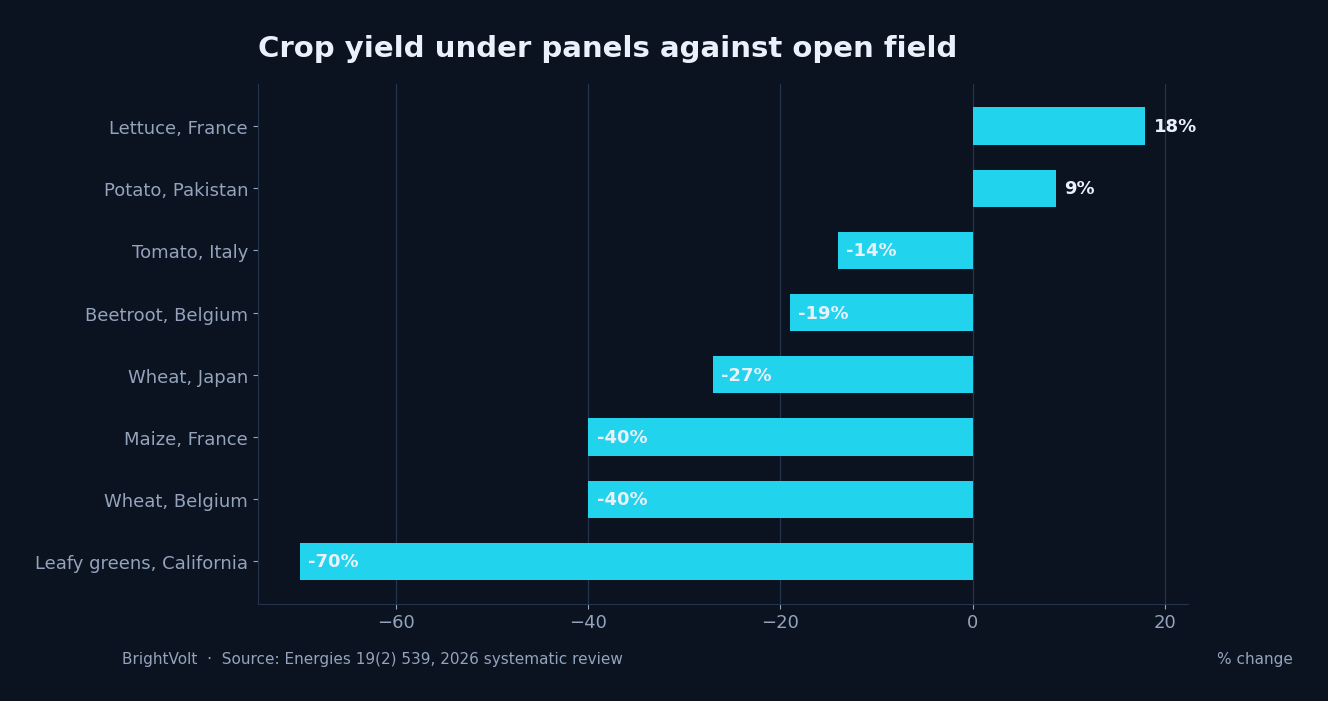
Read that table as a range, not a ranking. It is compiled from a separate systematic review in Energies, which states that it performed no meta-analysis, no formal risk-of-bias assessment, and selected studies with a single reviewer. Some widely quoted figures — beans up 123.7% in Tanzania — are single-season small-plot results that should never anchor a story.
Land equivalent ratio is the number that matters
Yield-versus-open-field is the wrong test, because it ignores the electricity. Land equivalent ratio measures the combined output of both uses against the land needed to produce them separately. Above 1.0, the combination beats splitting the land.
Reported ratios: Italian vineyard 3.54, Tanzanian multi-crop 1.88, Brazilian sugarcane at 35% shade 1.69, Japanese rice 1.24, Belgian beetroot 1.22.
A 19% beetroot yield loss with a ratio of 1.22 is a good trade. That is the actual argument, and it does not require pretending crops like being shaded.
The economics do not work without support
Crop-compatible geometry is expensive. German figures from January 2026 put standard ground-mount at €450–600 per kWp, elevated two-metre mounting at €600–800, and four-metre elevated — the height crops and machinery need — at €1,000–1,200. Vertical bifacial sits near €700.
Then the electricity yield falls: vertical loses 50–60% against ground-mount, four-metre elevated 30–40%.
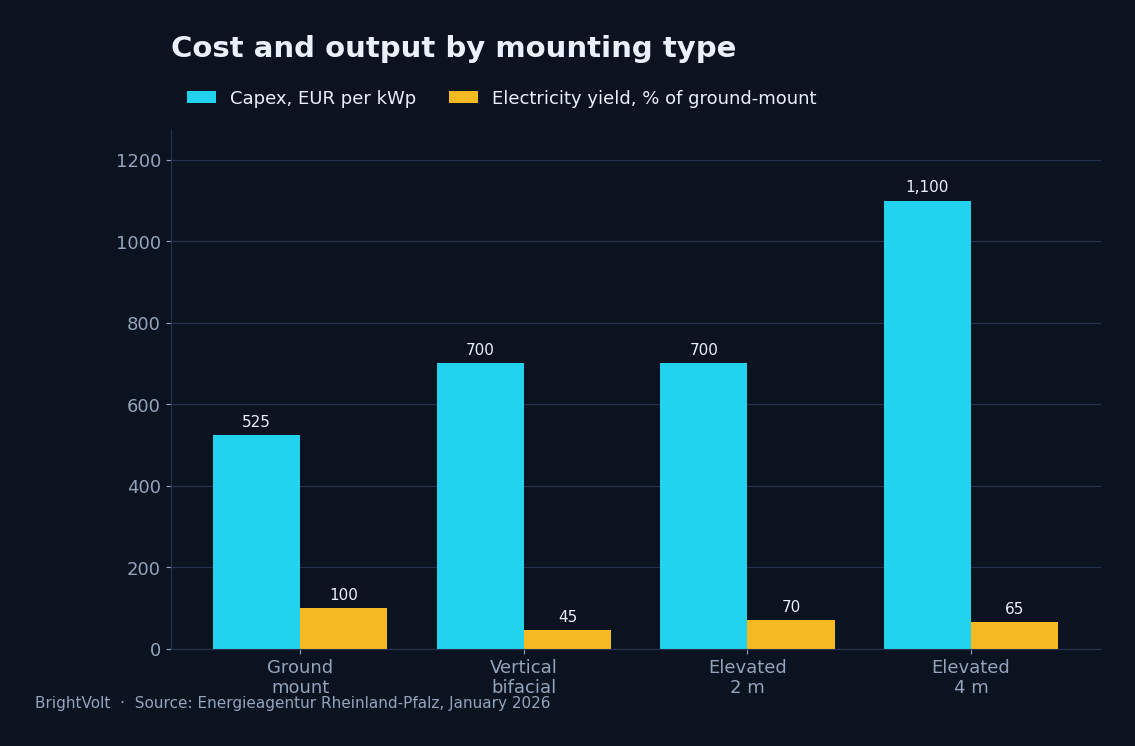
Higher capex, lower output. Fraunhofer ISE puts agrivoltaic levelised cost at 7–12 cents per kWh against a German ordinary ground-mount tender clearing price of 5.00 cents in December 2025. The gap is why Germany set a 9.5 cent ceiling for special installations, against roughly 5 cents for ordinary ground-mount, and why France gave agrivoltaics its own ring-fenced slot in the national tender rather than making it compete on price.
Land rent explains the farmer’s side. German cropland rents for €407 a hectare a year; an elevated agrivoltaic lease pays €2,000–3,500. That is the incentive, and it is large enough to worry about.
Which is why the rules are getting stricter
Three jurisdictions have decided that “agrivoltaics” needs a legal definition with teeth.
France caps ground coverage at 40%, requires the site to maintain at least 90% of a control plot’s yield, inspects after six years, and can order removal. Japan issues renewable temporary farmland conversion permits and reviews any site whose yield falls more than 20% below the regional average. Italy went furthest: on 16 July 2026 its Constitutional Court upheld a ban on ground-mounted PV in agricultural zones, leaving elevated agrivoltaics with certified retention of 80% of gross marketable production as the only legal route onto farmland.
Japan is the only country with enforcement history, and it is sobering: 24% of solar-sharing sites reported farming problems, 71% of those attributable to yield loss or poor growth on the farmer’s side.
Most of what gets counted is sheep
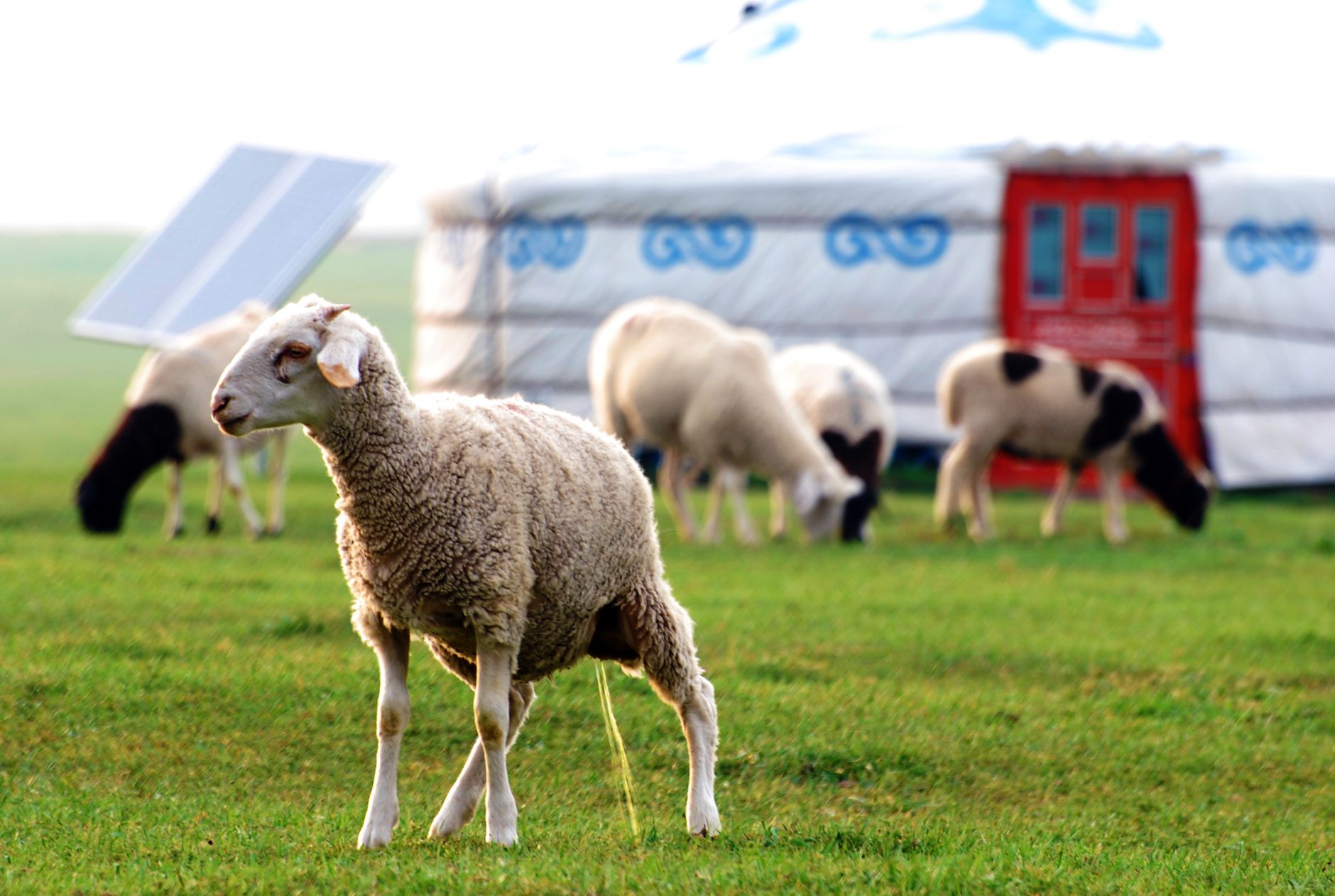
The American figure deserves scrutiny. The University of Pennsylvania’s Kleinman Center counts 596 agrivoltaic sites, 10,473 MW, 65,699 acres. The American Solar Grazing Association separately counts 113,050 sheep grazing 129,261 acres across 506 solar sites — an estimated 18–26 GW, or roughly 7–11% of all US solar capacity.
Grazing acreage is about double the entire self-reported agrivoltaics total, because sheep graze under ordinary ground-mount that nobody registers as anything special. Crop production under purpose-built elevated arrays is a rounding error by comparison: a world review counts 35 US crop sites totalling around 80 MW.
Grazing is also not the windfall it sounds like. Research in the northeastern US puts grazing at about $1,119 an acre a year against $337.50 for mechanical mowing — currently a cost to the site operator, converging only over longer contracts.
What to watch
France’s six-year inspections, which begin falling due from 2030 and will be the first real audit anywhere of whether agrivoltaic sites farm as promised. Italy’s response to being the only European market where elevated agrivoltaics is the sole legal path onto farmland — if capacity actually gets built there, the geometry works at scale. And India’s PM-KUSUM 2.0, announced in March with a 10 GW agrivoltaics component and no published terms yet; a scheme that size in a hot, dry, land-constrained country is where the arid-climate yield gains would finally be tested at something other than pilot scale.
One caution on any figure you read for this sector. China’s agrivoltaic capacity is quoted as either 134.55 GW or 31 GW depending on whether fishery and greenhouse PV are included — a fourfold spread on the same country. Germany publishes no installed figure from a non-commercial source. Japan publishes hectares but not megawatts. This is a field where the deployment numbers are considerably softer than the agronomy.
Photo by Lovesa Chang on Pexels · Photo by Lorenza Magnaghi on Pexels