
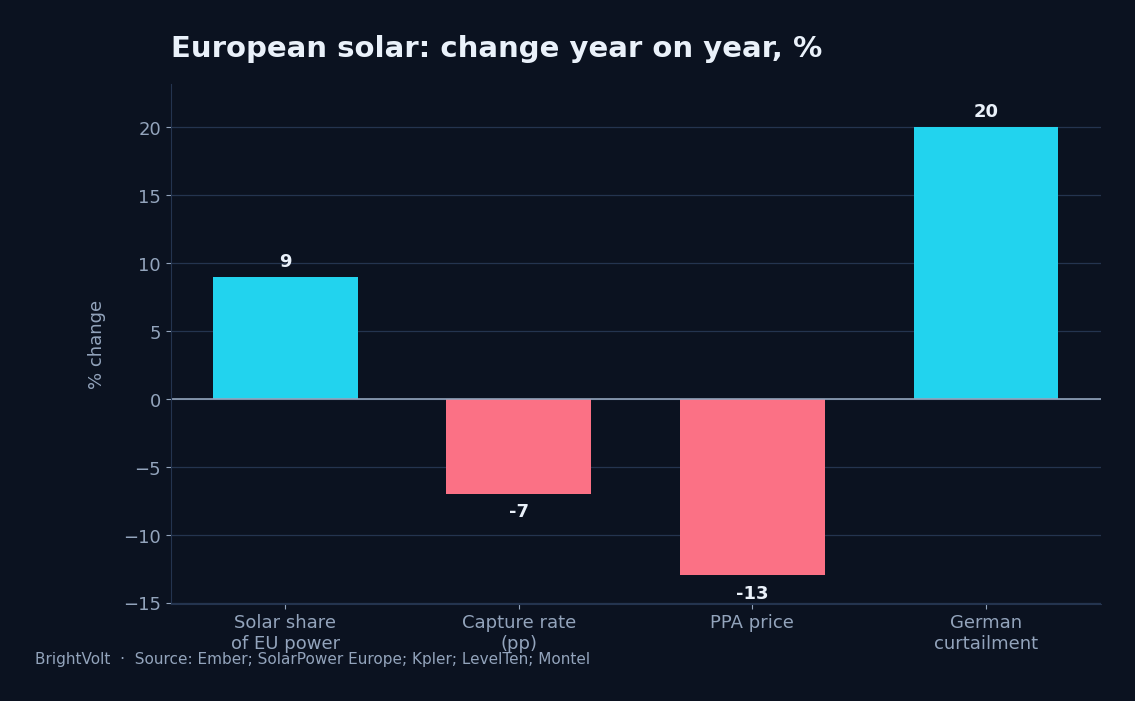
Solar supplied 25% of EU electricity in June 2026 — 52 TWh, the largest single source, ahead of nuclear, gas, wind, hydro and coal. In the same year, European solar farms captured the lowest share of the wholesale price ever recorded: an average of 38% in spring, down seven percentage points, with France at 9.5% in April.
Europe has solved the volume problem and is losing on value. The policy framework is still written in gigawatts, and gigawatts are no longer the constraint.
What a capture rate is, and why 38% is alarming
The capture rate is what a solar farm actually earns as a fraction of the average wholesale price over the same period. At 100% it earns the market average. At 38% it earns barely a third, because it generates at exactly the hours when everyone else’s solar is generating and the price has collapsed.
Kpler’s spring 2026 figure of 38% is the lowest ever recorded across Europe. Pexapark, working independently with a different methodology, found the same collapse in April:
| Country | April 2025 | April 2026 |
|---|---|---|
| France | 0.42 | 0.10 |
| Germany | 0.40 | 0.26 |
| Poland | 0.54 | 0.40 |
| Spain | 0.30 | 0.28 |
| Italy | 0.75 | 0.71 |
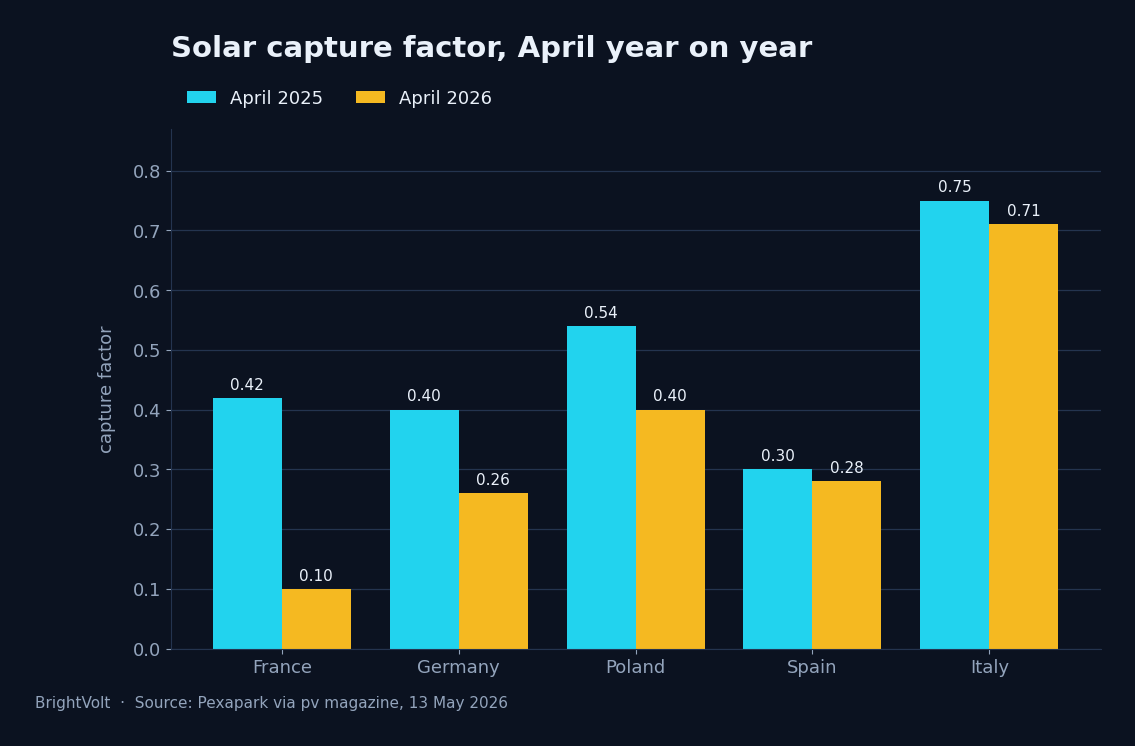
Two vendors, two methods, the same direction. That is what makes this a pattern rather than a data artefact.
The mechanism shows up in negative prices. The share of French solar output generated during negative-price hours went from 29.2% to 45.1% in a year; Germany from 32.6% to 46.8%. Across the first half of 2026, Spain recorded 596 negative-price hours, Portugal 462, France 370. Exchanges cut the price floor from −€500 to −€600 per MWh on 29 May, triggered by clearing prices hitting the old floor on 25 and 30 April.
The volume response has already started
EU solar installations fell to roughly 65 GW in 2025 — the first annual decline in a decade. SolarPower Europe warned the contraction puts the 2030 target at risk and called the slowdown potentially self-destructive.
Contract prices are following. European solar power purchase agreements averaged €55.05/MWh in the first quarter of 2026, down 13% year on year and the fifth consecutive quarterly fall.
German curtailment rose 20% in the first half, from 1,216 GWh to 1,463 GWh.
None of this is a European peculiarity. India curtailed 8,133 GWh of solar between April and June 2026 — disclosed by Shripad Naik, minister of state for new and renewable energy, in a written parliamentary answer on 28 July — on transmission commissioning mismatches, grid security limits and daytime absorption.
The strongest argument against us
Low capture rates are not a market failure. They are a price signal doing its job, and it is already being arbitraged away.
Europe added 36 GWh of batteries in 2025, up 48%, passing 100 GWh cumulative for the first time, with utility-scale exceeding half of new installations. SolarPower Europe forecasts over 50 GWh in 2026 and 138 GWh a year by 2030.
And in the market with the most solar, the problem is already shrinking. German negative-price hours fell 23% in the first half of 2026, from 389 to 299, despite more solar on the system. Finland fell 89%. French commercial curtailment fell 32%.
Spring is also the trough rather than the year. Kpler’s own forecasts have capture rates recovering to roughly 107% in Germany and 101% in France by December, and France was back to 63% in June during the heatwave. Building an annual verdict out of April is a caricature.
That is a serious case and we do not think it is wrong. It narrows the thesis rather than defeating it.
Why the distinction matters for policy
A target expressed in gigawatts is indifferent between two very different assets: a south-facing array with no storage that floods an already-saturated midday market, and an east-west array with four hours of batteries that sells into the evening. The first makes the capture problem worse for every other solar farm on the system. The second fixes a little of it.
Subsidy design that pays per installed megawatt cannot tell them apart. Design that pays for delivered value at the hour of delivery can. That is the change: post-2030 European renewables policy should be denominated in flexibility — storage, east-west orientation, shiftable demand, interconnection — rather than in capacity.
Cheap midday power is also the mechanism that eventually fixes this from the demand side, by making electrified industrial heat and daytime-shifted consumption economic. That is real and it is slower than batteries.
What would prove us wrong
Five things, all published on a regular schedule and all checkable.
European average spring capture rates recovering above roughly 45% in 2027 while installed solar keeps growing, on Kpler or Pexapark’s quarterly numbers. EU annual solar installations returning to growth in 2026 or 2027 despite depressed capture rates, on SolarPower Europe’s December outlook. European solar PPA prices rising for two consecutive quarters after five straight declines, on LevelTen’s index. Iberian negative-price hours falling in 2027 despite more solar, repeating what Germany and Finland managed this year. And 2026 European storage installations landing above the 50 GWh forecast with merchant battery revenues in Spain and Italy holding up.
If three of those five land, this piece was wrong and we will say so in print.
Photo by Ramesh Kambattan on Pexels · Photo by K on Pexels