
On 18 August, LG Energy Solution started production at an all-new $2 billion plant in Lansing, Michigan, rated at more than 35 GWh of cells a year. Paired with its Holland plant up the road, the company now anchors more than 50 GWh of North American lithium iron phosphate capacity by year’s end. LFP is roughly 61% of the world’s batteries. Until this year, almost none of it was American.
That last sentence is the whole story. The United States spent a decade building battery plants for the wrong chemistry, watched the market move to the one it did not make, and is now scrambling to catch up — just as the subsidies that justified the scramble are being pulled out from under it.
What LG switched on in Lansing
The Lansing plant sits on 226 acres and represents more than $2 billion of investment since 2022. At full ramp it will run beyond 35 GWh a year and employ about 1,700 people; roughly 900 are on site today. It makes two different things on two different lines. The LFP cells go into utility-scale energy storage, integrated into finished systems by LG’s Vertech arm, with Detroit utility DTE Energy named as an early customer. The nickel-manganese-cobalt (NMC) cells go into cars — specifically the 2027 Toyota Highlander EV.
It is not a standalone bet. LG has now put more than $5 billion into Michigan since 2010, and expects its statewide headcount to pass 3,300 by the end of 2026. Lansing is the second LFP plant it has lit up in the state this year, and the larger of the two.
The chemistry America imported
LFP won the battery market while the American supply chain was looking the other way. The chemistry now accounts for about 61% of global lithium-ion production against roughly 32% for nickel-based cells, and analysts expect it to push toward 70%. It is cheaper, it does not use cobalt or nickel, it tolerates abuse without catching fire, and it lasts for thousands of cycles — which makes it close to ideal for a grid battery that charges and discharges every day and cares more about cost than about squeezing range out of every kilogram.
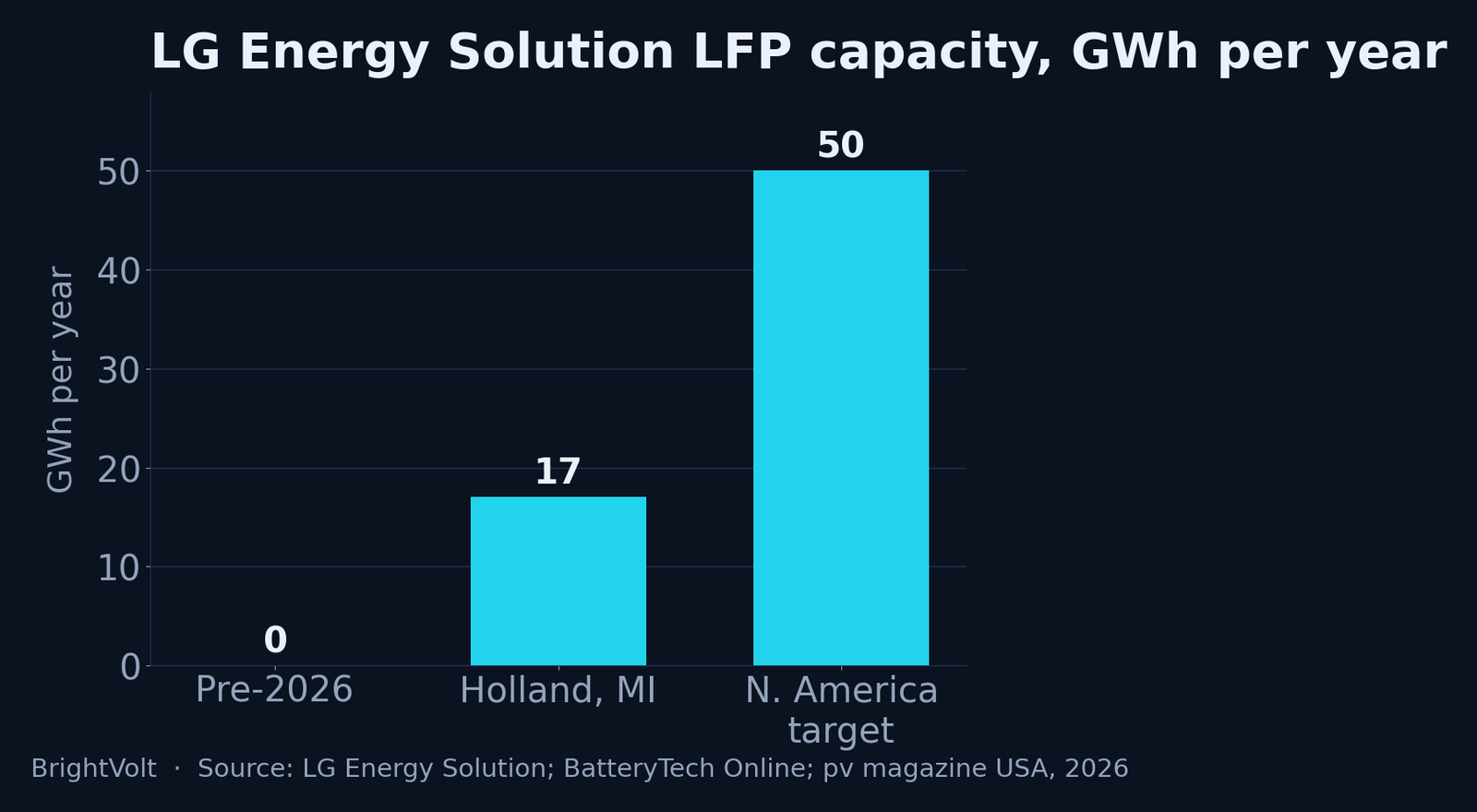
The catch is where it comes from. Commercial LFP production migrated to China in the early 2000s and stayed there, to the point that “until now, American battery customers had to turn to China for any LFP supplies.” Every LFP cell in an American home battery, grid project or cut-price EV was an import. LG’s Holland plant, which came online earlier this year at a cost of $1.4 billion and about 17 GWh of annual capacity, was billed as the first facility to make LFP at scale on US soil. Lansing doubles down on it.
| LG Energy Solution’s US LFP build-out | Investment | Capacity | Products |
|---|---|---|---|
| Holland, MI (online early 2026) | $1.4bn | ~17 GWh/yr | LFP for grid storage |
| Lansing, MI (production from Aug 2026) | $2bn+ | 35+ GWh/yr | LFP for storage, NMC for EVs |
| North America, all sites (target, end 2026) | — | 50+ GWh/yr LFP | 80% of LG’s global ESS capacity |
The customer that makes 50 gigawatt-hours make sense
A plant is only as good as its order book, and this is where the strategy stops looking speculative. In March, the US government confirmed Tesla as the buyer behind a $4.3 billion LG supply agreement for LFP cells destined for domestically built Megapack 3 systems. That single contract does more to de-risk 50 GWh of new capacity than any subsidy: it is a multi-year, dollar-denominated promise to buy the exact cells these lines produce.
The demand behind it is the grid-storage boom, and its most conspicuous driver is the data center. The long-duration and grid storage market is being pulled forward by loads that need firm power and cannot wait years for transmission, and LFP is the default chemistry for almost all of it. LG’s read is that demand for storage “will slow but it will bounce back” because it is not optional — the grid additions the country has committed to do not work without a battery sitting next to them.
The subsidy cliff it opens into
Here is the awkward part. These plants were greenlit in 2022 and 2023, when a domestic cell earned a 45X manufacturing credit, the storage that used it earned an investment tax credit, and the whole calculation assumed federal support would still be there when the lines switched on. That assumption is now shaky. The Trump administration’s tariffs and Congress’s moves to claw back clean-energy tax credits have turned the economics that justified the investment into a moving target, and the industry is opening these factories into the headwind rather than the tailwind it planned for.
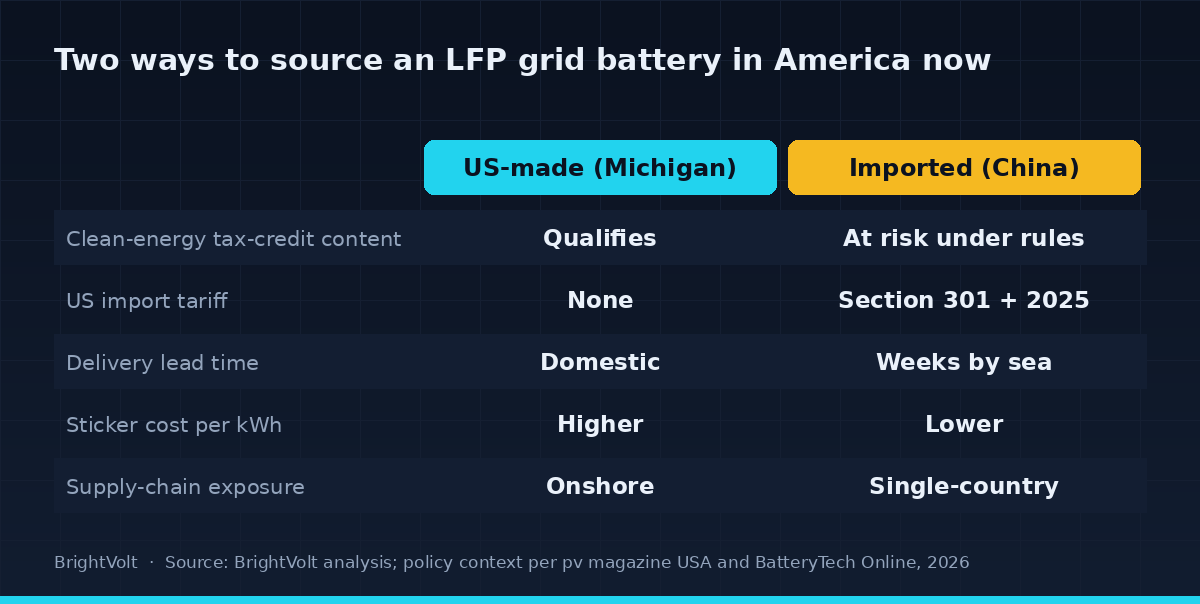
So why keep building? Because the same policy shift that removes the carrot sharpens the stick against imports. New content rules increasingly gate the surviving tax credits on where the cell was made, which turns a Michigan-made LFP pack from a nice-to-have into the only version that qualifies. Tariffs raise the landed cost of the Chinese alternative. And the data-center demand is real money regardless of what Washington does next. A domestic plant hedges all three at once — which is a more durable reason to build than a credit that a future Congress can delete.
What to watch
The tell will be utilization, not ribbon-cuttings. A 35 GWh line that runs near capacity in 2027 proves the onshoring bet was right; the same line running at a third proves it was a subsidy mirage that lost its subsidy. Watch whether the Tesla and DTE volumes are joined by new offtake deals over the next year, and whether LG’s rivals — the Korean and Japanese makers retooling their own US plants for LFP — commit or quietly stall. The chemistry America ignored is finally being made here. Whether it can be made here profitably, without the incentives that started the whole thing, is the question the next twelve months will answer.
Photo by Heru Dharma on Pexels · Photo by Heru Dharma on Pexels