
Lyten, a Silicon Valley startup that has never shipped a battery cell at gigawatt scale, has agreed to buy Norway’s bankrupt Morrow Batteries — its sixth distressed European battery asset in fourteen months. Morrow burned through NOK 5.1 billion, roughly €468 million, before it folded. Lyten bid NOK 8 million for the right to negotiate.
Read that ratio again. A factory that consumed close to half a billion euros changed hands after a bid worth about $850,000. This is being written up as a rescue of European battery manufacturing. The price says it is a liquidation, and Lyten is the liquidator.
What Lyten actually bought
Morrow opened its plant in Arendal, southern Norway, in the summer of 2024 with one gigawatt-hour of annual capacity — enough cells for about 25,000 small cars — and a business plan that ran to 43 GWh by 2028. It never reached the second gigawatt-hour. The line never got to series production at all; management said in January 2026 it was “now ready,” then ran out of money before proving it. Insolvency came in early summer, and on 21 August Lyten signed to take the assets as a going concern, securing about 70 jobs through the autumn.
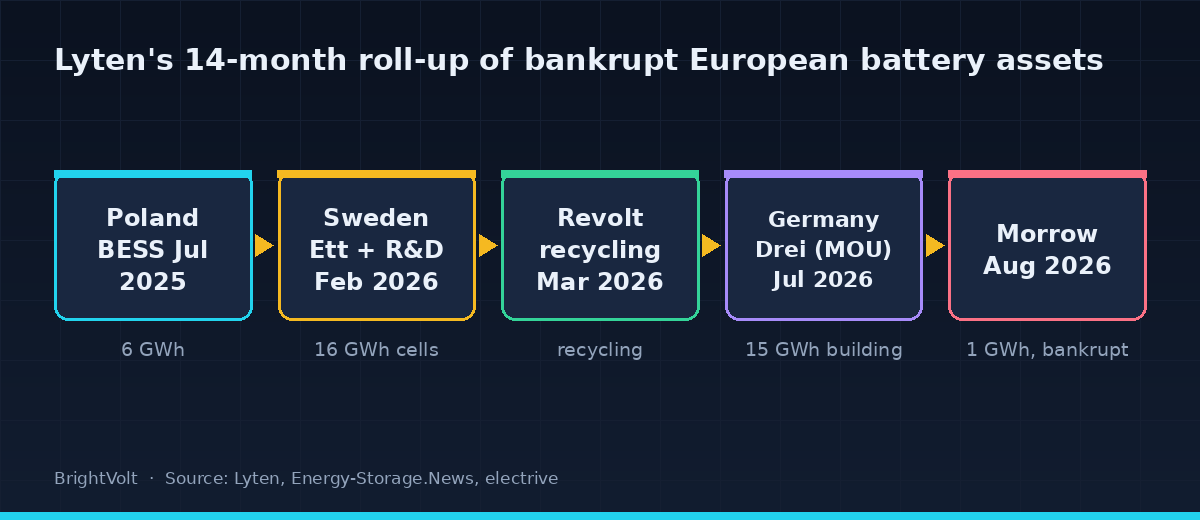
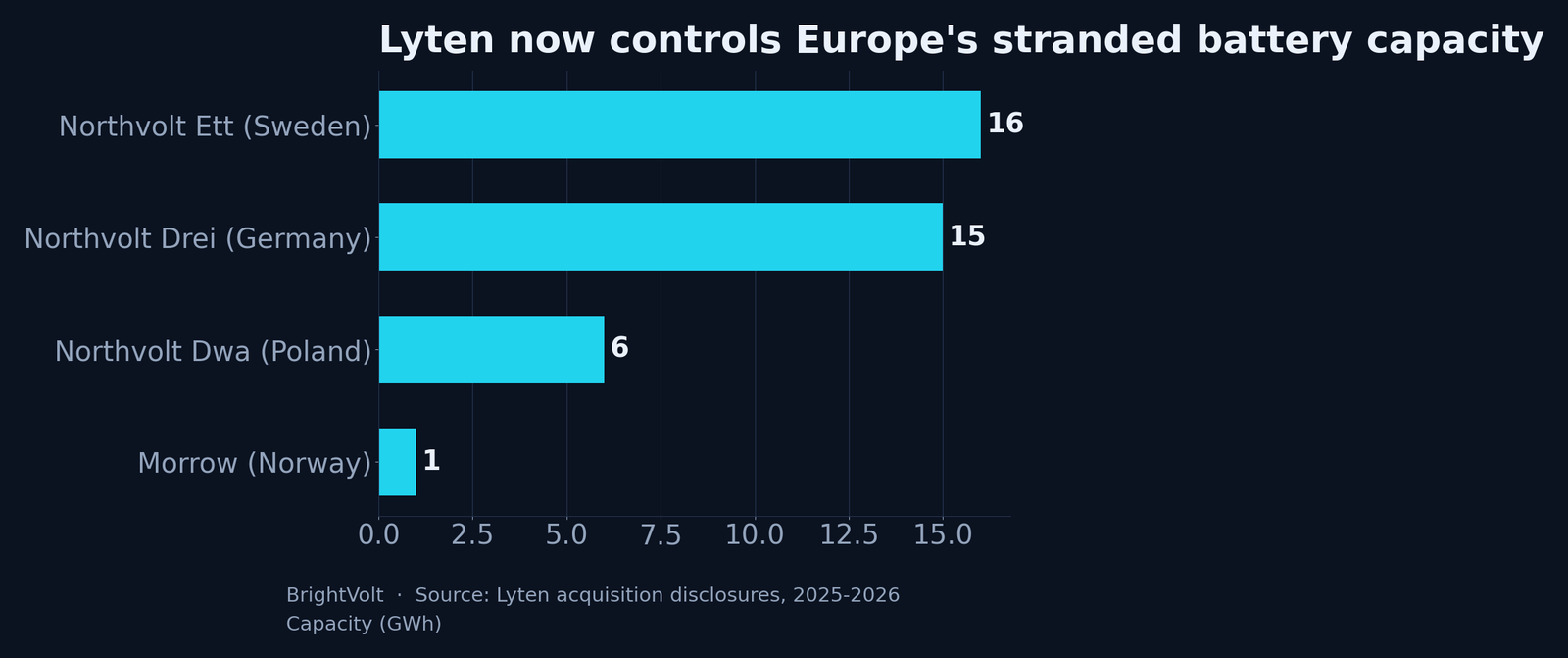
Morrow is not the story on its own. It is the sixth in a run. Since July 2025 Lyten has bought, or signed to buy, almost every stranded battery asset in Europe: Northvolt’s giant BESS plant in Gdańsk, Poland; the Northvolt Ett cell factory in Skellefteå, Sweden, with 16 GWh of installed lithium-ion lines, completed in February 2026; the Västerås research labs; Northvolt’s Revolt recycling site; an agreement in July for the half-built Northvolt Drei plant in Heide, Germany; and now Morrow. On paper the company controls 16 GWh of operational capacity, another 15 GWh under construction, and a stated path beyond 100 GWh. It has raised more than $625 million in equity and holds a letter of interest for a $650 million loan from the US Export-Import Bank.
The company’s own product is a lithium-sulfur cell built around 3D graphene. It is not what these factories make, and by Lyten’s own account it is “less commercially ready” than the lithium-ion lines it is buying. So the plan, for now, is to run Northvolt’s and Morrow’s plants on the chemistry Northvolt and Morrow already had — the chemistry that bankrupted both of them.
The same wall, three times
Northvolt was supposed to be the answer to Chinese battery dominance. Founded in 2016, it raised more than $15 billion from Goldman Sachs, JPMorgan, Microsoft and Volkswagen, which took a 21% stake. It ended with $5.8 billion of debt, $30 million of cash, a lost €2 billion BMW contract, and lines running at around 5% of capacity. It filed for US Chapter 11 in November 2024 and for Swedish bankruptcy in March 2025 — the largest startup collapse in modern European history.
Morrow is the same story in miniature. Freyr, a third Norwegian hopeful, is the same story with an exit: rather than fail in Europe it abandoned battery manufacturing in December 2024 and moved to US solar, buying Trina’s American assets for $340 million. Three champions, one autopsy report.
| Champion | Capital consumed | Capacity reached vs planned | Fate |
|---|---|---|---|
| Northvolt (Sweden) | >$15bn raised, $5.8bn debt | ~5% of installed lines running | Bankrupt, Mar 2025 |
| Morrow (Norway) | NOK 5.1bn (~€468m) | 1 GWh, no series production; 43 GWh planned | Bankrupt, 2026 |
| Freyr (Norway) | Billions raised, then redomiciled | 0 GWh built in Europe | Quit Europe, Dec 2024 |
The wall all three hit is the same, and it is not mysterious. Chinese producers have driven the price of a lithium iron phosphate cell to the floor. CATL now sells LFP cells directly at $63 per kilowatt-hour; finished packs have fallen to around $108/kWh worldwide. A first-of-kind plant in Norway, in its opening months, at one gigawatt-hour of output, cannot come close to those numbers, and no investor was willing to fund the years of losses it would take to try. That is what killed Morrow. It is a version of the same maths now squeezing US cell plants, where the subsidy is at least larger and the market is walled off by tariffs. Europe offered grants against a Chinese cost curve and lost.
Why buying the assets doesn’t buy the business
The generous reading is that Lyten is doing something sensible. Someone should keep 16 GWh of finished production lines, a recycling plant and Europe’s best battery R&D team from being sold for scrap metal. Buying distressed is how good operators grow; paying $850,000 for a €468 million factory is not a scandal, it is a bargain, and consolidating a fragmented, bankrupt sector under one owner with real funding is more coherent than the mess it replaces. All of that is true.
It also does not touch the problem. Every one of these plants failed at the cost wall, and Lyten arrives with no way through it. Its lithium-sulfur cell, the thing that might eventually change the economics, is years from a production line and is not what these factories are tooled to build. In the meantime it will make lithium-ion — the same nickel-based and iron-phosphate cells that could not compete when Northvolt and Morrow made them, on the same lines, into the same market, against a CATL that has only gotten cheaper since. The assets are cheap because the business case underneath them is negative. Buying a negative business case at a discount does not flip its sign.
What would make this a rescue
We would change our read on one piece of evidence: cells leaving one of these plants, at scale, at a price that wins a contract on cost rather than on the flag it is made under. That has never happened at any of them. Northvolt never cleared roughly 5% utilisation. Morrow never reached series production. The relevant number in 2027 is not how many gigawatt-hours Lyten owns — ownership is the easy part when the assets are free — but how many it ships, and at what euro-per-kilowatt-hour.
Until then, the honest description of what happened this month is not that a Californian startup saved European battery manufacturing. It is that European battery manufacturing failed so completely that its flagship assets could be assembled, for the price of a nice house, by a company that has yet to prove it can do the one thing all of them could not. Lithium-sulfur may yet vindicate the bet. But that is a bet on a chemistry that does not exist at scale yet, financed by flipping the wreckage of the chemistry that does. The sovereignty language is doing a lot of work. The receipts say asset arbitrage.
Photo by Heru Dharma on Pexels · Photo by Faruk Tokluoğlu on Pexels