
The United States has now built 100 gigawatts of solar modules over its history, and more than 70% of that total was assembled after the Inflation Reduction Act passed in late 2022. It is a genuine industrial turnaround. It is also a milestone measured at the one step of the supply chain that was always going to be easiest to reclaim: the last one.
A module is a frame, a sheet of glass, a junction box and a laminate wrapped around solar cells. Building the frame is not the hard part. The cells inside it — and the wafers and polysilicon behind the cells — are where the value, the difficulty and, for now, almost all the imports still sit. America has learned to staple panels together at scale. It has barely started making what goes in them.
What crossing 100 gigawatts actually counts
The 100 GW figure, from the analyst Terawatt PV Research, is cumulative production going back to the early 1970s, not capacity announced on a press release — a distinction that matters, because announced US solar capacity has a long history of never being built. On that stricter measure the number is real, and the post-IRA acceleration is real: annual module nameplate capacity has gone from about 8 GW before the credits to roughly 65 GW now, enough on paper to cover every panel the country installs in a year.
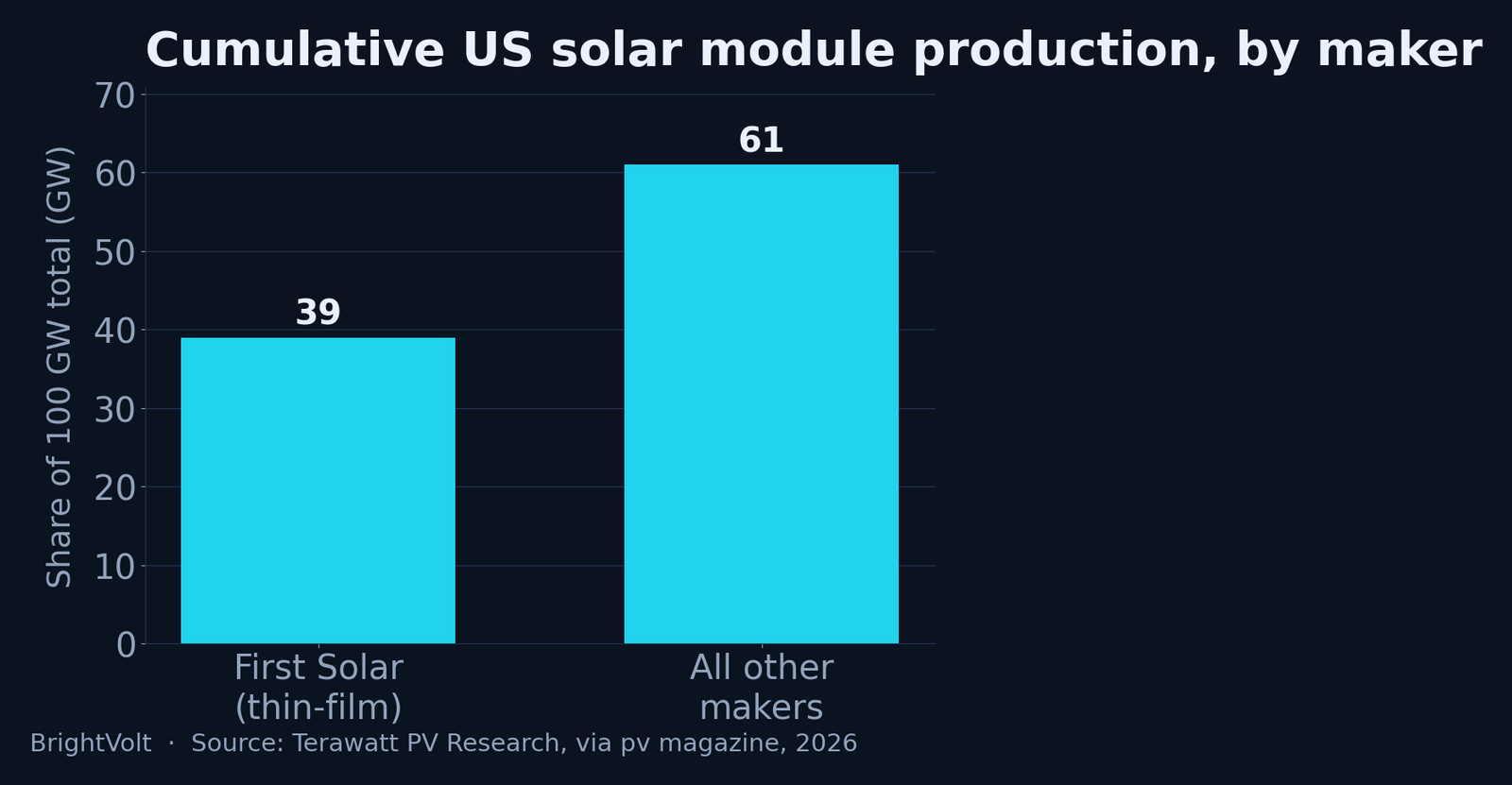
The catch is in the word module. What crossed 100 GW is assembly capacity — the stage where imported cells are soldered into strings, sandwiched in glass and framed. The Solar Energy Industries Association and Wood Mackenzie put nameplate US module capacity above 70 GW while domestic cell capacity sits at one operational plant. Everything upstream of the module — the part that turns sand into a working semiconductor — is still overwhelmingly somewhere else.
The step the credit rewards most
This did not happen by accident, and it is not simply that modules are easier. The IRA’s Section 45X manufacturing credit pays a producer per unit made, and it pays most, in the terms that matter to a factory’s balance sheet, for the final step.
A finished module earns 7 cents per watt. A solar cell earns 4 cents. A wafer earns $12 per square metre and polysilicon $3 per kilogram — real money, but spread across steps that are more capital-intensive, slower to build and, critically, competing against Chinese incumbents who make the same components at a fraction of the cost. Stack a module from imported cells and you collect the largest, most accessible credit in the stack while sidestepping the hardest manufacturing in the industry. Given that incentive, a wave of module lines fed by foreign cells is exactly what you would expect to get. It is what the country got.
| Supply-chain step | 45X credit | US capacity, 2026 |
|---|---|---|
| Polysilicon | $3 / kg | Limited (Hemlock, Michigan) |
| Wafer / ingot | $12 / m² | ~1 GW, nascent |
| Solar cell | 4¢ / W | ~3 GW |
| Module (assembly) | 7¢ / W | ~65 GW |
The credit steps down after 2029 — to 75% of value in 2030, half in 2031, a quarter in 2032, then nothing — so the window to build the missing upstream steps under this incentive is already closing. And from January 2026, new “prohibited foreign entity” and material-assistance rules begin restricting how much of a subsidised module’s content can come from China, which is the first policy pressure aimed squarely at the imported-cell shortcut.
One company is two-fifths of it
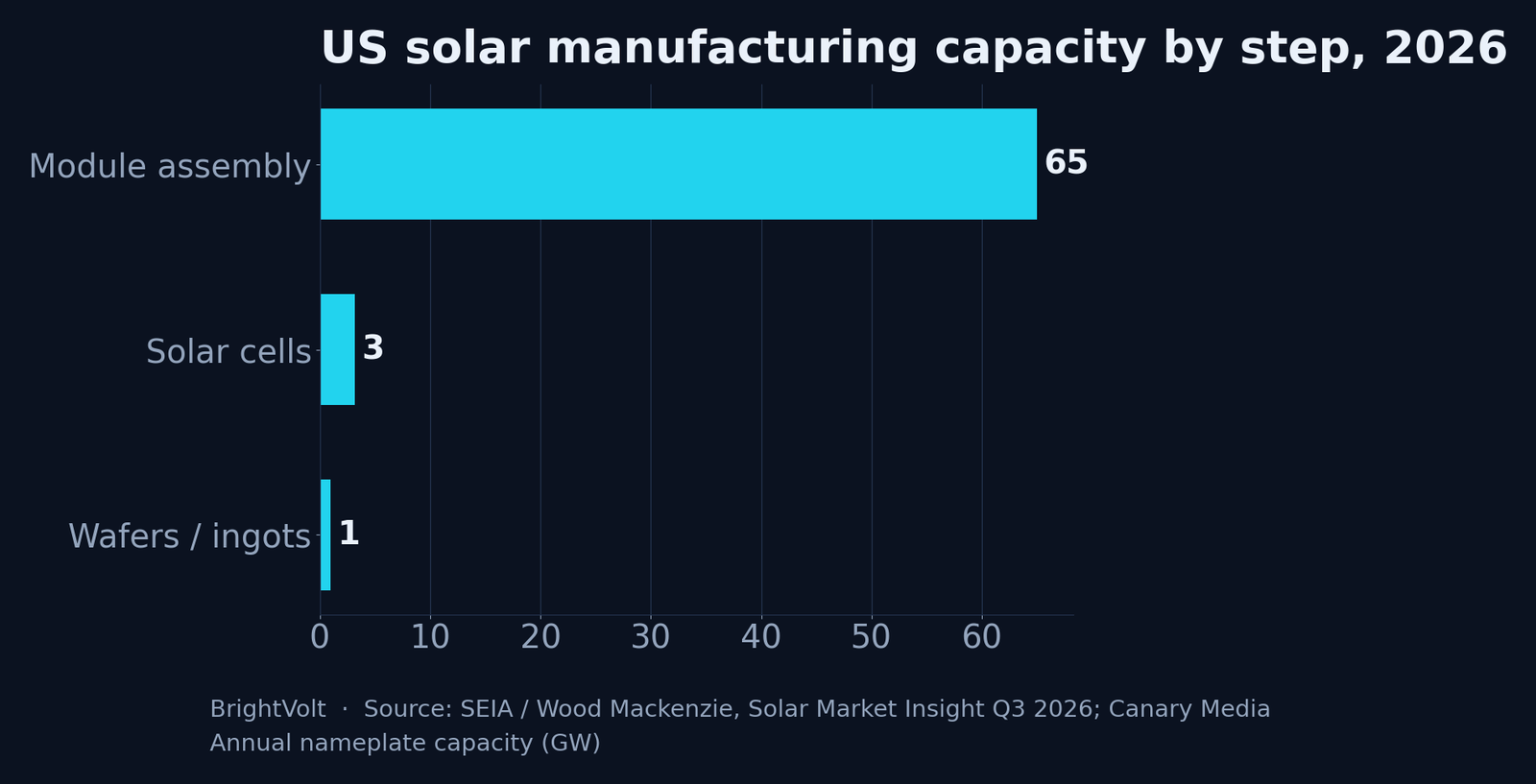
The 100 GW total also hides a quieter distortion. According to Terawatt’s breakdown, close to two-fifths of every module the US has ever produced came from a single manufacturer: First Solar.
First Solar does not make silicon cells at all. It makes cadmium telluride thin-film panels, a different technology it produces end to end on US soil — roughly 14 GW of annual capacity across Ohio, Alabama and Louisiana, with a South Carolina plant coming. That is a real domestic supply chain, and it is the reason the American picture looks as healthy as it does. But it is also the exception that flatters the average. Strip out First Solar’s thin film and the crystalline-silicon module base — the technology 95% of the global market actually runs on, and the one those imported cells feed — is far thinner than 100 GW suggests. The headline counts two industries as one, and only one of them has the upstream hole.
Where the chain actually breaks
Follow a crystalline-silicon panel backwards and the domestic capacity thins at every step. Modules: about 65 GW. Cells: around 3 GW, essentially the Qcells plant in Georgia, with T1 Energy in Texas ramping a first 2.1 GW line. Wafers and ingots: close to nothing — Corning quietly restarted domestic wafer production in Michigan in late 2025, but NorSun’s planned 5 GW wafer plant near Tulsa, one of the largest bets on closing this gap, was abandoned this year. Polysilicon: Hemlock in Michigan makes it, much of it for export and semiconductors rather than solar wafers.
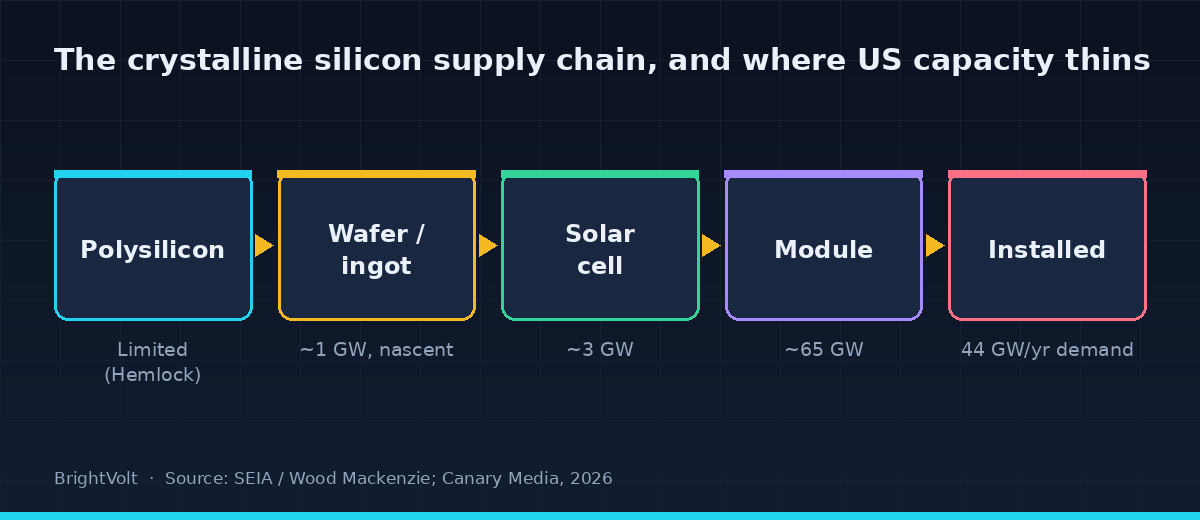
A module line without a domestic cell behind it is not energy independence; it is a re-labelling operation with a tariff-shaped risk sitting under it. If trade policy tightens on cells — and the new foreign-content rules are pointed in exactly that direction — 65 GW of module capacity can be left waiting on parts. The same quarter the 100 GW milestone landed, US installations told the other half of the story: Q1 2026 additions fell to 7.8 GW, down 27% year on year, as the demand-side credits that drove the boom began to expire. Supply and demand are both being reshaped by the same law, in opposite directions.
What to watch
The number that matters over the next two years is not module capacity, which is effectively solved, but cell and wafer capacity, which is not. If T1 Energy’s Texas ramp holds, Qcells finishes its Georgia ingot-to-cell lines, and anyone at all commits to wafering at scale before the 45X credit fades, the US will have converted a stapling industry into a real one. If the upstream stays stranded — a NorSun cancellation for every Corning restart — then 100 GW of modules is a stockpile of frames waiting on imported hearts, and the milestone will read, in hindsight, as the easy part done first. The same pattern is playing out in batteries, where cell assembly arrived years ahead of the materials that feed it. Watch the cells, not the panels.
Photo by EqualStock IN on Pexels · Photo by Nic Wood on Pexels