
From October 1, every new solar panel sold in Alberta carries a flat C$14 environmental fee, and sending a dead panel to landfill becomes illegal. It is the first stewardship scheme of its kind in Canada, and the industry that lobbied for years to be taken seriously as infrastructure is furious about it. The fight is not over whether panels should be recycled. It is over a number nobody will show the working for.
Alberta’s answer to the coming pile of dead solar panels is a good idea wrapped around an unexplained figure. The landfill ban is the part that actually matters, and almost nobody is arguing with it. The C$14 is the part that has united solar developers, green-building groups and recyclers in the same complaint: where did that come from?
What actually changes on October 1
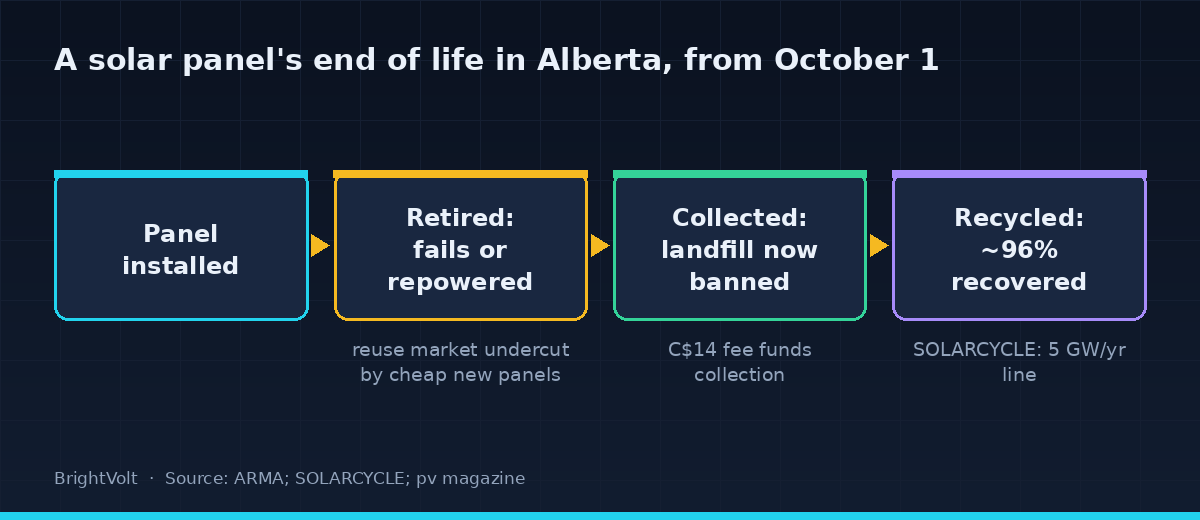
Two things start together. A recycling fee of C$14 applies to every new panel one square metre or larger — residential, commercial and utility alike — and panels are banned from provincial landfills, so end-of-life modules must go to reuse or recycling instead. The scheme is run by the Alberta Recycling Management Authority (ARMA), the same body that already handles tyres, electronics and paint. Panels installed before October 1 are not charged retroactively, but they are covered for collection when they eventually come down.
The coverage is deliberately broad. It catches crystalline silicon, including the perovskite-silicon tandems now reaching market, and every thin-film chemistry — cadmium telluride, CIGS, amorphous silicon. It notably does not catch solar thermal panels, which contain the same recoverable glass, aluminium and copper, an early sign that the boundaries were drawn around a fee schedule rather than around the waste stream.
Why a landfill ban is the right instrument
Start with what the ban fixes, because it is the genuinely defensible half of the policy. A solar panel is roughly 80% glass and aluminium by weight, with small amounts of silver, copper and silicon that are worth recovering. The problem has never been that panels cannot be recycled. It is that landfilling one is far cheaper than recycling it.
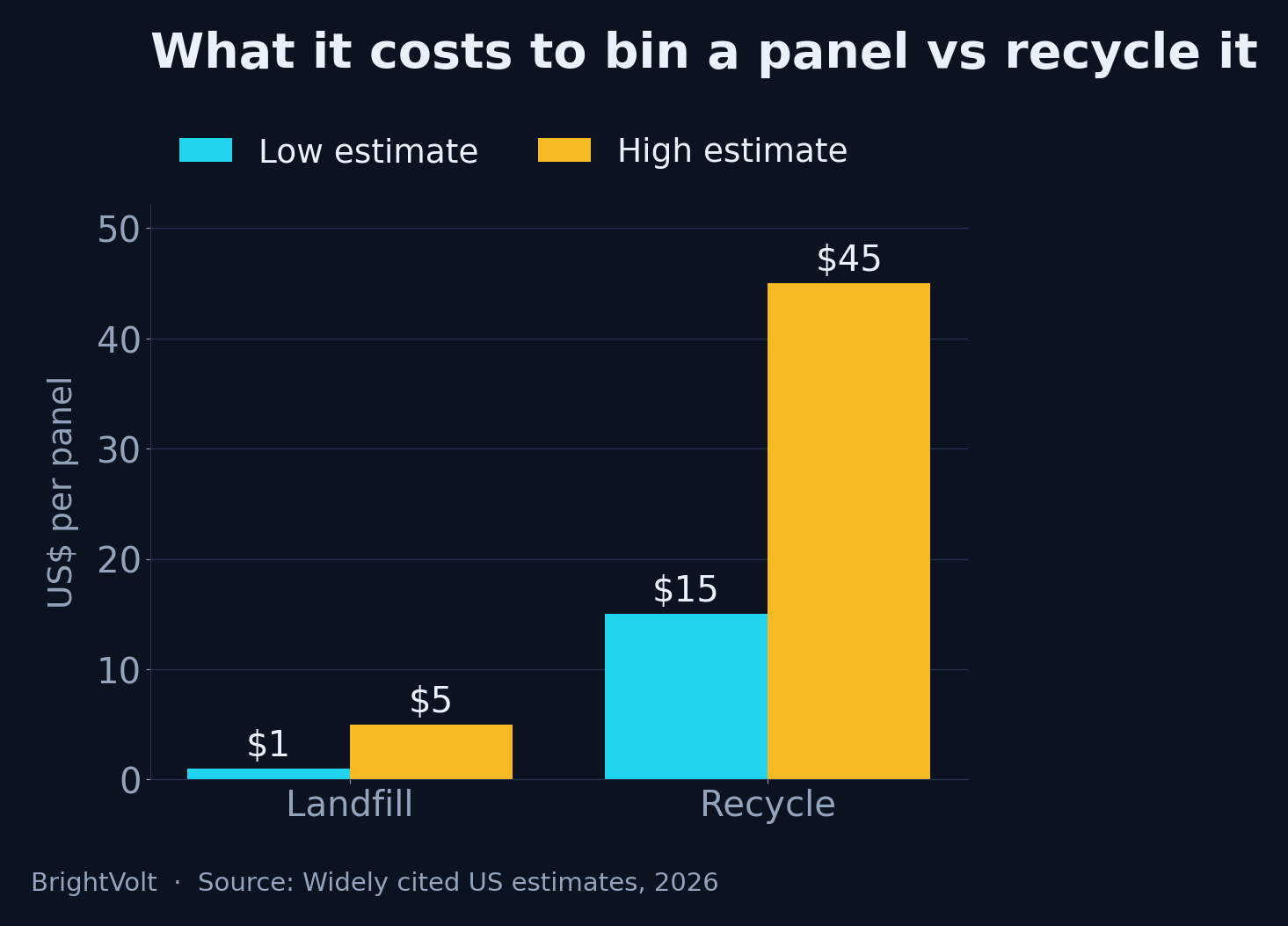
Widely cited North American estimates put the cost of dropping a panel in a landfill at US$1 to US$5, against US$15 to US$45 to recycle the same module. That gap is the entire reason most panels have gone into the ground. No amount of good intention closes a ten-to-one cost difference; only a rule does. Ban the cheap option and the expensive one stops being optional — which is why extended-producer-responsibility schemes exist at all.
The volume that makes this urgent is no longer theoretical. Globally, the IRENA and IEA-PVPS projected 78 million tonnes of panel waste by 2050, and the US EPA reckons the recoverable material in end-of-life panels will be worth about US$450 million a year by 2030. Alberta’s own slice: by 2045, more than 95% of the panels installed there today reach end of life, generating up to 72,700 tonnes of material. A landfill ban with no collection system behind it would simply create illegal dumping. A fee with no ban would be a tax that changed nothing. The pairing is the point.
The problem is the price, not the principle
The objections are not coming from climate sceptics. Business Renewables Centre-Canada, whose members build the projects, called the fee “a punitive tax” while stating plainly that it supports a recycling charge in principle. Its director, Jorden Dye, put two numbers on the table: the C$14 is at least 139% higher than comparable levies outside Canada, and it will add roughly C$1 million to the start-up cost of an average utility-scale solar project. The Canada Green Building Council raised the equity point — that a fee applied unevenly disadvantages clean technology against the conventional alternatives it competes with.
What none of them can do is check the arithmetic, because ARMA has not published it. The C$14 is described as a “blended fee” but never broken into its parts — how much covers collection and transport, how much builds recycling capacity, how much is offset by the resale value of recovered glass and metal, and how much is held as reserve. For a scheme justified on the circular-economy value of the materials, the absence of that line is conspicuous. A fee that recovers valuable aluminium, silver and copper should, over time, cost less than one that recovers nothing. The flat number implies the recovered value was not counted, or was counted and not disclosed.
There is a second awkwardness hiding in the comparison. At C$14 — roughly US$10 — the fee sits below the US$15-to-US$45 it reportedly costs to actually recycle a panel in North America. So the levy is simultaneously higher than what other jurisdictions charge and lower than what the job appears to cost. Both cannot be reconciled without the breakdown, and that is precisely what has not been shared.
| End-of-life path | Cost per panel | What happens to the materials |
|---|---|---|
| Landfill | ~US$1–5 | Glass, aluminium, silver, copper buried; now banned in Alberta |
| Recycle | ~US$15–45 | Up to ~96% of material value recovered at industrial scale |
| Reuse (second-hand) | Lowest, but market is thin | Panel keeps working elsewhere; undercut by cheap new modules |
Recycling is finally industrial — and reuse is stalling
The timing is not arbitrary. Panel recycling has just crossed from pilot to industrial scale. In January, SOLARCYCLE switched on a 5-gigawatt-a-year plant in Cedartown, Georgia — a 255,000-square-foot line that says it recovers about 96% of a panel’s material value, with a glass factory rising alongside to feed recovered material straight back into new US-made modules. The capacity to process the wave now exists. What was missing was the feedstock, and that is what a landfill ban delivers: a guaranteed stream of panels that can no longer take the cheap exit.
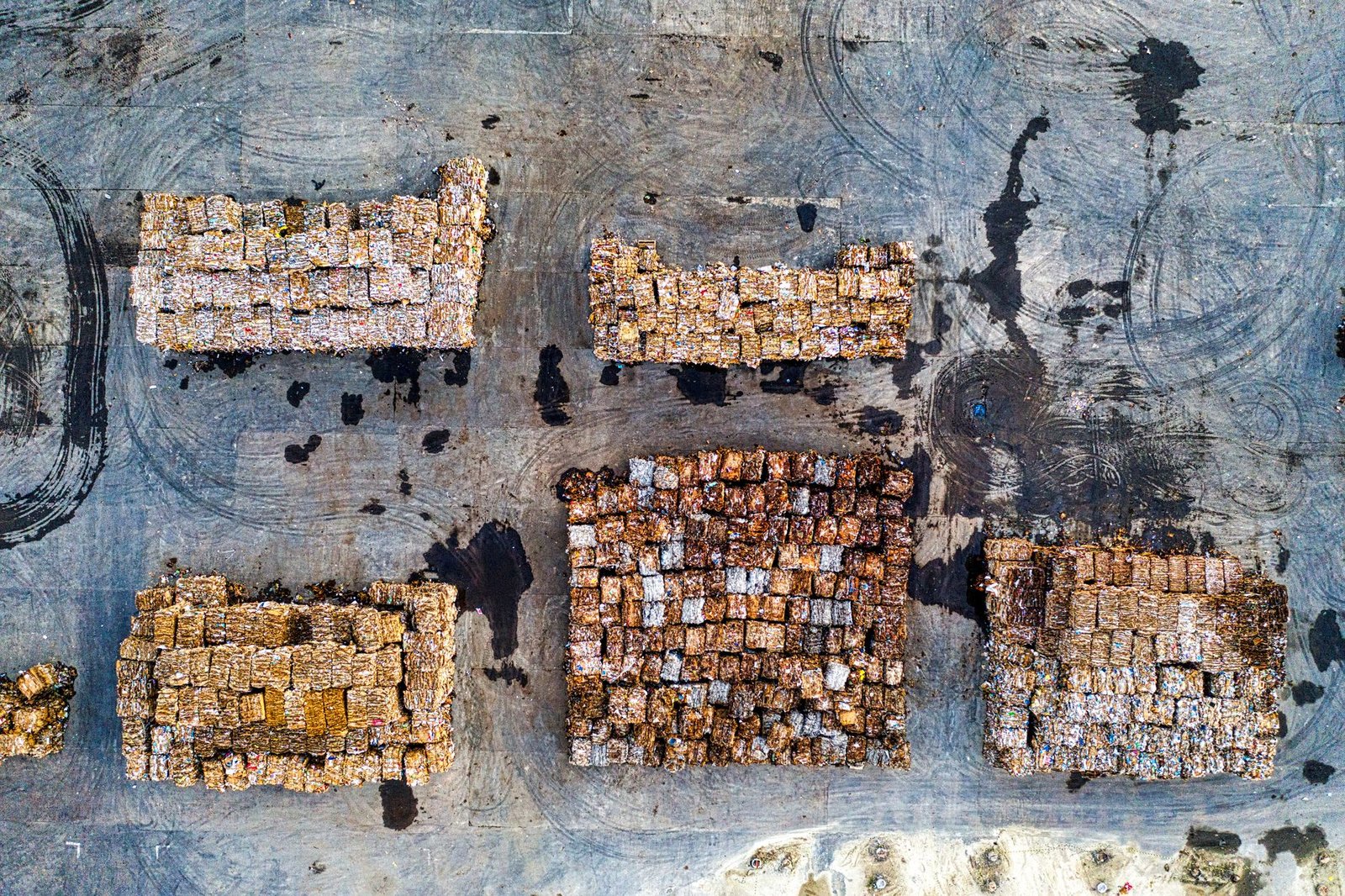
The one option a fee like this quietly discourages is the best one for a panel that still works. A retired module is not always a broken module. Panels are increasingly pulled early for repowering — swapped out for denser, cheaper new ones long before they fail — and the obvious home for those is the second-hand market. But that market is stalling for the same reason recycling was stuck: new modules have become so cheap that a working used panel struggles to compete. Alberta’s fee applies to new panels only, which nudges the maths a little further toward the landfill-banned recycler and away from the reseller. Recovering 96% of a panel’s glass and metal is good. Not retiring a working panel at all is better, and no line item rewards it.
What to watch
The number to watch is not the C$14 but whether ARMA publishes what it buys. An extended-producer-responsibility fee is only as legitimate as its cost model, and a blended figure with no breakdown invites exactly the “punitive tax” reading the industry has reached for. If the recovered-material value is real — and SOLARCYCLE’s 96% says it can be — the fee should fall as the recycling market matures, and Alberta should be able to show the curve. If it stays flat at a number set above every comparator and never itemised, the developers’ suspicion hardens into fact. Either way, the landfill ban is the part that will still be doing useful work in a decade. The rest of the country is watching a policy that got the instrument right and the arithmetic opaque, and deciding which half to copy. Meanwhile the harder waste question — what a solar panel is actually worth in materials versus what it costs to reclaim them — is the one every jurisdiction after Alberta will have to answer out loud.
Photo by K on Pexels · Photo by Tom Fisk on Pexels