
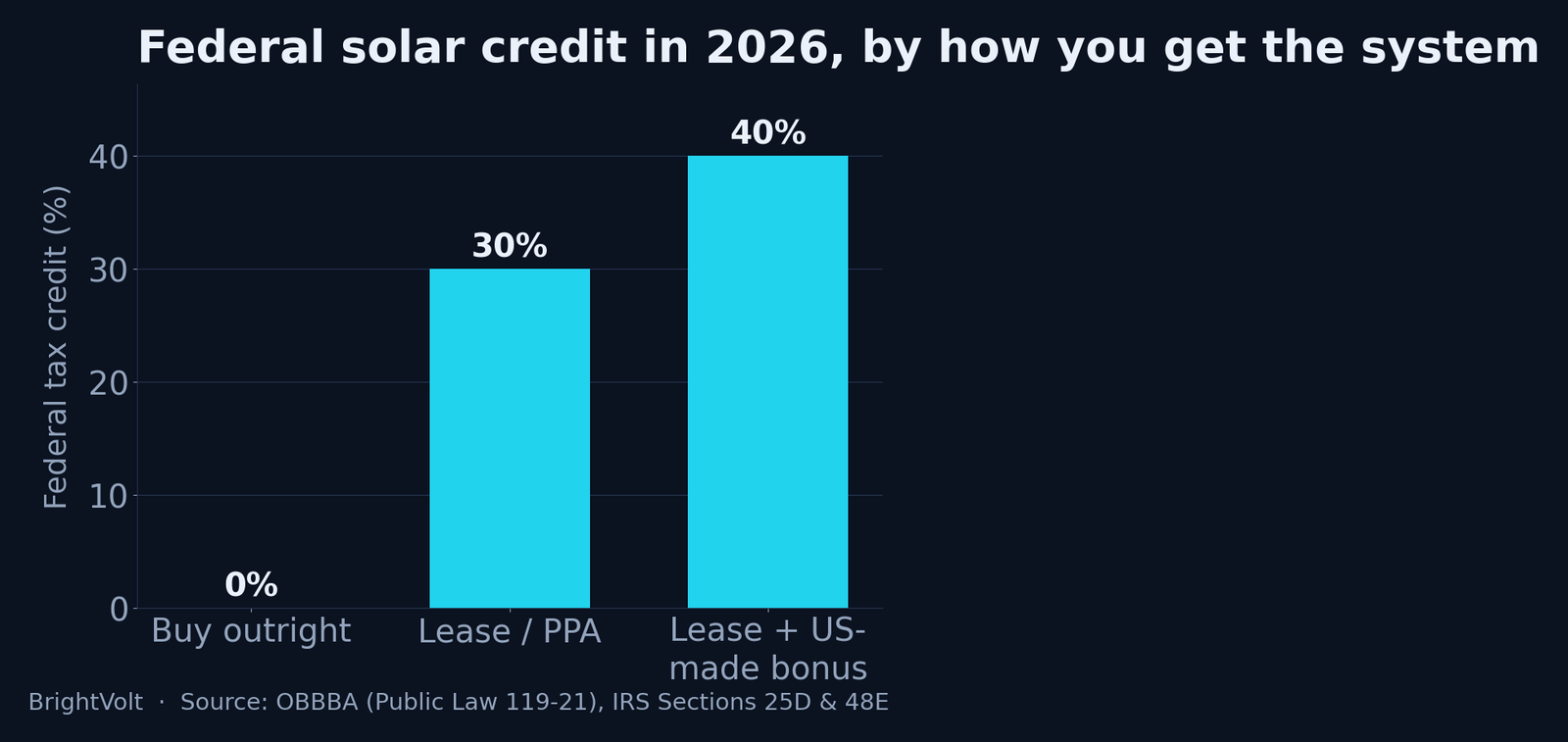
In 2026 a US household that buys rooftop solar outright collects no federal tax credit. One that leases the same panels collects 30% — or 40% with a domestic-content bonus — because the leasing company claims a commercial credit Congress left standing. The residential solar subsidy was not repealed last year. It was handed to whoever owns the roof instead of the person living under it.
That is the part of the One Big Beautiful Bill nobody advertised. The law was sold as the end of clean-energy handouts. For rooftop solar it ended exactly one of them — the one that went to homeowners. The larger one, the one that now decides how Americans get solar at all, it left in place and pointed at Wall Street.
What the One Big Beautiful Bill actually did to rooftop solar
Section 25D, the 30% credit a homeowner claimed for buying their own panels or a home battery, expired on 31 December 2025. Section 25C, the companion credit worth up to $2,000 toward a heat pump, went with it. Eligibility turns on the install date, not the deposit, so a family that paid in 2025 and had panels fitted in January 2026 gets nothing. We covered that cliff when net metering started unwinding. This is the other half of the same rollback, and the more consequential half.
One credit survived, and it is the one that matters. Third-party-owned systems — leases and power purchase agreements, where a company owns the hardware bolted to your roof — can still claim the commercial investment credit under Section 48E. That credit stays at 30%, runs until systems are placed in service by the end of 2027 (2030 if construction starts before July 2026), and stacks with a 10% bonus for US-made equipment. A leased array is therefore eligible for up to 40% federal support in the same tax year an owned one gets zero.
| Federal credit | Covers | Status in 2026 |
|---|---|---|
| Section 25D | Homeowner-owned solar and batteries | Gone after 31 Dec 2025 |
| Section 25C | Heat pumps, efficiency upgrades | Gone after 31 Dec 2025 |
| Section 48E | Leased / third-party-owned systems | 30% (+10% US-made), through 2027–30 |
Why leasing is now the only route to a federal discount
Follow the incentive and you can predict the product. If the only surviving credit belongs to whoever owns the system, the market will find ways to make sure a company owns it. It already has. Installers are pushing prepaid leases: the household pays for twenty-five years of power in a single up-front sum, the financier owns the panels long enough to satisfy the IRS — typically six or seven years — then sells the system to the homeowner for a nominal fee. The financier claims the 30% credit, adds the 10% domestic-content bonus where it can, and passes part of the combined 40% back as a discount. Programs with names like EnergyLock and Propel exist for one reason: to route a homeowner’s roof through a balance sheet that can use the credit the homeowner no longer can.
None of this is hidden. “It allows our customers to benefit from still-available commercial solar incentives,” the chief executive of All Energy Solar told pv magazine, which is true and also the entire point. The incentive is still there. The homeowner just cannot reach it directly anymore.
The market is already migrating
The share of US home solar that is leased rather than owned was climbing before the law and is now set to jump. Third-party ownership hit 45% of the residential market in 2024, its highest since 2016, and crossed half in the fourth quarter. Ohm Analytics now expects third-party models to settle at 60 to 65% of the 2026 financing mix, with prepaid leases alone reaching about a tenth of all installations by year end. Ohm’s team had first modelled a 50% collapse in customer ownership; the correction came because well-funded leasing providers moved in faster than expected.
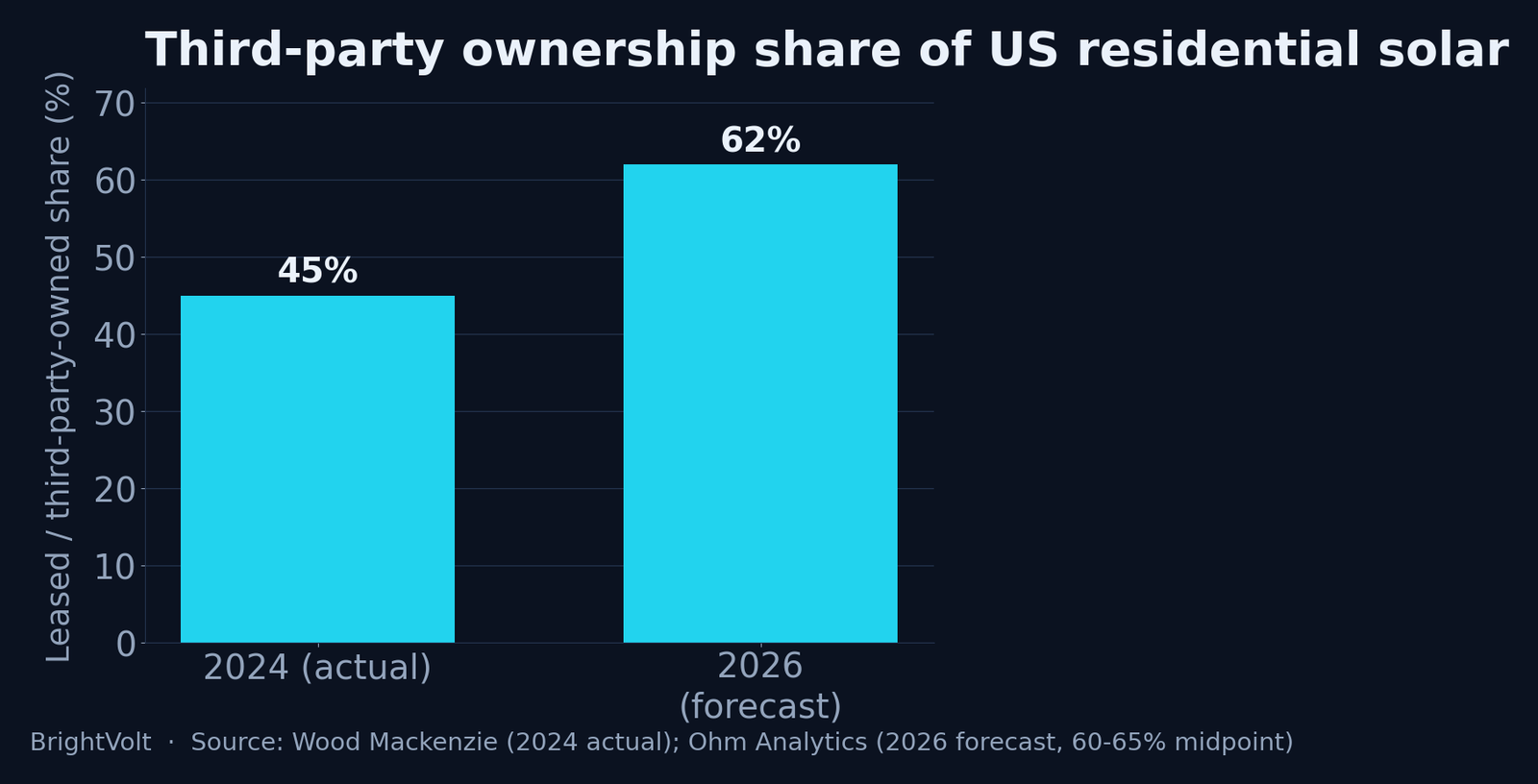
Two-thirds is the figure to sit with. A market that was split roughly evenly between owning and renting your own generation is becoming one where renting is the default — not because households prefer it, but because the tax code now rewards it and penalises the alternative.
The deal a leasing homeowner actually signs
A lease is not a scam, and pretending otherwise would be its own kind of slop. For a household with little tax appetite — a retiree, anyone whose federal bill was already small — 25D was never worth its full face value, and a prepaid lease that delivers a 40% discount beats a credit they could not fully use. Leasing lowers the wall of up-front cost that kept solar off working-class roofs for a decade. Those are real gains, and they are the strongest case for the arrangement the law has produced.
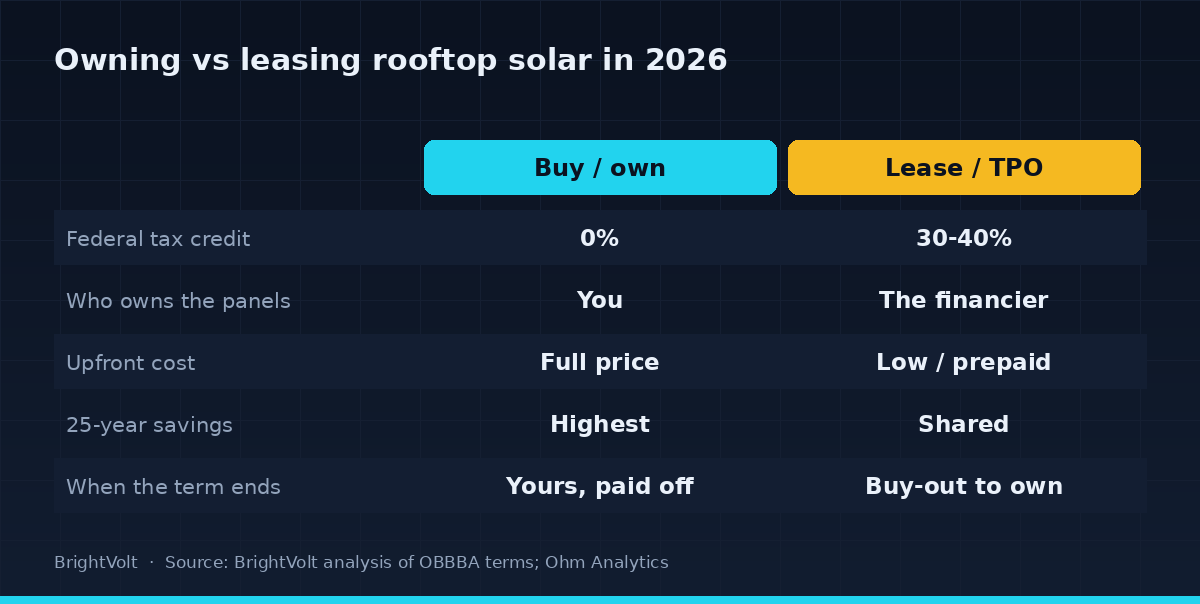
Here is why it does not settle the question. The household that leases gives up the thing worth having, which is the asset. Over twenty-five years an owned array is a paid-off machine producing free power; a leased one is a contract with a counterparty that keeps the depreciation, keeps any renewable credits, and takes a margin on every kilowatt-hour in between. Where a battery is involved and the household could have joined a utility’s virtual power plant, it is now the lessor, not the resident, who collects the payments. And where a household can use the credit, ownership still wins on lifetime cost — yet the policy nudges even those households toward renting. A subsidy that still writes the cheque, while quietly moving the rooftop from the resident to a financier, is not the spending cut it was billed as. It is the same cheque, made out to a different name.
What this is, and what would prove us wrong
Strip the branding and 2026 is the year Washington privatised the American roof. The federal government still pays up to 40% toward a residential solar system. It simply will not pay it to the person who lives there. The predictable result — leasing crossing from a large minority to two-thirds of the market — is a transfer of the country’s fastest-growing distributed asset out of households and onto the balance sheets that finance them.
We would be wrong if the migration stalls. If SEIA’s coming quarterly figures show third-party share flattening rather than climbing toward Ohm’s 60–65%, or if the leased customer’s lifetime economics turn out to match an owner’s once fees are counted, the “worse deal” reading fails and this is merely a financing shuffle. Two things decide it: the IRS’s final “material assistance” rules, due late in 2026, which set which leased systems clear the foreign-content bar, and the first SEIA residential number untouched by the 25D deadline rush. The credit didn’t die. It moved out of your name.
Photo by Robert So on Pexels · Photo by Stefan de Vries on Pexels