

Green Mountain Power spent this July doing something no utility did a decade ago: it dispatched 90 MW of home batteries during a heat wave, avoided the most expensive hour on the wholesale market, and saved every customer on its system $6 million — not just the ones with a battery. Then it kept two shuttered gas peakers shut. The batteries in Vermont basements are not a science project. They are the largest single power resource the utility owns.
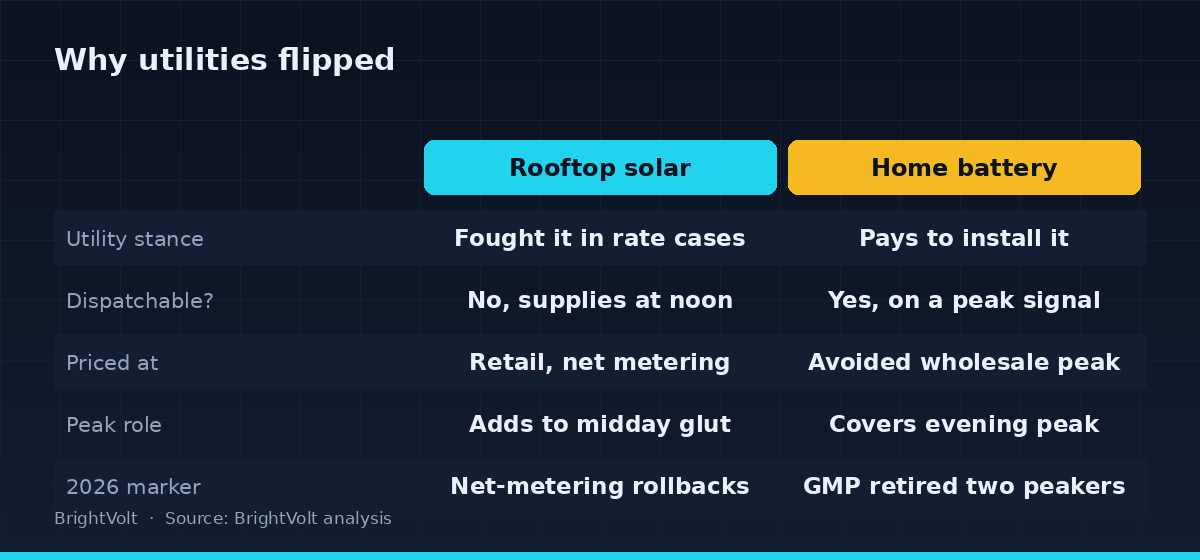
This is the reversal worth naming. For fifteen years, utilities fought rooftop solar in rate cases across the country. In 2026 those same utilities are paying households to install batteries and handing them the keys to dispatch them. Nothing about the politics of distributed energy changed. The technology did.
What a utility actually objected to
The standard story is that utilities hated rooftop solar because it ate their sales. That was part of it, but it was never the real operational grievance. The grievance was that a rooftop array is generation the utility cannot control. It produces at noon, whether or not the system needs power at noon, and under old net-metering rules the utility had to buy that midday electricity back at the full retail rate — the same rate it charges for power delivered at 7pm on the worst day of the year. A resource that shows up uninvited and bills you peak prices for off-peak energy is a genuine headache, and dressing the complaint up as concern for non-solar ratepayers did not make the underlying problem imaginary.
A home battery removes both halves of that objection. It does not generate at all; it stores. And critically, it discharges when told to — on a signal, into the evening peak, exactly when the grid is short. The thing utilities disliked about customer-sited power was never that it sat on the customer’s side of the meter. It was that it was undispatchable. Storage is dispatchable, so the fight is over.
We covered the homeowner’s side of this shift when net metering started unwinding: as states stopped paying retail rates for exported solar, households worked out that storing a kilowatt-hour beats selling it for a twelfth of what it costs to buy back. That is the private case for a battery. The utility case is bigger, and it is the one now moving the numbers.
Vermont retired two power plants and kept the lights on
Green Mountain Power’s virtual power plant now totals 110 MW, of which 53 MW is home batteries — the largest residential storage fleet in New England. More than 5,000 customers run over 10,000 batteries the utility can call on together. On the July peak it summoned 90 MW of that, an amount it describes as roughly equivalent to pulling 50,000 homes off the grid at once. The stored fleet covers close to 10% of Vermont’s summer peak demand.
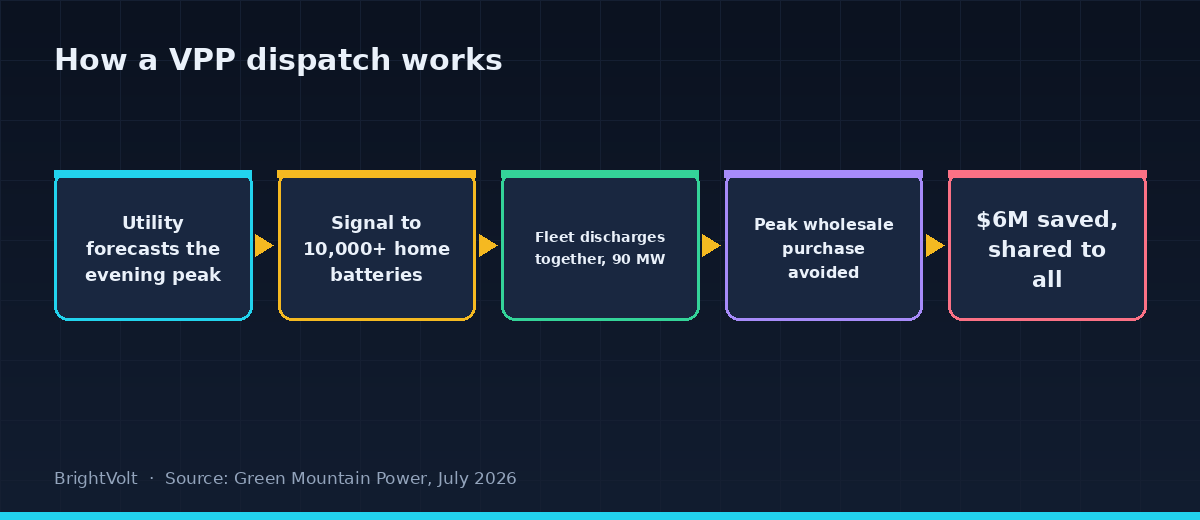
The tell is not the savings figure. It is that GMP has now permanently closed its Vergennes and Rutland peaker plants and is planning more closures, because the battery fleet has proven reliable enough to stand in for them. A peaker is a physical asset a utility builds and maintains for a few dozen hours of use a year. Replacing one with capacity that already exists in customers’ homes is the cheapest new firm capacity a utility can get, and GMP is the first to treat it that way at scale rather than as a pilot.
That is why the leasing model looks the way it does. GMP will put two Powerwalls in your house for $55 a month or $5,500 up front on a ten-year term. The utility is not doing you a favour. It is acquiring dispatch rights to a battery for less than it would cost to build the peaker the battery replaces.
The money moved from your bill to the peak
The clearest evidence that this is a capacity play, not a green gesture, is where the payments come from. In Massachusetts, Connecticut and New Hampshire, the ConnectedSolutions program paid 5,251 residential battery owners $5.4 million for the 2025 season alone, at a rate of $275 per average kilowatt a battery delivers during summer peak events — $1,375 to $2,750 for a typical participant. Those dollars are not a subsidy drawn from a clean-energy fund. They are a share of the wholesale peak costs the aggregated batteries let the utility avoid.
| Program | Region | Residential battery capacity | What households get |
|---|---|---|---|
| Green Mountain Power | Vermont | 53 MW (110 MW total fleet) | Leased Powerwalls at $55/mo; peak savings shared to all ratepayers |
| ConnectedSolutions | MA / CT / NH | 28.9 MW (2025), 93 MW targeted by 2027 | $275 per summer-peak kW — $1,375 to $2,750 a year |
| Sunrun–Tesla–Renew Home | National | Part of a planned 16.8 GW | ~$70 million paid to date; capacity sold to data centres |
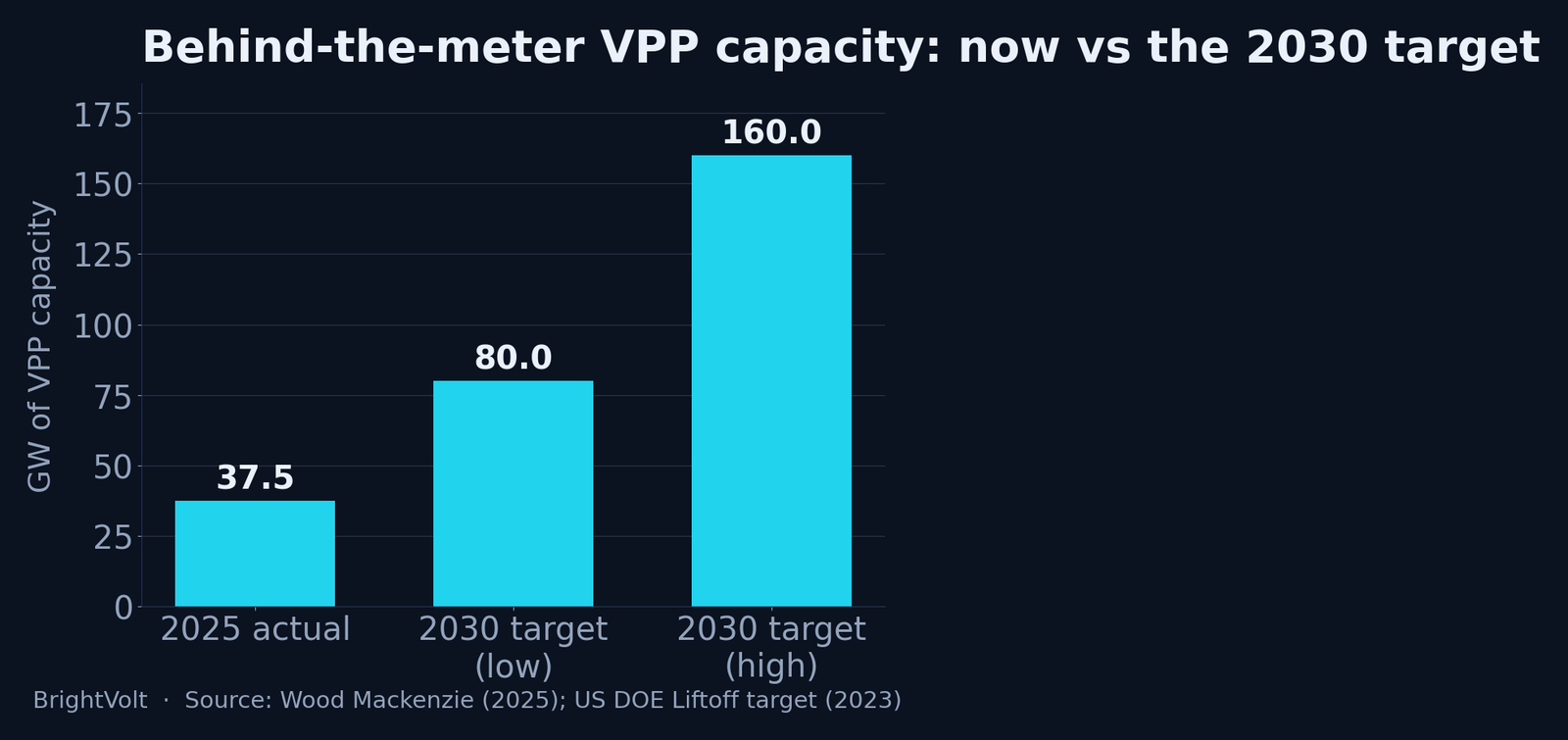
Nationally the behind-the-meter fleet reached 37.5 GW in 2025, up 13.7% in a year, with residential resources now 10.2% of wholesale-market capacity, up from 8.8% the year before. The Department of Energy’s 2023 Liftoff analysis argued that tripling VPP capacity to 80–160 GW by 2030 could meet 10–20% of US peak demand and save roughly $10 billion a year. Those are power-plant numbers, assembled out of hardware someone else bought for their own reasons.
The catch nobody enrolling has priced in
Here is the strongest version of the case against getting excited. Most of the headline gigawatts are not batteries at all. When Sunrun, Tesla and Renew Home announced a 16.8 GW virtual power plant, more than eight million of the twelve million enrolled devices were smart thermostats — load you can nudge, not power you can supply. A thermostat that lets the utility drift your air-conditioning up two degrees shaves demand; it does not put electrons on the wire. Counting it the same as a battery inflates the number.
The second problem is durability of value, and it is one this site has already spelled out. A home battery that discharges for two to four hours is worth a lot when the evening peak is a two-to-four-hour problem. But as batteries saturate that window, the grid’s shortage migrates to hours a short battery cannot cover, and the capacity credit each new battery earns falls. Wood Mackenzie flags this directly: the brake on VPP growth is not enthusiasm, it is utility program caps and the capacity-accreditation reforms that decide how much a short-duration resource is actually allowed to count. The 90 MW Vermont dispatched this July will not automatically be worth 90 MW of capacity in 2030.
Both objections are real. Neither reaches the conclusion that this is hype. A thermostat-heavy fleet is still a fleet, and the battery slice — GMP’s 53 MW, ConnectedSolutions’ 28.9 MW — is firm, dispatchable and growing faster than the thermostats. The accreditation math tightens the value of the marginal battery; it does not erase the value of a fleet that let a real utility retire two real power plants this year. The right read is not that VPPs are a mirage. It is that their value has a shelf life measured in how fast the grid’s peak moves, and utilities acquiring dispatch rights cheaply today are the ones who understood that first.
What would change this read
Watch the capacity-accreditation dockets, not the enrollment counts. If regulators cut the credit for short-duration storage faster than fleets grow — or if grid-scale batteries fall far enough to undercut the home fleet on the same peak — the economics that made GMP close its peakers weaken, and the leasing offers get stingier. Until then, the signal is unambiguous. The utility knocking on your door to install a battery is not being generous. It has simply run the arithmetic on what that battery is worth to it, and concluded the answer is more than it is asking you to pay.
Photo by Ramesh Kambattan on Pexels · Photo by Riccardo Zerbinati on Pexels