
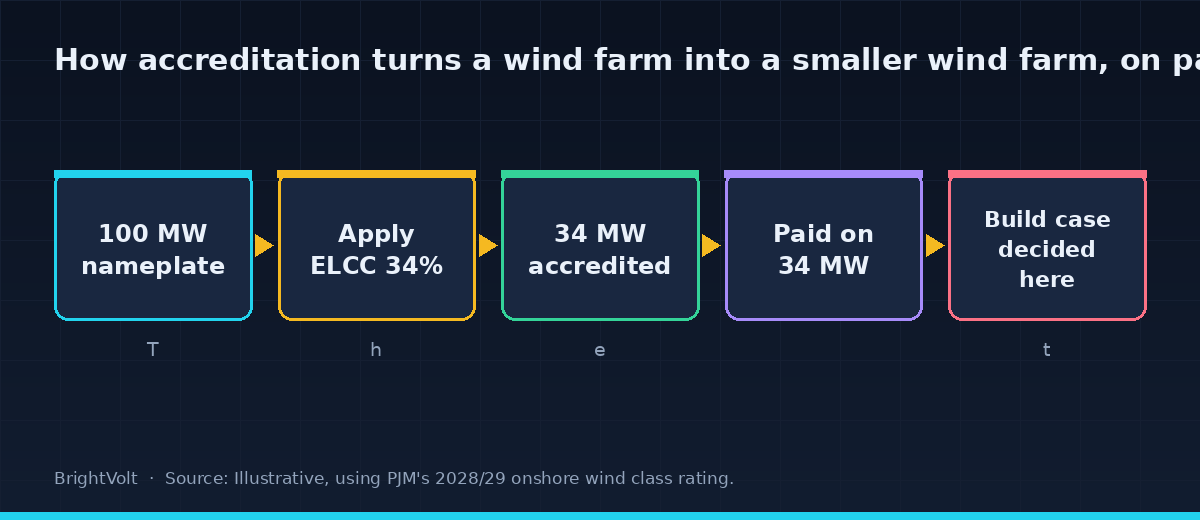
Build a 100 MW wind farm in PJM and the grid will pay you for about 34 MW of it. The turbines are real, the nameplate is real, and the other 66 MW is not a penalty or an accounting trick. It is the grid’s estimate of how much of your wind farm it can count on being there at the moment the system is closest to running out.
That estimate is called capacity accreditation, and the method used to produce it is Effective Load Carrying Capability — ELCC. It decides how much a generator earns, which projects get financed, and increasingly which technologies get built at all. Almost everything written about it is a regulator’s manual, a consultancy’s slide deck or a trading desk’s note. Here is the plain version.
Two different things a grid buys
A power market buys two products that are easy to confuse. Energy is electricity actually delivered, measured in megawatt-hours and paid for when it flows. Capacity is a promise to be available when the system needs you, measured in megawatts and paid for whether or not you are called.
Capacity payments exist because reliability has to be bought in advance. A grid operator has to know, years ahead, that enough resources will show up on the worst evening of the year — a still, freezing January dusk, or a heatwave at 6pm when solar has gone and air conditioning has not. So it runs an auction, buys a quantity of capacity, and pays everyone who supplies it.
The question that immediately follows is: how many megawatts is a given resource actually worth to that promise? A gas plant that can run on demand is worth close to its nameplate. A wind farm that might be becalmed on exactly the wrong evening is worth rather less. Accreditation is the answer to that question, and ELCC is how it gets calculated.
What ELCC actually measures
ELCC asks a counterfactual: if you added this resource to the system, how much additional demand could the grid serve without becoming any less reliable than before? Express that as a share of the resource’s nameplate and you have its accreditation.
PJM describes ELCC as a method that “considers the simultaneous reliability contribution of all resources and recognizes both complementary and opposing interactions among resources.” That sentence is doing a lot of work, and it is the part most summaries drop. Accreditation is not a property of your wind farm. It is a property of your wind farm given everything else on the system.
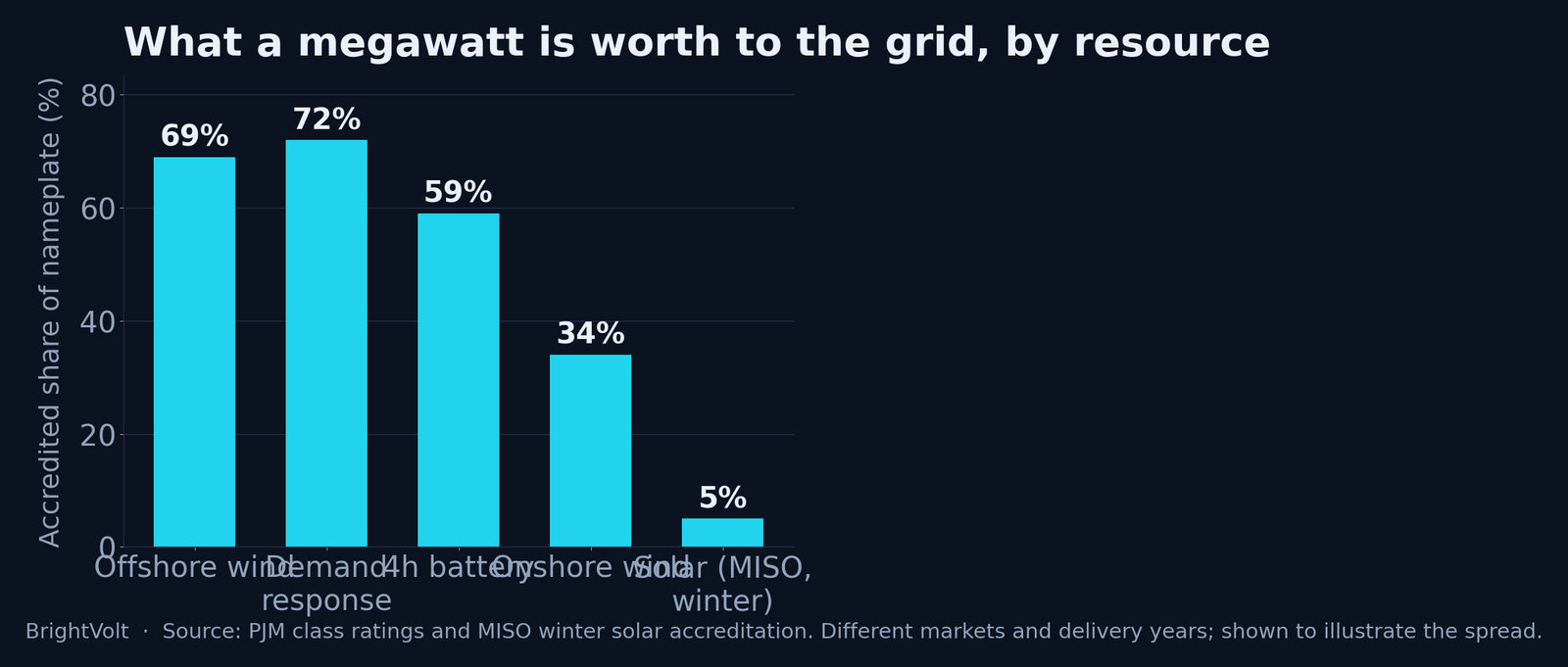
The spread is enormous. Offshore wind, which blows more reliably and more in winter, accredits far higher than onshore. Demand response — paying large consumers to switch off — accredits at 72% in PJM for the 2026/27 delivery year. Solar in MISO’s winter accredits at around 5%, because the moment MISO worries about is a January evening and the sun has set.
Why the number falls as you build more
This is the counter-intuitive part, and it is deliberate. PJM uses a marginal rather than an average approach, which means each new increment is valued for what it adds to a system that already contains everything built before it.
Solar is the cleanest illustration. The first solar farm on a summer-peaking grid is genuinely valuable: it generates hard in the afternoon, when demand is high. Add enough solar and the afternoon stops being the difficult hour — the peak moves to the evening, after sunset. The panels have not changed. The problem has moved out from under them. PJM’s own framing is that “increasing one intermittent resource alone, such as solar, leads to saturation, reducing the resource’s capacity contribution.”
The same logic runs in reverse for combinations. PJM notes that “solar paired with an energy storage resource could have a higher combined contribution” than solar alone, because the battery moves the generation to the hour that still hurts. Accreditation rewards filling the remaining gap, not producing more of what the system already has plenty of.
This is the same economic force we described in solar’s capture rate — the market value of a resource falling as more of it is added — measured on the capacity side rather than the energy side. Capture rate is what your electricity earns. Accreditation is what your promise earns.
Where the money is
The arithmetic is brutally simple: accredited megawatts multiplied by the capacity price is your capacity revenue. Halve the accreditation and you halve that line of the business case.
That is why a change in class ratings is a financing event, not a technical footnote. And the ratings are moving fast in opposite directions. In PJM, onshore wind’s accreditation fell from 41% to 34% between the 2026/27 and 2028/29 delivery years, while four-hour battery storage rose from 50% to 59% over the same period — the point at which a battery began to count for more, per megawatt, than a wind turbine.
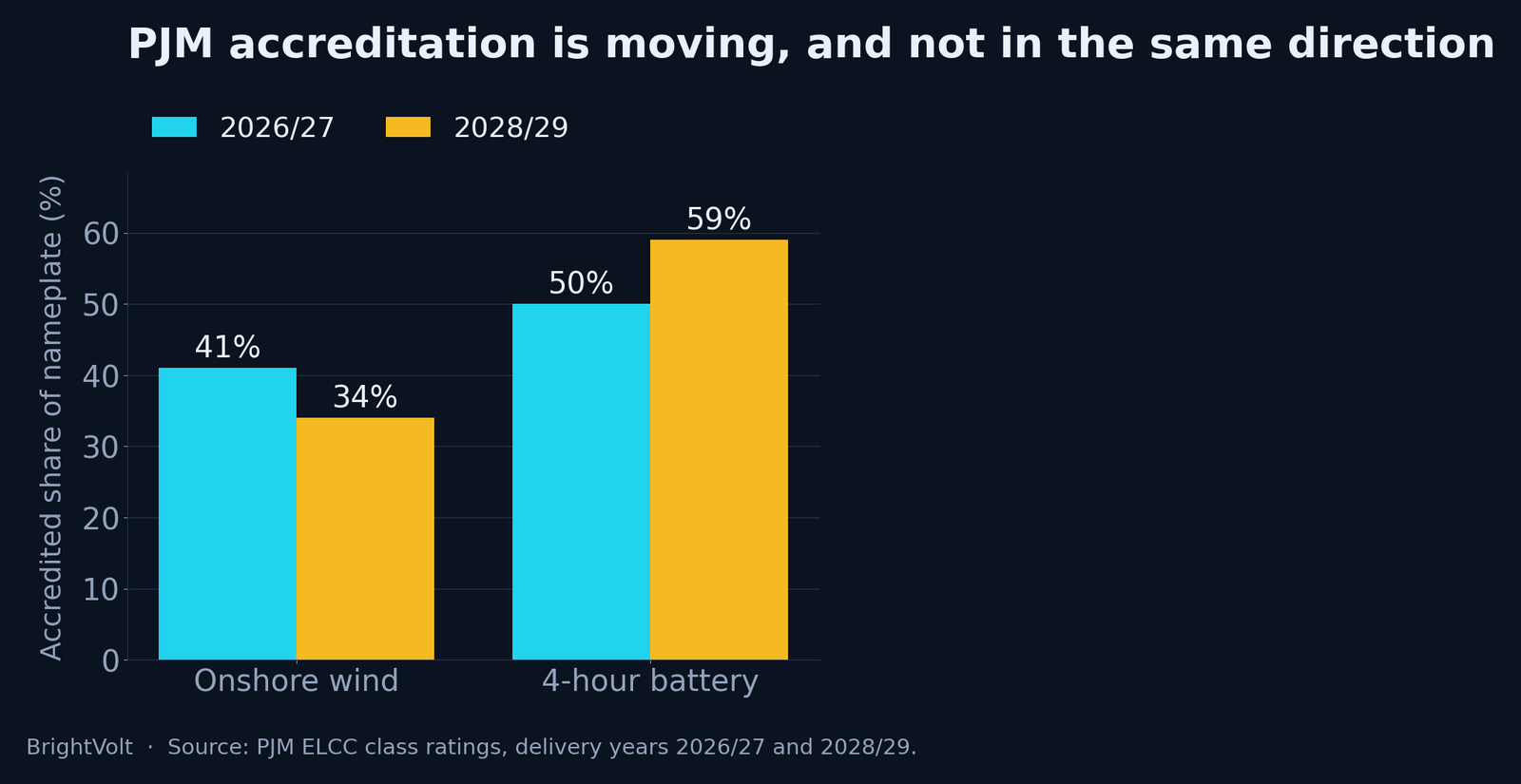
Nothing about wind got worse in those two years. There is simply more wind on the system, so each additional turbine adds less to the specific hours PJM is worried about, while each additional battery still has scarce evening capacity to sell into.
What accreditation is not
It is not a verdict on whether a technology is worth building. A wind farm accredited at 34% still produces energy for all the hours it turns, and energy is the larger revenue stream for most renewable projects. A resource can be a poor capacity provider and an excellent generator at the same time; the two payments answer different questions.
Nor is it a fixed physical property. Accreditation depends on the market you are in, the year, the weather years modelled, and what everyone else has built. The same wind farm accredits differently in PJM and MISO, and differently in 2029 than in 2026. Anyone quoting a single number for “wind’s capacity value” without saying where and when is quoting something that does not exist.
What to watch
Two things decide where this goes. The first is whether accreditation methods start rewarding duration explicitly — an eight-hour battery is worth more than a four-hour one on a long winter evening, and the class structures are only beginning to reflect that. The second is what happens as data-centre load pushes peaks later and makes them longer, because a system whose difficult hour moves will re-rate every resource on it.
Accreditation is the quiet mechanism that turns a reliability judgement into a cash flow. When you next read that a grid operator is worried about resource adequacy, or that a developer has shelved a project that looked economic a year ago, this is usually the number that moved.
Photo by 光术 山影 on Pexels