
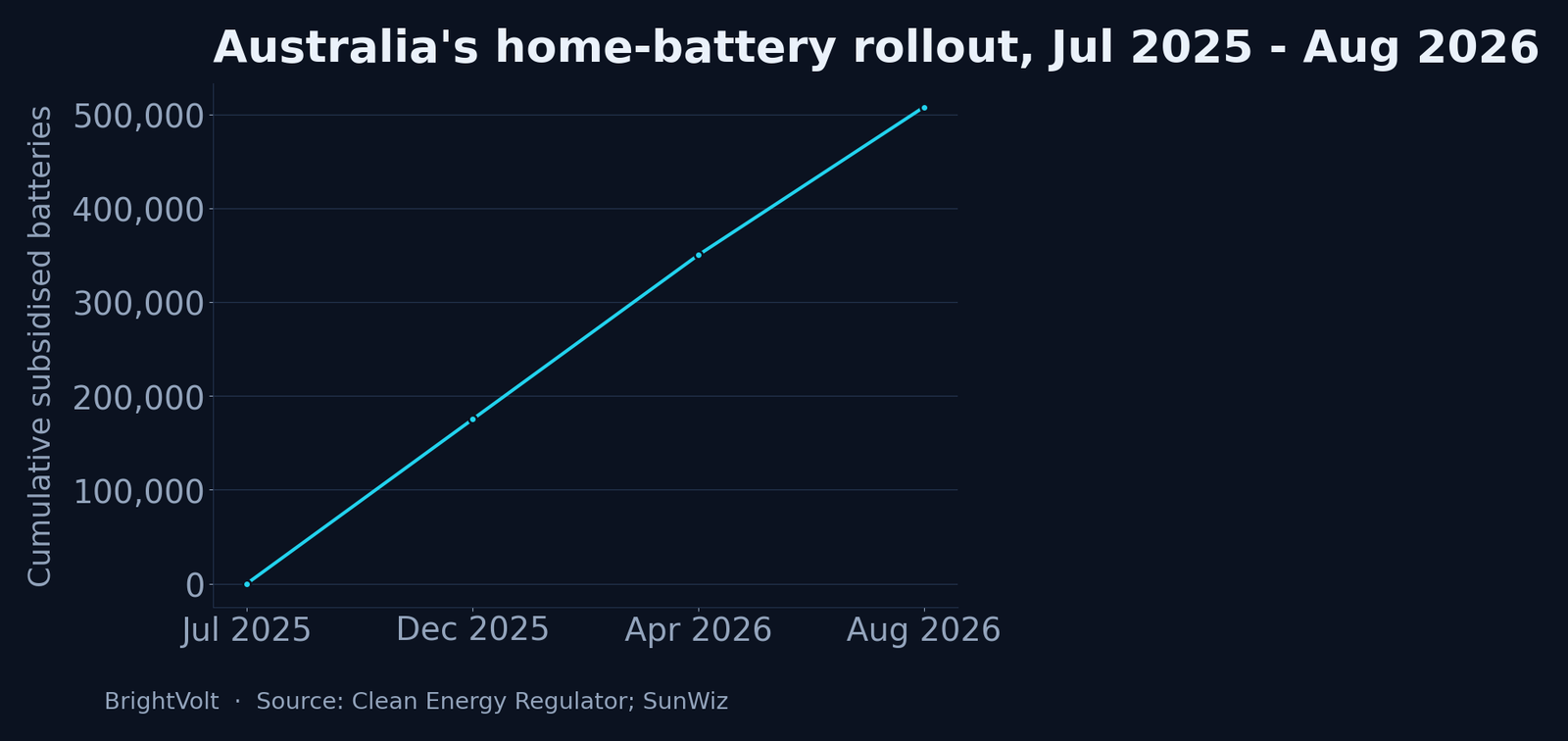
Australia has installed more than 507,000 subsidised home batteries in the thirteen months since it switched on a national rebate, crossing half a million in mid-August 2026 and parking roughly 14 GWh of storage behind household meters. The United States spent the same stretch doing the opposite: its 30% federal battery credit expired on 31 December 2025, and the market has already turned. Two wealthy, solar-saturated countries, opposite policies, one natural experiment.
The Australian figure comes from SunWiz, which put the count at 507,651 subsidised batteries by 18 August, and the Clean Energy Regulator, which administers the scheme. Both land on the same 14 GWh of new behind-the-meter capacity — more residential storage than most countries have of any kind.
How Australia added half a million batteries in thirteen months
The Cheaper Home Batteries Program went live on 1 July 2025, days after the Albanese government’s re-election. The mechanism is blunt: knock about 30% off the upfront cost of a home battery, paid as an instalment-point discount so the buyer never files a form. Applications ran at several thousand a week almost immediately. By the end of 2025 more than 175,000 systems were in; by the end of April, 350,000; by mid-August, past 500,000.
The budget tells the same story of underestimation. The scheme was costed at A$2.3 billion over four years. Demand blew through the assumptions fast enough that the government added a further A$5 billion in December 2025, taking the four-year envelope past A$7 billion. Energy minister Chris Bowen noted the uptake was concentrated outside the capital cities, with some electorates already past 10% household-battery penetration — a subsidy landing hardest in the suburbs and regions, not the inner-city rooftops that took the first wave of solar.
Why the rebate only worked because the solar was already there
A battery rebate on its own would have done far less. Australia could bolt storage onto the grid at this speed because the hard part was finished years ago: by mid-2025 the country had 4.2 million rooftop solar systems and 26.8 GW of capacity, on close to one home in three — the highest per-capita rooftop solar penetration in the world. Millions of households were already generating surplus power at midday and buying it back at night. The battery was the missing verb.
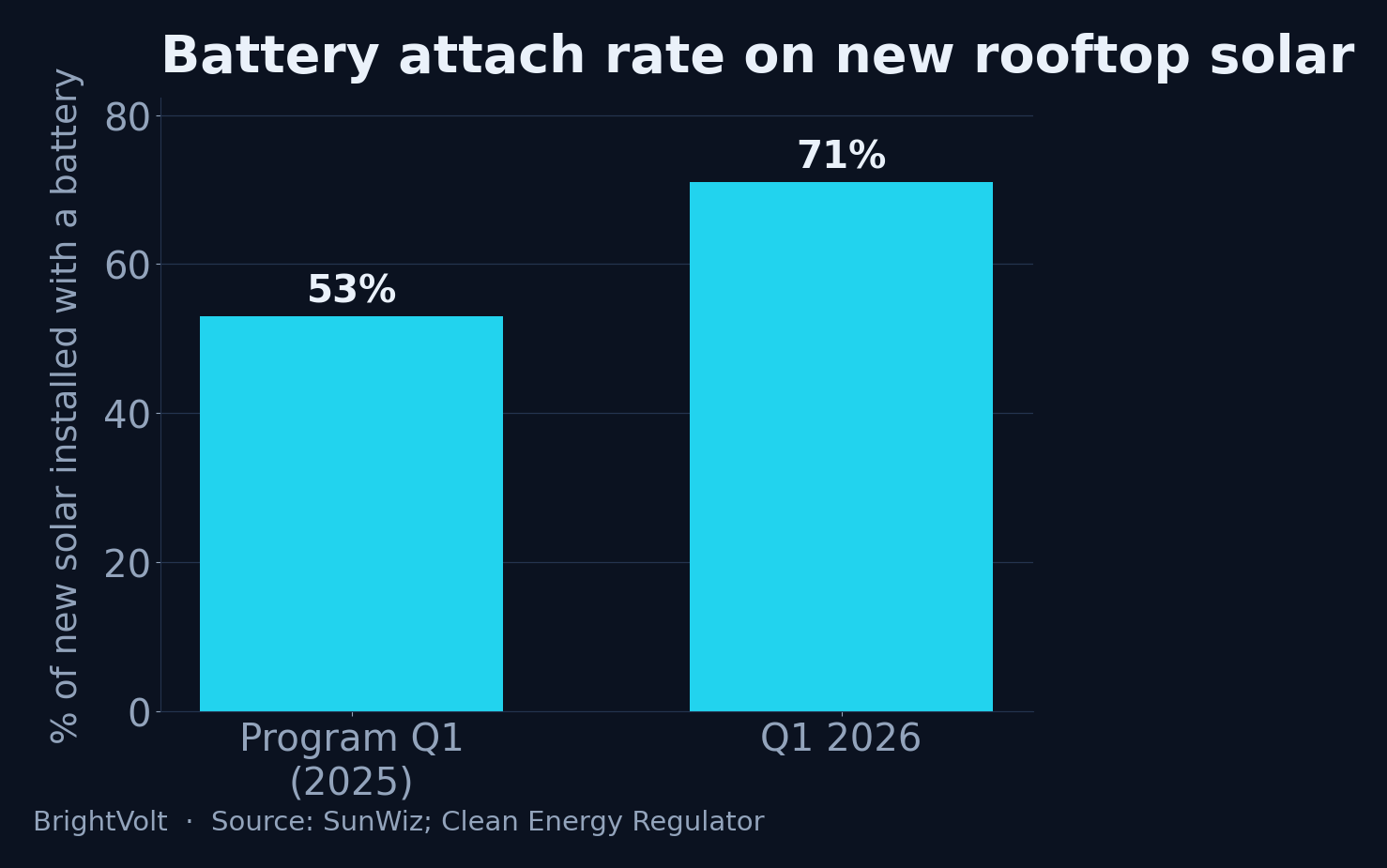
The attach rate proves the point. In the program’s first quarter, 53% of new rooftop solar systems went in with a battery. By the first quarter of 2026 that had climbed to 71%. Solar and storage have effectively fused into a single purchase, and systems bought with a battery are larger — 11.1 kW on average against 9.1 kW for solar alone.
That is the lesson the headline number hides. The rebate did not create the demand; it released demand that four million solar roofs had already built up. A country installing its first panels would not get this curve from the same cheque.
What the United States did instead
Washington ran the film backwards. The Section 25D residential clean energy credit — 30% off a home battery of 3 kWh or larger — expired for any system not switched on by 31 December 2025, its sunset pulled forward from 2032 by last year’s budget law. We covered the parallel unwinding of the rooftop-solar credit in the leasing loophole it left behind.
The early numbers look, misleadingly, like a boom. US residential storage hit a record 1.3 GWh in the first quarter of 2026, up 86% year on year, according to Wood Mackenzie and the American Clean Power Association. But that spike is a deadline, not a trend: households rushing to install before the credit vanished. Wood Mackenzie now forecasts the residential segment to contract by around 5% across 2026 as that pull-forward exhausts itself and tighter permitting and tax-equity rules bite. Australia added a subsidy and the curve went vertical. America removed one and the curve is about to bend down. The mechanism is not subtle.
The design flaw Australia had to fix in May
Cheap policy invites gaming, and this one did. Because the original rebate paid a flat rate per kilowatt-hour of capacity, the rational move was to buy the biggest battery on offer. Early-program systems averaged 40 to 50 kWh — closer to an electric car’s pack than a house’s daily need — because the taxpayer was effectively pricing storage by the slab. A subsidy that pays by the kilowatt-hour will buy you kilowatt-hours you have no use for.
From 1 May 2026 the scheme was re-tiered to pay for what a home actually cycles:
| Battery capacity | Subsidy after May 2026 |
|---|---|
| First 14 kWh | Full rebate rate |
| 14–28 kWh | Reduced rate |
| Above 28 kWh (to 50 kWh cap) | Minimal |
The recut worked as intended. The 20–30 kWh band became the largest segment by installed capacity, and the average system drifted down toward something a household will genuinely use across a day. The scheme kept its volume while shedding the incentive to oversize.
What 14 GWh of mostly-passive storage does to the grid
Here is the part utilities keep missing. Only about 24% of these solar-and-battery households have joined a virtual power plant, the coordinated fleets we wrote about last week. The other three-quarters are running passively — soaking up their own midday solar and discharging it in the evening for their own benefit, with no signal from a system operator.
That still helps. AEMO chief executive Daniel Westerman has made the point that even a battery acting purely selfishly — storing cheap daytime solar, avoiding the evening peak — shaves the load curve the grid has to serve. Australia’s grid stress is an evening problem: a mountain of midday solar that collapses at sunset into a steep demand ramp. Half a million batteries quietly time-shifting sunlight into the evening flattens exactly that ramp, VPP contract or not.
The comparison to watch runs both ways. Australia’s test is whether the recut rebate holds its volume now that the oversizing gravy is gone, and whether that passive fleet can be coaxed into coordinated dispatch without souring households on the deal. America’s is simpler and grimmer: whether a market stripped of its residential subsidy can sustain home storage on economics alone, or whether the 2026 contraction is the first year of several. The figure that would change our read is the US residential number for the back half of 2026. If it falls only slightly, the credit was a nudge. If it falls off a cliff, it was the market.
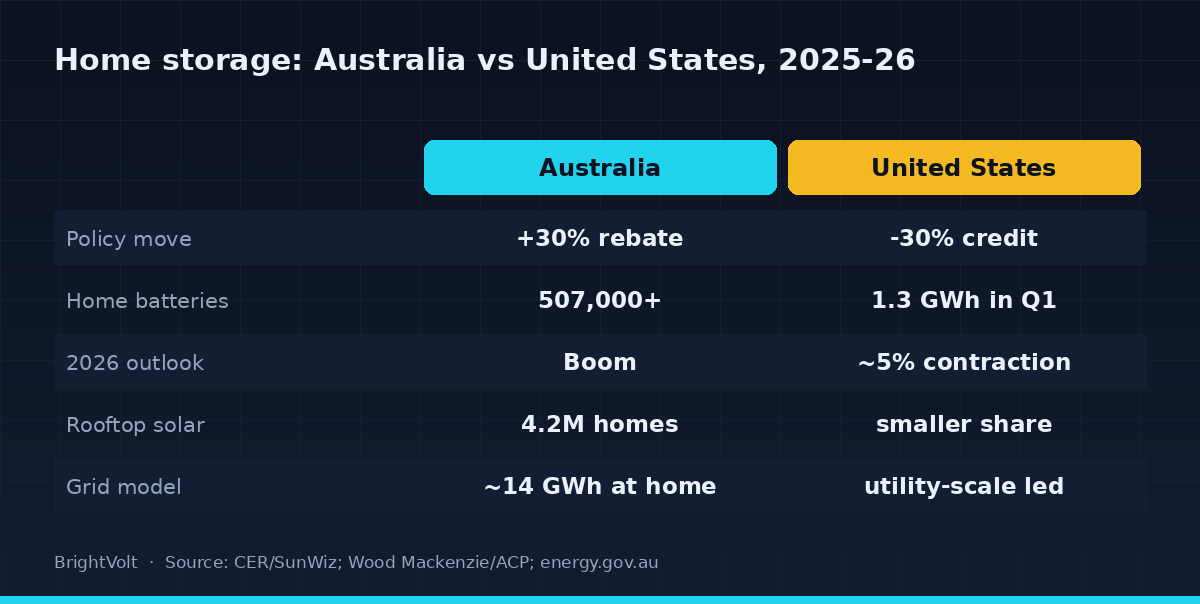
Photo by Elite Power Group on Pexels · Photo by Robert So on Pexels