
Researchers at Nanjing University pushed a perovskite-organic tandem solar cell to a certified 26.88% efficiency — 27.35% before independent verification — a world record for the design, published in Joule in September 2026. It is a real milestone. It is also the wrong number to cheer.
The efficiency that reaches a roof is lower than the record, the efficiency of the panels you can actually buy is lower again, and the number that decides how long any of it lasts is the one the headline leaves out. Perovskite has spent a decade breaking cell records. The gap between those records and a shipping module is the story.
What Nanjing actually built
The record cell came from a team at Nanjing University and the Fujian Institute of Research on the Structure of Matter, using a new near-infrared organic acceptor to squeeze more current out of the bottom layer. That fixed the specific weakness of this cell type: a perovskite-organic tandem stacks a wide-bandgap perovskite on an organic (carbon-based) absorber, and the two halves have historically struggled to produce matched current, which caps the pair. The 26.88% certified result beats the previous perovskite-organic mark of 26.4%, set by Singapore’s SERIS in mid-2025.
Here is the first thing the coverage tends to skip: perovskite-organic is not the design anyone plans to build utility-scale power plants from. Its appeal is that both layers can be printed from solution at room temperature and stay flexible, which suits curved surfaces, building facades and vehicle bodies — places a rigid silicon panel cannot go. The commercial tandem, the one racing toward mainstream rooftops and solar farms, puts perovskite on silicon, and it is a different and considerably more mature race.
Three efficiencies, and only one you can buy
A solar efficiency figure is meaningless until you ask what it was measured on. There are three numbers, and they are routinely quoted as if they were one.
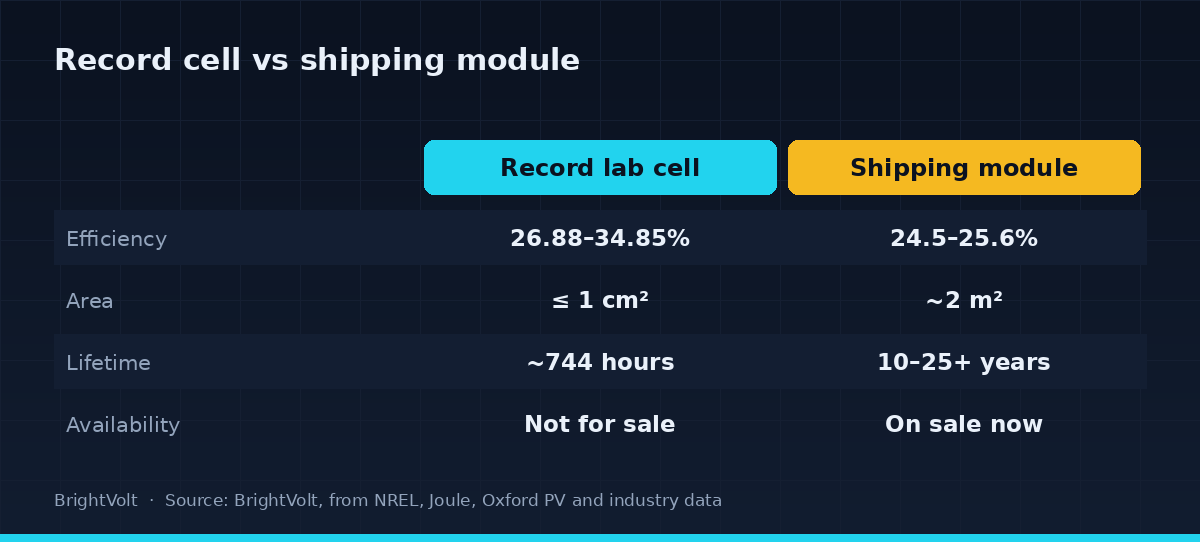
The champion cell is a laboratory sliver, often smaller than a fingernail, measured under ideal light. On that scale the perovskite-silicon record is 34.85%, set by LONGi on a one-square-centimetre cell and certified by the US National Renewable Energy Laboratory in 2025. Nanjing’s 26.88% organic cell sits well below that, as does the 26.95% single-junction perovskite record — measured, tellingly, on a cell of 0.058 cm².
| Cell record (lab champion) | Efficiency | Area | Holder |
|---|---|---|---|
| Perovskite–silicon tandem | 34.85% | 1.0 cm² | LONGi (2025) |
| All-perovskite tandem | 30.1% | 0.049 cm² | Nanjing / Renshine (2024) |
| Perovskite single-junction | 26.95% | 0.058 cm² | SooChow / UNSW (2025) |
| Perovskite–organic tandem | 26.88% | lab cell | Nanjing (2026) |
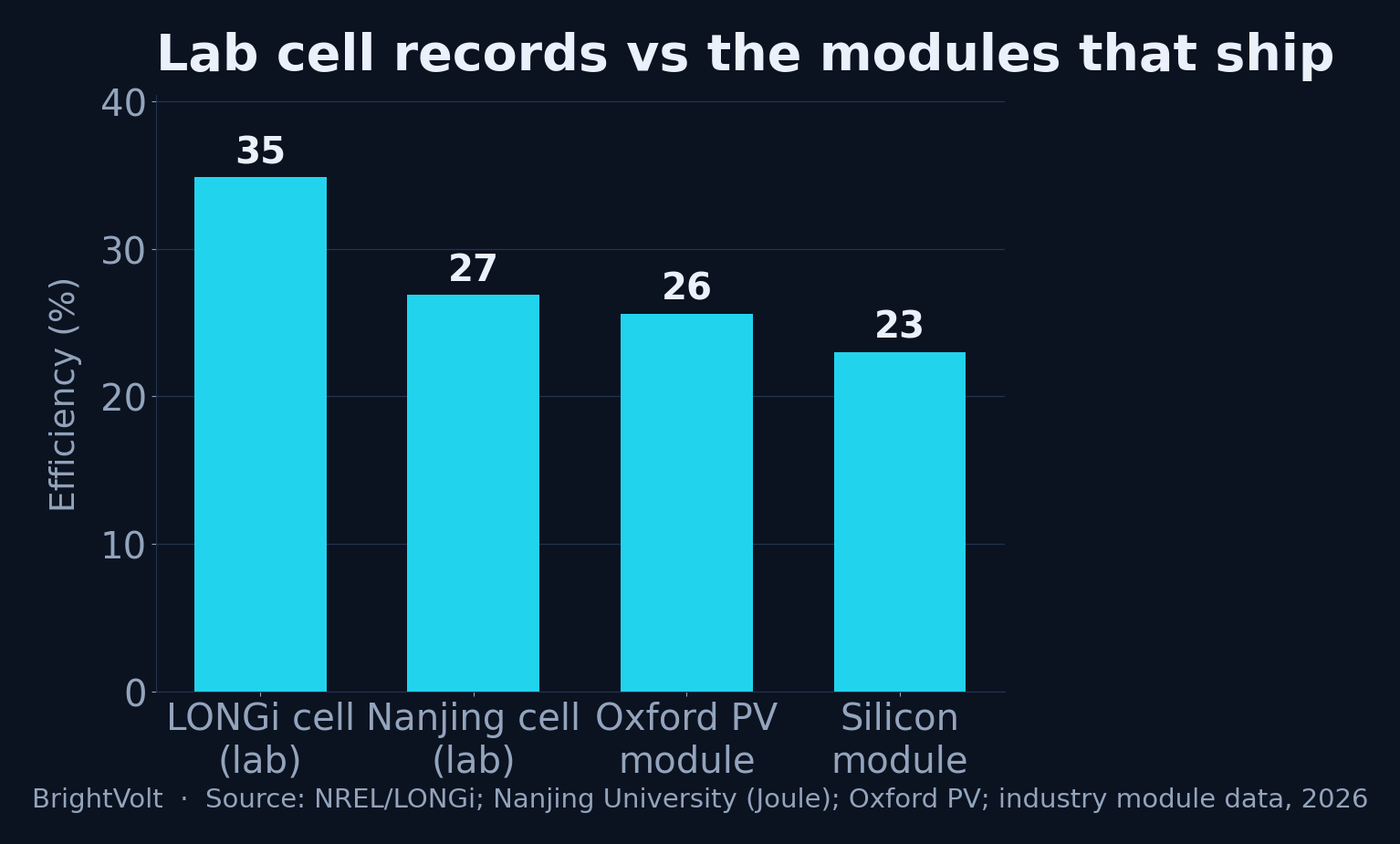
The module is what leaves a factory: a glass-and-metal panel of roughly two square metres, which is about twenty thousand times the area of that record cell. Efficiency always falls on the way up to that size — edges, wiring resistance and the impossibility of making every square centimetre perfect all take their cut. Oxford PV, the furthest along in commercialising perovskite-silicon, shipped its first commercial modules in 2024 at 24.5%, and in June 2026 demonstrated a 25.6% module — a 491-watt panel over 1.92 m². The best mainstream silicon panels on sale in 2026 reach roughly 23–25%. So the tandem module that exists today beats a good silicon module by a point or two, not by the ten-point margin the cell records imply.
That margin still matters — a point of module efficiency is real money across a solar farm. But it is a fraction of the gap the headline number advertises.
The number nobody puts in the headline
Efficiency is where perovskite wins the press release. Durability is where it has always lost, and it is the number the record omits.
The Nanjing cell’s own paper is a case in point: pv magazine reported the unencapsulated device held about 80% of its output after roughly 744 hours of continuous full-sun exposure — a month. A silicon panel is sold on a 25-to-30-year warranty and loses around half a percent of its output a year. These are not the same category of product, and a champion-cell efficiency says nothing about which one you are looking at.
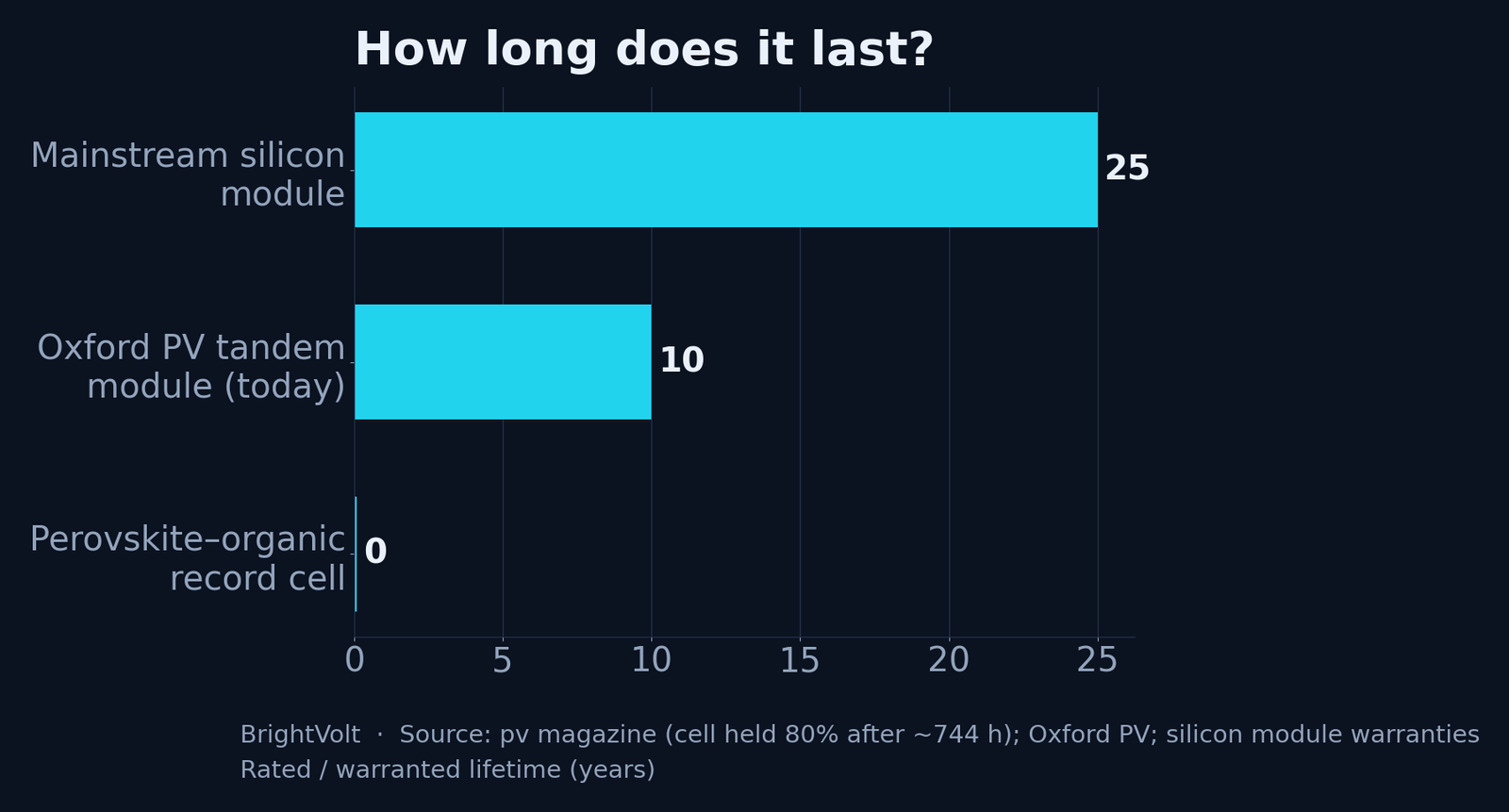
The honest version of the state of play comes from Oxford PV itself, which has every reason to talk its own book and still puts it plainly: its current tandem modules are “already delivering efficiencies of 25% with a 10-year lifetime today,” with a 26% product due this year and “a path to 27% with extended lifetimes by 2027.” Read that against the 34.85% cell record and the distance between the laboratory and the loading dock is exact. The lab has a ten-point lead on efficiency. The factory is still working to match silicon’s lifetime, which is the property that actually determines the electricity a panel makes over the years it is bolted to a roof.
Why the record still matters, and to whom
None of this makes the record worthless, and the strongest case for cheering it is worth stating in full. Champion cells map the ceiling, and the ceiling is what tells you whether a technology is worth industrialising at all. A solution-processed, flexible organic tandem is not competing with a silicon panel on a solar farm; it is opening façades, vehicle roofs and curved surfaces that silicon physically cannot cover, and 26.88% is a genuinely useful ceiling for that job. The broader perovskite-silicon trajectory is real too: Oxford PV is shipping, LONGi is planning gigawatt lines, and module efficiency has climbed from 24.5% to 25.6% in under two years. This is not cold fusion.
But for the solar that actually decarbonises a grid — utility-scale and rooftop, measured in gigawatts and dollars per megawatt-hour — cell efficiency was never the binding constraint. Silicon panels are already cheap and already efficient enough; what limits how fast solar gets built is the queue to connect it and the value it earns once it does, not the last point of conversion efficiency. A perovskite tandem changes that calculus only when it delivers a durable, warrantable module at a cost silicon cannot match — and on today’s numbers it is close on efficiency and years short on lifetime.
So watch the module-years figure, not the cell-percentage one. The number that would make perovskite matter for mainstream power is a 27%-plus module carrying a 25-year warranty at a price at or below silicon, shipping in gigawatt volume. If Oxford PV or a Chinese line clears that bar in the next two or three years, the decade of record-chasing will look like the leading indicator it was meant to be. If the warranty stays stuck at ten years while the efficiency headlines keep climbing, the records were the distraction. Either way, 26.88% on a lab cell does not tell you which — and it was never going to.
Photo by Los Muertos Crew on Pexels · Photo by Mark Stebnicki on Pexels