
The United States does not have a solar problem. It has a queue problem, and every headline celebrating record renewable output while data centre demand climbs is measuring the wrong thing. American solar farms posted their highest monthly output ever this summer, up 21% year on year, and developers are on track to add 43.4 GW of utility-scale solar this year — 51% of all new generating capacity. None of that will decide whether the AI build-out runs on sunlight or on gas. What decides it is a five-year wait for a grid connection.
The number that actually constrains the transition
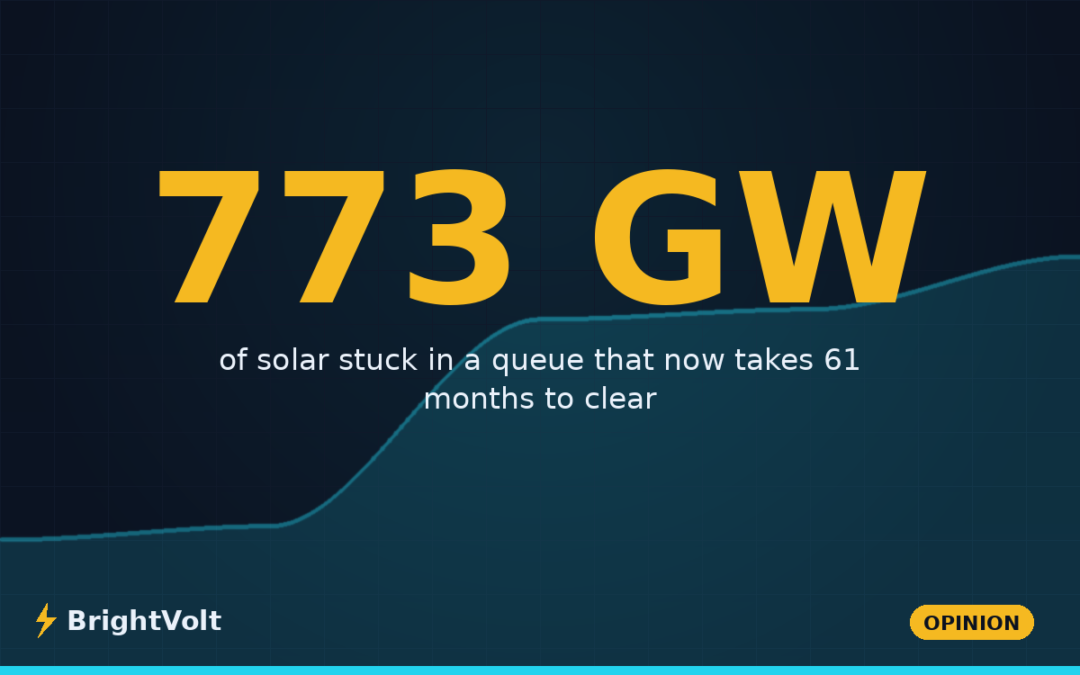
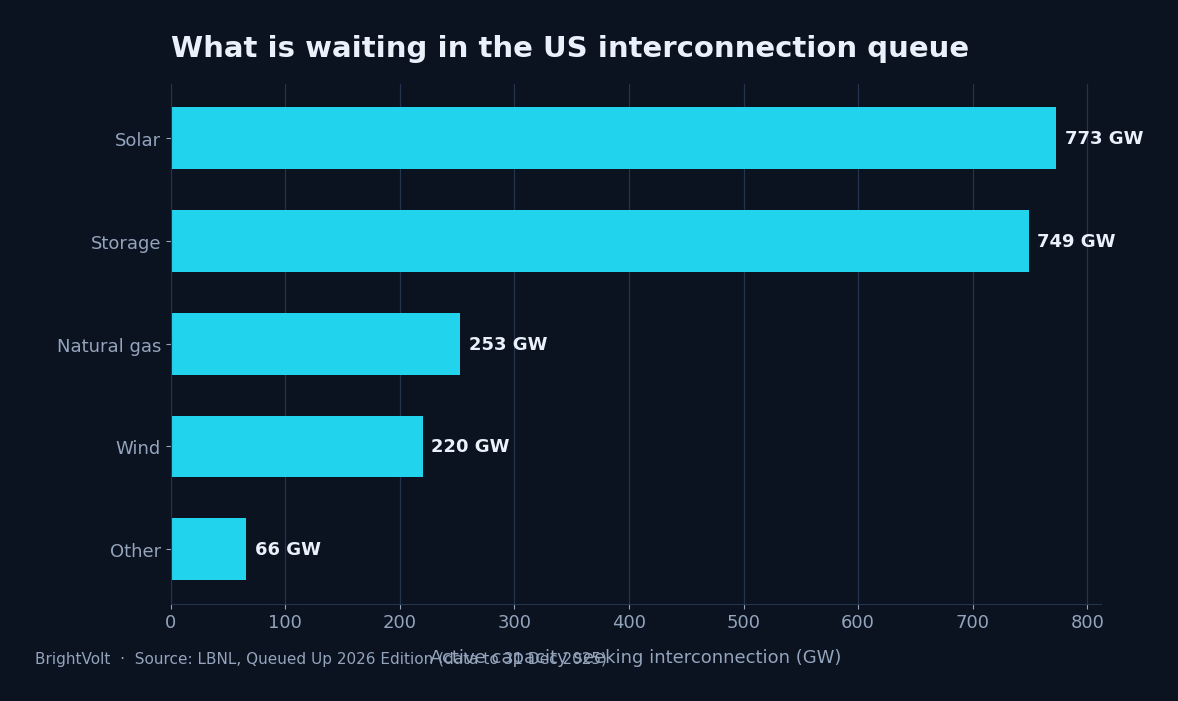
Lawrence Berkeley National Laboratory’s Queued Up 2026 Edition, published last month, counted 2,061 GW of capacity actively seeking interconnection as of 31 December 2025. Solar accounts for 773 GW of it and storage 749 GW. For scale, that solar figure alone is roughly eighteen years of construction at this year’s record pace.
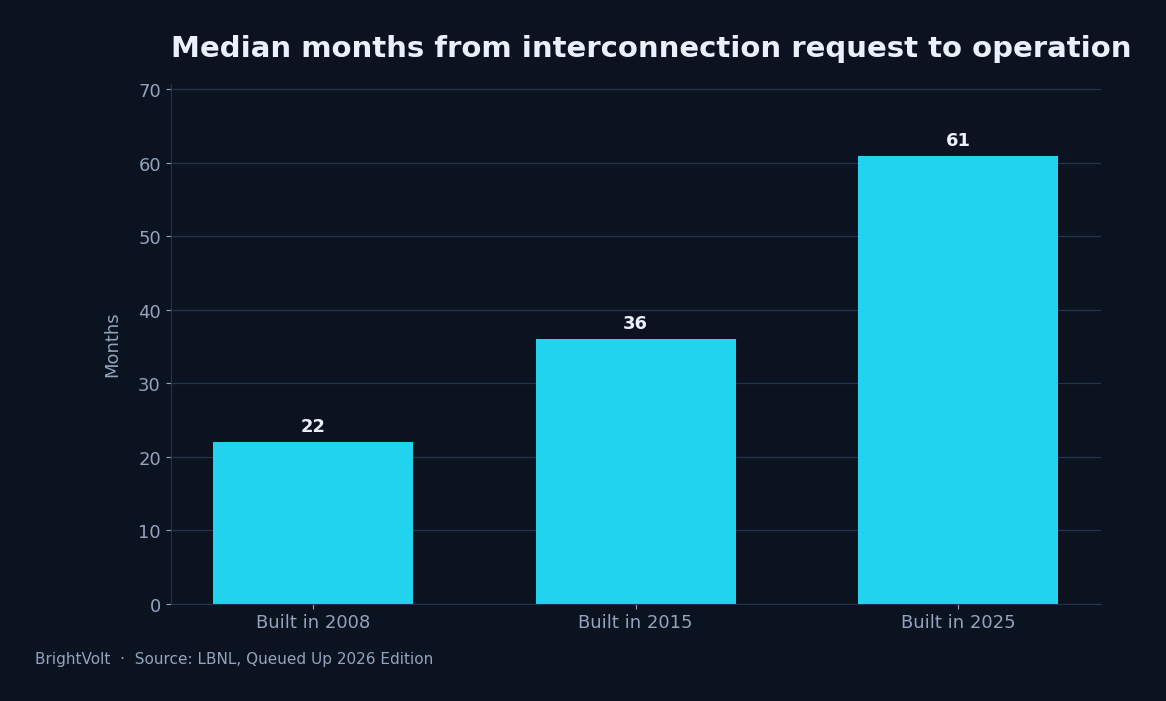
Two figures from that report matter more than the headline total. The median project reaching commercial operation in 2025 took 61 months from its interconnection request — up from 36 months in 2015 and 22 months in 2008. And of all the capacity that requested interconnection between 2000 and 2020, just 13% had been built by the end of 2025. Roughly 75% was withdrawn.
A pipeline where seven of every eight gigawatts never arrives, and the ones that do take five years, is not a pipeline. It is a waiting room with a very high mortality rate.
Why this hands the AI boom to gas
Data centre demand is the fastest-moving load the US grid has faced in decades: roughly 31 GW in 2025, a projected 41 GW this year and 66 GW by 2027, on a total system that the EIA expects to consume 4,269 billion kWh in 2026. Peak-summer share is forecast to climb from 4.1% to 8.5% across the same three years.
Now put those two clocks side by side. A hyperscaler signs a lease and wants power in twenty-four to thirty-six months. The median queued generator takes sixty-one. That gap is the whole story, and it is not a gap that gets closed by building more panels.
It is a gap that gets closed by whatever can be sited quickly and, increasingly, behind the meter — which in practice means gas turbines, which is exactly why 253 GW of gas now sits in a queue that was overwhelmingly renewable a few years ago. Gas is not winning on levelised cost. It is winning on schedule certainty, and schedule is the only currency a data centre developer with a signed AI training contract actually cares about.
Every month a solar-plus-storage hybrid spends in a cluster study is a month in which the load it would have served gets matched to something else. The queue does not merely delay clean capacity. It reallocates the demand.
The strongest case against this argument
The serious counter-argument runs like this: the queue is dominated by solar and storage precisely because the market has already picked the winner, FERC Order 2023 replaced serial studies with cluster processing, and the withdrawal rate is a feature rather than a bug — speculative projects filing cheap applications and washing out is how a queue is supposed to triage itself.
There is real force in that. A 75% withdrawal rate genuinely does include a large volume of never-serious projects, and the completion statistic covers requests going back to 2000, when the process was different in kind. Cluster reform is also demonstrably raising throughput in several regions.
It still does not rescue the timeline. The 61-month median describes projects built in 2025 — after cluster reform began, not before. Whatever the reforms are achieving, they have not yet moved the number that determines whether clean capacity arrives before the load it was meant to serve. Triage explains why projects leave the queue; it does not explain why the survivors take five years. And a reform that improves the ratio of applications to approvals while leaving duration untouched optimises the wrong variable.
The second counter — that behind-the-meter solar and storage can be built on data centre timelines — is true and is happening. But it applies to a slice of load, not to the 66 GW aggregate, and co-located generation still needs grid interconnection the moment it wants to export or draw backup.
What this should change
If the binding constraint is interconnection rather than generation, the priorities invert. Transmission capacity, grid-enhancing technologies that raise the throughput of existing lines, and study-process throughput matter more than the next solar capacity record. Storage co-location deserves particular attention: 749 GW of it is queued, and storage is the cheapest way to make an existing interconnection point carry more useful energy without new wires.
It also means the industry’s favourite metric — gigawatts installed per year — is a poor proxy for progress. A better one is median months from request to operation, and it has been getting worse for seventeen years.
What would change our mind
This argument is falsifiable, and here is the test. If the 2027 edition of Queued Up shows the median time from request to commercial operation falling meaningfully below 55 months, and the completion rate for recent request cohorts climbing above 20%, then cluster reform is working on the variable that matters and the queue is ceasing to be the binding constraint. If gas capacity in the queue starts shrinking rather than growing while data centre load keeps rising, that would also suggest clean capacity is winning the schedule race after all.
Neither has happened yet. Until one of them does, the record solar numbers are a measure of how much the industry can build — not of how much of it will ever be allowed to connect.