
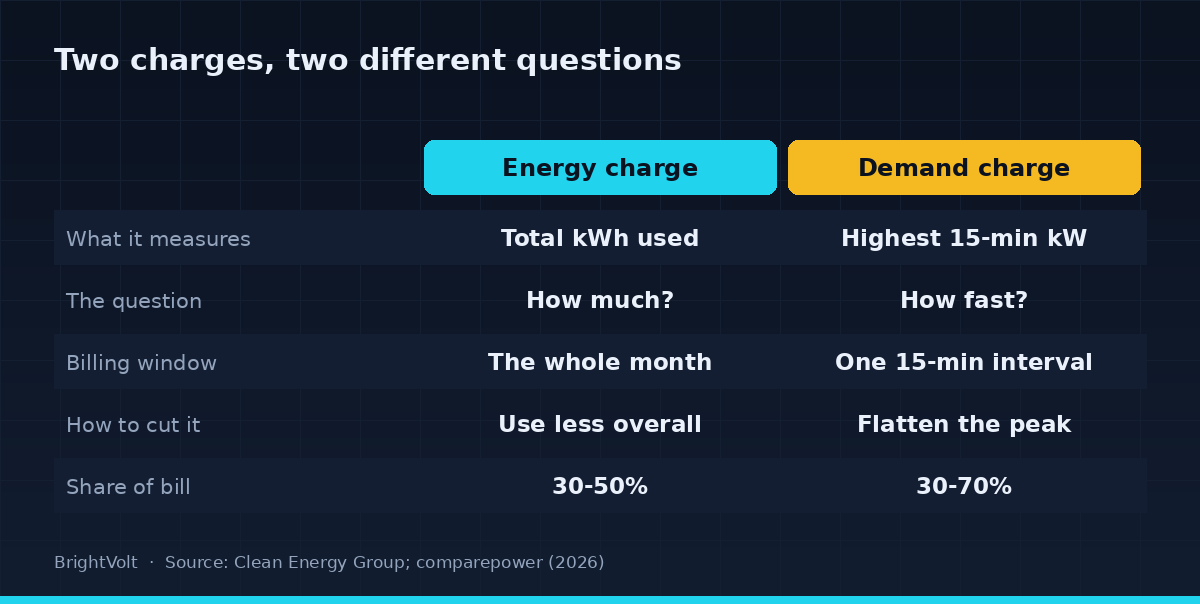
A demand charge is the part of a commercial electricity bill set by the single highest 15-minute burst of power a building draws in a month — not by how much electricity it uses over that month. It is billed in dollars per kilowatt of that peak, and for most medium and large commercial customers it accounts for 30 to 70 percent of the total bill. A business can cut its consumption and watch the bill barely move, because the expensive number is speed, not volume.
That is the part almost every explanation skips. Two businesses can use the identical number of kilowatt-hours in a month and get very different bills, because one drew its power in a smooth line and the other spiked. The spike is what the utility charges for, and understanding why is the difference between a bill you can manage and one you cannot.
What a demand charge actually measures
Your meter does not just total up energy. It also records the average power drawn in every interval — usually 15 minutes — across the whole billing month. At the end of the month the utility finds the single highest of those intervals and bills you for it, at a rate quoted in dollars per kilowatt.
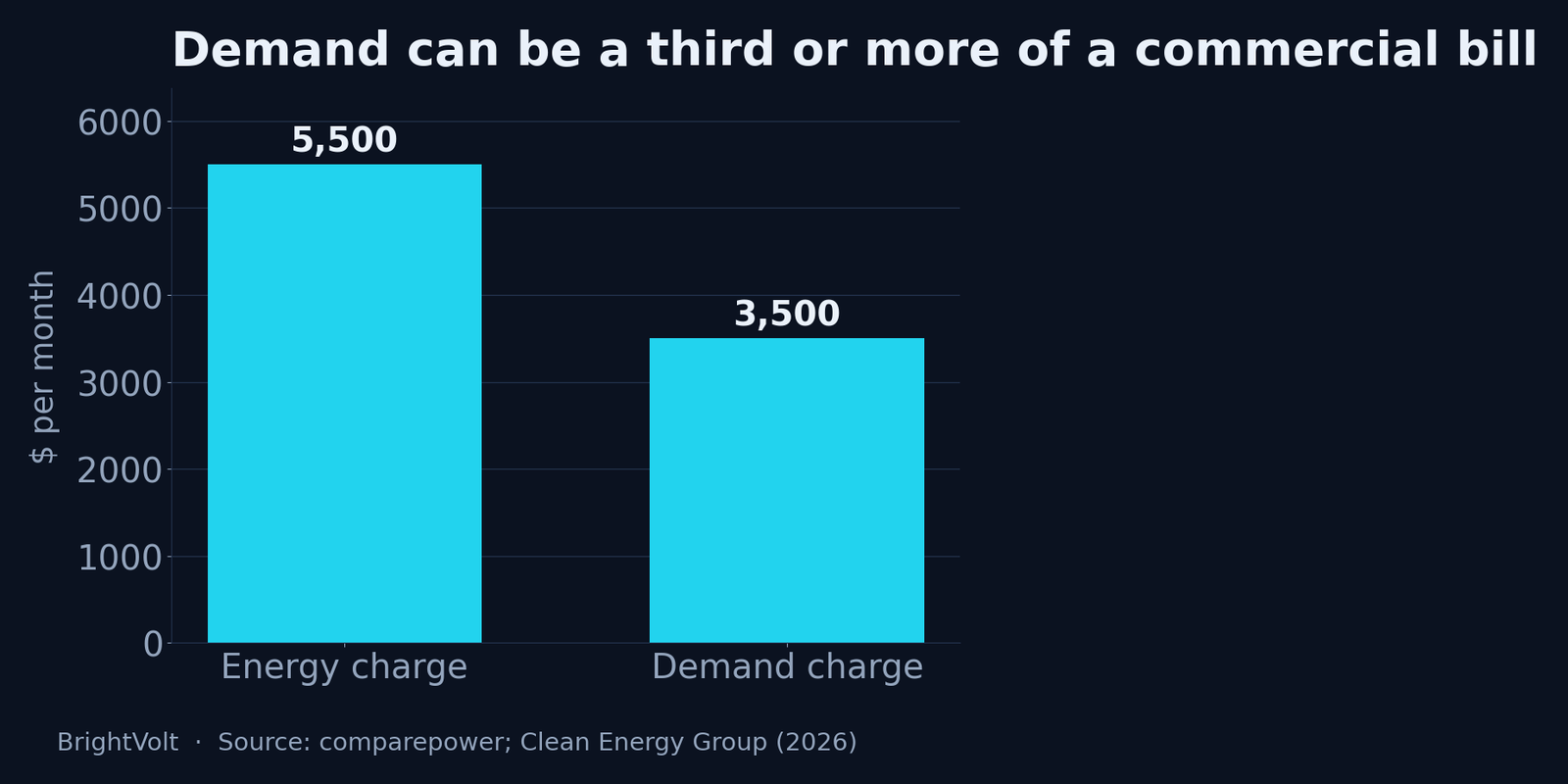
The arithmetic is blunt. A building that peaks at 250 kW on a tariff of $14/kW pays 250 × $14 = $3,500 in demand charges that month, on top of what it pays for the energy itself. Rates of $12 to $20/kW are common. That $3,500 is set by one 15-minute window — the afternoon every rooftop unit, every compressor and every EV charger happened to run at once. The other 2,976 fifteen-minute intervals in the month are irrelevant to it.
This is why demand charges feel unfair to the people who pay them. Energy charges reward using less; a demand charge does not care how frugal a building is for 719 hours if it spikes in the 720th. It is a charge for the capacity the grid has to keep on standby for that customer’s worst moment, which is a real cost — the wires, transformers and peaker plants sized for peak demand sit idle the rest of the time — but it lands as a line item most business owners never see explained.
Why it exists: you pay for the pipe, not the water
The cleanest way to think about it is plumbing. Energy (kilowatt-hours) is the water you use; demand (kilowatts) is the width of the pipe the utility had to install to deliver your worst-case flow. A house and a car wash might use similar water over a month, but the car wash needs a fire hose for its busy hour, and someone has to pay for the fire hose whether or not it runs the rest of the time.
The grid works the same way. A distribution network is built to serve the sum of its customers’ peaks, not their averages, and that infrastructure is the single biggest fixed cost a utility carries. Demand charges are how that cost is pushed back onto the customers who drive it. A building with a flat, predictable load is cheap to serve; a building that draws 400 kW for fifteen minutes a day and 50 kW the rest of the time forces the utility to size everything for the 400 and earn on the 50.
The ratchet: one afternoon, eleven months
The detail that turns a demand charge from painful to punishing is the ratchet clause, and it is the one most tariff explainers omit. Under a typical ratchet, your billed demand for any month cannot fall below 80 percent of the highest peak you have hit in the previous 11 or 12 months.
Work it through. A business hits 400 kW one hot afternoon in July when everything runs at once. Under an 80 percent ratchet, its billed demand is floored at 320 kW for the next eleven months — even in November, when its actual peak never tops 250. At $12/kW, that single afternoon sets a minimum of 320 × $12 × 11 = $42,240 in demand charges it cannot avoid, regardless of how carefully it runs for the rest of the year.
| Without ratchet | With 80% ratchet | |
|---|---|---|
| July peak | 400 kW | 400 kW |
| November actual peak | 250 kW | 250 kW |
| November billed demand | 250 kW | 320 kW (floor) |
| November demand charge at $12/kW | $3,000 | $3,840 |
| Cost of the July spike | one month | eleven months |
The ratchet is why a demand charge is not just a monthly cost to shave but a peak to avoid setting in the first place. One badly timed fifteen minutes can underwrite nearly a year of bills.
The fix: flatten the peak, don’t cut the energy
Because the charge is about shape, not volume, the levers that reduce it are different from the ones that reduce an energy bill. Rescheduling the heaviest equipment so it does not all run in the same quarter-hour — staggering an HVAC cycle against a compressor, delaying EV charging out of the afternoon window — flattens the peak without using a single kilowatt-hour less.
Where load cannot be rescheduled, a battery does it automatically. A behind-the-meter battery charges during the flat hours and discharges into the peak, shaving the demand the meter sees. Shaving 40 kW off a peak on a $15/kW tariff saves 40 × $15 × 12 = $7,200 a year, before the ratchet is even counted — and avoiding a ratchet-setting spike is worth far more than the monthly number suggests. Clean Energy Group puts the rule of thumb at demand charges of $15/kW or higher, above which storage starts to pay for itself on peak-shaving alone. It is the clearest behind-the-meter storage payback there is, because the saving is a predictable line on the bill rather than a bet on volatile wholesale prices.
The sizing follows from the shape. To shave 40 kW across a two-hour afternoon peak takes roughly 80 kWh of usable storage; a sharper, shorter spike needs the power but less energy. That is why demand-charge batteries are specified in kilowatts first and kilowatt-hours second — the opposite of a solar-paired home battery, which is sized for the evening’s energy.
What to watch on your own bill
Find the demand line. If it is a large share of the total and your consumption is modest, the shape of your load is costing you more than the amount of it, and the savings are in the peak, not the meter. Check whether a ratchet applies, because that decides whether one bad afternoon is a one-month problem or a one-year one. And if the demand charge clears roughly $15/kW, a battery sized in kilowatts — not kilowatt-hours — is likely the cheapest way to make the single most expensive fifteen minutes of the month disappear.
Photo by Connor Scott McManus on Pexels · Photo by Ramesh Kambattan on Pexels