
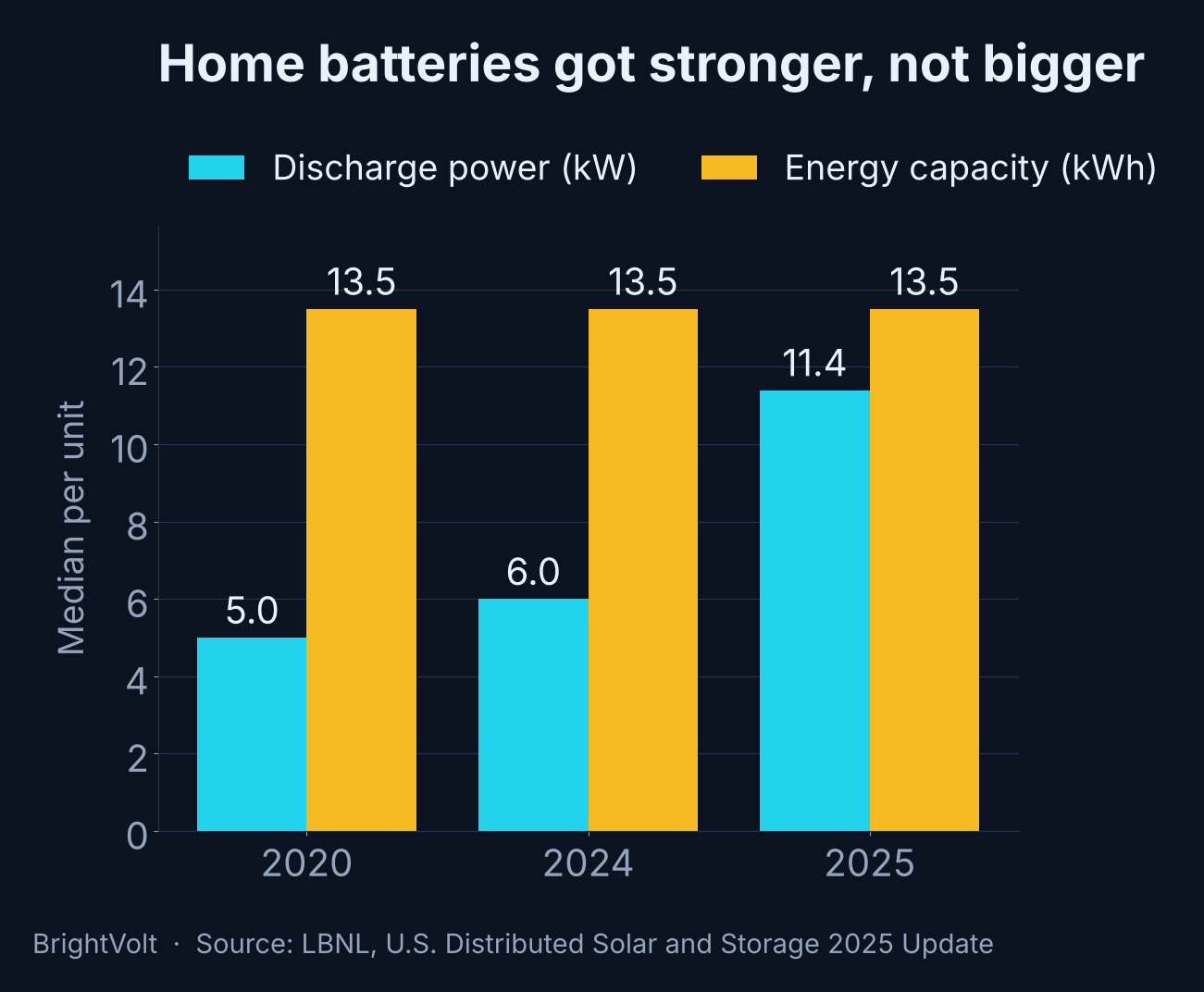
The median home battery installed in America in 2025 could push 11.4 kilowatts — nearly double the 6 kilowatts of a year earlier — while holding exactly the same 13.5 kilowatt-hours it held in 2024. Buyers did not ask for a bigger tank. They asked for a stronger engine, and the industry quietly re-engineered the product to give it to them.
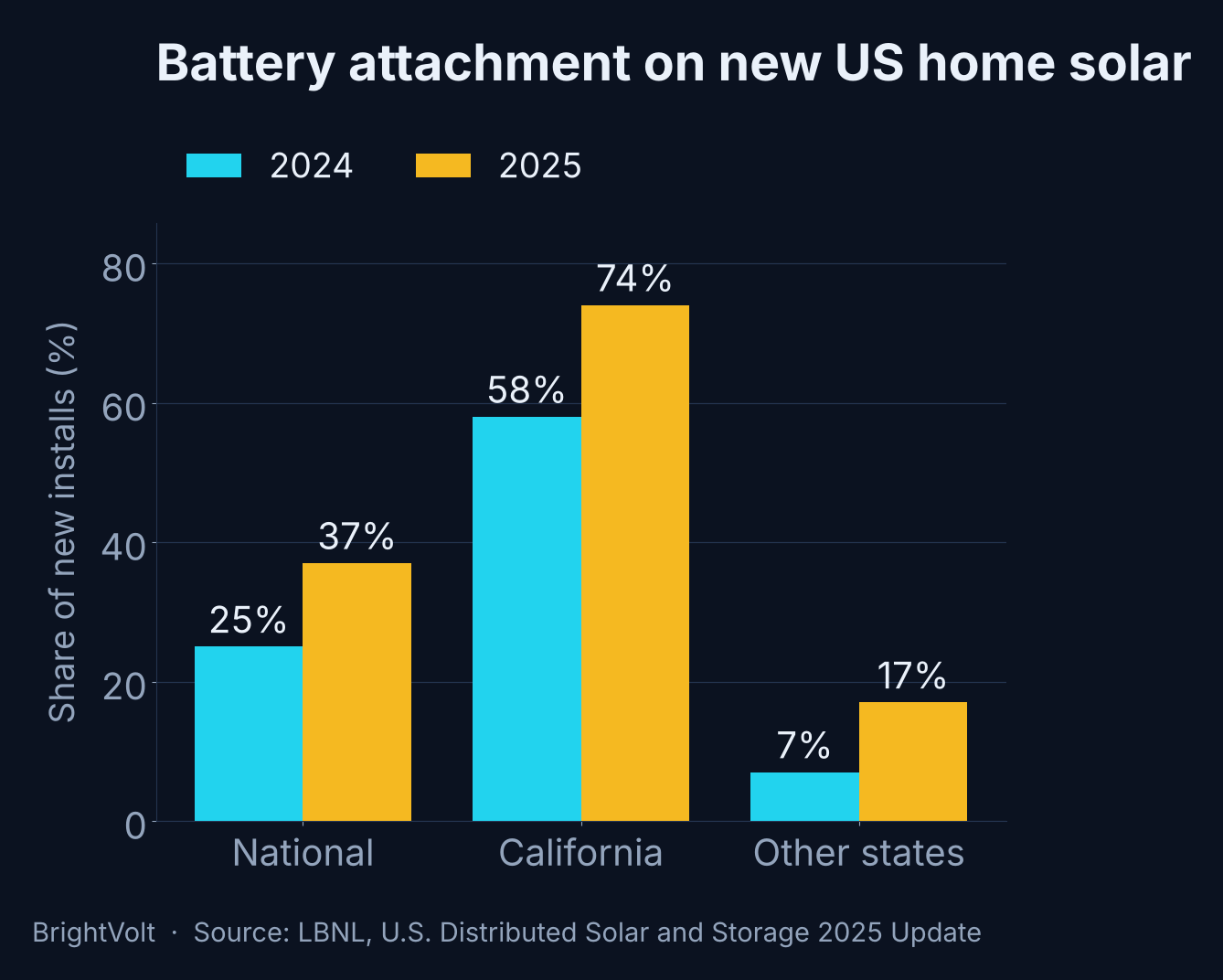
That single divergence — power up sharply, energy flat — is the most interesting number in Berkeley Lab’s latest distributed-storage data, and almost nobody has picked it up. The coverage fixed on the headline instead: 37% of new American rooftop solar now ships with a battery, up from 25% a year ago. True, and we have argued before that killing net metering turned rooftop solar into a battery business. But the attachment rate tells you that people are storing their solar. The power-to-energy ratio tells you what they are storing it for — and the answer has changed.
What the Berkeley Lab numbers actually say
The dataset is the U.S. Distributed Solar and Storage 2025 Update, covering roughly 5.3 million systems and about 93% of the American distributed-solar market. Strip out the attachment-rate story everyone ran with and two lines move in opposite directions.
Median energy capacity has not budged. It was 13.5 kWh in 2024 and 13.5 kWh in 2025 — enough to carry a typical house through an evening, and apparently all the storage most buyers think they need. Median discharge power, meanwhile, jumped from 6 kW to 11.4 kW in a single year. Put those together and the power-to-energy ratio — how hard a battery can push relative to how much it holds — went from 0.44 to 0.84. In one year the American home battery nearly doubled its instantaneous muscle and added not one extra hour of runtime.
| Metric (median US residential) | 2024 | 2025 |
|---|---|---|
| Energy capacity | 13.5 kWh | 13.5 kWh |
| Discharge power | 6 kW | 11.4 kW |
| Power-to-energy ratio | 0.44 kW/kWh | 0.84 kW/kWh |
A battery that holds the same charge but discharges twice as fast is a different machine aimed at a different job. A 6 kW battery feeds the lights, the fridge and a few circuits; it is backup insurance you ration. An 11.4 kW battery runs the air conditioning, the well pump and an EV charger at the same time, without the installer having to tell you which rooms go dark. The difference between power and energy is the whole story of what a grid — or a house — can actually do with a battery, and the home market just voted decisively for power.
Why the median moved: Tesla redesigned the Powerwall around power
The jump is not a thousand households independently deciding they wanted more kilowatts. It is one product. Berkeley Lab attributes the shift directly to the spread of the Tesla Powerwall 3, and the arithmetic is almost too neat: the median 2025 home battery discharges 11.4 kW, and a Powerwall 3 discharges 11.5 kW continuously. The median is a Powerwall 3.
That is not a coincidence of market share — it is a consequence of it. Tesla’s Powerwall is roughly half of every residential battery installed in America. When one product is half the market, its spec sheet is the national median, and Tesla rewrote that spec sheet. The Powerwall 2 pushed about 5 kW continuous. The Powerwall 3 pushes 11.5 kW from the same 13.5 kWh, and folds in a solar inverter that can take six strings of panels.
| Powerwall 2 | Powerwall 3 | |
|---|---|---|
| Continuous power | ~5 kW | 11.5 kW |
| Usable energy | 13.5 kWh | 13.5 kWh |
| Integrated solar inverter | No | Yes (up to 6 inputs) |
Tesla more than doubled the power and left the energy alone. That is a deliberate statement about where the company thinks the value is — and because of its share, the statement became the market’s.
What a power-heavy battery is for
Two things are worth paying for in a home battery in 2026, and both scale with kilowatts, not kilowatt-hours.
The first is backup that does not make you choose. The selling point of a whole-home system is that when the grid fails, nothing visibly changes indoors — the point is a seamless transition, not a survival ration. That takes power, because the worst second is the one where the compressor, the pump and the oven all call at once. Energy decides how long you last; power decides whether the lights so much as flicker. Households are buying the flicker-free version.
The second is the grid paying you back. When a utility calls an emergency event, it pays for the megawatts you deliver in that window, not for the kilowatt-hours sitting in reserve. California’s emergency programmes pull a far deeper discharge out of a home fleet than a routine tariff does, and in one event last year a single aggregated fleet pushed about 580 MW back onto the grid. A battery that can only trickle is worth little to that call; a battery that can sprint is worth a great deal. Utilities now pay to put these batteries in, and what they are buying is dispatchable power.
Net billing closes the loop. Once California stopped paying retail for exported solar in 2023, the value of a stored kilowatt-hour rose — but the money in a grid event, and the comfort in an outage, both live in the kilowatt. The policy pushed people to store their solar; the product they bought to do it was tuned for discharge.
The counter-argument, and where this could be wrong
The strongest objection is that this is a product story wearing a trend’s clothes. One company redesigned one battery, it happens to dominate, and the national median lurched because the statistics are measuring Tesla’s roadmap rather than a thousand considered choices. There is real force in that. A median this captured by a single SKU is fragile, and if Tesla shipped a Powerwall 4 tomorrow with twice the energy, the “power not energy” trend would reverse in a year and this piece would read as pattern-matching on noise.
But a dominant product does not win by accident. Tesla sells a power-heavy battery because a power-heavy battery is what the two paying uses reward, and the buyers keep choosing it over cheaper, lower-power rivals that offer the same 13.5 kWh. The median is a Powerwall 3 because the Powerwall 3 is the right answer to the question the market is actually asking, and the flat energy line is the tell: if households wanted multi-day resilience they would be buying second units and stacking kilowatt-hours, and at scale they are not. They are buying one strong box.
Here is the test. If the 2026 Berkeley Lab update shows median discharge power flattening while energy capacity climbs — households stacking a second Powerwall for days of runtime, or a cheaper high-energy chemistry eating Tesla’s share — then the home battery is reverting to an energy device and we are wrong. If power keeps rising or holds near its new ceiling while energy stays pinned at one unit’s worth, the shift is real and the home battery has settled into its role as a small, fast, grid-facing power plant that happens to live in a garage.
Watch the ratio, not the attachment rate. The share of homes buying batteries will keep climbing for boring reasons — the export rate is gone and storing beats selling. The more revealing number is how hard those batteries can push, because that is the one that says whether America is quietly assembling a fleet of backup tanks or a distributed power station. For now, the needle points at the power station.
Photo by Elite Power Group on Pexels · Photo by Elite Power Group on Pexels · Photo by Robert So on Pexels