
Pakistan’s rooftop-solar boom gets told as a miracle. It is better read as the sound of a grid failing. In two years, households, farms and factories bolted an estimated 27 to 38 gigawatts of panels onto their own roofs — against roughly 6 GW the state actually has on its books — with no subsidy and no national plan. In February 2026 the government moved to slow it down. That reversal, from cheerleading to clampdown, is the tell.
The usual framing treats the surge as a policy triumph, proof that cheap panels and sunshine can decarbonise a developing economy from the bottom up. Half of that is true. The other half is that people did not install solar because the state asked them to. They did it to escape a grid that was expensive, unreliable, and getting worse — and the escape is now eating the grid that the people who cannot afford panels still depend on.
What Pakistan actually built
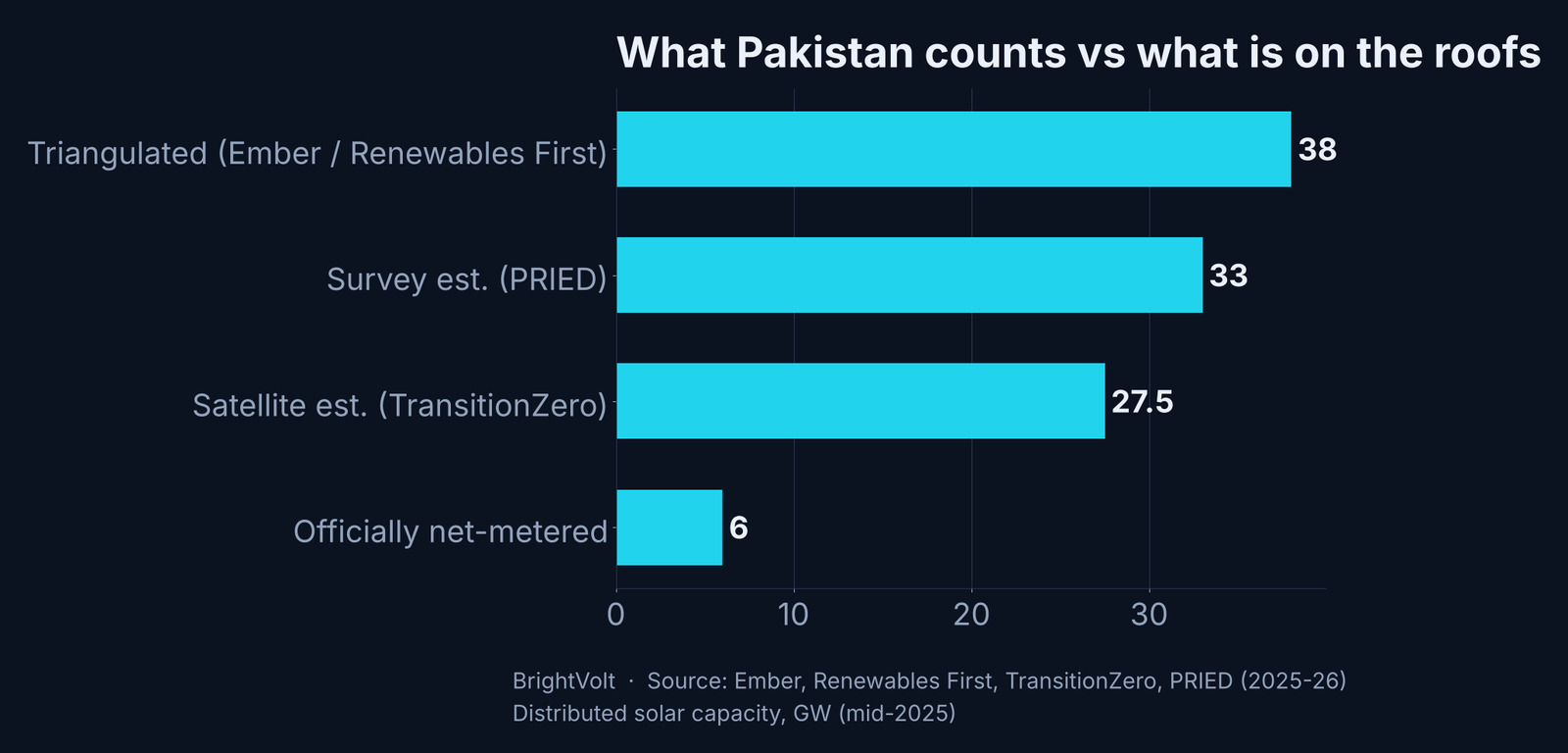
Nobody knows the exact number, and the size of the uncertainty is itself the story. Pakistan’s power regulator counts about 6 GW of net-metered rooftop solar and another 680 MW of utility-scale capacity. Independent attempts to measure the real fleet land three to six times higher. Renewables First and Ember triangulate roughly 38 GW of distributed solar by mid-2025; TransitionZero’s satellite survey puts it at 27.5 GW; a PRIED household survey lands at about 33 GW. The common thread is that most of it is invisible to the official register — behind the meter, off-grid, or simply never declared.
The import data explains how it happened so fast. Ember’s reading of Chinese customs records shows close to 50 GW of solar panels shipped to Pakistan by mid-2025, more than 16 GW of that in 2024 alone. This is a country whose entire installed generating fleet is around 46 GW. On Renewables First and Ember’s estimate, solar rose from 10% of generation in the 2023 fiscal year to 28% in 2025 — 51 terawatt-hours, up from 15. A grid took fifteen years to reach that share in most rich countries. Pakistan’s households did it in roughly three, and largely without telling anyone.
This was never about climate
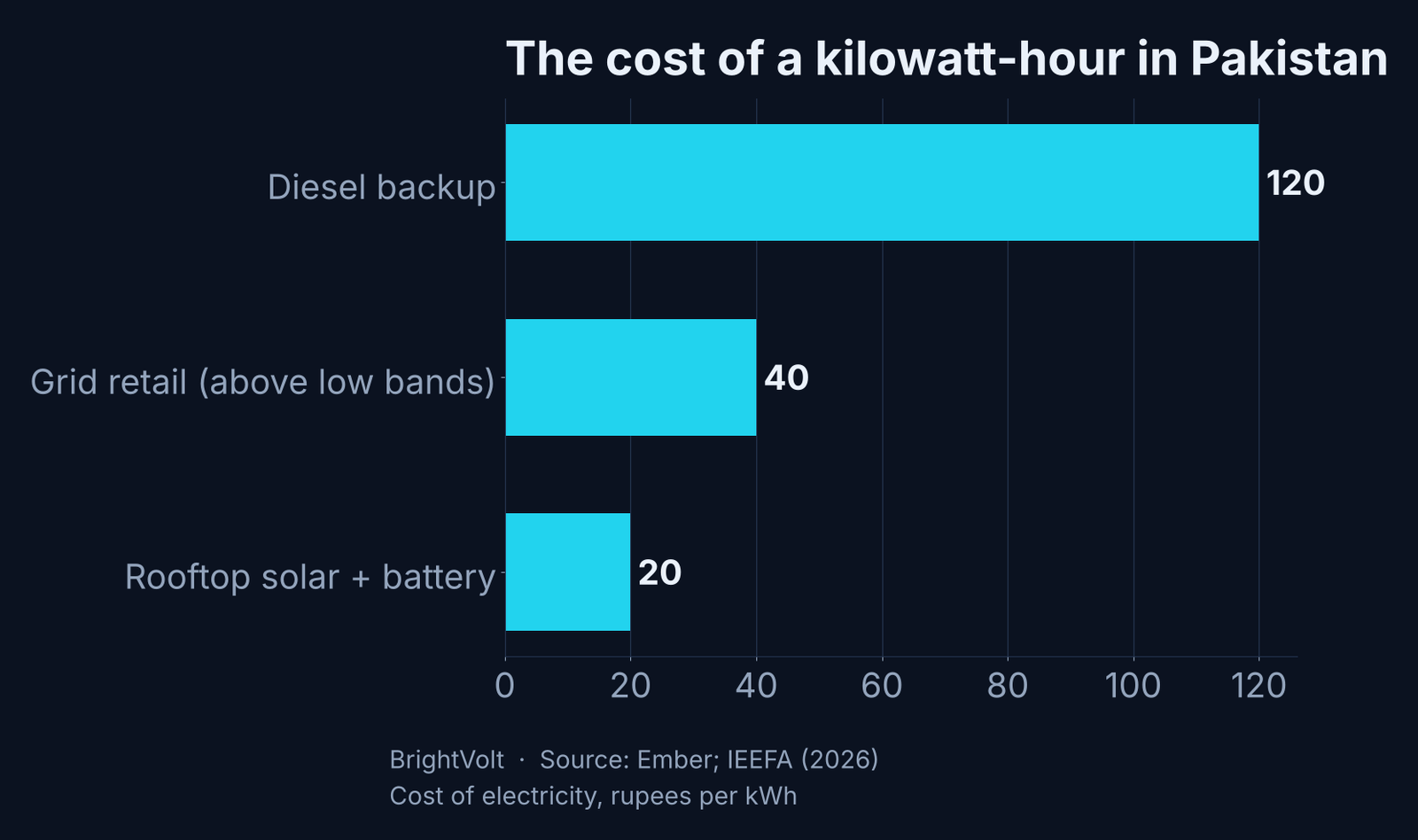
The engine was arithmetic, not idealism. Grid electricity for Pakistani households and businesses above the lowest tariff bands runs around 40 rupees a unit; a rooftop system paired with a modest battery delivers power at roughly 20, on Ember’s and IEEFA’s figures. The grid alternative for anyone who loses supply — a diesel generator — costs about 120. When the cheapest reliable kilowatt-hour on offer is the one you make on your own roof at half the grid price, the decision stops being ideological.
It got that way because the grid priced itself out of its own market. Domestic tariffs rose around 155% over three years as the government raised prices to cover the cost of idle capacity, fuel import bills, and a currency that kept sliding. Pakistan carries close to 20,000 MW of surplus generating capacity it must pay for whether or not anyone uses it, and transmission and distribution losses of roughly 22% — a fifth of everything generated lost to leakage and theft before it is billed. Every one of those costs is recovered through the per-unit price. The higher that price climbed, the better a roof full of Chinese panels looked, and the panels had never been cheaper.

The bill the grid cannot pay
Here is where the miracle narrative runs into the accounting. In the 2025 fiscal year, Pakistan’s total electricity demand actually rose 21%, alongside 5.2% GDP growth. Demand for grid electricity fell. Ember’s figures show grid generation down 3% over the year, with the sharpest retreat among exactly the customers a utility most wants to keep.
| Who buys grid power | Change in grid use, FY2025 |
|---|---|
| Agriculture | −38% |
| Industry | −6% |
| Total grid generation | −3% |
| Commercial | +8% |
| Residential | +6% |
The two groups pulling away — farms running tube-wells off solar, and industry self-generating to dodge tariffs — are the high-volume users whose payments spread the grid’s fixed costs across everyone else. When they leave, those fixed costs do not leave with them. They are reloaded onto the per-unit price paid by the customers who remain, which is to say the households too poor to put 20 rupees of capital on the roof to escape the 40-rupee grid. That is the mechanism behind a utility death spiral: higher prices drive defection, defection shrinks the base, the shrunken base raises prices again. Pakistan is the clearest live example on the planet, and it is running at national scale.
Net billing is the admission
On 10 February 2026 the regulator did what a government does when a death spiral stops being theoretical. It ended net metering for new and existing rooftop customers and replaced it with net billing. The buyback rate for power exported to the grid was cut from 26 rupees a unit to about 11 — roughly what the government pays to buy power from a power station, rather than the retail rate a prosumer used to earn. The permitted ratio of solar capacity to a connection’s sanctioned load was tightened from 1.5-to-1 down to 1-to-1.
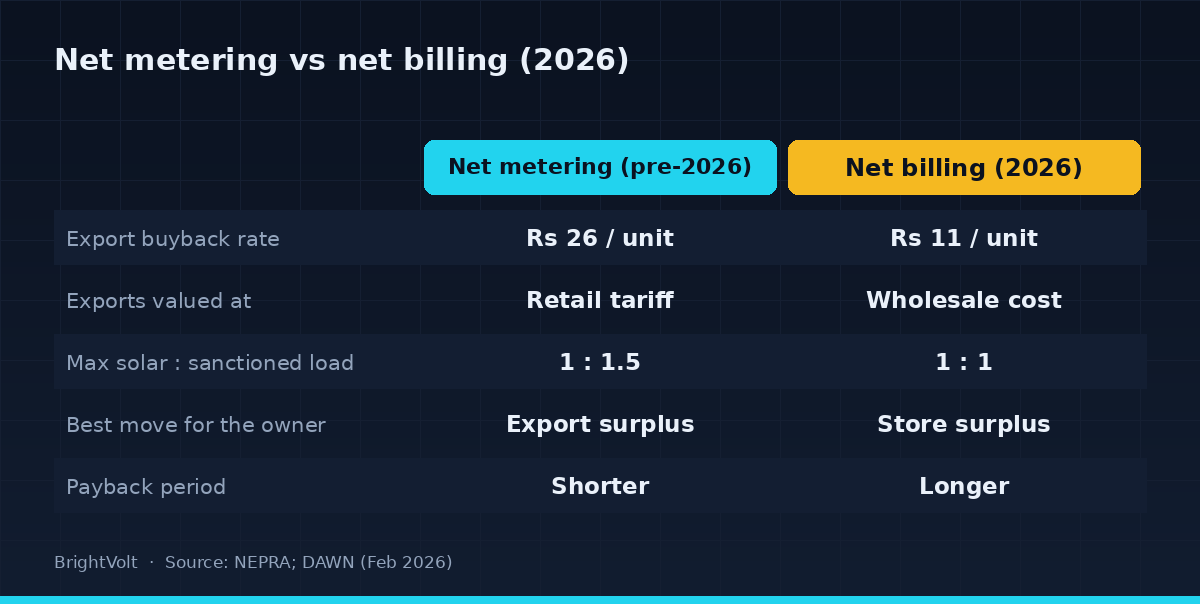
The official justification is equity, and on its own terms it is correct: net metering let solar owners run their meter backwards at full retail value, which is a direct transfer from non-solar bill-payers to solar ones. Cutting the export rate stops that transfer. But look at what it does to behaviour. A low export price does not send anyone back to the grid. It tells them their surplus is now worth almost nothing sold, so they should stop selling it and start storing it — a bigger battery, a smaller grid connection, and for the businesses that can afford it, the exit ramp to leaving the grid altogether. A clumsy net-billing regime does not cure grid defection. It accelerates it, because it removes the one thing — a fair price for exports — that kept a solar household tethered to the wires at all.
What we think, and what would change it
The case for celebrating Pakistan is real and we should not wave it away. The country has avoided more than $12 billion in oil and gas imports since the boom began, millions of people have power during outages for the first time, and it happened with private money the state did not have to spend. As a demonstration that distributed solar can decarbonise a poor, sunny, high-tariff grid faster than anyone modelled, it is genuinely important, and the self-consumption economics only improve as batteries get cheaper.
But a transition that works by letting the people who can afford capital walk away from a shared asset, leaving its fixed costs to the people who cannot, is not a model anyone should want to copy. It is a warning about what happens when a grid prices power so badly that defection becomes the rational choice, and then tries to tax its way back after the fact. The fix was never going to be a lower export rate. It is a tariff that charges for the wires and the fuel separately, so that staying connected is worth something even when you generate your own power — the reform Pakistan skipped on the way up and is now trying to retrofit on the way down.
We will know which story is true by about 2028. If net billing stabilises grid sales and tariffs stop climbing without a fresh wave of full disconnections, the regulator will have threaded the needle and the death-spiral read will have been too gloomy. If grid sales keep falling, residential tariffs keep rising, and solar-plus-storage quotes keep landing on roofs faster than the register can count them, then February’s clampdown will have been one more push on a wheel already turning the wrong way.
Photo by Vinícius Vieira ft on Pexels · Photo by Pixel Senses on Pexels · Photo by Vinícius Vieira ft on Pexels