
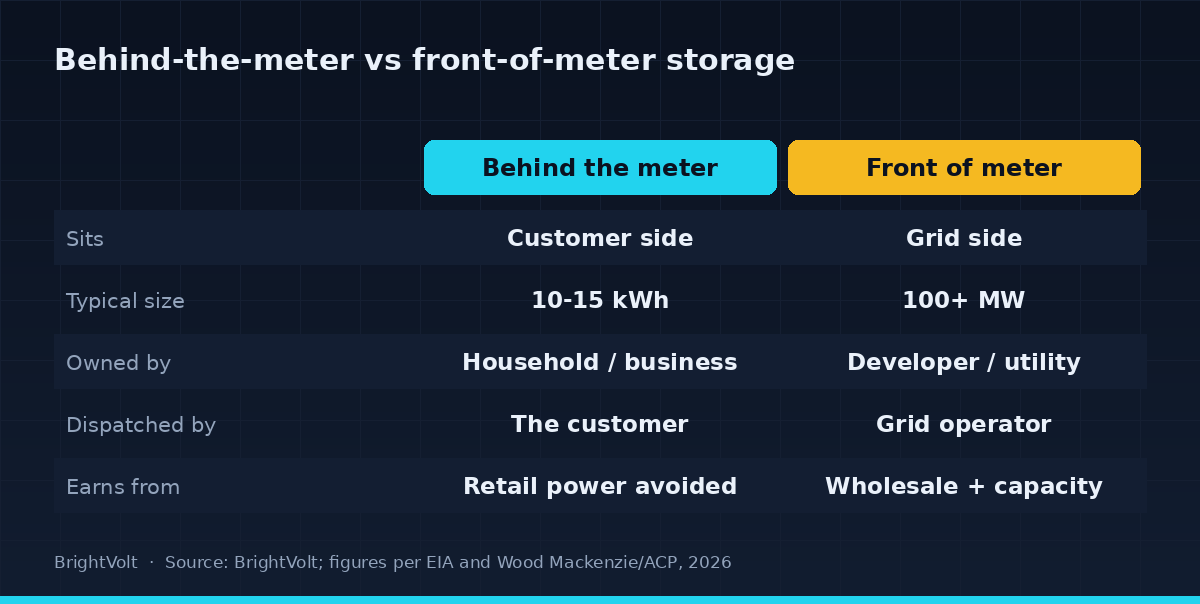
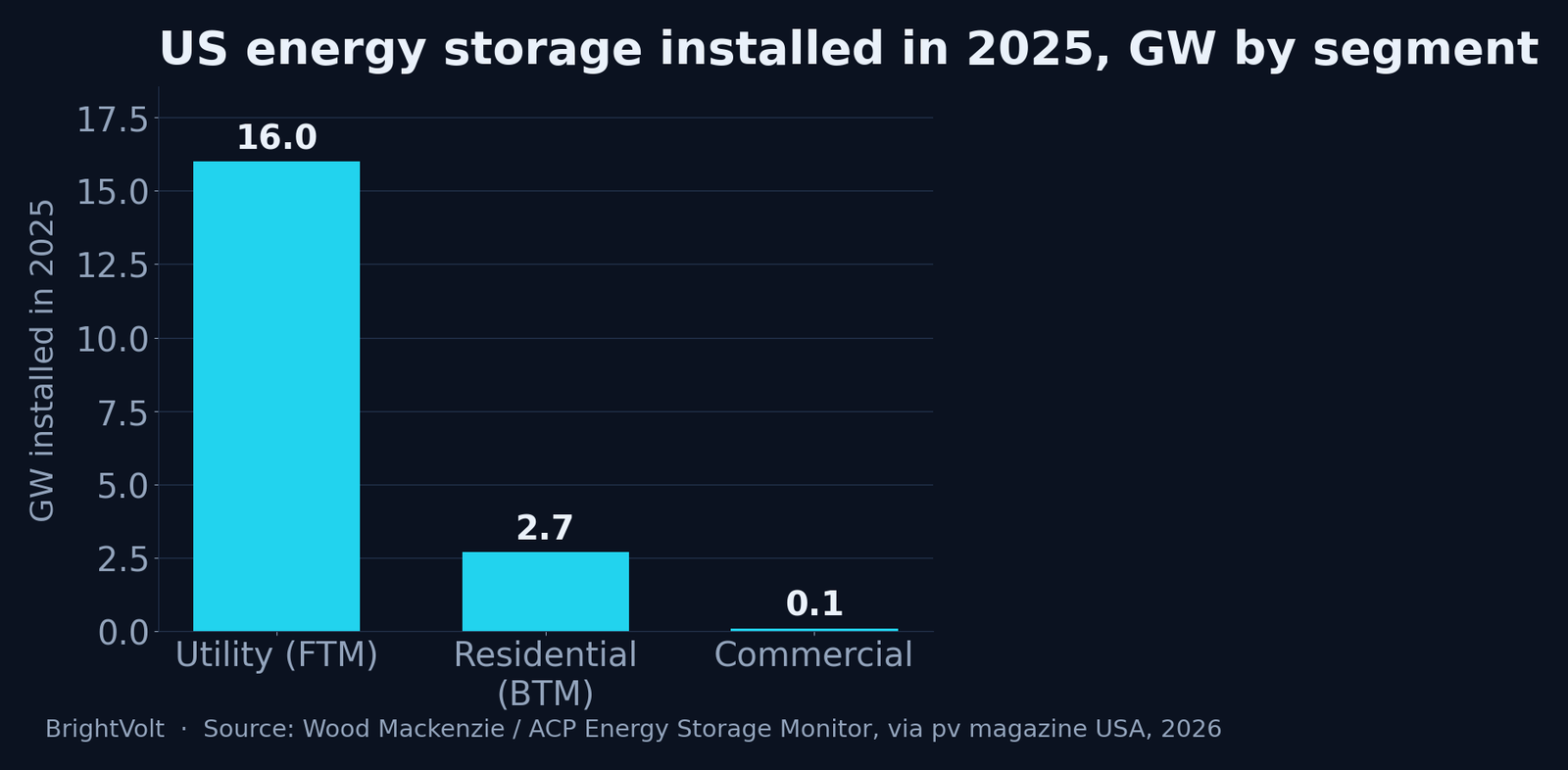
A behind-the-meter battery sits on the customer’s side of the electricity meter; a front-of-meter battery sits on the grid’s side. That is the entire distinction, and it decides everything that matters about a battery: who owns it, who tells it when to run, and who gets paid when it does. In 2025 the US installed 16 GW of front-of-meter storage and 2.7 GW behind it.
The meter is a smaller object to hang a whole market on than it sounds. It is the point where the utility stops selling you electricity and you start using it — the boundary between the grid’s balance sheet and yours. A battery’s position relative to that one line changes what it is for.
Which side of the meter a battery sits on
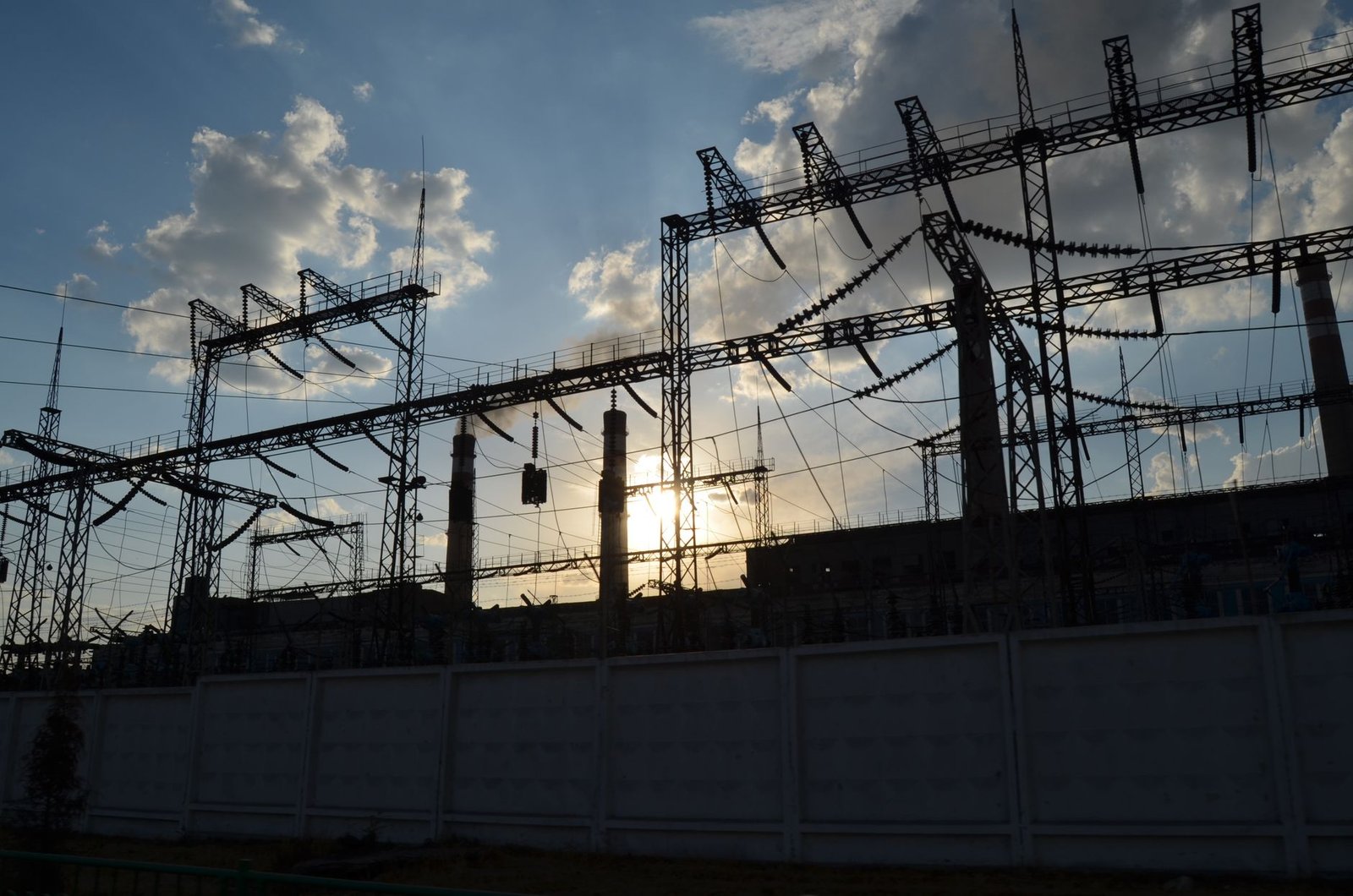
Front-of-meter (FTM, also called grid-scale or utility-scale) storage connects to the distribution or transmission network, upstream of any customer. It is a power plant that happens to be a battery: it buys and sells electricity wholesale, and the grid operator sees it as a resource to be dispatched. These are the big installations — the hundred-megawatt container yards next to a solar farm or a substation. US front-of-meter capacity reached nearly 52 GW by mid-2026, after growing at an average of 70% a year for three years.
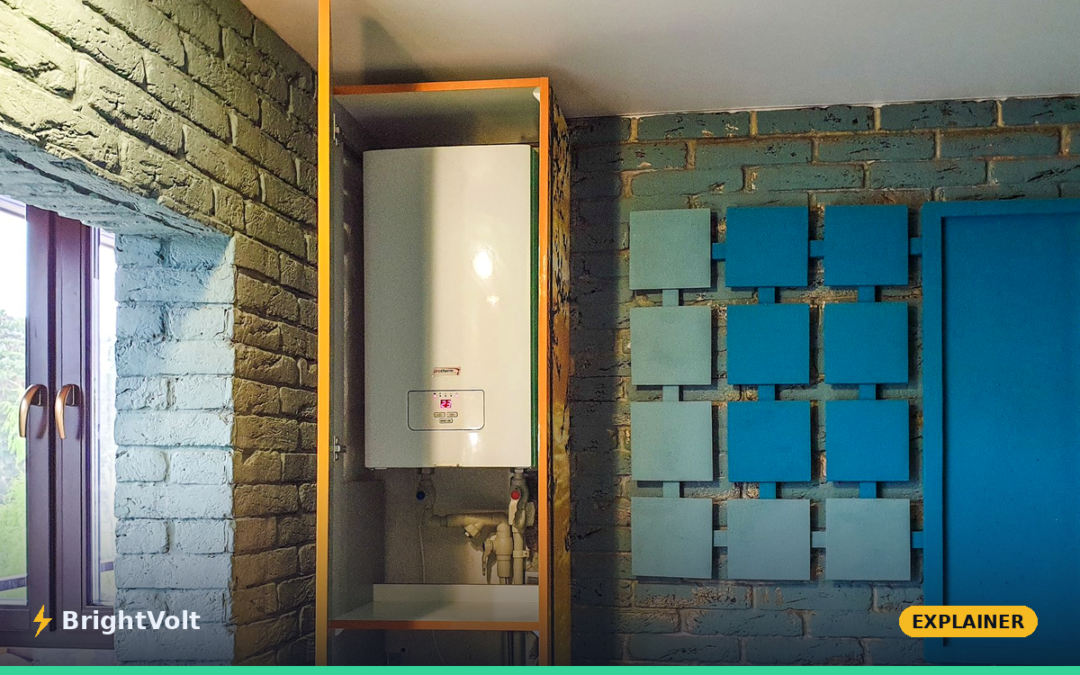
Behind-the-meter (BTM) storage sits downstream of the meter, on the customer’s premises — the Powerwall in a garage, the battery room behind a factory. It never sells into the wholesale market directly. It charges from rooftop solar or cheap overnight power and discharges to cut what the customer would otherwise buy. A home unit holds ten to fifteen kilowatt-hours; a single grid-scale project holds a thousand times that.
Who owns it, who dispatches it, who gets paid
This is the part the definitions usually skip, and it is the only part that changes any decision.
A front-of-meter battery is owned by a developer or a utility, dispatched by the grid operator or a trader chasing the wholesale spread, and paid by the market — arbitrage between cheap and expensive hours, plus capacity payments for being available. Its economics live in the difference between the midday price and the evening price.
A behind-the-meter battery is owned by the customer, dispatched by the customer (or their installer’s app), and “paid” by avoidance — the retail electricity it means you don’t buy, the demand charge it shaves off a commercial bill, the outage it rides through. It never earns a wholesale price; it earns the retail price it displaces, which is usually higher. That is why a home battery can pay off at a household while the same cells in a grid project answer to a completely different sum.
Why the two are not the same megawatt
A gigawatt of front-of-meter storage and a gigawatt of behind-the-meter storage do different work. The grid-scale battery is a single asset the operator can call on directly and count on precisely. The behind-the-meter gigawatt is scattered across tens of thousands of homes, each running on its owner’s priorities first — a household charging for its own evening peak is not thinking about the grid’s.
Front-of-meter also wins on cost per kilowatt-hour, because scale is most of what makes storage cheap, while behind-the-meter wins on the value of each kilowatt-hour, because it offsets the full retail rate rather than the wholesale one. Neither is simply better. They are priced against different benchmarks, which is exactly why a comparison of their headline gigawatts tells you almost nothing.
The virtual power plant that blurs the line
The interesting case is when someone bundles thousands of behind-the-meter batteries and dispatches them together, so distributed storage starts to behave like a grid-scale plant. That is a virtual power plant, and it is real — but the numbers attached to it need reading carefully.
Take the VPP that Sunrun, Tesla and Renew Home announced in mid-2026, headlined at 16.8 GW. A reader hears “16 GW” and pictures batteries. Most of it is not. The programme aggregates hundreds of thousands of home batteries alongside more than 8 million smart thermostats — and a thermostat is not a battery. It shifts load; it does not supply power. Turning air-conditioning down a notch is demand you move, not a megawatt you put on the wire, and the two are not interchangeable capacity.
Even the battery portion is quoted as rated capacity plus one hour of peak load-shifting, which is a theoretical maximum rather than firm, sustained output. By the programme’s own account, the capacity ready to deploy in the near term is around 300 MW, rising to a planned 500 MW by 2030. That is a useful grid resource. It is not sixteen gigawatts of power station, and the gap between those two readings is the whole reason the behind-the-meter versus front-of-meter distinction is worth keeping straight.
Reading a storage number correctly
Two questions decode almost any storage figure. First: which side of the meter — is this a plant the grid can dispatch, or capacity that lives on customers’ premises and answers to them first? Second: is it supply or load-shift — a battery that puts energy on the wire, or a device that merely moves demand around? The distinctions matter more every year, because behind-the-meter storage is growing faster than front-of-meter — US residential installs jumped 92% in 2025 — and the aggregators bundling it are quoting bigger and looser numbers as they go. The battery on the wall and the battery at the substation are both real. They are just not the same megawatt, and no headline that adds them together is telling you what it appears to.
Photo by Алексей Вечерин on Pexels · Photo by Daryana Vasson on Pexels