
India’s rooftop solar reached 30.7 GW in July 2026, and almost none of it stores a single kilowatt-hour. A new analysis from the think tank Ember shows why: under the net-metering rules that power the boom, a home battery takes about nine years to pay for itself against three and a bit for solar alone. A ₹28,000 crore battery subsidy, Ember argues, would unlock 15–25 GWh of storage the grid increasingly needs.
The finding is awkward because the rooftop programme is a genuine success. Capacity has roughly tripled since the PM Surya Ghar scheme launched in 2024, reaching 14.9 GW across about five million homes in its residential tier alone. The households did exactly what the subsidy asked. The subsidy asked for the wrong thing.
Why a home battery in India never pays for itself
Net metering is the reason, and it works too well. A unit exported to the grid at noon is credited one-for-one against a unit drawn back at nine in the evening. The grid, in effect, is a perfect battery with no capital cost, no degradation and a round-trip efficiency of 100%. Set against that, a lithium cell in the utility room is a worse product at a higher price.
Ember models a representative case — a 3 kW rooftop system on a home using about 350 units a month — and the numbers are stark. Solar alone costs ₹1.65 lakh and, after the ₹78,000 central subsidy, pays back in 3.3 years. Add a 5 kWh battery and the system costs ₹2.27 lakh; with no help on the battery itself, payback stretches to roughly nine years, most of a cell’s useful warranty. A household looking at that spreadsheet does not buy the battery, and almost none of them do.
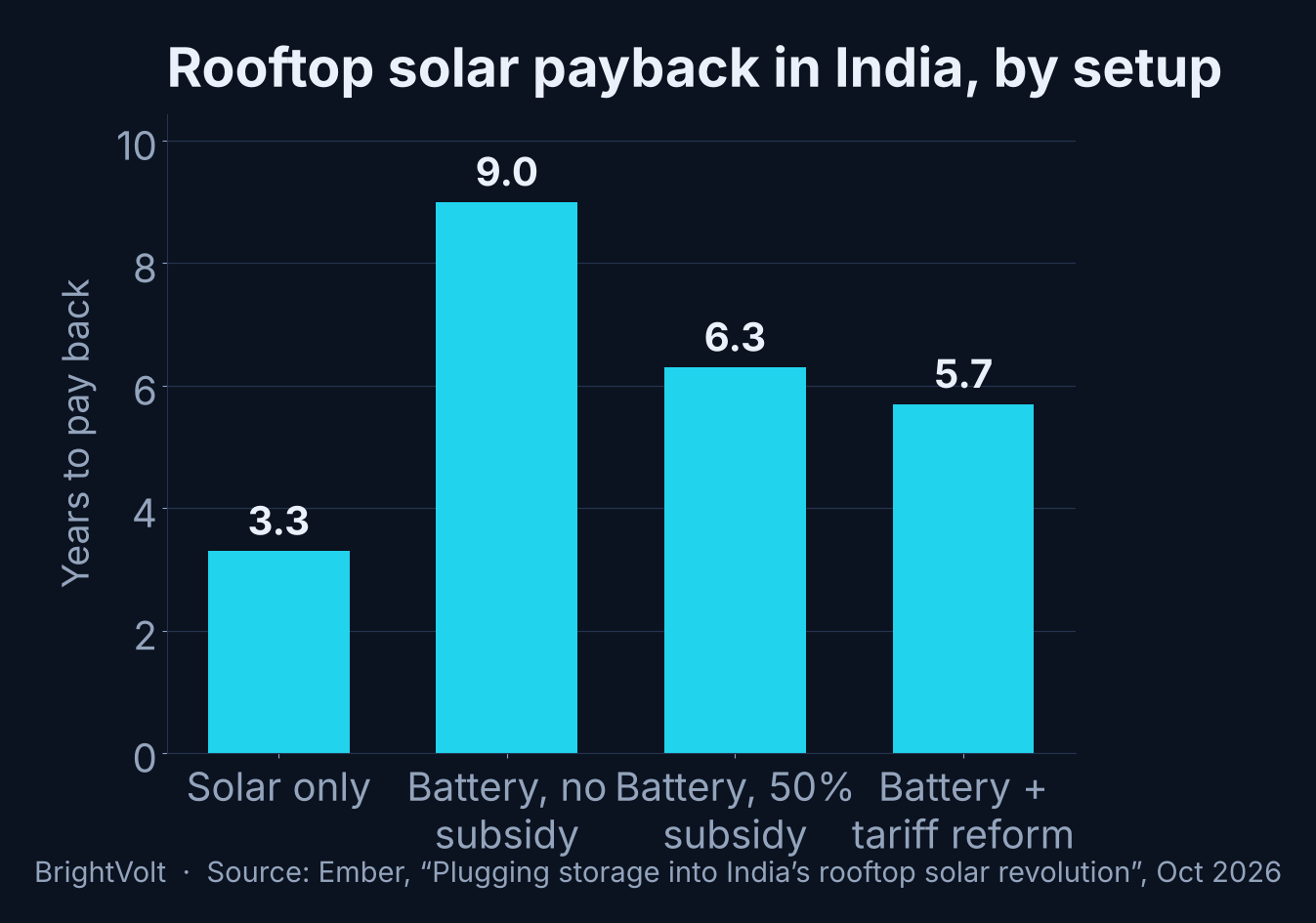
A 50% capital subsidy on the battery pulls that back to 6.3 years — still worse than solar alone, but inside the range where early adopters move. The point Ember keeps returning to is that the technology is not the obstacle and the battery price is only half of it. The other half is a tariff that pays a household nothing for storing power it could simply bank on the grid for free.
The grid is screaming for the evening shift
Here is the mismatch that makes this more than an accounting curiosity. The hours when rooftop solar floods the grid and the hours when it is worth the most have come apart, and the gap is now enormous.
A 5 kWh battery, Ember finds, would cut a household’s daytime exports by 85–90% and shift 1,600–1,800 units a year into the evening. Multiply that across the scheme and the grid stops absorbing a noon surplus it has to curtail or dump at the floor price, and gains a few gigawatt-hours of dispatchable evening capacity it would otherwise build as gas or utility-scale storage. The value is real. It simply accrues to the system, not to the person who paid for the cell — the same split that has stalled home batteries wherever net metering is generous.

What ₹28,000 crore of battery subsidy would buy
Ember’s proposal is specific: route a battery capital subsidy through the next tranche of PM Surya Ghar, aimed at hybrid solar-plus-storage systems rather than panels alone. Cover roughly half of the scheme’s current five-million-household target, at a cost of about ₹28,000 crore (₹280 billion), and you get 15–25 GWh of distributed storage — built on rooftops already wired, metered and subsidised, with no new land or transmission.
| PM Surya Ghar, as it stands | Figure |
|---|---|
| Rooftop solar installed (Jul 2026) | 30.7 GW, ~19% of India’s 164.6 GW total |
| Residential tier | 14.9 GW across ~5 million homes |
| Household target | 10 million systems |
| Capital subsidy | ₹30,000/kW (first 2 kW), ₹18,000/kW to 3 kW; ₹78,000 ceiling |
| Geographic concentration | 10 states hold ~85% of rooftop capacity |
That concentration is the catch worth naming. Gujarat and Maharashtra alone account for about 44% of rooftop capacity, so a blanket battery subsidy would pour evening capacity into two states that may not be where the evening-peak stress is worst. The instrument is good; aiming it is a second problem, and the states are already a lever — Tamil Nadu and Bihar top up the central subsidy today, and Ember suggests they direct those top-ups at the battery cost gap rather than at more panels.
The fix is tariff design, not hardware
A subsidy alone would still be fighting the net-metering maths. The sharper half of Ember’s argument is that the tariff has to change in step, so that storing a unit is worth more than banking it — the move California made with NEM 3.0, which cut export credits hard and watched attachment of home batteries climb as a result.
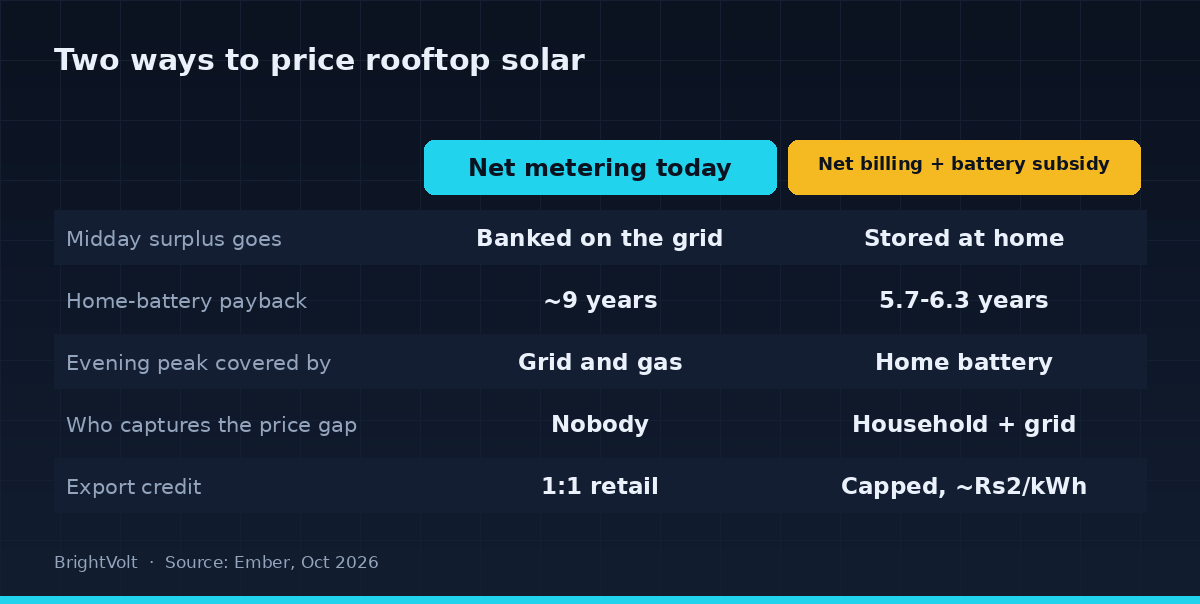
The levers Ember lists are unglamorous and all point the same way. Cap the share of solar a household can bank, and pay a low ₹2/kWh for the rest. Stop letting banked solar be withdrawn during the evening peak, or charge a surcharge when it is. Put net-metering customers in their own tariff category with a time-of-day component, as the Central Electricity Authority has proposed. On Ember’s own numbers, a 40% banking cap plus a peak-withdrawal limit and a 20% surcharge pulls a subsidised battery’s payback down to 5.7 years — the first scenario in the set that genuinely beats leaving the money in the bank.
What would overturn this read is cheaper cells. If pack prices keep falling at their recent pace, the nine-year payback shrinks on its own and the subsidy case weakens — storage gets added because it is cheap, not because the tariff rewards it. The other watch item is the opposite risk: a storage mandate without the tariff reform. The CEA floated requiring two hours of storage on new rooftop systems, and bolting hardware onto a tariff that still pays nothing for using it would load the cost onto households while leaving the incentive exactly as broken as it is now. India has built the rooftops. Whether they ever learn to hold power until dark is now a question about tariffs, not batteries.
Photo by Robert So on Pexels · Photo by Elite Power Group on Pexels · Photo by Jimmy Liao on Pexels