
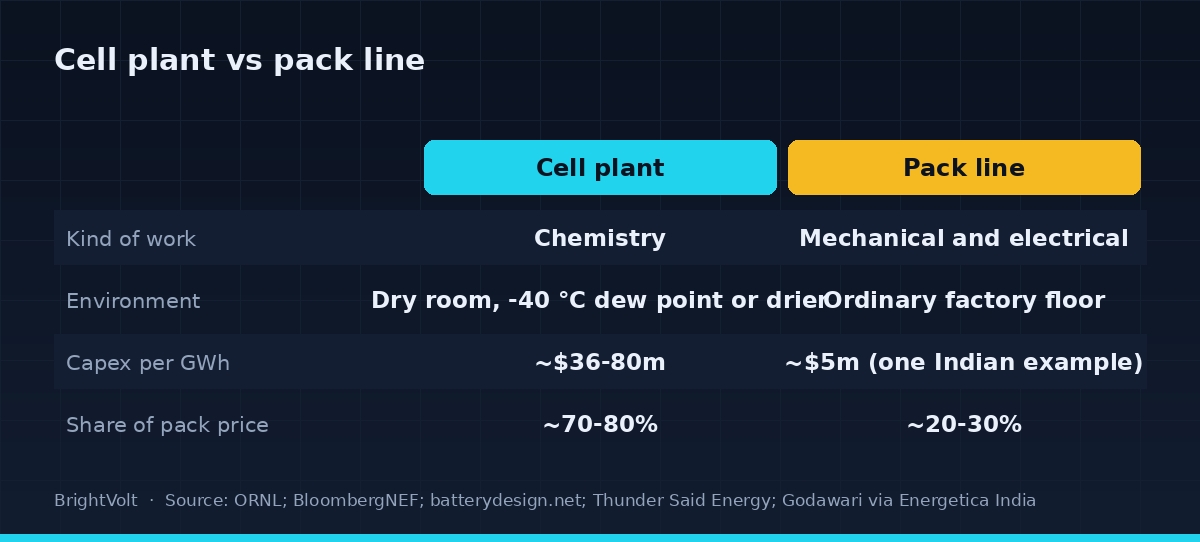
A battery cell is made by chemistry and a battery pack is made by assembly, and the difference decides where the money and the know-how sit. Cells account for roughly 70–80% of a finished pack’s price. A cell plant costs about $36–80 million per gigawatt-hour of annual capacity to equip and build. A pack line can cost a small fraction of that. So when a country announces “battery manufacturing capacity”, the first question is always which half it means.
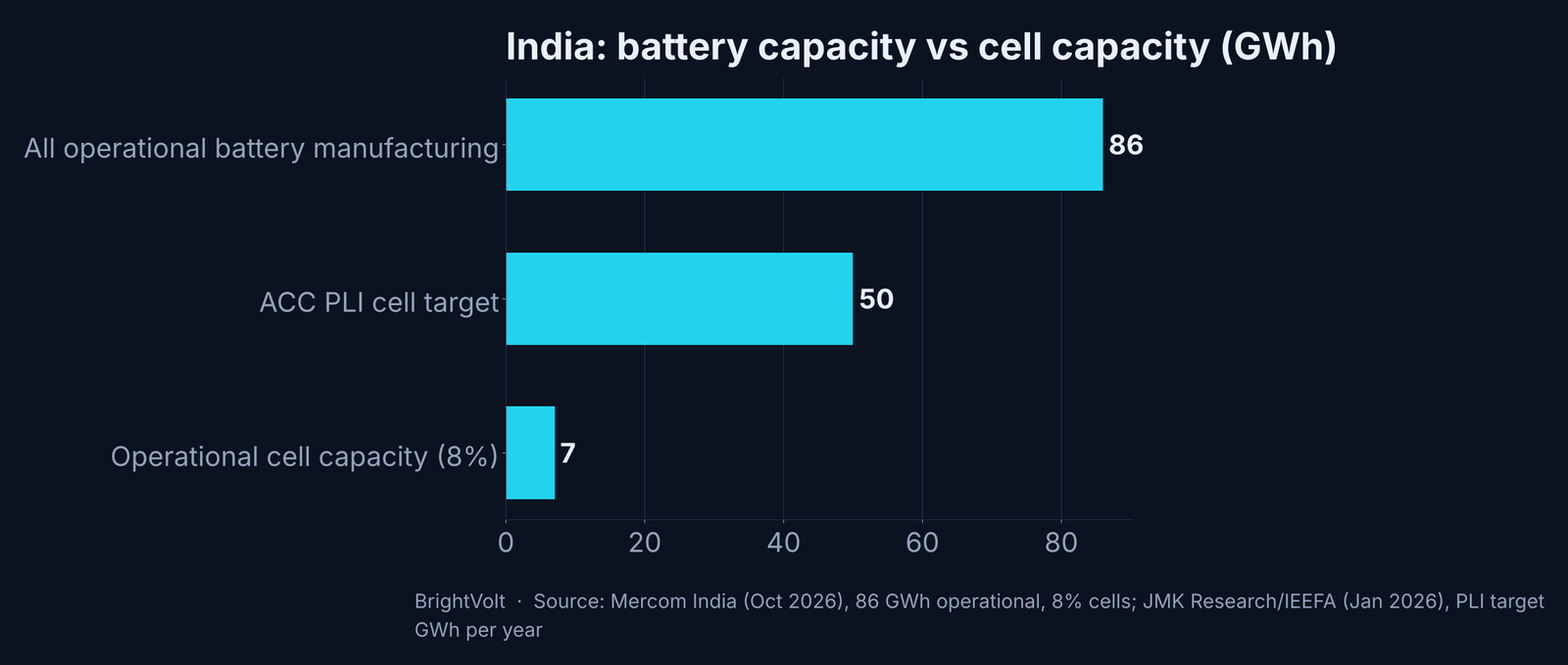
India is the clearest recent example. Of the roughly 86 GWh of battery manufacturing capacity operating there in October 2026, Mercom counts 92% as downstream (packs, containers and systems) and only 8% as cells. The cells mostly arrive from China, which held about 85% of global cell manufacturing capacity in 2024, according to the IEA. Our news analysis of the Indian figures covered what that means for India. This piece covers the underlying question: why one half is so much harder than the other.
What happens inside a cell factory
A cell factory turns powders into an electrochemical device, and most of its steps are easy to get slightly wrong. Electrode materials are mixed into a slurry, coated in thin films onto metal foil and dried. The coated foil is pressed to a precise thickness (calendering) and slit. The electrodes are then stacked or wound with a separator, sealed in a can or pouch with liquid electrolyte, and finally charged for the first time under control. That last step is called formation, and it is followed by weeks of ageing.
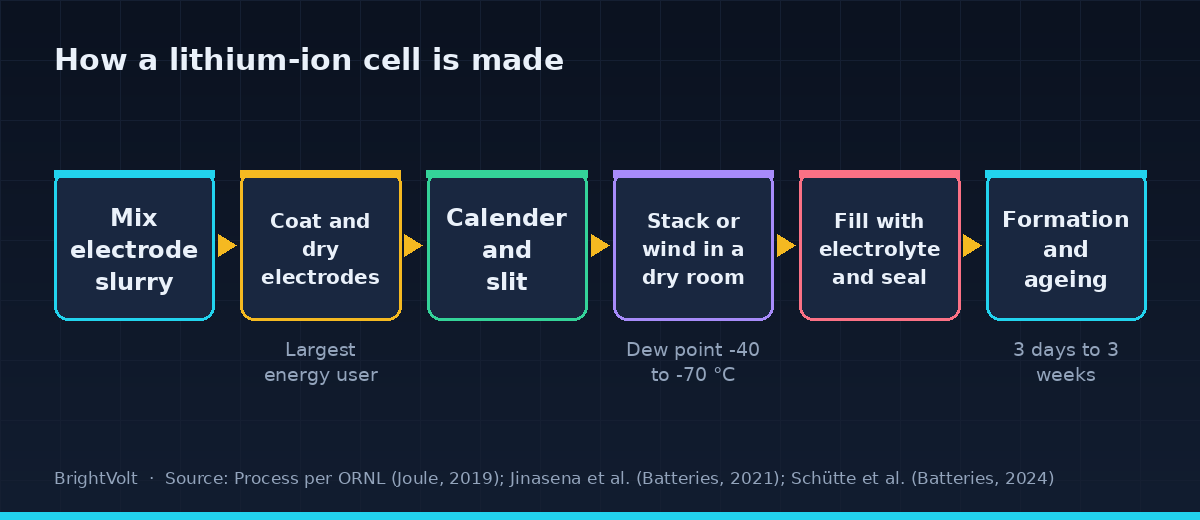
Three of those steps carry most of the difficulty.
Drying and the dry room. Lithium-ion chemistry reacts badly with water, so cell assembly happens in dry rooms held at a dew point of −40 to −70 °C, with humidity below 1%. Electrode drying is the single largest energy user in the plant. One 2024 study puts it at about 27% of plant energy, and other studies it reviews put it at 47–48%. Altogether, Fraunhofer researchers estimate a cell factory uses 20–40 kWh of electricity for every kWh of cells it produces. A 2024 review gives a wider 30–65 kWh range. A pack line has no equivalent, because it bolts together cells that are already sealed.
Formation and ageing. A new cell has to be charged slowly the first time, so that a protective film forms on the anode, and then left to age so that the bad cells reveal themselves. That takes three days to three weeks. Oak Ridge National Laboratory found that wetting and formation alone take three to seven days, with up to two more weeks of ageing, and can occupy a quarter of the factory floor. Every cell in the building sits on a charger for days, and the line is only as fast as that rack of chargers.
Yield. A cell that fails formation is scrap, along with the cathode material inside it. One 2024 review puts scrap rates anywhere from under 5% in a mature plant to as high as 90% during ramp-up. That spread is the whole risk of the business.
Why pack assembly is the easier half
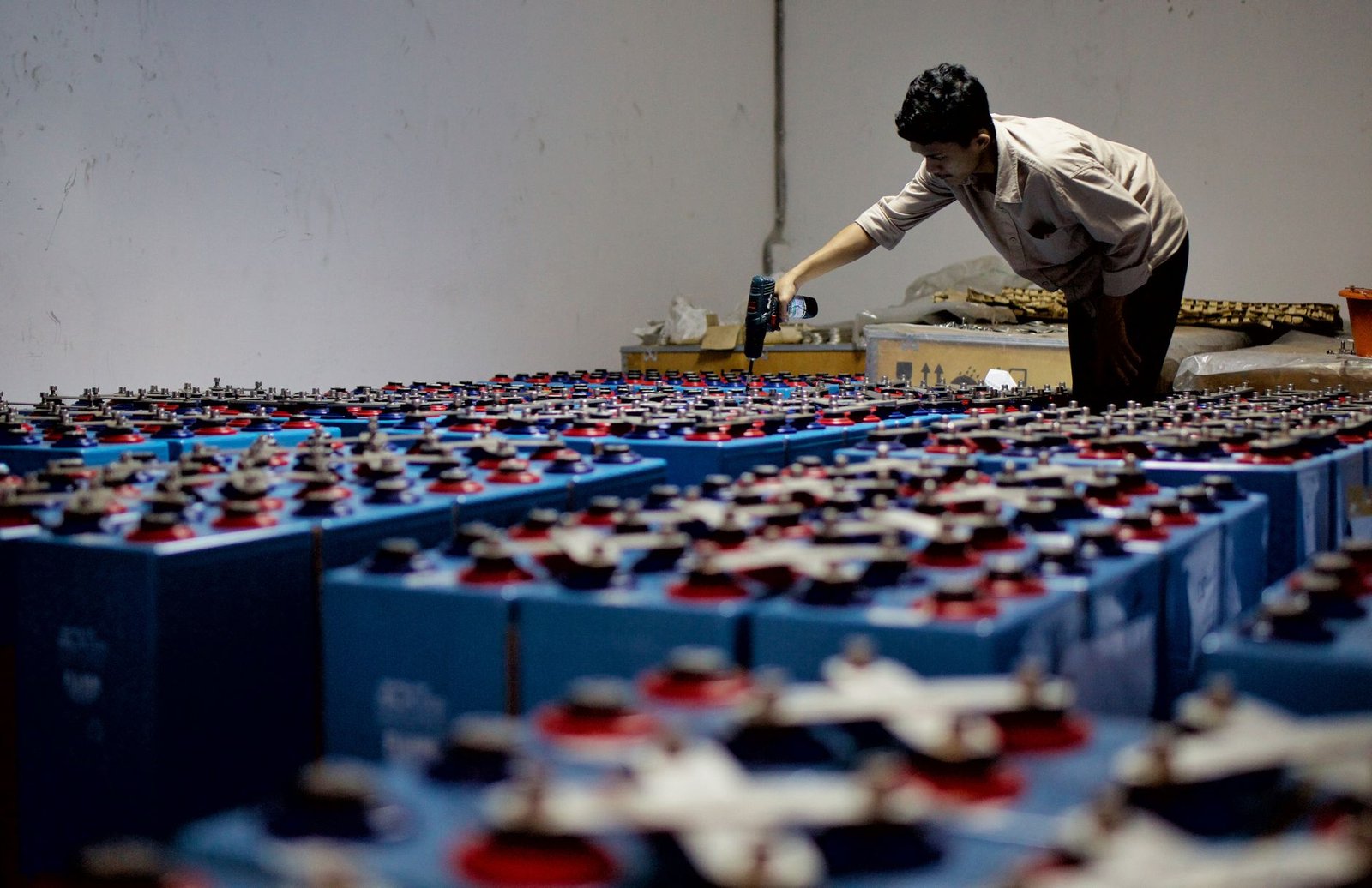
Pack assembly is mechanical and electrical work: cells into modules, modules into a housing, plus busbars, cooling, a battery management system (BMS) and the software that runs it. None of that is trivial. A badly designed pack overheats or fails a crash test. But it uses the tools and skills of an ordinary electronics or automotive plant, it happens on a normal factory floor, and nothing in it waits days for chemistry to settle.
The capital cost shows the gap. Thunder Said Energy puts an all-in cell plant at about $80 million per GWh of annual capacity, with China cheapest and the US and Japan more than twice China’s cost. The cell-making equipment alone runs about $36 million per GWh. On the pack side, one recent Indian project, Godawari’s planned 40 GWh pack and container plant, is budgeted at ₹1,625 crore. That is roughly $190 million, or under $5 million per GWh. It is one example, not a benchmark, but the order of magnitude is the point.
Where the value sits
The value sits mostly in the cell. BloombergNEF’s 2023 survey found that cells made up 78% of an average pack’s price. Battery Design’s analysis puts the typical share at around 70%, rising to about 80% in a well-optimised pack. Prices have kept falling since. BNEF’s December 2025 survey put the global average pack at $108/kWh, and $84/kWh in China. But the split between cell and pack has not moved much.
That split explains why pack assembly localises quickly and cells do not. A government can attract pack lines with modest tariffs or procurement rules, because the investment is small and the skills already exist. Cells need billions of dollars up front, years of yield learning and a materials supply chain beneath them. India’s cell incentive scheme shows the difference. It targeted 50 GWh of advanced cell capacity, and JMK Research and IEEFA found only 1.4 GWh, or 2.8%, commissioned by late 2025. Mercom’s October 2026 count of supported projects is higher, at 6.4 GWh operating, but still a fraction of the goal.
The Northvolt lesson: money does not buy yield
Europe’s most expensive attempt at cells shows what the scrap problem looks like in practice. Northvolt raised billions to build cells in Skellefteå, Sweden. By summer 2024 the plant was turning out “far too many production rejects”, as electrive later reported. The company filed for Chapter 11 in November 2024, went bankrupt in Sweden in March 2025, and ended production at the plant on 30 June 2025. Nobody has published a reliable yield figure for it. Nobody needed to. A cell plant that cannot get its scrap rate down cannot sell cells at a price that covers its capex.
That is the durable lesson. When an announcement quotes gigawatt-hours of “battery manufacturing”, two follow-up questions sort it out. Are these cells or packs? And if they are cells, what yield has the plant actually reached? The first question tells you how much of the value chain is real. The second tells you whether it will last. Most headlines answer neither, which is why we read a cell plant’s figures differently from a pack line’s, and why the cell suppliers, not the pack assemblers, are the companies whose market share matters.
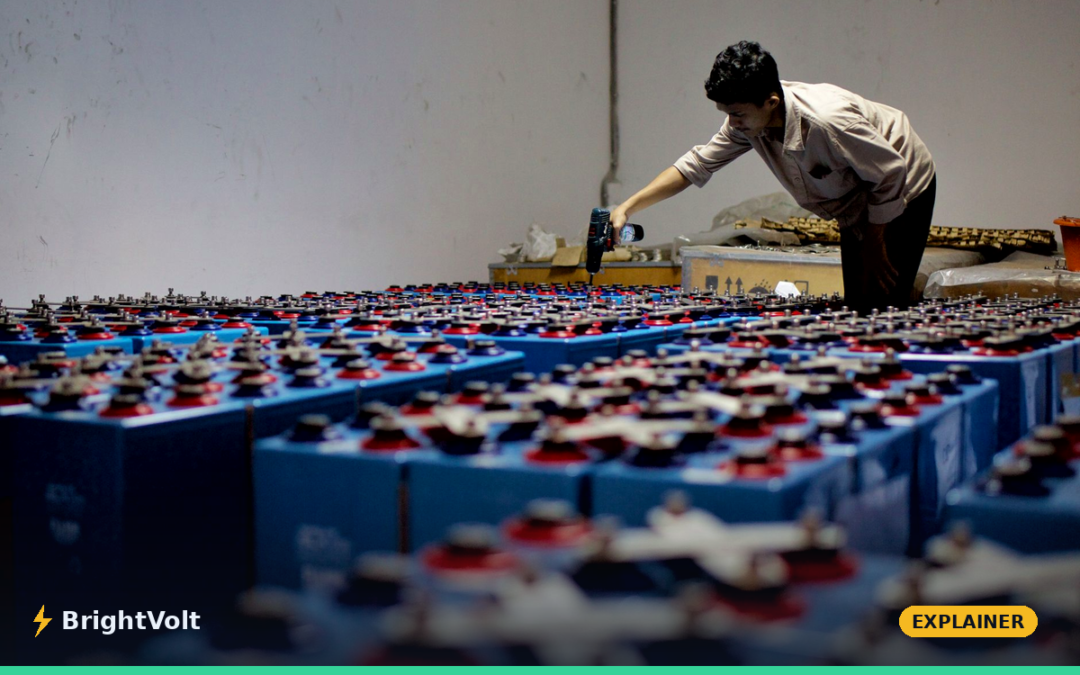
Photo by Heru Dharma on Pexels · Photo by Heru Dharma on Pexels