
On 19 October the European Commission handed €3.4 billion to 77 net-zero technology projects, including roughly €895 million for a dozen factories — among them two lithium iron phosphate cell plants, in Spain and Poland, meant to claw back the cheap-battery chemistry Europe handed to China. The flagship plant runs on Chinese technology.
That is not a gotcha. It is the whole problem in one sentence. Europe makes almost no LFP — the iron-phosphate cell that now sits under most of the world’s electric cars and nearly all of its grid storage — and a subsidy does not conjure the thing the money is meant to buy. The plant the round leads with proves it.
What €895 million actually bought
The cash comes from the EU Innovation Fund, which recycles revenue from the bloc’s carbon market into decarbonisation projects. The latest call, launched in December 2025, drew 358 applications requesting €17.5 billion against a €2.9 billion budget — demand ran roughly six times past supply. Of the 77 winners, twelve sit in the “clean-tech manufacturing” bucket and together asked for almost €895 million; the figures are the amounts requested, with final grants settled in negotiation with the Commission’s funding agency and the results due in the first quarter of 2027.
Two of the twelve are battery plants. Volkswagen’s cell unit, PowerCo, takes the headline slot with an LFP gigafactory in Sagunto, Valencia, rated at up to 27 GWh a year; LG Energy Solution’s “ArisEU” project adds a 9 GWh LFP line in Poland. A French project, SOLAR4EU, covers photovoltaic modules. Batteries and solar, the two technologies Europe most conspicuously does not own.
| Plant | Location | Planned LFP capacity | Series production | Owner / cell technology |
|---|---|---|---|---|
| PowerCo | Sagunto, Spain | up to 27 GWh/yr | ~mid-2027 | VW’s PowerCo; Gotion (China) tech |
| LG Energy Solution | Poland | 9 GWh/yr | not disclosed | LG (South Korea) |
The Commission’s framing is all industry and independence. Climate commissioner Wopke Hoekstra called the winners proof that “Europe’s innovators are turning climate ambition into industrial leadership,” money that strengthens “competitiveness” and a “resilient, net-zero economy.” Read the announcement in full and one word never appears: China. That omission is the story, because the dependency the grants are supposed to cure is stitched into the project the Commission put first.
36 gigawatt-hours against 465
Start with scale, because scale is the whole argument. Built and running, the two funded LFP plants will make about 36 GWh of cells a year — and not before 2027. In 2025 alone, CATL installed 464.7 GWh of EV batteries, 39.2% of a 1,187 GWh global market, according to SNE Research. Six of the ten largest cell makers on Earth are Chinese. Even Gotion, the fifth-largest and itself a Chinese maker, put out 53.5 GWh last year — more than both EU-funded plants will manage combined, once they exist.
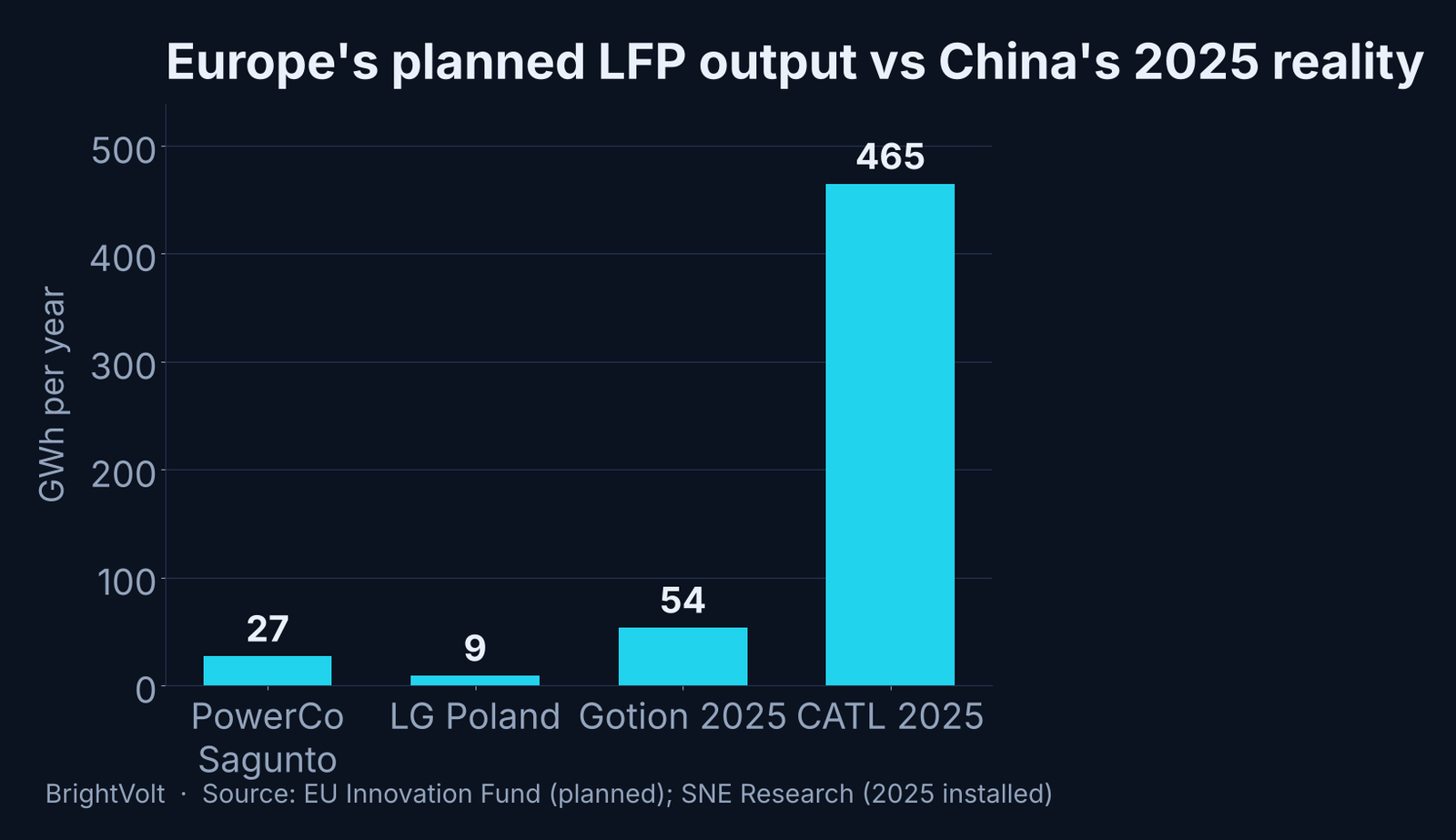
Scale is not a vanity metric here; it is the cost curve. A gigafactory’s unit cost falls as its volume rises, and the Chinese plants are an order of magnitude further down that slope. CATL now sells an LFP cell directly at $63 per kilowatt-hour. That is the number a brand-new European line, in its opening year, at a fraction of the scale, has to beat — and it is the exact wall that bankrupted Northvolt and Morrow, Europe’s two most-funded cell start-ups, over the past two years. The United States is throwing larger subsidies at the same problem from behind a tariff wall, and its LFP plants are still fighting for the gap. Europe is trying it with grants and an open market.
Sagunto runs on Gotion
Here is where the subsidy meets reality. PowerCo is Volkswagen’s in-house battery company, and its “Unified Cell” — the standard prismatic cell Sagunto will build — was developed hand in hand with Gotion High-Tech, a Chinese maker in which VW is the largest shareholder, holding around a quarter of the stock. Gotion built PowerCo’s first plant at Salzgitter, reportedly with hundreds of Chinese specialists on site, and has mass-produced VW’s cells at its Hefei factory since November 2025, shipping them into the Spanish-built ID. Polo and Cupra Raval today.
Then, in mid-2026, VW was reported to be in talks for Gotion to take a large stake in Sagunto itself. Accounts differed on how large — one outlet said a controlling majority, another put it at 49% — and PowerCo insisted it had “no plans to relinquish control.” The final share is unsettled. What is not in dispute is the direction of every input that matters: the cell design, the plant-building know-how and, for now, the finished cells all come from China. PowerCo expects to begin supplying its own Spanish-made cells in July 2027.
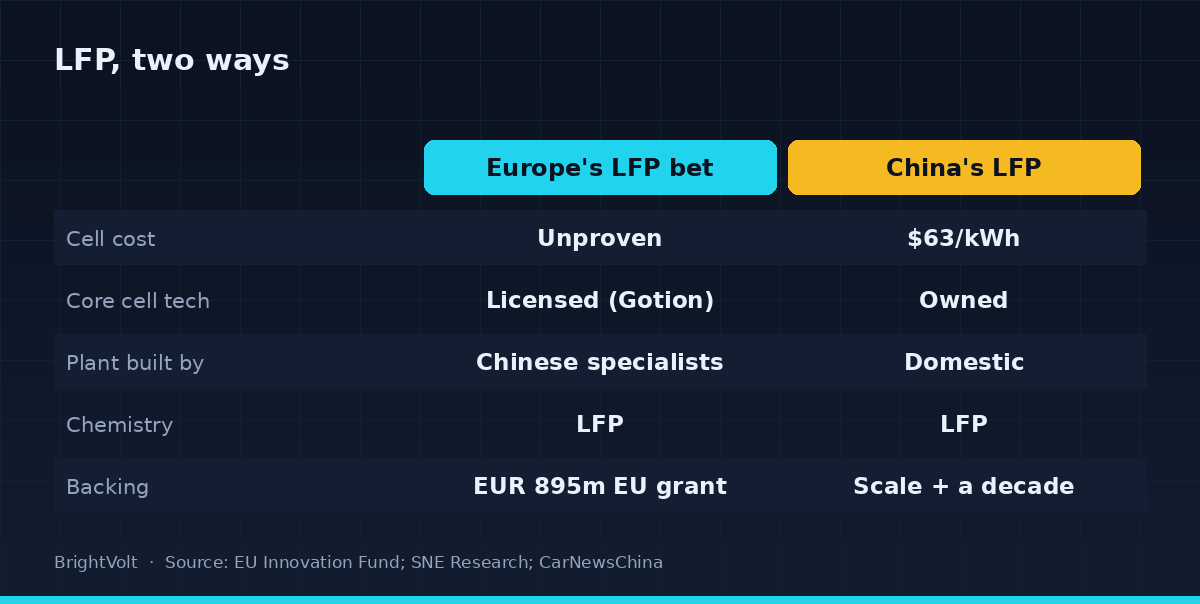
None of this is a scandal. Licensing a mature technology to stand up a domestic industry is how South Korea and China themselves began, and VW’s stake in Gotion means some of the value flows back to Europe. But it changes what the Innovation Fund cheque is honestly described as buying. It is not buying an independent European LFP cell. It is subsidising the installation of Chinese LFP manufacturing on European soil.
Localisation is not independence
Those are different things, and the difference is the entire point of the exercise. €895 million spread across a dozen plants buys factories, jobs and a supply chain rooted inside the EU — real benefits, and a genuine hedge against a shock that cut Europe off from imported cells. It does not yet buy a cell that a European firm designs, owns and sells at a price that wins on cost rather than on the flag stamped on the casing. The Commission’s silence on China is the tell: name the dependency and the sovereignty story gets harder to tell.
The test is close enough to watch. By 2028, do any of these lines ship LFP cells at a euro-per-kilowatt-hour that beats an imported CATL cell without the grant propping it up — and does a European company own the cell design, or merely license it? If the answer to both is yes, the €895 million was seed capital for an industry. If these plants run the way Salzgitter runs, on Chinese cells and Chinese engineers, then the money bought a very expensive import-substitution scheme: useful for jobs and resilience, and worth having on those terms, but not the technological independence the word “sovereignty” is doing so much work to imply. Europe can pay for the factory. It is still renting the recipe.
Photo by Ayyeee Ayyeee on Pexels · Photo by Cọ Sơn Thanh Bình on Pexels