
CATL now sells lithium iron phosphate battery cells from a web page. Pick a 314 Ah cell, and the price is 0.423 yuan per watt-hour — about $63 per kilowatt-hour, no distributor, a 600-cell minimum, shipped in three to five days. More than 1,800 energy-storage firms have signed up. The coverage has framed this as the moment home and grid batteries get cheaper. It is the opposite of a consumer story. It is the moment the cell stopped being a product and became a commodity — and that is a problem for everyone the West is paying to build one.
What CATL actually put online
CATL Mall opened quietly in June 2026 and drew little notice until the August price list. The mechanics are what matter. A small integrator that wants a few thousand cells has never been able to buy them the way CATL’s large customers do — the minimum order quantities are enormous, so the small buyer goes through resellers and inherits their markup, their quality drift and their delivery risk. CATL has now removed that layer. You order the same cells the giants order, at a published price, with a five-year warranty and no tacked-on fees.
The catalogue reads like a components distributor, because that is now what it is.
| CATL Mall (Aug 2026) | Price | Notes |
|---|---|---|
| 314 Ah LFP cell | ~$62.9/kWh | 1C, 8,000 cycles to 70% SoH |
| 280 Ah LFP cell | ~$73.5/kWh | 1C, 8,000 cycles to 70% SoH |
| 47 kWh LFP module | listed | drop-in storage module |
| 105 kWh LFP module | listed | drop-in storage module |
| 20-ft container | up to 5 MWh | 6.6 m, turnkey enclosure |
None of this is exotic. The 314 Ah prismatic cell is the workhorse of grid storage, rated for 8,000 cycles — more than two decades of daily use — and CATL holds 42.9% of China’s domestic battery market with 31.4 GWh installed as of June 2026. The company that makes more of these cells than anyone alive has decided the most efficient way to sell the marginal one is a shopping cart.
Why $63 is a floor the West cannot reach
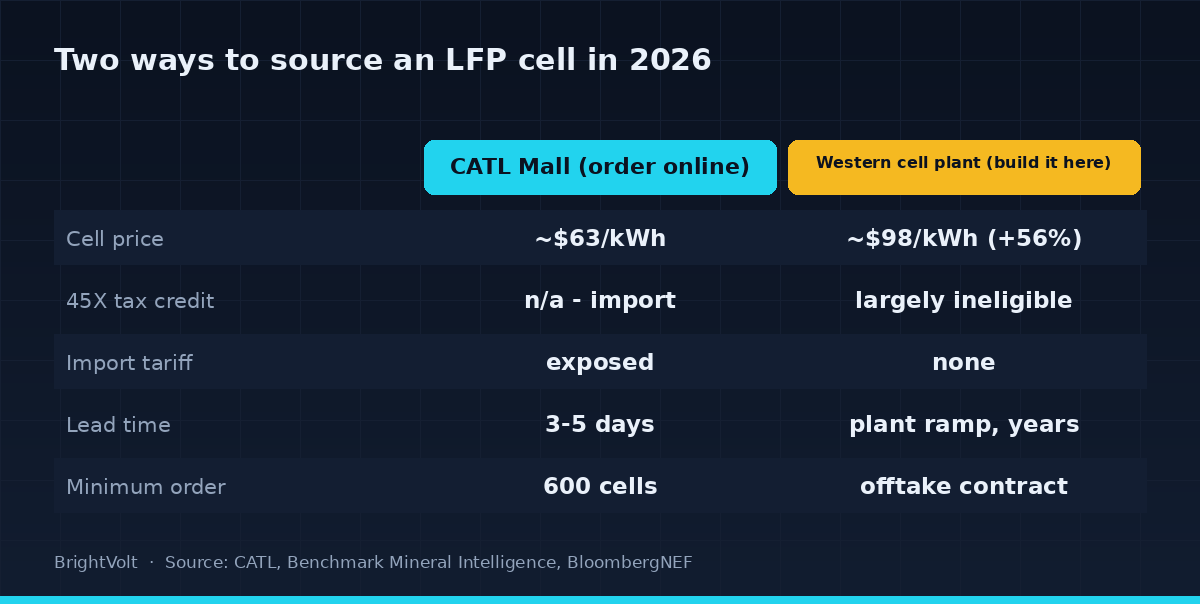
Here is the number that should worry anyone building a cell plant outside China. Benchmark Mineral Intelligence forecasts that a US-made LFP cell costs 56% more than its Chinese equivalent, and stays more than 40% dearer out to 2030. Apply that premium to CATL’s list price and an American cell lands near $98 per kilowatt-hour — before a cent of margin, and, per Benchmark, without the 45X manufacturing credit that LFP production largely cannot claim.
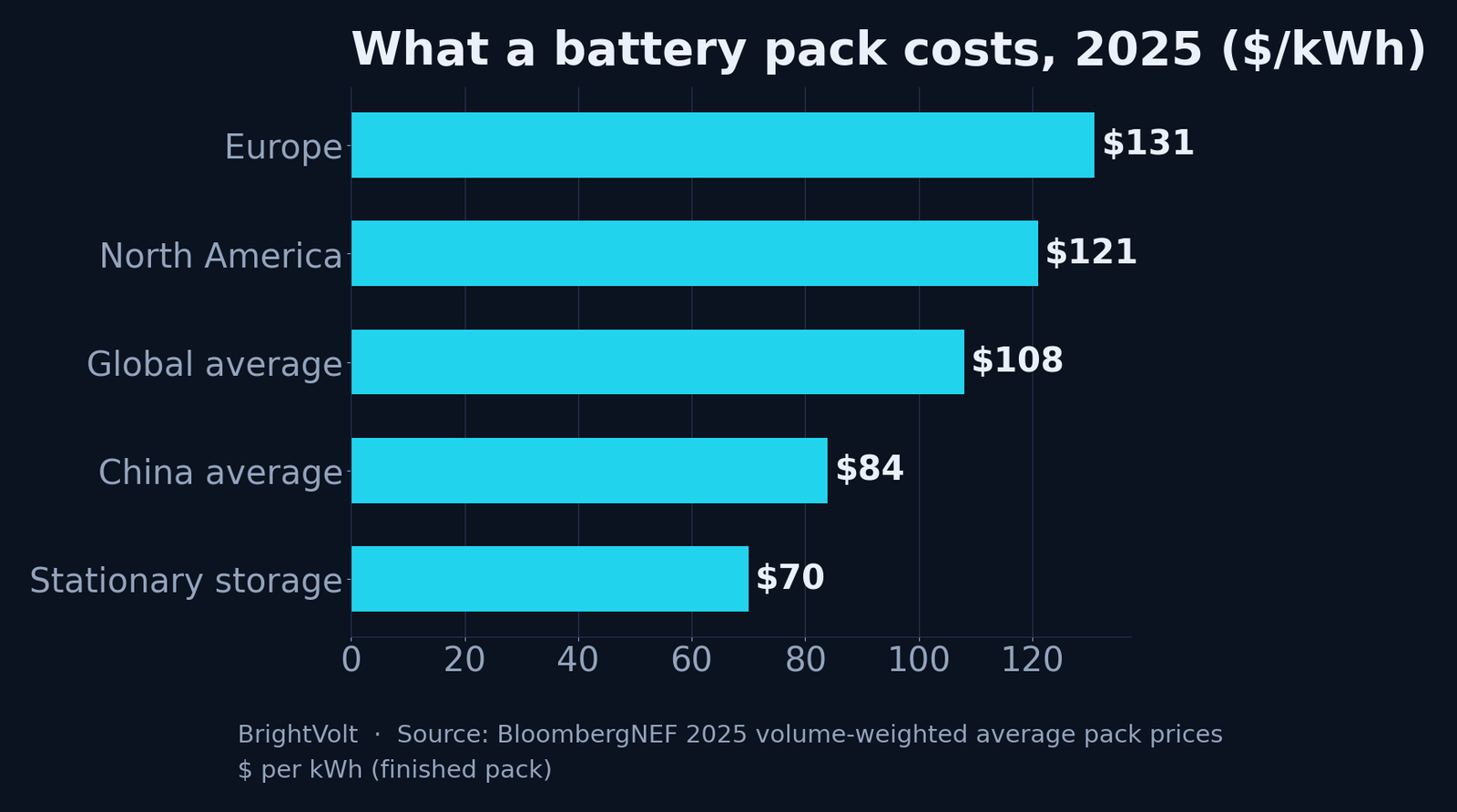
The finished-pack figures tell the same story from the other end. BloombergNEF put the 2025 volume-weighted pack price at a record-low $108/kWh, with stationary storage the cheapest segment at $70. A Chinese pack averaged $84; a North American one ran 44% higher, a European one 56% higher. CATL’s $63 is a bare cell, not a finished pack — but the cell is the largest single line in any pack’s bill of materials, so a cell that undercuts the global pack average drags everything above it down with it.
Stack the two facts and the trap is visible. The Chinese cell is a published $63. The American cell, subsidised, is comfortably north of $90. The subsidy the American plant was built to earn largely does not apply to the chemistry it makes. That is not a gap a better process closes. It is structural.
The commodity trap
A commodity is a thing you buy on price alone, because every supplier’s version is interchangeable. That is now true of the LFP cell, and CATL has just certified it by selling its own on a web page. The strategic damage is not that batteries got cheap. It is that the cell stopped being where the value lives.
For a Western manufacturer, that is the whole problem. A plant that can only sell the cell is selling the one part of the chain that no longer carries a margin, against the lowest-cost producer on earth, who will now quote you a price online. The parts that do carry margin — system integration, controls software, the offtake contract, the balance-of-plant — are not what a 35 GWh cell line makes. The onshoring case was that making the cell at home was the strategic prize. CATL Mall is an argument that the cell is the commodity input and the prize is everywhere else.
The integrators are caught in the same pincer, only faster. Their business was buying cells in bulk and adding value on the way to a finished system. Their supplier has now started selling those cells directly to their customers, at wholesale, with a warranty. The value they added — access, aggregation, trust — is exactly what a direct-sales portal removes.
What the cheap-battery headline gets wrong
The optimistic read is not baseless, and it deserves its strongest form. Cheaper cells genuinely do mean cheaper storage for the buyer, and cheaper storage is the single most useful thing that can happen to a grid running on wind and solar. If the point of the energy transition is more batteries for less money, CATL just delivered, and complaining about it is complaining that the transition is working. It is the same arithmetic that let Saudi Arabia contract 8 GWh of four-hour storage for $1.16 billion — Chinese cells bought at the going rate, with the saving booked as exportable crude.
Two things spoil that reading. The first is that CATL is not even the cheapest cell — second-tier Chinese makers were quoting around $52 while CATL listed $63. What CATL sells at that price is trust: a bankable warranty and 8,000 verified cycles from the market leader. When the reference price for a trusted cell is a public $63, the commoditisation is not a passing price war — it is the new baseline, set by the one supplier whose number everyone else is measured against.
The second is that the same cell prices stopped falling in a straight line this year. Chinese top-tier quotes rose more than 30% from their January 2026 lows as lithium carbonate recovered and data-centre demand surged. The floor is a floor, not a trapdoor. A Western plant betting on the price gap closing as Chinese cells keep sliding is betting against a curve that has already turned.
What would change our mind
One thing would: utilisation. If the US LFP plants opening this year run near capacity anyway — LG’s Lansing line alone is 35 GWh, backed by a $4.3bn Tesla offtake — then the onshoring bet was never really about beating $63. It was about tariffs, domestic-content rules and supply security buying a captive market at a premium the buyer accepts. That is a coherent strategy, and a full order book would prove it works without the cell ever needing to be competitive on price.
The tell is whether that demand is captive or contested. Watch three things over the next year: whether the Michigan lines run full or at a third; whether integrators’ margins compress as CATL Mall widens; and whether the portal jumps beyond China. Europe already sold its battery champions for scrap before this portal existed. The uncomfortable possibility is that the West spent a decade deciding to make the cell, and arrived just as the cell became the part nobody makes money on.
Photo by Hilary Halliwell on Pexels · Photo by Ramesh Kambattan on Pexels