
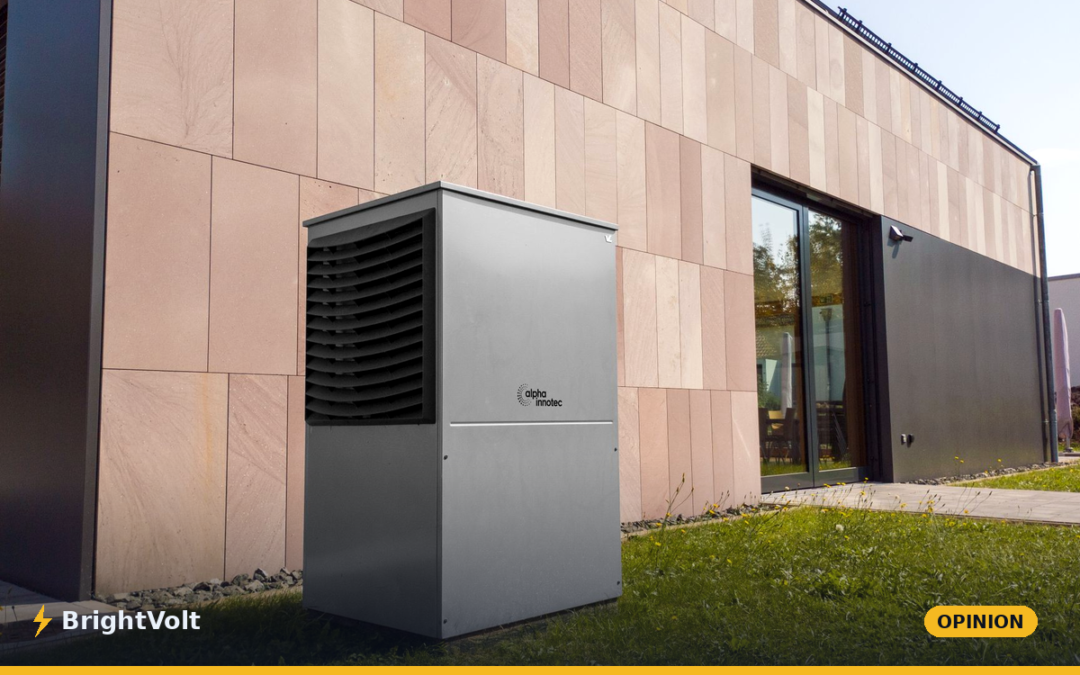
For a home with a heat pump, the cheapest storage on the property is the hot-water tank, not the battery — and Tesla has just conceded as much. Its new Heat Pump Optimisation lets a Powerwall 3 tell the heat pump to overheat its tank on spare solar: 300 litres lifted 30°C banks about 10.5 kWh of heat for roughly 3.5 kWh of electricity.
We think the feature is being sold the wrong way round. Tesla treats the tank as somewhere to put solar once the battery has had its fill. The arithmetic says the tank should fill first, and that plenty of heat-pump households being quoted a bigger battery should be quoted a length of cable instead.
What Tesla actually shipped
The feature is a relay, not a platform. Tesla’s support page lists the requirements: a Powerwall 3 or 3P on firmware 26.26 or later, an SG-Ready heat pump with an accessible SG-2 contact configured to accept external signals, and physical wiring between the two, fitted by a Tesla-certified installer. There is no cloud integration with the heat-pump maker. Tesla announced it on 30 October and it is live in Europe only, with nothing said about North America.
SG Ready is a German standard. The heat-pump association BWP introduced it in 2012 with 17 manufacturers, and its label rules define four states on two contacts: a utility block of up to two hours, normal running, a “switch-on recommendation”, and a firm start command. Tesla uses two of them — normal and boost — and the heat pump’s own controller is free to ignore the hint.
In Savings mode the Powerwall sends the boost when grid or solar energy is at its cheapest, using a 24-hour tariff forecast. In Self-Powered mode it boosts only on surplus solar left after the home’s other loads are met, which The Eco Experts reads as meaning once the battery is at 100%. In a power cut it reverts to normal.

The physics is the persuasive bit. Water holds about 1.16 watt-hours per litre per degree, so Electrek’s worked case — a 300-litre tank taken 30°C above its normal setpoint — stores around 10.5 kWh of heat. At a coefficient of performance of 3, that costs about 3.5 kWh of electricity to put there. A Powerwall 3 holds 13.5 kWh.
Why heat is the load that matters
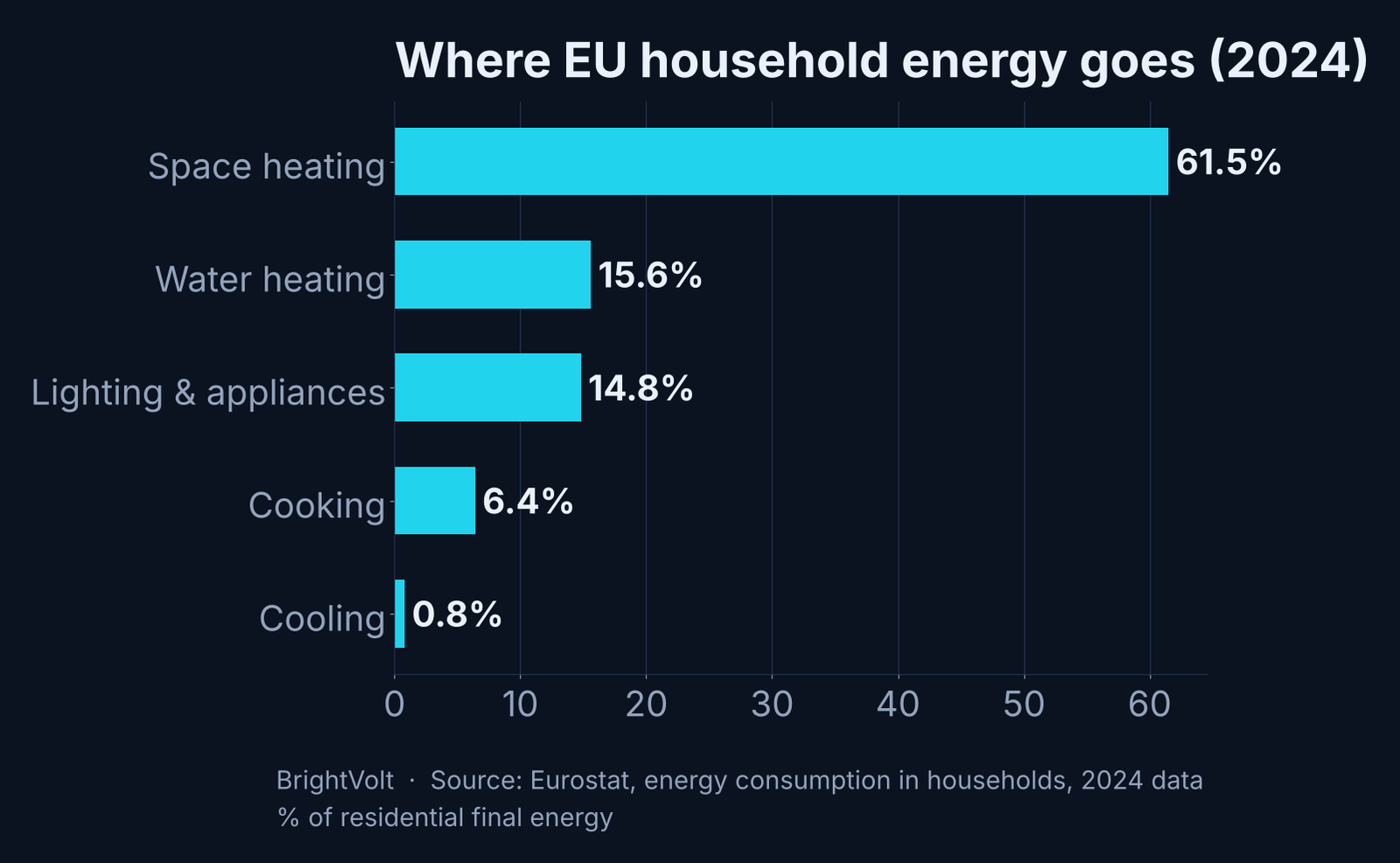
Because heat is most of what a European home buys. In 2024, Eurostat put space heating at 61.5% of residential final energy and water heating at 15.6%. Lighting and every appliance in the house together came to 14.8%. Seventy-seven percent of household energy ends up as warmth. A battery stores electricity; the household mostly wants heat.
The heat-pump base this feature can reach is no longer a niche either. Germany sold 299,000 heating heat pumps in 2025, up 55% on the year, and for the first time more heat pumps than gas boilers — 48% of new heating systems. Every one of those installed with a hot-water cylinder or buffer tank is a household that already owns a thermal store and, until last week, had no reason to fill it at noon.
The cost of a stored kilowatt-hour
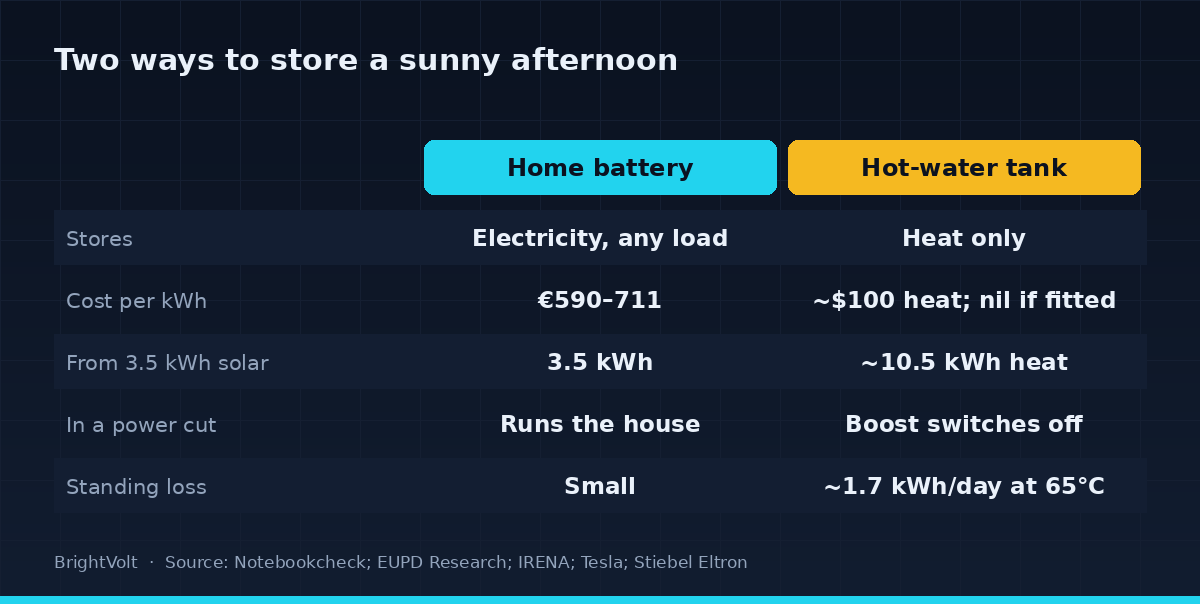
This is where the order of purchase stops being a matter of taste. A Powerwall 3 went on sale in Germany at €7,000 plus €1,000 for the gateway, before installation — roughly €590 per kWh of hardware. EUPD Research put the average German home battery at €711 per kWh in the first half of 2025, which is after a near-halving in price, not before it.
IRENA’s figure for small-scale hot-water storage is about USD 100 per kWh of heat, and it is an old number. Convert it at a COP of 3 into the electricity it displaces and a new tank still comes in near $300 per kWh — under half the battery. For a home that already has the cylinder, the marginal cost is an installer’s afternoon and two cores of cable.
So the sequencing in Self-Powered mode — battery first, tank with whatever is left — is backwards for exactly the homes this feature targets. The cheapest kilowatt-hour of storage should be the first one used, not the last.
The strongest case for the battery
It deserves a fair hearing, because it is not weak. A battery stores electricity, and electricity runs anything: the fridge, the induction hob, the car. Heat can only ever be heat. A tank also fills fast — once it is at temperature it is full, and on a July afternoon a household needs little more than a few showers’ worth.
Boosting has a physical cost, too. A heat pump’s efficiency falls as the water it makes gets hotter. Stiebel Eltron’s WPL A 07.2 datasheet gives a COP of 5.50 at 35°C flow and 3.19 at 55°C with 7°C outside air; at −7°C it slides from 3.25 at 35°C to 1.99 at 65°C. A hotter tank also leaks more: Stiebel’s 314-litre cylinder loses 1.70 kWh a day at 65°C. And only the battery keeps the lights on in a power cut.
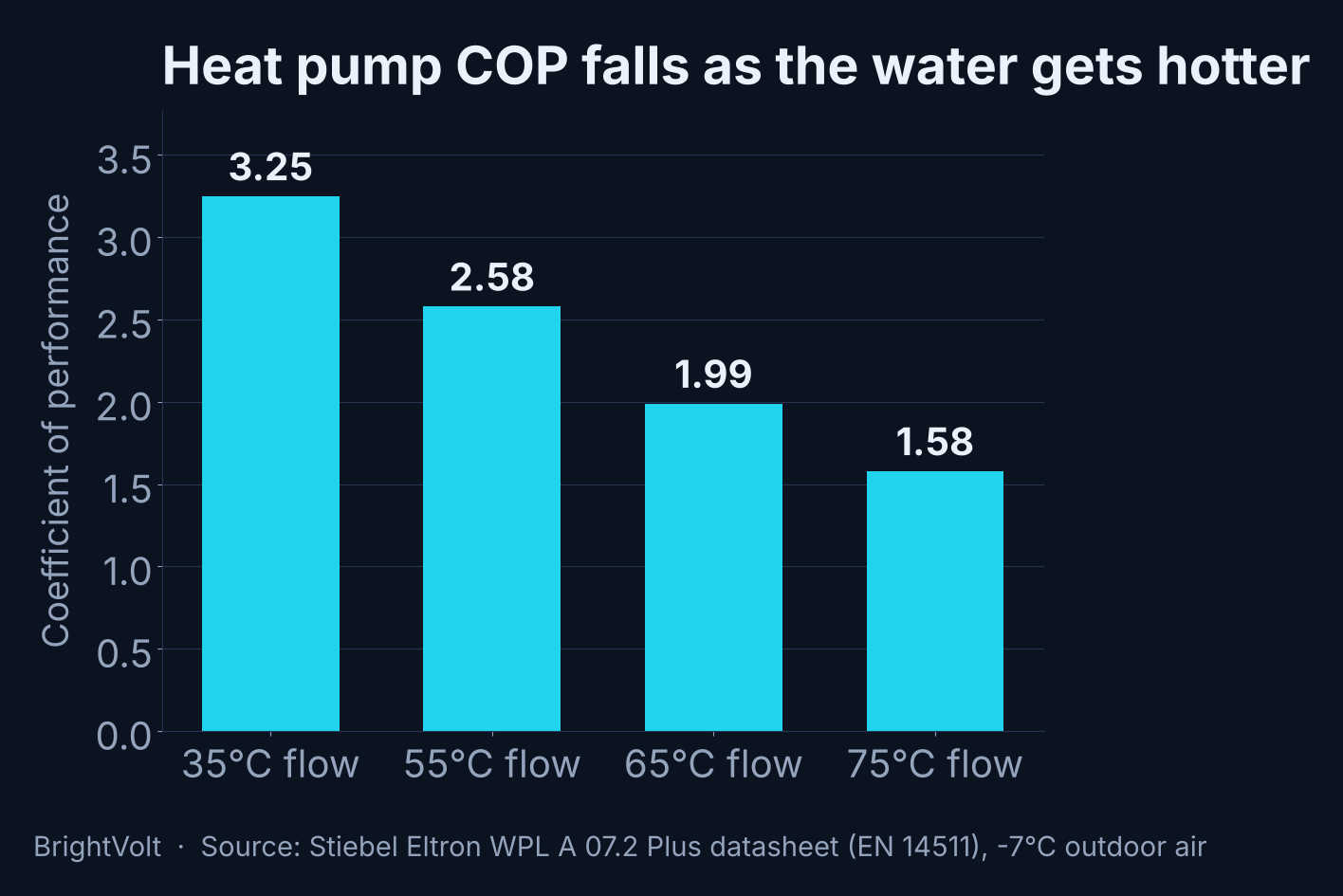
All true. None of it changes the order. The COP penalty argues for a modest boost — a few degrees above setpoint, not a tank cooked to 75°C — and it narrows the gain rather than erasing it: at a COP of 2, a kilowatt-hour of midday surplus still becomes two of heat the household was going to pay for that evening. The summer-saturation point cuts the other way in winter, when heat demand is largest and Savings mode can fill the tank from the cheapest overnight or midday tariff hours. And backup power is a reason to own some battery, which is a separate question from how big a battery actually pays. A home battery’s real limit is often power rather than energy, and a heat pump on boost is exactly the kind of large load that pulls on it.
What would change our mind
Two things would. First, field data: if Tesla or the SG-Ready installers publish measured savings and the boost turns out to be worth less per year than the installer’s visit, the argument collapses into a nice idea on paper. Second, battery prices: battery cells already sell for about $74 per kWh worldwide, far below the installed €711 figure, and if installed home batteries fall to something near the cost of thermal storage, convenience wins and the tank becomes a footnote.
What to watch meanwhile is whether installers start quoting the wire before the second module, and whether the feature crosses the Atlantic, where SG-Ready barely exists. France has already started making flexible heat pumps a condition of subsidy. The cheapest battery in a heat-pump home was installed by the plumber. It has simply never been told when to charge.
Photo by alpha innotec on Pexels · Photo by Robert So on Pexels