
The Philippines’ renewable “pipeline” of 130 GW was never a pipeline. It was a land bank of cheap options, held against a country that connected about 956 MW of new power plants of every kind in 2025. When ACEN handed back another 13 wind and solar contracts this week, it was not a retreat from the energy transition. It was the most honest thing the Philippine market has done in years.
That is our read, and it runs against the way the week’s news has been framed: a big developer surrendering projects, a cleanup that has now cancelled close to 18 GW, a sector apparently in reverse. The numbers say something else. What is being cancelled was never going to be built, and what is being built never depended on it.
What ACEN actually gave up
In an 11 November disclosure to the Philippine Stock Exchange, the Ayala group’s renewables arm said 11 subsidiaries had surrendered six wind energy service contracts and seven solar contracts. ACEN said the projects “remained in the early stages of pre-development and had not yet reached a final investment decision”, and that the move supports the Department of Energy’s contract cleanup. BusinessWorld and the Inquirer both put the capacity at nearly 5 GW. By Bilyonaryo’s count, 2,272 MW of that was planned offshore wind.
ACEN says the effect on its operations is “no material impact”, and on its own numbers that is believable. The company’s attributable capacity has grown from about 100 MW in 2016 to around 7,500 MW. Its chief executive, John Eric Francia, framed the reset as moving from “the scale we have built” to “stronger operating performance”. Context.ph summarised it as “better returns rather than capacity growth alone”.
Translated: these were rights to study sites, held because holding them was cheap.
How big is the Philippine renewable pipeline, really?
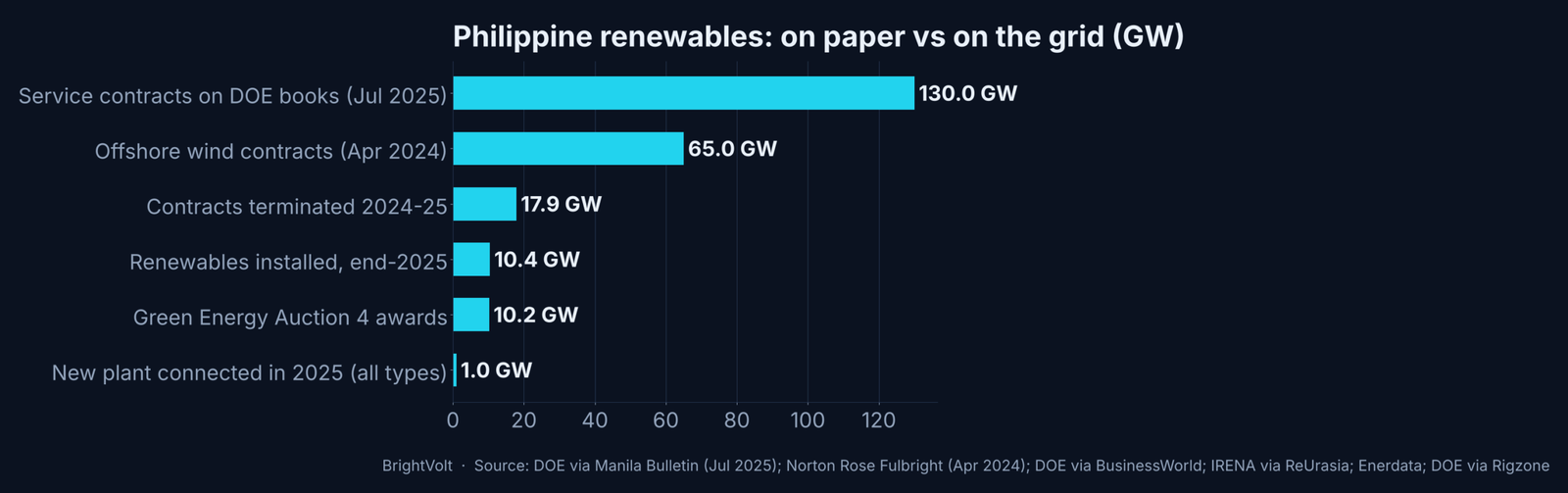
On paper, enormous. As of July 2025 the Department of Energy had awarded 1,400 renewable energy service contracts totalling 130 GW, a figure Power Philippines reported the same week. Offshore wind alone accounted for 92 contracts and more than 65 GW by April 2024. Not one offshore turbine is spinning.
Against that, the country’s entire renewable fleet was about 10.4 GW at the end of 2025, on IRENA’s count as compiled by ReUrasia. Renewables supplied about 22% of electricity in 2024 (28,193 GWh of 126,941 GWh, on DOE statistics reported by Rigzone). Coal supplied most of the rest. In 2025 the grid added about 956 MW across 14 plants, plus 160 MW of batteries.
So the contract book was more than twelve times the size of everything renewable ever built in the Philippines, and more than a hundred times a year’s actual additions.
Why do so few service contracts get built?
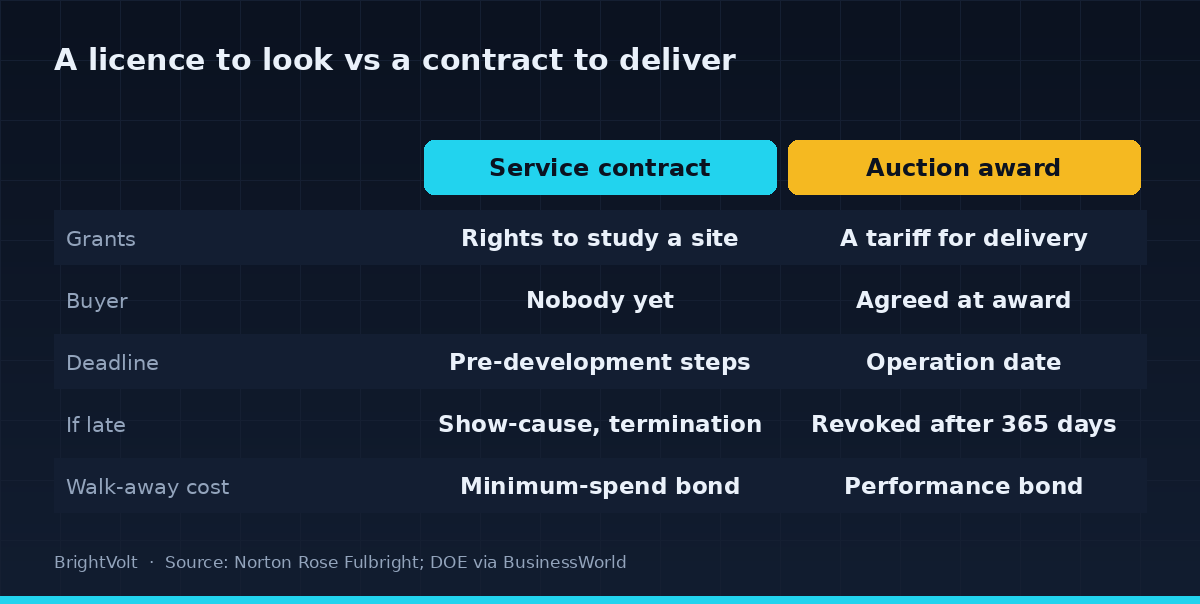
Because a service contract is a licence to look, not a promise to deliver. It grants a developer exclusive rights over a site through a pre-development stage, covering feasibility work up to financial close, and then a development stage. The developer posts a bond tied to a minimum first-year spending commitment and keeps a performance bond in place until construction starts. That is the whole obligation. Nobody has agreed to buy a kilowatt-hour.
That structure makes a contract worth holding even when you never intend to build. In February Bloomberg reported that many contract holders “had no plans of building them” and were waiting to sell the rights. A pipeline where the cheapest strategy is to sit still is not a pipeline. It is a parking lot.
The cleanup is the DOE finally charging for the space. It terminated or accepted the return of 163 contracts in 2024 and 2025, with a combined potential of about 17.9 GW. One group, Solar Philippines, accounted for 33 of them and 11,428 MW, roughly 64% of the total, and the DOE is pursuing about P24 billion in penalties and forfeited bonds. The company denies liability. “If it’s not moving, then they should not be holding those contracts,” said Energy Secretary Sharon Garin.
Where the real Philippine pipeline is
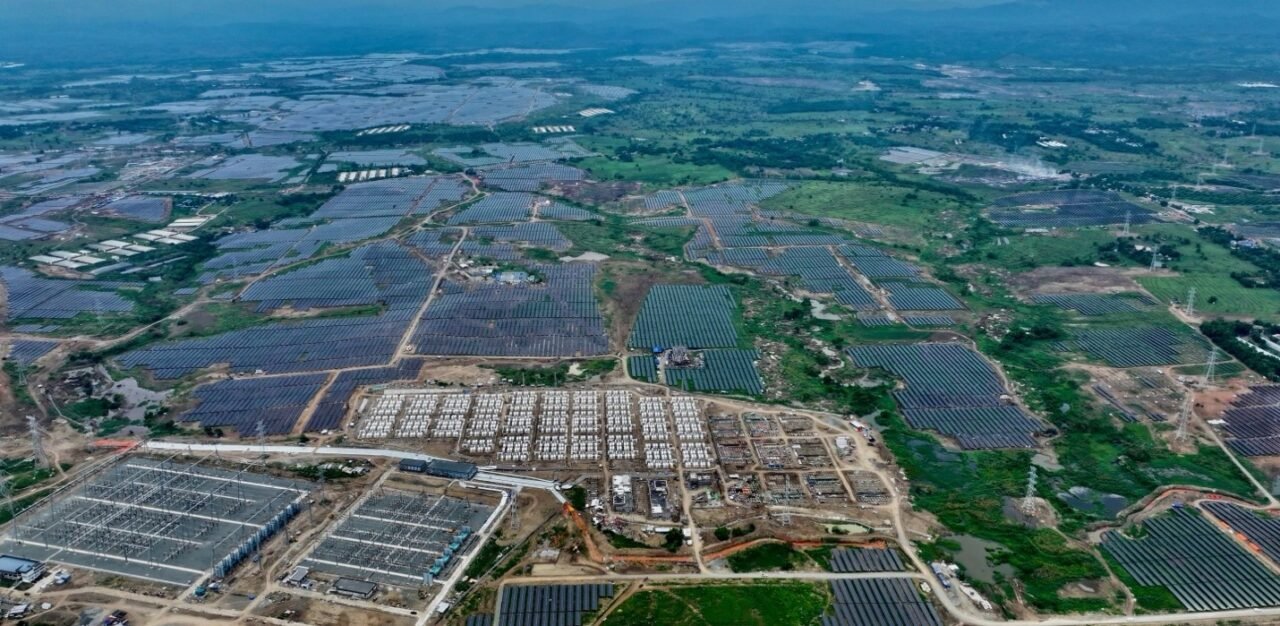
The projects actually getting built have one thing the cancelled contracts lacked: a buyer. MTerra Solar, the Meralco PowerGen and Actis project spread across Nueva Ecija and Bulacan, began commercial operation of its first 600 MWac on 26 August under a power supply agreement with Meralco, with 825 MW / 3.3 GWh of batteries already energised. Enerdata carries the same figures. The full project is 3.5 GWp of solar and 4.5 GWh of storage, due in 2027. Its first phase alone is most of a year’s national additions; finished, the plant will be several times larger than everything the country connected in 2025.
The other buyer is the state’s Green Energy Auction. The auction does what a service contract does not: it sets a tariff, fixes a delivery date, and revokes the award if construction runs more than 365 days late. The awards have grown every round, and the fourth closed at about 10.2 GW for delivery between 2026 and 2029, mostly solar, floating solar and solar-plus-storage.
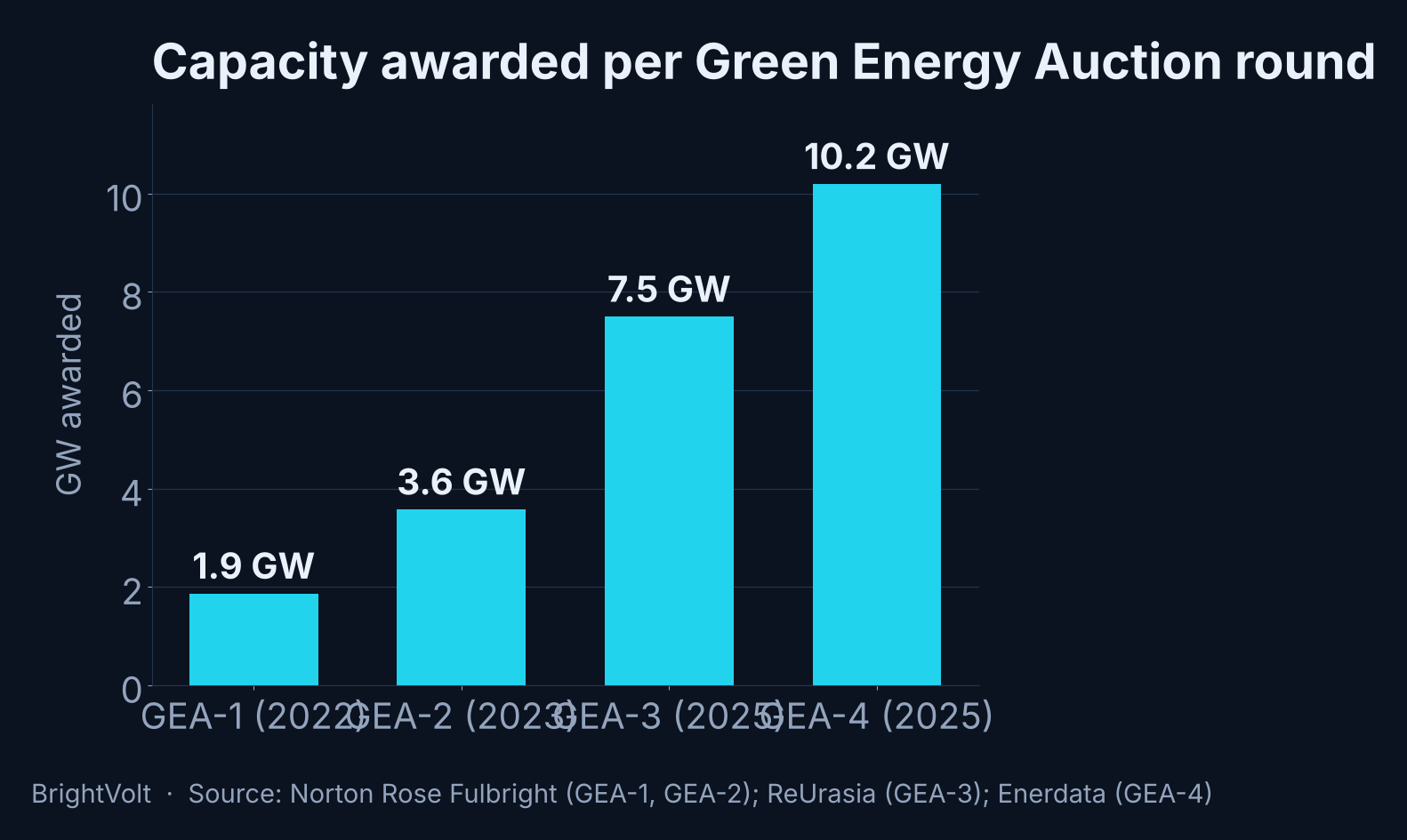
That is the number to watch, not 130 GW. A contract with an offtaker, a date and a penalty is a project. A contract with none of the three is a hope with a stamp on it.
This is the same pattern the US interconnection queue shows at larger scale. Of the projects that asked to connect between 2000 and 2020, only 13% reached operation and 75% withdrew. The Philippine book was worse because holding a place in it cost even less.
The strongest case against this view
The best counter-argument is not that the cancelled projects were real. It is that the cleanup frightens capital. Offshore wind in particular needs years of pre-development before any auction, and a developer who sees contracts torn up may not spend on met masts and seabed surveys at all. GEA-5, the country’s first offshore wind auction, offers just 3,300 MW against a PHP 11/kWh ceiling. If the pre-development layer empties out, there is nothing to bid.
It is a fair worry, and it does not change our conclusion. ACEN did not walk away because the DOE was unreasonable; it walked away from sites it had chosen not to fund, before investment decisions it had not taken. Garin has also said the 2030 and 2040 targets are “nonnegotiable”, and the terminated areas are being reopened to new applicants through competitive selection rather than abandoned. A developer serious about a site gets it back. One that was hoarding it does not.
The honest caveat is that the auction is not immune. The 163 terminations include contracts awarded through the Green Energy Auctions as well as by direct application, so a tariff and a deadline are necessary but not sufficient.
What would change our mind
The test arrives over the next two years. GEA-4’s first tranche is due from 2026, and the Philippines needs renewables to reach 35% of generation by 2030, up from about 22% in 2024. If that tranche slips at anything like the rate the old service contracts died, then the problem was never hoarding. It was the grid, the land and the cost of capital, and cleaning up the contract book will have achieved nothing but a smaller headline number.
If the auctioned capacity arrives roughly on time, the 130 GW will be remembered for what it was: a number that made a slow transition look fast. Until then, discount it entirely. We would rather read 10 GW with deadlines than 130 GW without them.
Photo by K on Pexels · Image: Meralco PowerGen Corporation