

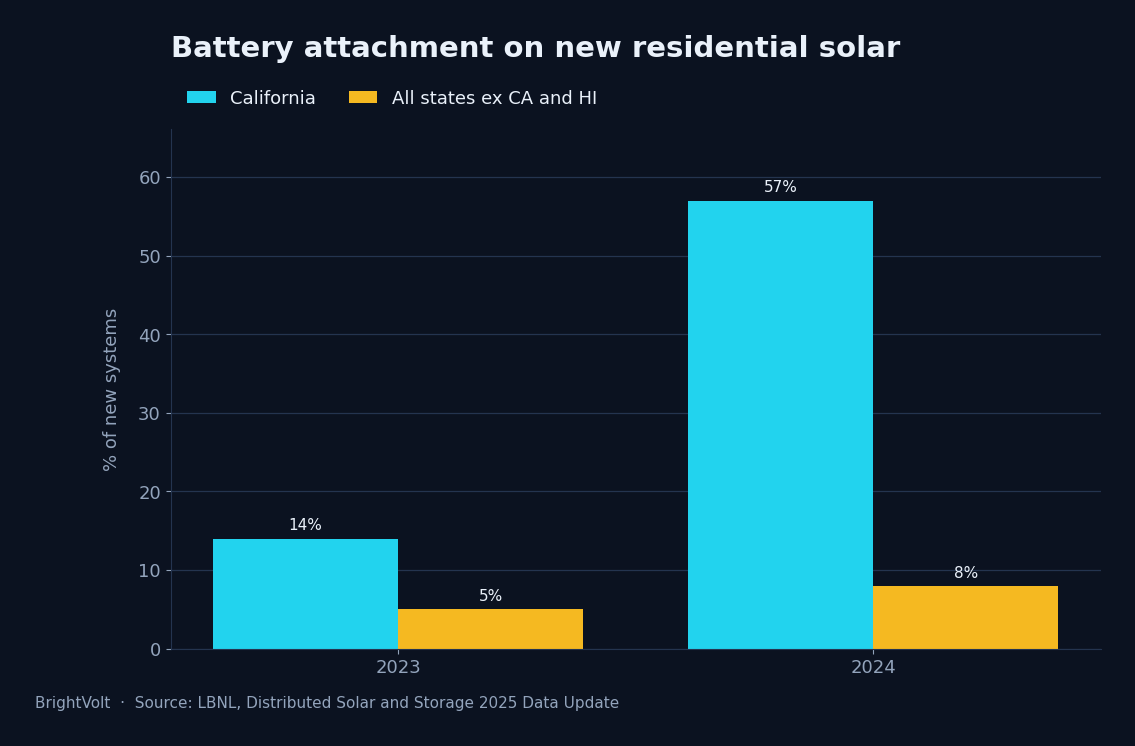
The share of new Californian home solar installations that came with a battery attached rose from 14% in 2023 to 57% in 2024, according to Lawrence Berkeley National Laboratory. Nothing about batteries changed in that window. What changed was that California stopped paying retail rates for exported power in April 2023, and households worked out that storing a kilowatt-hour beats selling it for a twelfth of what it costs to buy back.
That is the whole mechanism of what is happening to rooftop solar across the United States in 2026, and 2026 is the year several states put dates on it.
What actually changed this year
Maryland is the clearest case. The Utility RELIEF Act, signed by Governor Wes Moore on 12 May 2026, raises the state’s aggregate net metering ceiling from 3,000 MW to 6,000 MW across the existing programme and its successor combined — while closing entry to the one-for-one programme on 1 July 2027, or when 3,000 MW is reached, whichever comes first. The Public Service Commission is directed to design a successor that “must minimize ratepayer costs,” which in every state that has done this has meant compensation at grid value rather than retail.
Solar trade groups called it a win, pointing at the doubled ceiling. Both readings are defensible, which is part of why a bill that ends a decade-old subsidy passed the House 105-27 and the Senate 35-11.
California’s 2026 news was judicial rather than legislative. The First District Court of Appeal upheld the net billing tariff on 9 March, and on 10 June the state Supreme Court declined to hear a further appeal. Three years of litigation against NEM 3.0 are exhausted. The appellate court also held that the statute’s requirement that customer-sited generation “continues to grow sustainably” does not oblige the commission to sustain growth at the pace seen under earlier tariffs — a reading with consequences well beyond California.
Elsewhere the picture resists a single storyline. Virginia’s regulators approved a successor tariff on 30 April that keeps the twelve-month netting period, adds a cent per kWh to excess generation credits and rejects Dominion’s proposed application fee. Arizona’s Court of Appeals vacated a solar-specific grid access charge in June on due process grounds. Vermont’s biennial update, effective 1 August, actually raises the blended rate from 18.4 to 20.7 cents while trimming the siting adjustor — a net gain of about 1.3 cents, which the state’s industry association nonetheless calls a cut.
| Jurisdiction | 2026 action | Direction |
|---|---|---|
| Maryland | 1:1 net metering closes 1 July 2027; cap doubled to 6,000 MW | Rollback, dated |
| California | Supreme Court declines review; NEM 3.0 final | Rollback, settled |
| Rhode Island | Executive Order 26-01 orders review of net metering and REG, findings due 1 October | Rollback risk |
| New Jersey | Residential ADI incentive cut $85 to $77/MWh; net metering unchanged | Incentive cut |
| Vermont | Blended rate up 2.3¢, siting adjustor down 1¢ | Small net gain |
| Virginia | Netting period retained, +1¢ on excess generation, fee rejected | Mild win |
| Arizona | Grid access charge vacated on due process grounds, June | Win |
The aggregate is the better measure. North Carolina Clean Energy Technology Center’s 50 States of Solar counted 61 net metering policy actions in the first quarter of 2026 across 44 states plus DC and Puerto Rico, and 53 in the second across 45. It also logged 45 separate moves on residential fixed charges or minimum bills in the second quarter alone — which squeeze solar economics without touching a net metering rule, and attract a fraction of the attention.
The federal change that dwarfs all of it
Section 25D, the 30% residential clean energy tax credit, expired on 31 December 2025 under Public Law 119-21. The IRS ties eligibility to the date installation was completed rather than the date of payment, so a household that paid a deposit in 2025 and had panels fitted in January 2026 gets nothing.
A Californian buying today absorbs the credit’s disappearance and hourly avoided-cost export credits worth a small fraction of a retail rate that averages 33.7 cents at PG&E and 45.7 at San Diego Gas & Electric. The two shocks land on the same household within eighteen months of each other, and no published payback model we could find prices both together.
One channel survives. Third-party-owned systems — leases and power purchase agreements — can still claim the commercial credits under Sections 48E and 45Y, which is why the market is drifting toward models that keep the tax benefit with the installer.
Did people stop buying solar
No. They bought less of it, and they bought something different.
US residential installations peaked at 6,874 MWdc in 2023, fell 31% to 4,742 in 2024, and slipped a further 2% to 4,647 in 2025. California contracted 45% in 2024, which SEIA attributed directly to the net billing transition. The forecast for 2026 is a 21% decline.
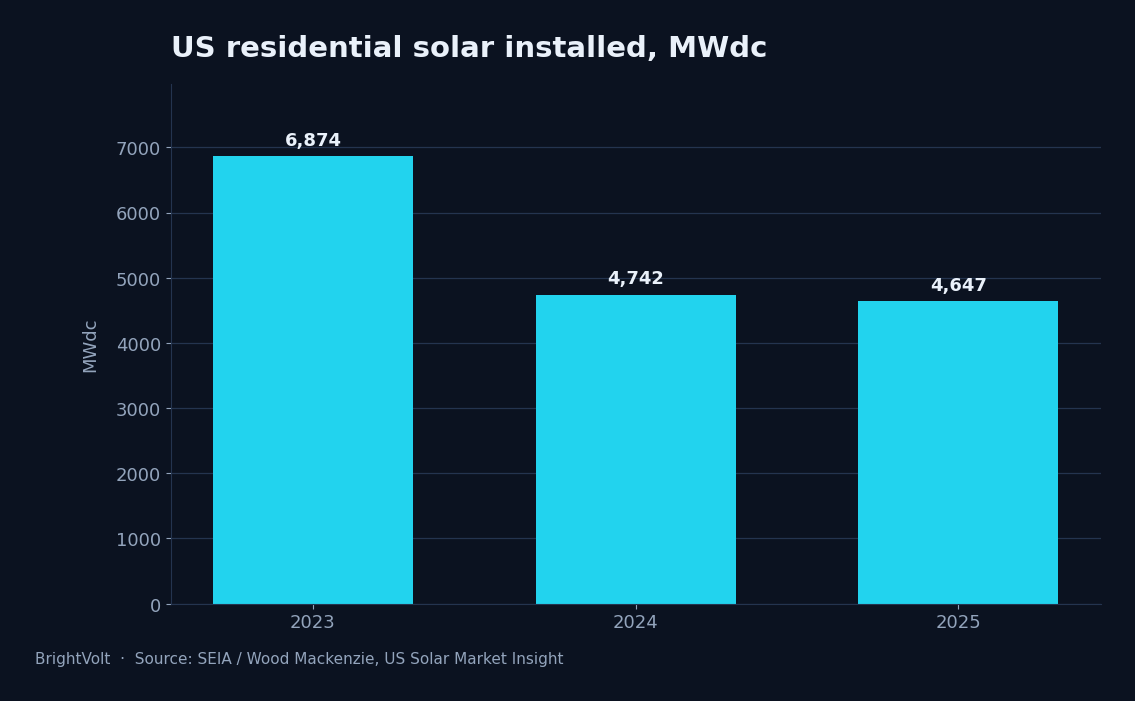
The first quarter of 2026 looks like a recovery — 1,179 MWdc, up 6% year on year — and it is not one. SEIA says plainly that the 25D installation deadline pushed work into what is normally the weakest quarter of the year, and forecasts a sharper drop in the quarters that follow. Anyone citing that 6% as evidence the market is fine is reading a pull-forward as a rebound.
Storage tells the opposite story. Residential batteries hit a record 827 MW and 1,334 MWh in the first quarter of 2026, up 86% year on year in energy terms. Nationally, 45% of new residential solar now ships with a battery, up from 38% a year earlier. In California it was 57% in 2024 on LBNL’s count, and in Hawaii, which ended net metering back in 2015, 85%.

Wood Mackenzie names the cause without hedging: California’s 2025 storage surge came from high retail rates and a net billing tariff that rewards discharging into the evening peak. The policy did not kill home solar. It changed what home solar is — from an export business into a self-consumption one.
It is not a free substitution. LBNL found solar-plus-battery pricing rose about 17% in real terms under the net billing tariff. Californians pay more to export less, and the market has consolidated around the firms that can carry it: the top five installers went from 40% of the state to 51% in a single year.
The human evidence arrived in April, when Freedom Forever — the second-largest US residential installer at 6.1% national share — filed for Chapter 11 with liabilities between $500 million and $1 billion, laid off about a fifth of a workforce of more than three thousand, and abandoned ten of its state markets.
Whether any of this was justified
Here the evidence is genuinely contested, and it is worth being precise about why.
The CPUC’s Public Advocates Office projected the 2024 cost shift from solar to non-solar customers at $8.5 billion, up from $3.4 billion in 2021, equal to 16–23% of a non-solar household’s bill. M.Cubed, working for the state solar association, looked back at the same year and found a $1.5 billion net benefit. That is a ten-billion-dollar disagreement about a single twelve months — and part of it is that one is a forecast made in August 2024 and the other a retrospective published the following spring.
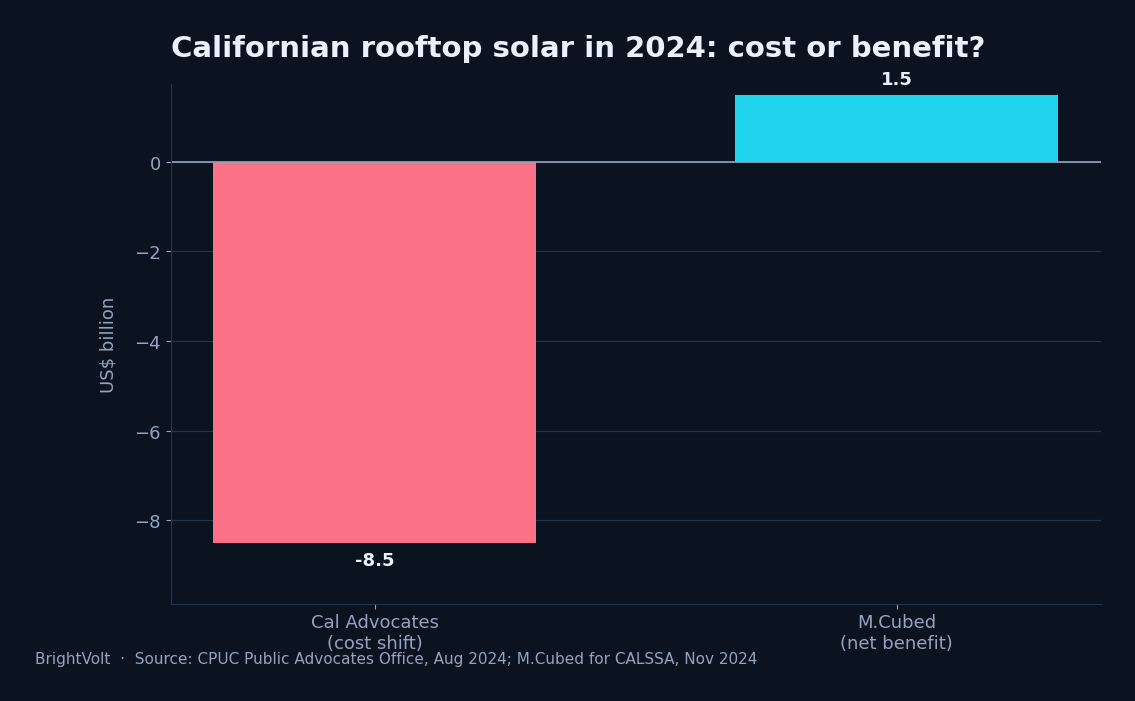
They are not arguing about data. Cal Advocates uses a forward-looking avoided-cost framework in which any bill reduction that fails to cover embedded fixed costs is a cost shift by construction. M.Cubed counts historical infrastructure that was never built as a benefit. Cal Advocates’ rebuttal says M.Cubed values the same benefits five to six times higher than the commission’s approved calculator does — and that is the crux. The choice of framework determines the answer before anyone enters a number.
Neither party is disinterested. Cal Advocates litigates these proceedings; M.Cubed’s study was commissioned by the trade association whose members lose money if the rules change. The appellate court’s March finding is also narrower than it is usually reported: it held that the commission adequately addressed cost-shift concerns, not that $8.5 billion is the right figure.
What to watch
Rhode Island’s Office of Energy Resources reports on 1 October, on behind-the-meter net metering and the Renewable Energy Growth programme together, under an executive order that explicitly frames both as ratepayer costs. Maryland’s PSC has to design its successor tariff before July 2027, and whether it lands nearer Virginia’s avoided-cost-plus-a-penny or California’s hourly avoided cost will tell other states what is politically survivable.
The number that settles the argument, though, is SEIA’s third-quarter report in September. It will carry the first residential figure untouched by the 25D deadline rush, and the gap between that and the artificially strong first quarter is the true size of what the last eighteen months of policy did.
Photo by Andersen EV on Pexels · Photo by Lena Netkach on Pexels