

A technology readiness level (TRL) is a nine-step scale for how close a technology is to real use, from TRL 1, “basic principles observed”, to TRL 9, “actual system proven in operational environment”. For batteries it answers only half the question. Whether a cell works and whether it can be made by the million are separate ladders, and most battery announcements are written to blur them.
This week supplied a clean example. On 11 November QuantumScape unveiled Osprey, an all-solid-state cell that it says ran 1,000 cycles to 80% capacity at room temperature without external pressure. A day earlier, a start-up called Appear announced that its solid-state battery had “moved into pre-production”. Both sound like progress. They describe very different places on the map.
What do the nine TRL levels mean?
The scale was devised at NASA, where Stan Sadin drew up a seven-level version in 1974 and the agency adopted nine levels in the 1990s, according to NASA’s own history. The definitions most energy funders use today come from the European Commission’s Horizon 2020 annex, and they are brief to the point of terseness:
| TRL | EU definition | What it looks like for a battery |
|---|---|---|
| 1–3 | Principles observed; concept formulated; experimental proof of concept | A new electrolyte or electrode in a paper and a coin cell |
| 4 | Technology validated in lab | Small cells cycling on a bench |
| 5–6 | Validated, then demonstrated, in a relevant environment | Multi-layer cells at commercial size, tested to automotive conditions |
| 7 | System prototype demonstrated in operational environment | Packs in test vehicles or a pilot grid installation |
| 8 | System complete and qualified | The cell passes the customer’s qualification |
| 9 | Actual system proven in operational environment | Cells in products people buy |
The right-hand column is our translation, not the Commission’s. The scale was written for spacecraft and grant applications, and it is silent on the question a battery buyer cares about most: can this be made cheaply, consistently, at volume?
Why TRL misleads on batteries
A battery chemistry can be scientifically finished and industrially nowhere. The cell is the hard half of battery manufacturing — the dry rooms, coating lines and weeks of formation covered in our cell-versus-pack explainer — and none of that is captured by a scale that asks only whether the thing works in its intended environment.
The US defence establishment hit the same problem decades ago and wrote a second ladder. Its Manufacturing Readiness Level deskbook runs from MRL 1 to 10, and the top three rungs are the ones battery press releases keep gesturing at: MRL 8 means “pilot line capability demonstrated; ready to begin low-rate initial production”, MRL 9 means low-rate production demonstrated, and MRL 10 means full-rate production with lean practices in place. MRL 9 and 10 both require TRL 9. You cannot manufacture your way past an unproven product, but you can very easily have a proven product you cannot manufacture.
Battery researchers have said as much in print. A 2022 paper in the Journal of Power Sources Advances from the University of Münster group proposed a Battery Component Readiness Level that rewrites the EU scale with battery-specific steps and folds in manufacturability and cost, arguing that a shared, battery-specific scale would improve communication between funders, academia and industry and cut wasted public funding. The cell maker Amprius has made the same point from the industry side: cost is unknowable at low TRLs, and manufacturing and market readiness need their own scores.
The ladder carmakers actually use
Inside the car industry, nobody talks in TRLs. They talk in sample letters, and these are the terms worth learning, because they appear in earnings calls and supply announcements.
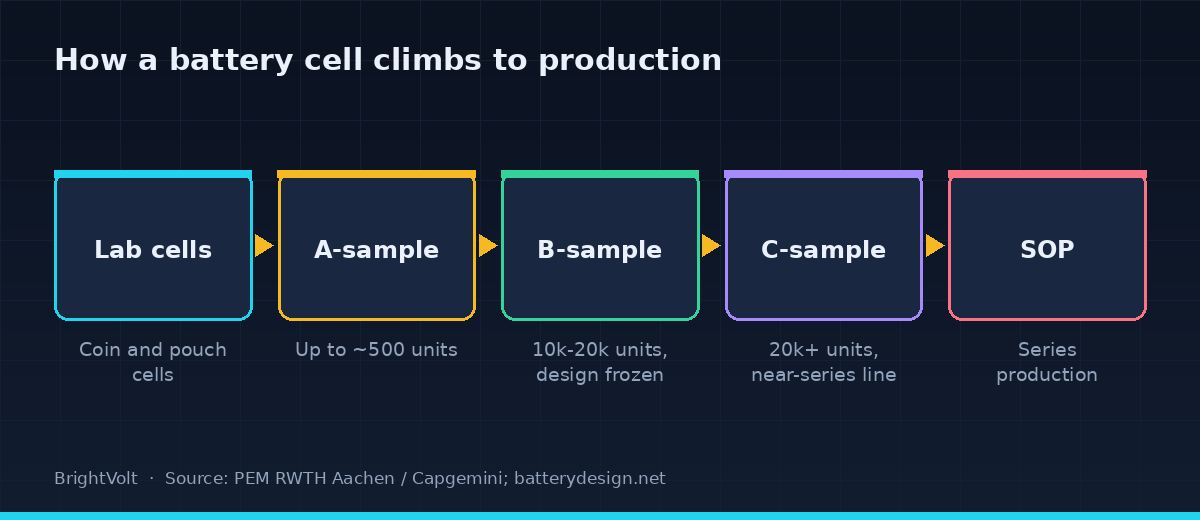
According to a PEM RWTH Aachen and Capgemini study, A-samples are built on laboratory equipment in runs of up to about 500 units. B-samples come off a lab or pilot line in the tens of thousands, typically 10,000 to 20,000. C-samples are made on a pilot or near-series plant with the design fixed for production, and start of production (SOP) ends the pre-series phase. Each sample phase takes one to two years, and full cell development takes four to six in the authors’ experience. Batterydesign.net describes the same sequence with one useful addition: at B-sample the cell design is frozen, and at D-sample the production process is locked, so any later change sends the cell back to B.
Reading this week’s announcements
Run the two solid-state claims through both ladders.
QuantumScape’s Osprey result is a lab result, and the company says so: the process is demonstrated “at laboratory scale” and “engineering and development challenges remain” before mass production. Electrek’s write-up notes the cycling was done in two-layer unit cells at 30°C, that its estimate of their capacity is roughly 0.3–0.4 Ah against about 5 Ah for QuantumScape’s production-bound QSE-5, and that the five-minute fast-charge figure was achieved at 80°C. On the EU scale that reads as TRL 4 for a new cell platform: a genuine result, with no manufacturing readiness to speak of yet. The company’s QSE-5 cell, by contrast, has been shipping B1 samples to the Volkswagen Group since the third quarter of 2025. Same company, two products, two rungs.
Appear’s “pre-production” is harder to place, which is the problem. The release names no manufacturing partner, publishes no specifications or volumes, and cites no third-party test; limited production is due in mid-2027 and full scale in 2028. In Argonne National Laboratory’s usage, “pre-production pilot” lines sit around MRL 3 to 5, roughly TRL 4 to 6. Without numbers there is no way to know which end.
Independent ratings help when they exist. The EU Joint Research Centre’s 2024 battery status report rated sodium-ion at TRL 9 and solid-state in general at 6 to 8, with individual developers including TRL 3–7 for Toyota, 4–5 for QuantumScape and Factorial and 6–8 for Blue Solutions. Treat any single number with care: the same report gives Toyota a five-level spread.
How long the climb takes
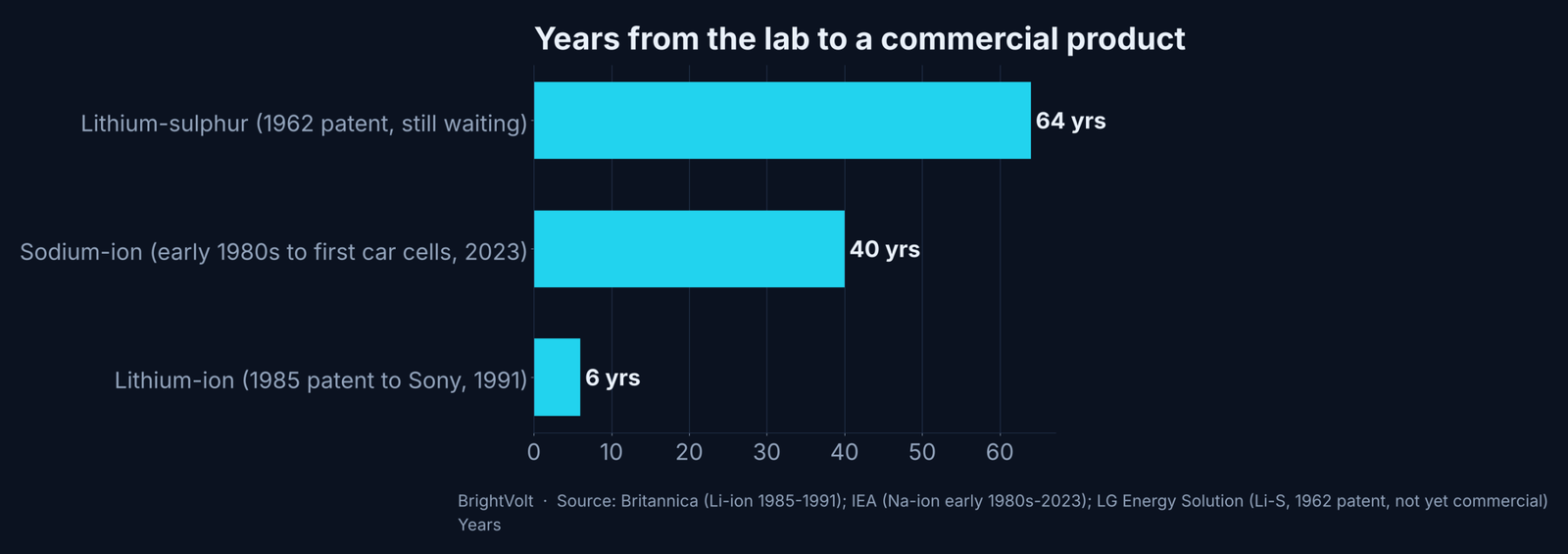
Fast, sometimes. Akira Yoshino’s lithium-ion cell was patented in 1985 and Sony was selling it in 1991, per Britannica. More often, slowly. Sodium-ion research began in the early 1980s, and the first sodium-ion car cells shipped in 2023, according to the IEA. Lithium-sulphur was first patented in 1962; LG Energy Solution still places it “after 2030” for aircraft and long-range cars.
The middle rungs are where time goes. The IEA tracks about 640 clean-energy technologies and found that of nearly 400 pre-commercial designs, about 40% had moved up one maturity step since 2020, and only 3% had moved up two in five years. It also counts around 115 technologies that sit at TRL 9 and still have not been adopted. Reaching the top of the ladder is not the same as being bought.
The three questions to ask
Every battery announcement can be pinned down with three questions. What size and how many: a two-layer lab cell, or thousands of full-format cells? Made where: lab kit, a pilot line, or a plant built for volume? Tested by whom: the developer, or a carmaker’s qualification? A release that answers all three can be placed on both ladders in a minute. One that answers none of them, however confident its verbs, is telling you where it is by omission.
For the wider argument about why solid-state keeps slipping, see our solid-state reality check, and for the compromise that reached the market first, our semi-solid-state analysis.
Photo by Artem Podrez on Pexels · Photo by Pavel Danilyuk on Pexels