
California has legalized plug-in “balcony” solar — small panels that feed a home through an ordinary wall socket — for its 39 million residents from January 2027. Governor Gavin Newsom’s signature on SB 868 sets a 1,200-watt ceiling, higher than Germany’s 800, and frees the devices from utility permission entirely. The hardware to fill that market barely exists yet.
That last sentence is the whole story. The law, authored by state senator Scott Wiener and nicknamed the “Plug Into the Sun Act,” does the one thing that has kept plug-in solar out of American homes while Germans bought it by the million. It is a genuine unlock. It is also well ahead of the certified kits anyone can actually buy.
What SB 868 actually removes
The headline is that renters and condo dwellers can now clip a panel to a railing and plug it in. The mechanism is duller and more important: the bill exempts these devices from utility interconnection requirements, and bars utilities from charging a fee or demanding permission to install one.
Interconnection is what strangled the idea here. A rooftop array in the United States means an application to the utility, an engineering review, an inspection and a meter swap — a process built for a system that exports serious power to the grid, and absurdly heavy for a 300-watt panel that offsets a refrigerator. Germany faced the same friction and cut it; most of the US never did. California has now said that a device below the cap is not a power plant the grid needs to study. Plug it in, and it simply trims what the meter draws.
The specifics matter. The cap is 1,200 watts of AC output per dwelling, the devices must carry UL or equivalent safety certification, and the whole exemption carries a sunset clause that repeals it at the end of 2030 unless the legislature renews it. California is the tenth state to legalize plug-in solar and by a wide margin the largest — the nine before it, from Utah’s first-in-the-nation law in March 2025 onward, cover a fraction of its population.
| State | Plug-in AC cap | Note |
|---|---|---|
| Utah | 1,200 W | First to legalize, March 2025 |
| Colorado | 1,920 W | Highest ceiling in the US |
| California | 1,200 W | Largest market; effective January 2027 |
| CT, ME, MD, NH, NJ, VT, VA | 1,200 W | Passed 2025–26 |
Why Germany is the comparison, and the caution
Germany is where this technology grew up, and its numbers set the expectation California is being measured against. The federal network regulator counted around 430,000 new plug-in balcony systems registered in 2025 alone, taking the registered fleet past a million; industry estimates that include the many unregistered units put the real total near four million — roughly one household in ten. The Balkonkraftwerk is a cultural object there, sold in hardware stores and discount supermarkets.
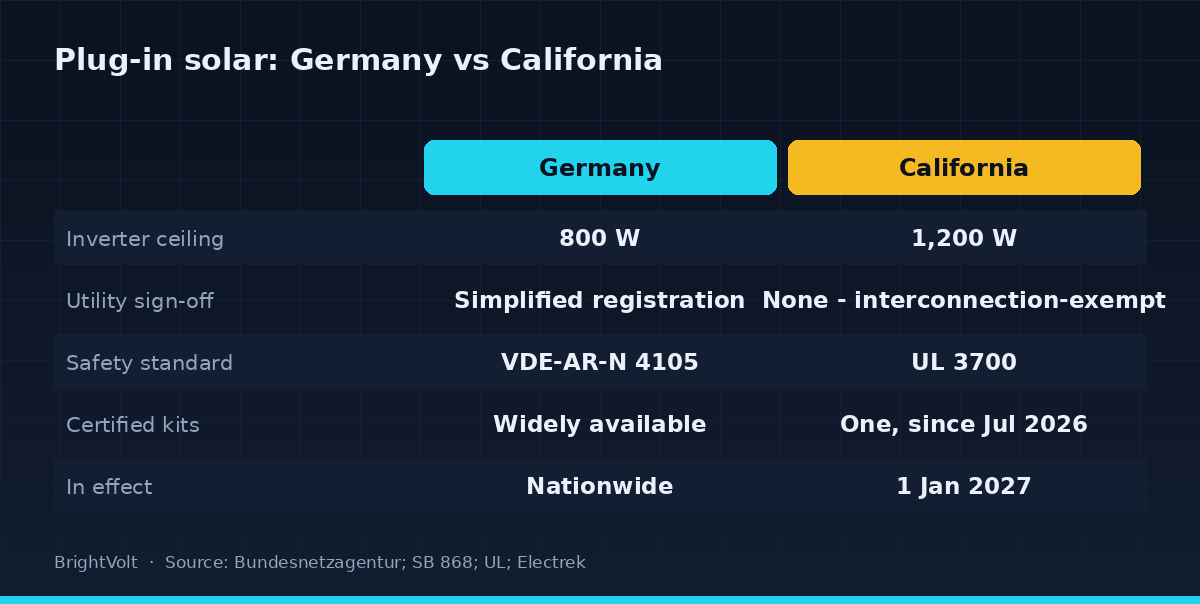
So the ceiling California chose is telling. At 1,200 watts it sits above Germany’s 800-watt inverter limit, which Germany itself only raised from 600 watts in 2024. On paper, California is the more generous regime. Whether a 1,200-watt device belongs on a shared household circuit is a question American electricians will argue about for a while, but the legislature has clearly decided to err toward letting people generate more, not less.
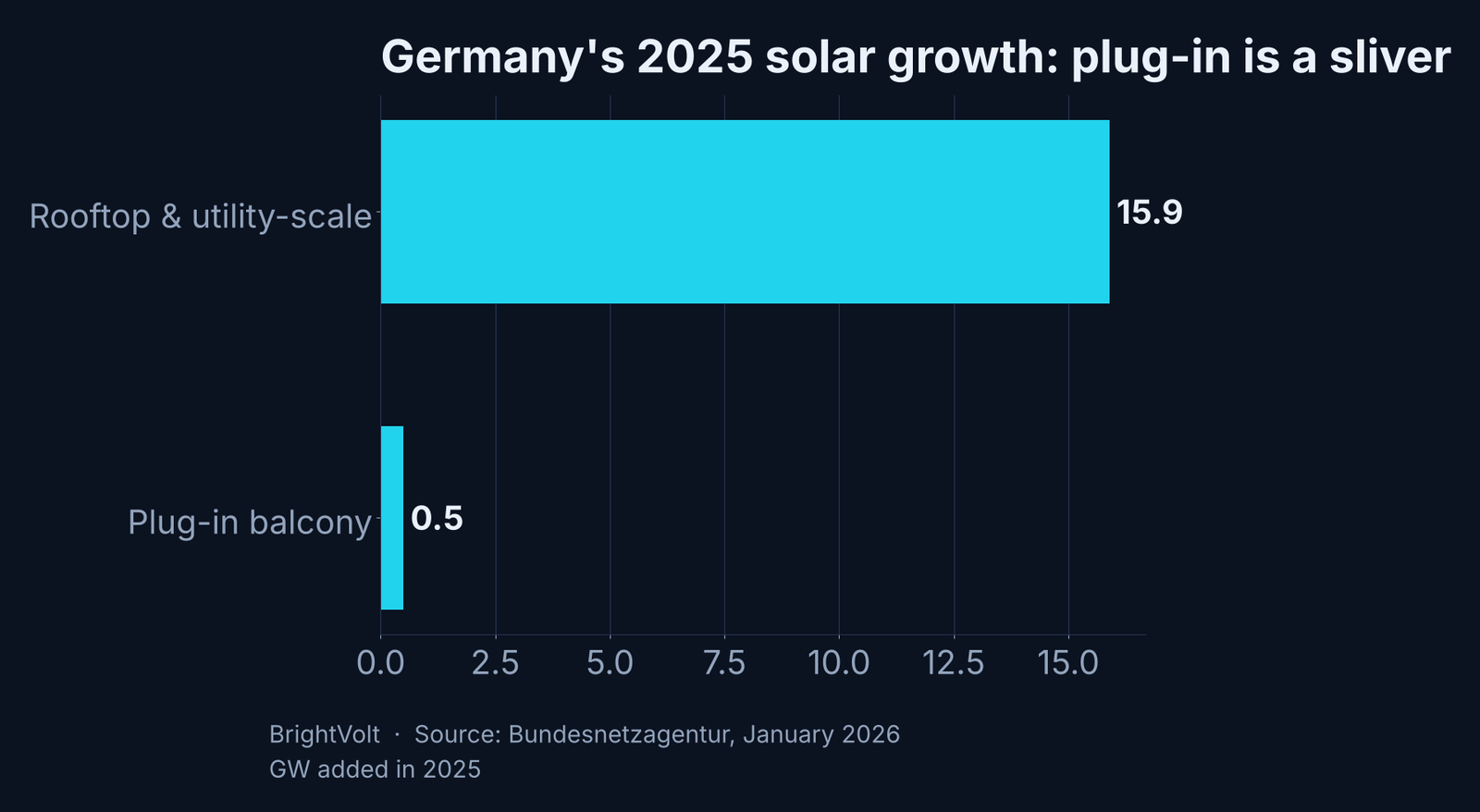
Here is the caution the enthusiasm tends to skip. Even in Germany, after a decade of growth and a gas-price panic to accelerate it, balcony solar added just 0.5 GW in 2025 — 3.2% of the country’s new solar capacity. The other 15.9 gigawatts came from rooftops and fields. Plug-in solar is a democratizing technology: it reaches the renter, the balcony, the household with no roof of its own and no capital for a full install. It is not a generation strategy. Both of those things are true at once, and an honest read of California’s law holds them together rather than picking the flattering one.
The hardware gap
A law that lets you plug something in is worth little if there is nothing certified to plug in, and this is where the German comparison turns from flattering to sobering.
The relevant American safety standard, UL 3700, was only finalized in early 2026. When advocates first saw the draft they complained it was too restrictive — early versions were read as effectively requiring an electrician, which would defeat the plug-and-play premise. The certified products that have since reached the market plug into a standard 120-volt outlet and lean on the safety behavior the standard demands: prongs that go dead within a second of being unplugged, automatic shut-off during a grid outage so a lineman is never working on a live wire, overload protection against backfeeding a circuit, and ground-fault detection.
The problem is supply. The United States got its first UL 3700-certified plug-in device in July 2026 — a single microinverter from Hoymiles, rated at 360 watts per unit and up to 1,200 watts when four are ganged together. One certified product, three months before the largest market in the country opens. Germany’s boom ran on a crowded shelf of cheap, pre-assembled kits from Anker, EcoFlow and a dozen others, sold for a few hundred euros and designed to be carried home and hung on a railing that afternoon. America has the law now. It does not yet have the shelf.
That gap also shapes the economics. A complete plug-in kit runs somewhere between a few hundred and around fifteen hundred dollars, and a 400-watt system typically offsets 10 to 20% of a home’s electricity — the kind of bill that pays a kit back in a few years, faster in a high-rate state like California. But those figures are German and the kits are German-priced. Until certified American hardware is plentiful enough to compete on price, the payback a California renter actually sees depends on a market that is one product deep.
What to watch
The law is the right move and the obvious one — removing the interconnection barrier is exactly what the net-metering fights of the last two years should have taught everyone. The open question is whether supply follows. The thing to track through 2027 is not policy but a count: how many UL 3700 products reach the market, whether any of them land under $400, and what California’s own sales and registration data show in the first year the law is live.
If a dozen certified kits arrive and prices fall to German levels, California could put plug-in solar on hundreds of thousands of balconies that a rooftop installer would never quote. If the shelf stays one product deep and priced for early adopters, the law will be remembered as a correct decision that arrived before its hardware — a market opened for a product that was not ready to fill it. Either way, the thing that changes the answer is not in Sacramento. It is on the certification queue.
Photo by Egor Komarov on Pexels · Photo by Egor Komarov on Pexels