
A land equivalent ratio, or LER, measures whether doing two things on one piece of land beats doing each on its own. In agrivoltaics — solar panels raised over a working field — an LER of 1.6 means you would need 1.6 hectares of single-use land, one growing the crop and one carrying the panels, to match what one shared hectare produces. It is the number every agrivoltaic project quotes, and it is more slippery than it looks.
The slipperiness is not a flaw in the arithmetic. The arithmetic is honest. The problem is that a headline above 1 is almost baked into the way the ratio is built, and the single figure quietly folds together a bushel of wheat and a kilowatt-hour as though they were the same thing.
What a land equivalent ratio actually measures
The metric predates solar by decades. It comes from intercropping agronomy, where farmers grow two crops in the same field and need a way to say whether the mixture uses land better than two separate monocultures. The FAO definition is precise: LER is the area of single-crop land required to match, at the same management level, the yields from one unit of intercropped land.
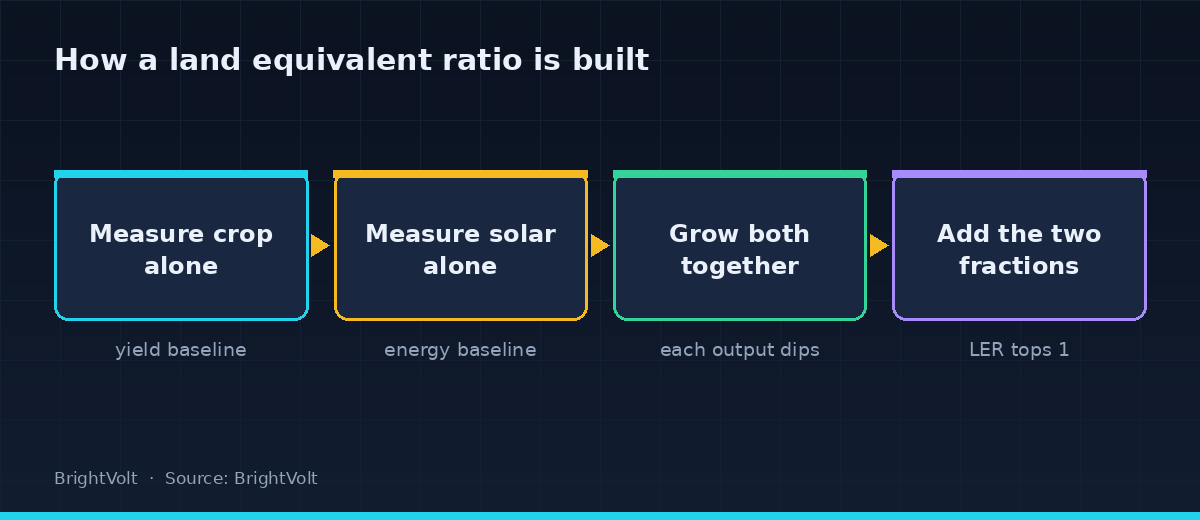
The formula adds fractions. For two crops it is the intercropped yield of each divided by its monoculture yield, summed:
LER = (yield of crop 1 intercropped ÷ yield of crop 1 alone) + (yield of crop 2 intercropped ÷ yield of crop 2 alone)
A worked example shows why the result is easy to misread. Suppose grain yields 4,000 kg per hectare intercropped against 5,000 kg grown alone, and a fruit yields 9,000 against 15,000.
| Crop | Intercropped | Monoculture | Fraction |
|---|---|---|---|
| Grain | 4,000 kg/ha | 5,000 kg/ha | 0.80 |
| Fruit | 9,000 kg/ha | 15,000 kg/ha | 0.60 |
| LER | 1.40 |
Read the fractions before the total. Each crop, grown together, produced less than it would have alone — 20% less grain, 40% less fruit. Nobody harvested more of anything. Yet the LER is 1.40, comfortably above 1, because the two shortfalls, added, still beat either single use. That is the whole trick of the number: it rewards sharing land even when every individual output falls.
How the ratio crossed over to solar
The German physicist Adolf Goetzberger proposed raising photovoltaic arrays above crops in 1981, and the borrowed metric came with the idea. The agrivoltaic version swaps one crop for electricity: the first fraction is the field’s crop yield under the panels divided by its yield in the open, and the second is the array’s generation divided by what a dedicated solar farm on the same ground would produce.
Here the ratio tilts toward 1 before a single measurement is taken. A crop-only field generates no electricity; a solar-only field grows no food. Each single-use baseline therefore scores 1.0 on its own axis and zero on the other. Put both on one plot and, unless the panels cook the crop or the crop wrecks the panels, both fractions land somewhere above zero — and their sum lands above 1 by construction. An agrivoltaic system almost has to “win” on LER. The interesting question is never whether the ratio clears 1. It is how far, and at what cost to the harvest.
What the numbers look like in the field
The reference case is Heggelbach, in southern Germany, where Fraunhofer ISE raised a 194-kilowatt array five metres above an arable field in 2016 and measured the first full season in 2017. Land-use efficiency rose about 60% — an LER near 1.6 — and in the drought that followed, the shade helped the crops and pushed the figure higher still.
The crop side of that ledger is the part the ratio buries. Under the panels, potatoes, wheat and celeriac each yielded 18–19% less than the open-field reference; only the clover grass held up, down just 5%. The electricity side over-delivered: the array produced 1,266 kWh per kilowatt installed against a German average nearer 950, because raising and spacing the panels for the crop also improved their ventilation and light. A near-19% harvest cut and a strong solar yield, blended, is exactly what an LER of 1.6 looks like from the inside.
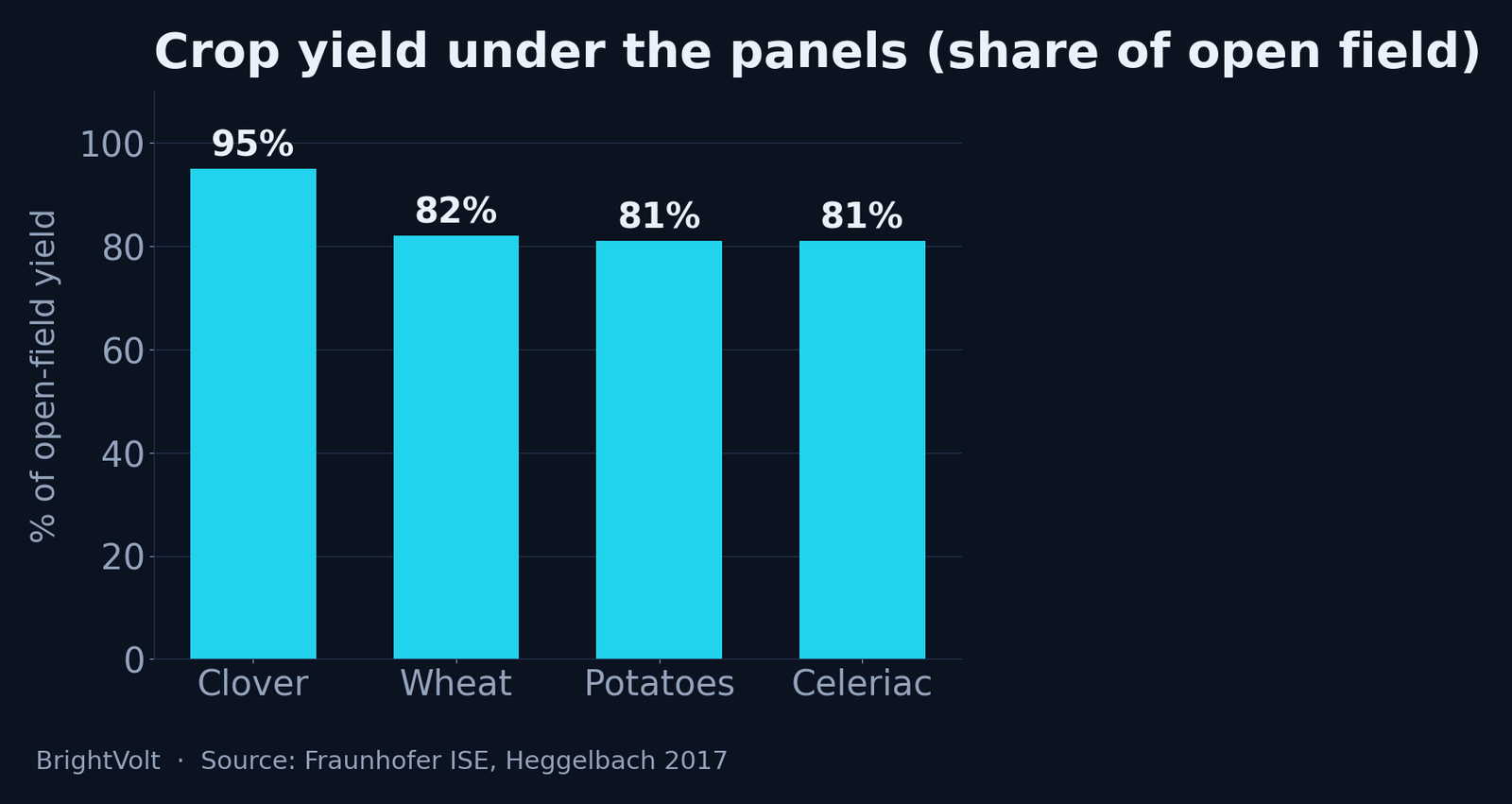
Values in the literature spread widely because the crop, the climate and the panel spacing all move the result. Reviews and the NREL synthesis put most measured agrivoltaic LERs between about 1.2 and 1.7, with maize trials in Italy reported as high as 2.05. Shade-tolerant crops — leafy greens, berries, forage, grazing pasture — sit at the top; thirsty, sun-hungry staples sit at the bottom, and in a hot dry year the ranking can flip as shade turns from a penalty into protection.
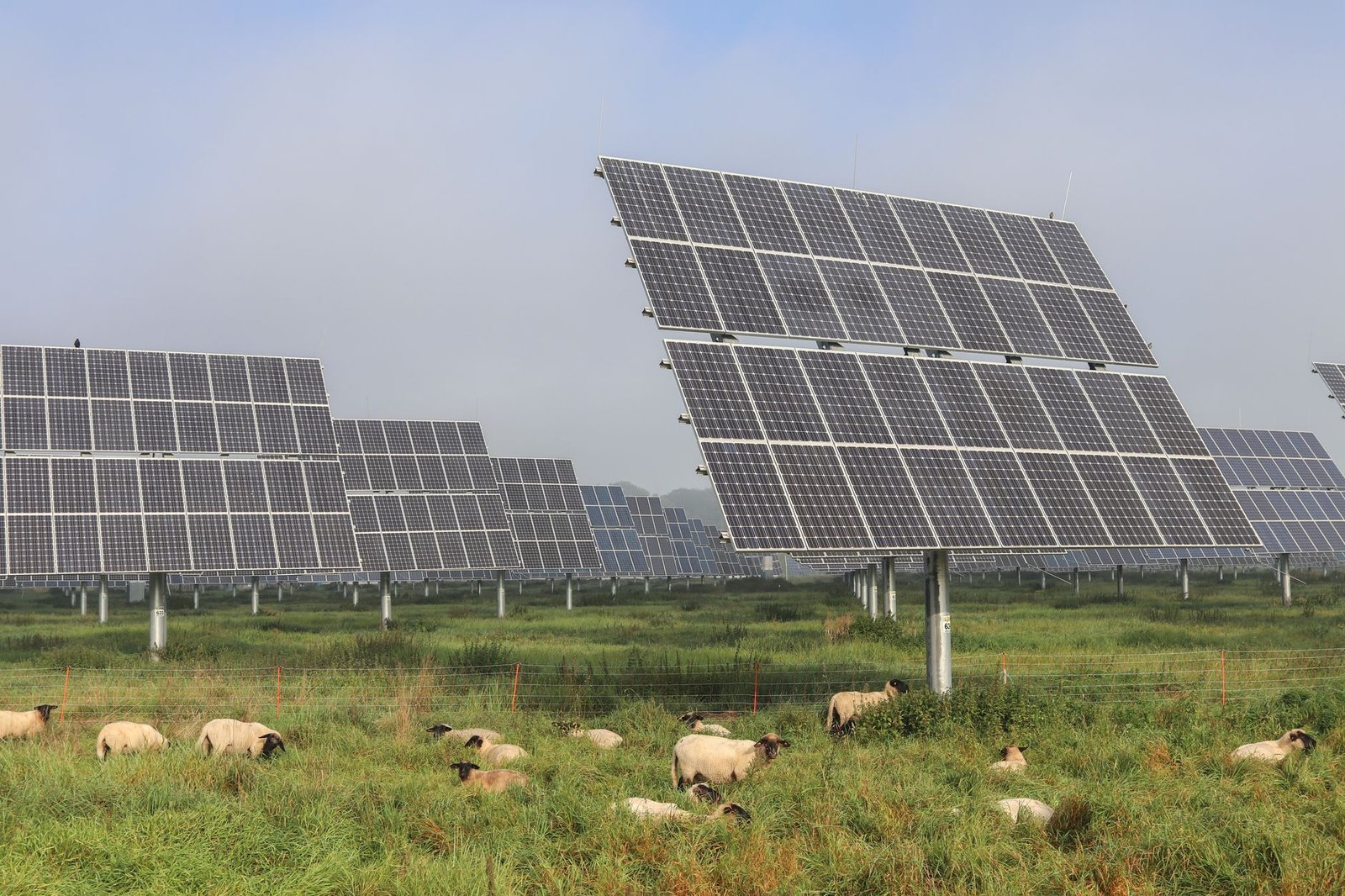
Grazing is the clearest case of a high ratio that costs the farmer almost nothing: pasture loses little under well-spaced panels, the sheep keep the vegetation down, and the land carries a full array on top. It is also why the ratio, built the same way for every pairing, flatters a sheep-and-solar plot and a wheat-and-solar plot with numbers that look alike and mean very different things.
What the ratio doesn’t tell you
LER answers one narrow question — is combined output per hectare higher than split output — and is routinely asked to stand in for questions it cannot touch.
It treats a kilowatt-hour and a kilogram of potatoes as interchangeable units of “land productivity.” They are not. A farmer cannot eat electricity, a grid cannot dispatch celeriac, and the two have prices that move independently, so a rising LER can coincide with a falling farm income if the crop that got shaded out was the one that paid the bills. The metric is also silent on water, on labour, on the capital cost of mounting panels five metres up, and on whether an 18% yield cut is a triumph or a disaster — that depends entirely on the lease payment sitting on the other side of the ledger, which the ratio never sees.
It is sensitive to its own baselines, too. Choose a weak monoculture reference and the crop fraction rises; site the comparison solar farm on worse ground and the energy fraction rises. Because the number is a sum of two ratios, each denominator is a lever, and a developer quoting “LER above 1.5” has chosen both. Academics have started asking in print whether the ratio is a sufficient indicator of an agrivoltaic system’s worth at all. The honest answer is that it is necessary and nowhere near sufficient.
How to read an LER when someone quotes one
Treat the ratio as the beginning of the question, not the answer. When a project reports an LER, the figures that decide whether the land is genuinely working harder sit underneath it: which crop, what it yielded against an honest open-field baseline, and what the grower was paid to accept the difference. A system that keeps 95% of a forage yield while carrying a full solar array is doing something real. A system that reports a shiny 1.7 by pairing a token crop with a near-complete solar build is doing arithmetic.
The concept is worth keeping — it is the cleanest single way to show that shared land can out-produce split land, and the field evidence that it often does is the reason agrivoltaics is scaling. Just read the fractions before the total. The total is designed to reassure; the fractions are where the farming is.
Photo by Tom Fisk on Pexels · Photo by Vincent Delsuc on Pexels