
SG Ready is a German label for heat pumps that can take simple orders from outside: two relay contacts, four combinations, four operating states. It was introduced in 2012 by the heat-pump association BWP with 17 manufacturers, and it lets a solar inverter or a utility say “run harder” or “stop for a while”. It does not let anyone turn your heating down to a specific power. That job now belongs to a different rule entirely.
The confusion between the two is the thing worth clearing up. SG Ready is a voluntary, fourteen-year-old wiring convention used mostly to soak up rooftop solar. Germany’s grid-control law, §14a of the Energy Industry Act, is a 2024 obligation that lets a network operator dim a heat pump to 4.2 kW in exchange for cheaper network fees. One is a suggestion box. The other is a dimmer switch with a rebate attached.
What are the four SG Ready states?
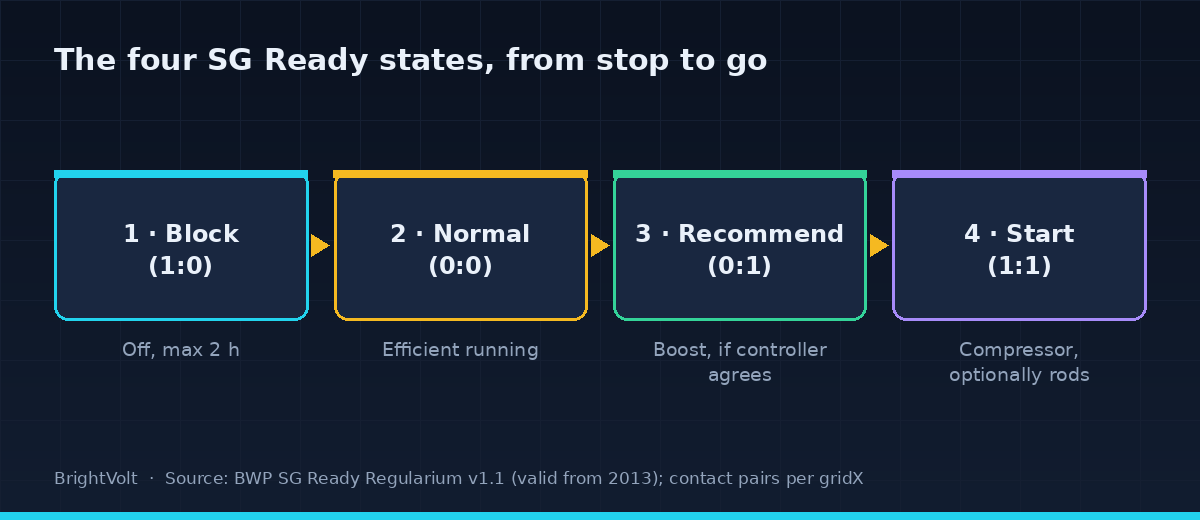
Each state is a combination of two contacts, open (0) or closed (1). The definitions below come from the BWP’s own label rules, valid from 1 January 2013, with the contact pairs as gridX summarises them.
| State | Contacts | Name in the rules | What the heat pump does |
|---|---|---|---|
| 1 | 1:0 | Utility block (EVU-Sperre) | Stops. A “hard” block of at most two hours |
| 2 | 0:0 | Normal operation | Runs efficiently, keeping enough heat stored to ride through a block |
| 3 | 0:1 | Switch-on recommendation | Runs harder for space heating and hot water, if its controller agrees |
| 4 | 1:1 | Start command | Switches on as far as its settings allow; optionally with electric backup heaters too |
Two details in the rules matter more than they look. State 3 is explicitly “not a definitive start command but a switch-on recommendation”: the heat pump’s own controller decides whether to act. And state 4 must offer installers two variants — compressor only, or compressor plus the electric heating rods — because a heating rod turns one kilowatt-hour of electricity into one of heat, where the compressor typically makes about three. That only makes sense when the electricity is close to free.
The rules are also less prescriptive than most summaries suggest. The 2012 document caps a block at two hours and says nothing about how many blocks a day are allowed, or how long the heat pump must run between them. Manufacturer guides fill the gap differently: Alpha Innotec describes up to three blocks a day of up to 120 minutes each, while gridX reads it as two hours a day in total. Neither figure appears in the original rules. The rules do require one thing many summaries skip: a room-thermostat cut-off alone is not enough to qualify.
What SG Ready is actually used for
Mostly, rooftop solar. An inverter or home energy manager watches the meter, and when the panels are exporting more than the house is using, it closes a contact. The heat pump lifts its hot-water or buffer-tank setpoint and banks the surplus as heat instead of selling it to the grid for a few cents. When the surplus disappears, the contact opens and the heat pump drops back to normal.

That is the whole of Tesla’s new Powerwall 3 heat-pump feature, which BrightVolt argued last week is a better use of spare solar than a second battery module: one SG Ready contact, two of the four states, normal and boost. No cloud link to the heat-pump maker, no data, just a relay. That is SG Ready’s strength and its ceiling. A relay can say “more” or “less”. It cannot say “run at 3 kW until 4pm”.
The label is also a German-speaking-world phenomenon. The BWP rules say it is awarded only in Germany; Alpha Innotec says it applies in Germany, Austria and Switzerland. By June 2023 the BWP listed 103 compliant manufacturers, per gridX, and Viessmann says most newly delivered units now carry the contacts. Outside that region, a heat pump may have equivalent terminals under another name, or none at all.
Is SG Ready mandatory? No, but it is close. Viessmann notes that owning an SG Ready heat pump is not an obligation but is a condition for claiming Germany’s federal heating subsidy, whose rules require an interface for grid-supportive control.
How SG Ready differs from §14a grid control
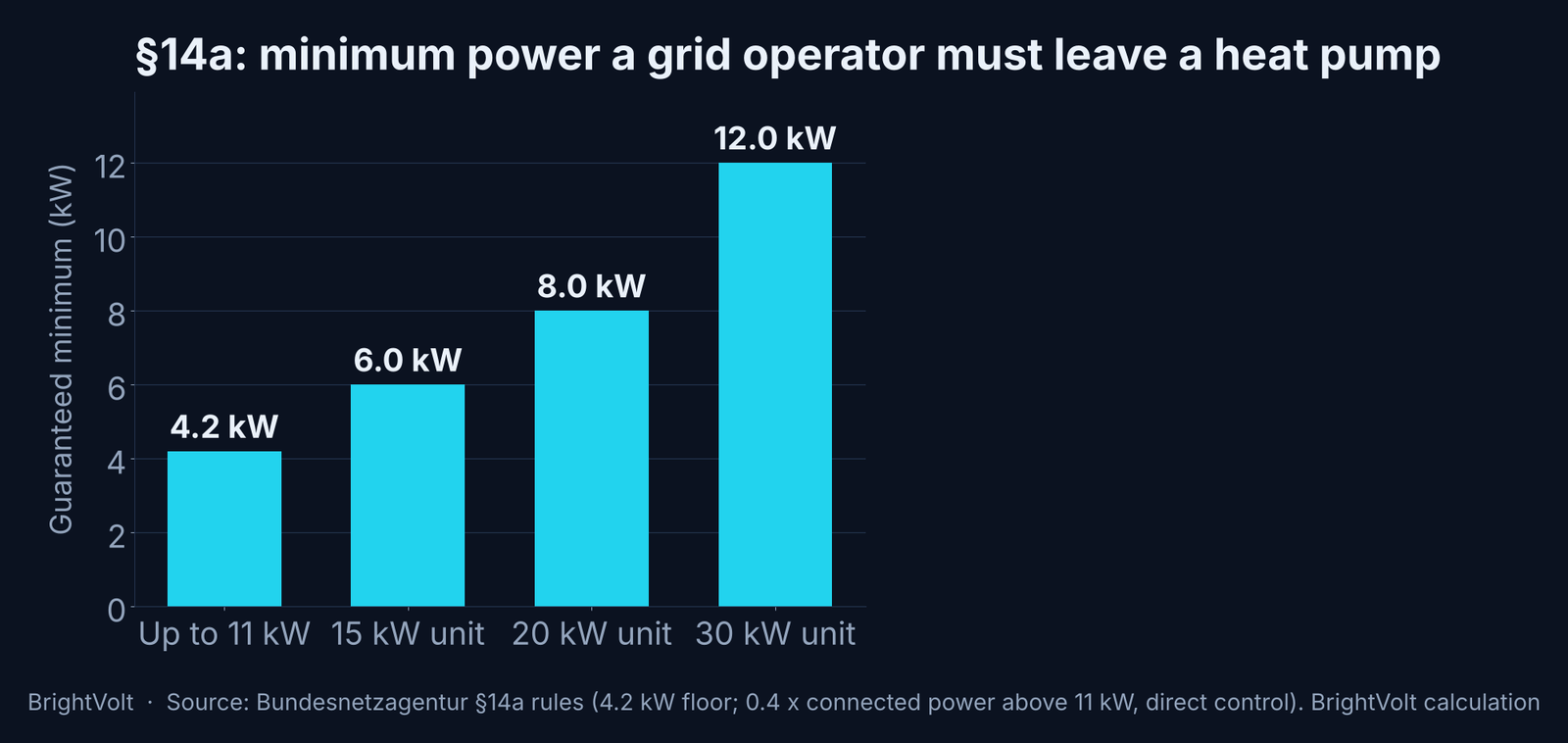
Since 1 January 2024, heat pumps, wallboxes, home batteries and air-conditioners with a grid connection above 4.2 kW count as “controllable consumption devices” under §14a of the Energy Industry Act. The Bundesnetzagentur’s rules give the network operator a new power and take one away. It may no longer refuse or delay connecting a heat pump because the local grid might overload. In return, when overload genuinely threatens, it may dim the device — but never below 4.2 kW of guaranteed power. For large heat pumps above 11 kW the floor scales to 40% of connected power; Viessmann’s summary gives the same 4.2 kW and 40% figures.
The household gets paid for accepting this. Under the Bundesnetzagentur’s Module 1 the network-fee discount is a flat sum, between €110 and €190 a year depending on the grid area (2023 figures). Module 2 cuts the network-fee energy price by 60% on a separately metered heat pump, which the regulator says can suit heat pumps especially well. Since April 2025 a time-variable network fee (Module 3) can be stacked on Module 1.
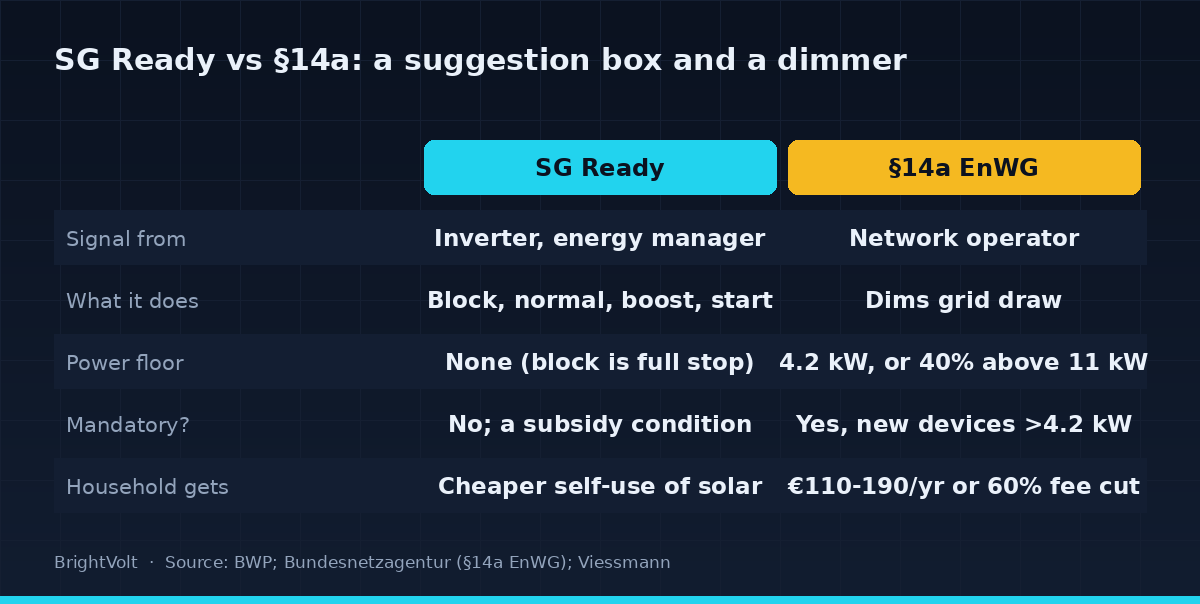
So the two answer different questions. SG Ready asks the heat pump to use more when power is cheap or local. §14a lets the grid use less of it when the wires are full, with a floor that keeps the house warm. The old utility block — SG Ready’s state 1 — is what §14a replaced: a full cut-off for up to two hours has become a partial dim with a guaranteed minimum. The regulator’s page does not mention SG Ready at all; dimming is meant to run through the smart-meter control box, with older control methods allowed only until the end of 2025.
What to check on a heat pump spec sheet
Three things, in this order. First, whether the unit carries the SG Ready label or equivalent contacts, because that is what any solar inverter, Powerwall or energy manager will wire into. Second, which state-4 variant the installer has configured: compressor-only for everyday solar soaking, heating rods only if export prices are near zero. Third, in Germany, which §14a module the household has chosen, because Module 2’s separate meter and Module 1’s flat rebate reward different usage.
What would make this explainer date is a successor that carries numbers rather than on/off states. §14a dimming already works in kilowatts rather than contact states. When heat pumps start taking a kilowatt figure instead of a contact closure, SG Ready will become what the utility block became: a legacy mode, still wired, rarely used. Until then, two wires remain the cheapest grid interface in the house.
Photo by alpha innotec on Pexels · Photo by alpha innotec on Pexels · Photo by Pavel Danilyuk on Pexels