

Ember’s new report on the “electro-fortification” of Britain lands one striking claim above the rest: a home with rooftop solar, a battery, a heat pump and an electric car is up to ten times better protected from energy price shocks than a home without them. The data underneath it is real, and the direction is right. So is the divide it describes.
The report reads as a case for national resilience: electrify a house and you unplug its bills from the price of gas. That is true. But the same figures describe a shield that is bought upfront, installed fastest where money and rooftops already are, and quietly paid for by the households that cannot buy one.
What Ember counts as a fortified home
The core idea is simple. When most of Britain’s power came from gas, almost every household bill tracked the gas price, which is why the 2022 spike hit everyone at once. Clean generation breaks that link at the grid level — around 64% of UK electricity came from clean sources last year — and household electrification extends the break to the meter. Ember’s term for doing it deliberately, one house at a time, is electro-fortification.
The adoption is not hypothetical. Ember counts 1.7 million UK homes with rooftop solar, and nearly half of new solar installations now ship with a battery. Domestic battery uptake has doubled every year for more than three years running. Each month, roughly 15,000 homes add solar, 6,000 add a battery, and 48,000 electric cars are bought.
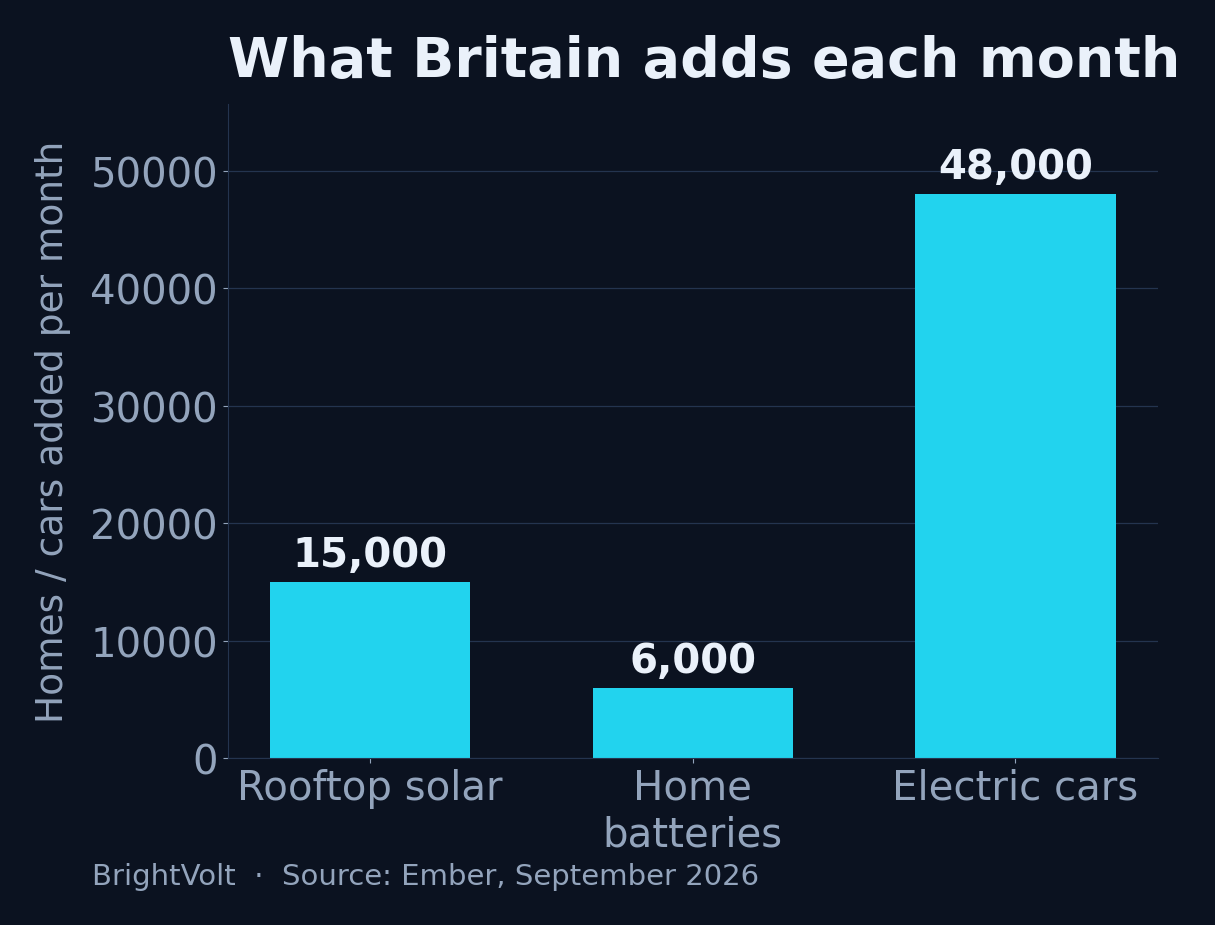
Set against the size of the country, those are early numbers. There are still 4.8 million homes off the gas grid — the obvious first market for a heat pump — and 19 million private cars parked on driveways whose owners still pay pump prices. The fortified home is real, replicable and, so far, rare.
Where the savings come from
The mechanism is self-consumption. A solar-and-battery home generates its own power by day, banks it, and draws grid electricity mainly when it is cheapest — so the share of the bill exposed to wholesale prices shrinks. Pair that with an EV and the saving compounds: Ember puts the reduction in annual charging cost at more than £500 a year for a household charging on its own solar rather than at pump-equivalent rates. A heat pump does the largest single thing of all: it moves home heating off gas entirely, onto a grid that is two-thirds clean and getting cleaner.
| Technology | UK homes reached | Typical upfront cost | What it shields |
|---|---|---|---|
| Rooftop solar | 1.7 million | ~£7,000 for a typical array | The daytime grid price |
| Home battery | ~half of new solar installs | £7,000–£9,000 for 10 kWh | Evening peaks and spikes |
| Heat pump | 4.8m homes off the gas grid | £8,000–£14,000, less a £7,500 grant | The gas price, entirely |
| Electric car | 48,000 bought per month | New-car outlay | Petrol and diesel prices |
The “ten times better protected” figure is a modelled headline, not a meter reading, and it stacks the full set of four technologies to get there. Take it as a direction rather than a promise. But the direction is not in doubt: a house that makes and stores its own power and burns no fuel has very little bill left for a gas crisis to inflate.
The shield is bought upfront
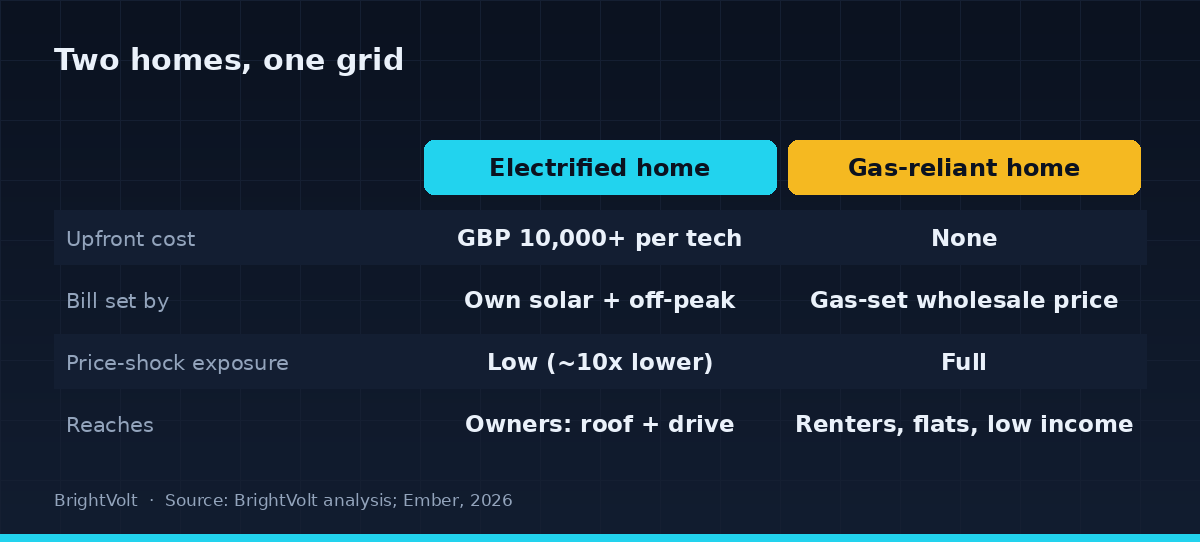
Here is the number the resilience framing skirts. Every row of that table has a four- or five-figure entry price. A battery alone is £7,000 to £9,000. A heat pump is £8,000 to £14,000 before the £7,500 Boiler Upgrade Scheme grant, and the grant only helps if you own the home and can fund the balance. Solar needs a roof you own and control. An EV that charges cheaply needs a driveway with a socket. Stack the set Ember models and you are past £20,000 of capital before the “ten times” protection arrives.
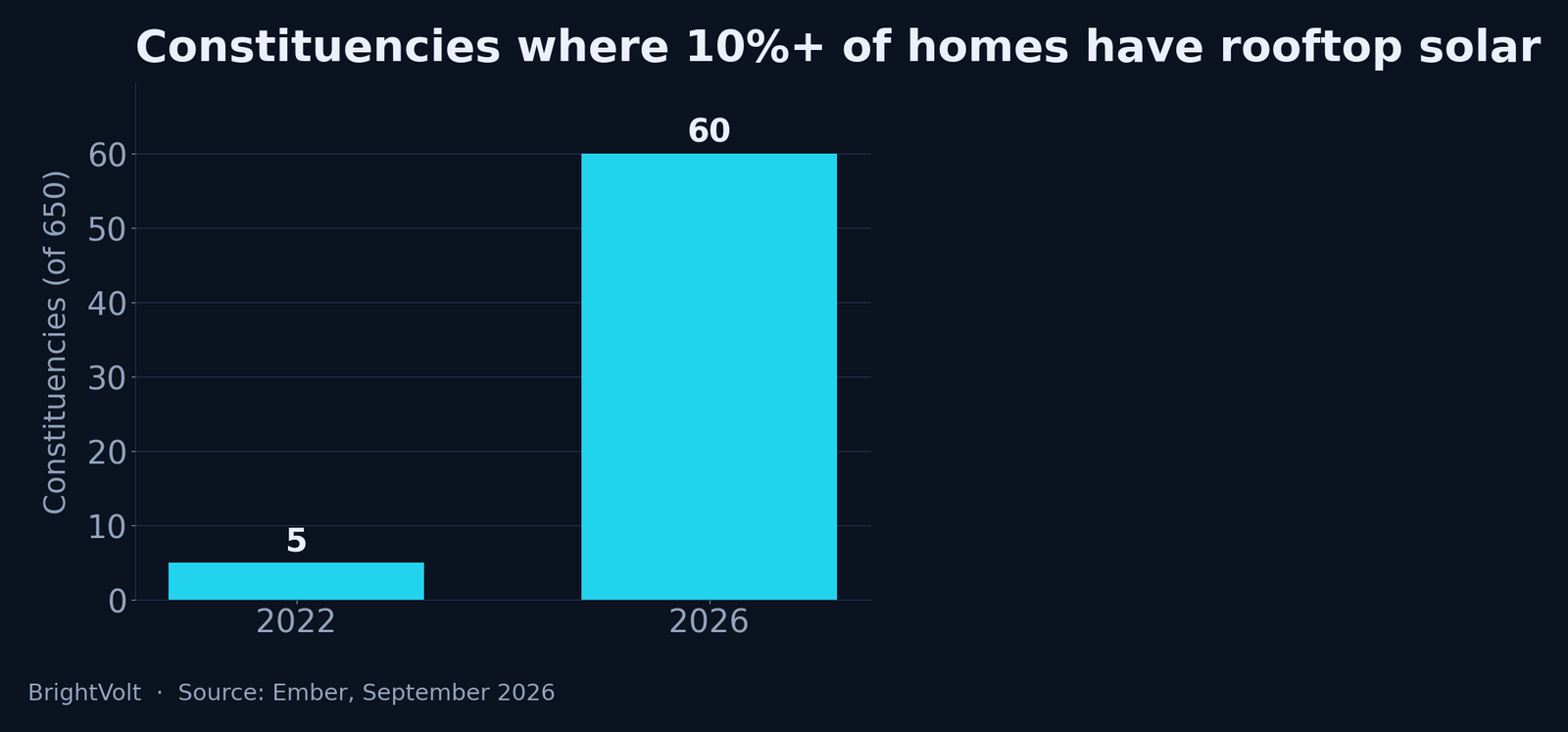
That entry cost sorts the country. Ember found rooftop solar on more than 10% of homes in over 60 parliamentary constituencies, up from just five in 2022 — genuine, fast growth, but growth concentrated in the places with owner-occupied houses, south-facing roofs and spare capital. Wales leads on solar, batteries and heat pumps together, holding seven of the ten fastest-growing solar constituencies; Orkney and Shetland top the heat-pump table. The map of fortification is tracking housing stock and ownership, not need.
And the households left outside the shield do not merely miss the savings. They increasingly carry the fixed costs the fortified homes stop paying into. Network upkeep, policy levies and the standing charge are recovered largely from grid electricity that is still bought and metered — so as affluent homes buy less of it, a rising share of those fixed costs falls on the consumption that remains, which belongs disproportionately to renters, flat-dwellers and low-income homes that cannot self-generate. It is the same cost-shift that drove the net-metering fights elsewhere, arriving in Britain through the back door of a resilience story.
The counter-case, and where it holds
The strongest reply is that this is not zero-sum. Every rooftop that generates and every heat pump that displaces a gas boiler cuts national gas demand, which softens the wholesale price everyone pays — the un-fortified included. Distributed solar and storage also shave the evening peak, the most expensive hour on the grid, lowering the marginal price that sets bills for all. On that reading, early adopters are not just insulating themselves; they are financing a transition whose benefits leak outward, and the costs of the kit are falling every year.
Some of that holds. The system-wide gas displacement is real and measurable. But the wholesale-price relief is thin and shared across 28 million homes, while the £500-plus and the “ten times” protection are concentrated and private. Falling costs help only the household that can still find the entry fee, and the payback maths that makes a battery worth it assumes you had the capital to start. Ember’s own recommendation — tailor the rollout to regions and tackle the easy wins first — is a quiet admission that, left to the market, the shield reaches the already-comfortable first and the exposed last.
What to watch
The report’s headline is a good one, and electro-fortification is a real and rising thing: the technologies work, the savings are genuine, and Britain is adopting them faster than the political conversation has noticed. The open question is not whether the electric home protects its owner. It is who gets to own one.
Watch three things. Whether financing — low-cost loans, social-housing retrofit, on-bill repayment — starts reaching the 19 million driveway households and the renters who cannot install a thing. Whether the standing-charge and fixed-cost reforms now under discussion stop the un-fortified subsidising the fortified. And whether the next 60 constituencies look like the first 60, or somewhere poorer. If fortification stays a purchase, resilience becomes a postcode. If policy makes the entry cost reachable, Ember’s shield could be something like universal. On today’s numbers, it is neither — it is real, and it is uneven.
Photo by Daria Agafonova on Pexels · Photo by alpha innotec on Pexels