
The United States is now spending public money to make its own electricity scarcer. On 6 August the Interior Department agreed to pay RWE $1.22 billion to surrender every offshore wind lease it holds — about 5.8 GW of planned capacity off three coasts. It was the fifth such buyback in six months, and it brought the running total to nearly $3.9 billion spent to cancel power the grid was counting on.
That is happening in the same eighteen months the administration declared a national energy emergency over a looming power shortage. The premise of the emergency was that America does not have enough electricity for the data-centre boom. The policy is to pay developers to build less of it.
What the RWE deal actually buys
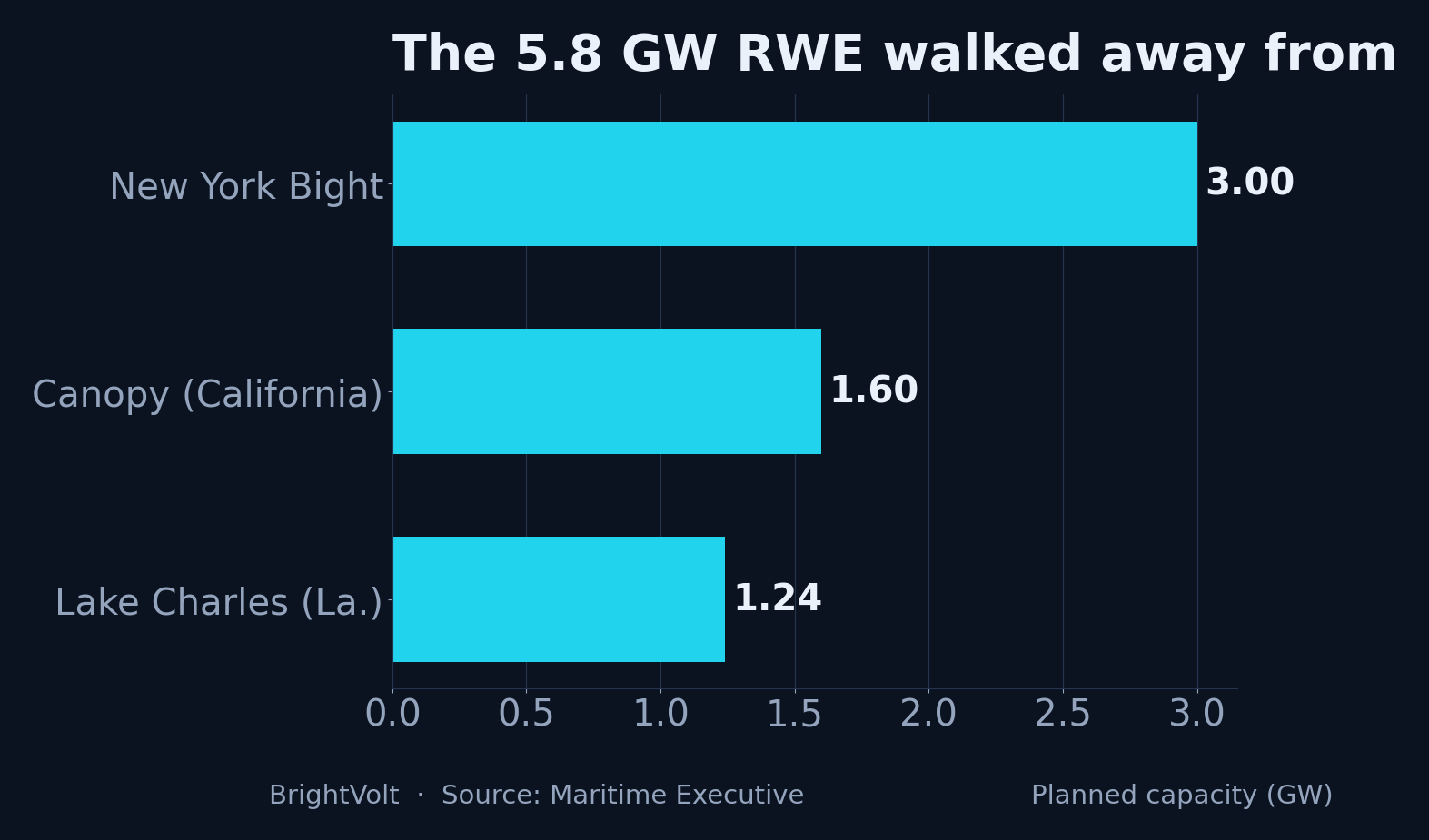
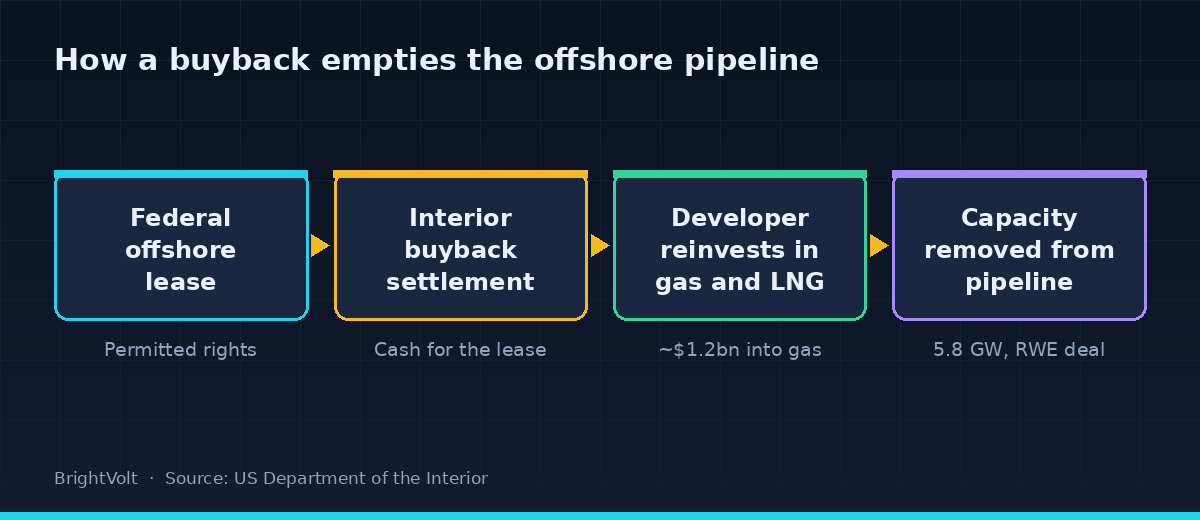
The $1.22 billion does not buy a wind farm, a factory or a single megawatt-hour. It buys the cancellation of three leases: the New York Bight (about 3 GW), the Canopy Offshore Wind site off Humboldt County, California (1.6 GW), and the Lake Charles area off Louisiana (1.24 GW). RWE relinquishes all of it and exits US offshore wind entirely. The Associated Press rounded the total to 7 GW and “enough to power more than five million homes”; the itemised lease capacities come to about 5.8 GW. Either way it is a large amount of firm coastal generation that will now not be built.
None of these were half-built turbines being torn down. They were permitted or early-stage development rights — the pipeline, not the fleet. That is the point of the mechanism. Cancelling a project under construction invites lawsuits and stranded-asset claims; buying back a lease before the steel is ordered is cleaner, and the developer often prefers the cash to a fight with its own regulator. The buyback is a way to empty the pipeline quietly.
The money doesn’t leave the energy business — it switches fuels
Here is the part that makes this more than a subsidy reversal. RWE is not banking the $1.22 billion and walking away from American power. It is redirecting almost exactly that sum straight into gas. The company has committed $900 million to a stake in a Louisiana LNG project and $300 million to reserve gas turbines, part of a pipeline of fifteen gas-fired peaking plants and some $19.6 billion of planned US investment over six years.
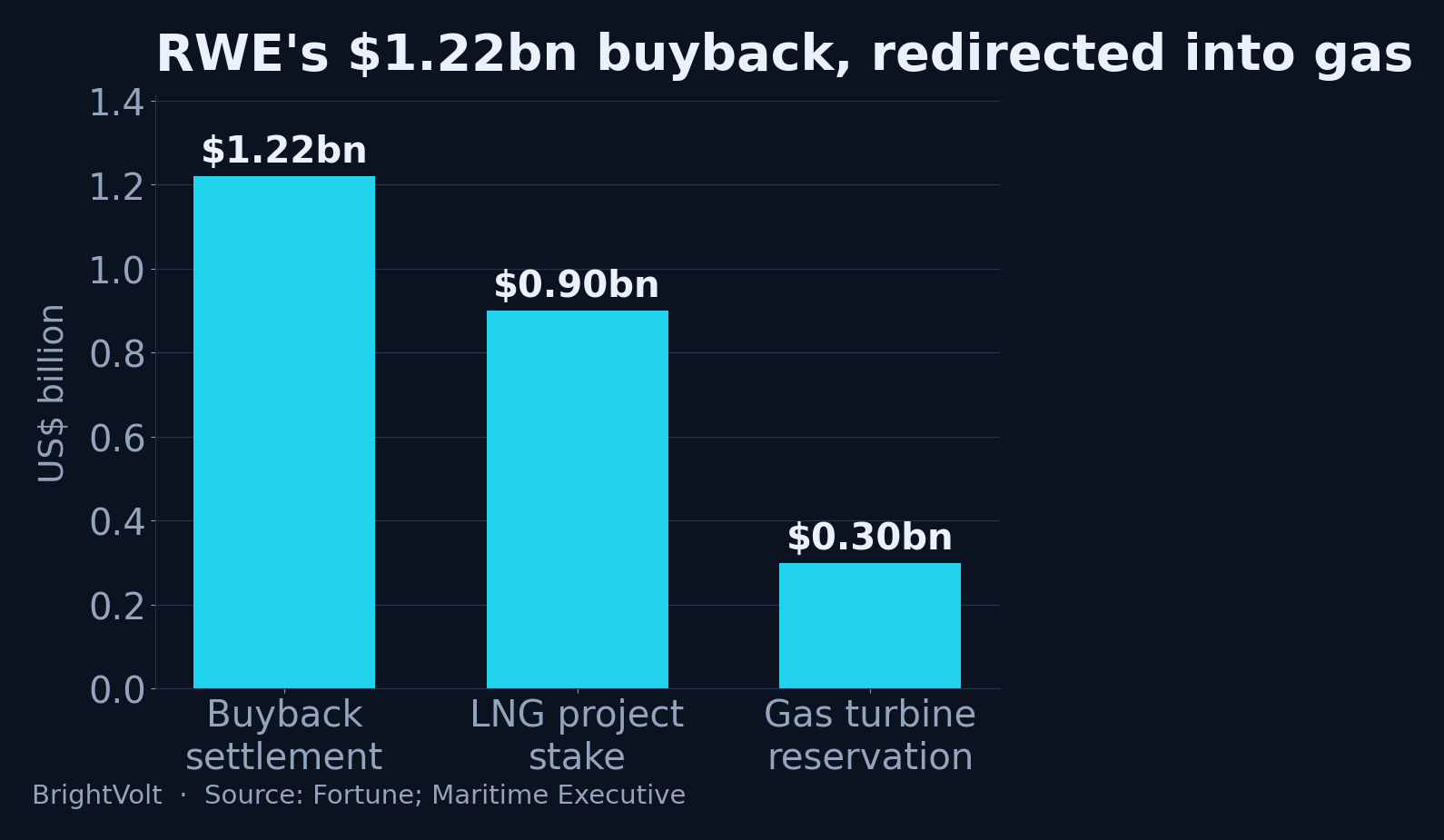
Nine hundred million plus three hundred million is $1.2 billion. The buyback cheque and the gas cheque are the same size. So the transaction is not the government buying back a lease; it is the government paying a European utility to swap 5.8 GW of offshore wind for a portfolio of gas plants and an LNG terminal, and covering the switching cost.
The trouble is that the gas cannot arrive on the timescale the emergency is supposed to be about. Heavy-duty turbines are the single most back-ordered piece of equipment in the power business: GE Vernova closed the second quarter with a 116 GW order book and is now selling delivery slots for 2031. A gas peaker reserved in 2026 is a 2031 machine. The offshore capacity being cancelled would have connected between 2027 and 2030. On pure schedule, the swap trades nearer power for later power.
Five deals, nearly four billion dollars
The RWE agreement is not a one-off. It is the fifth and largest in a run of buybacks that has become a standing programme.
| Developer | Announced | Payment | What was cancelled |
|---|---|---|---|
| TotalEnergies | March 2026 | ~$1.0bn | Two leases; company pledged to invest the proceeds in fossil fuels |
| Golden State Wind | April 2026 | ~$0.9bn combined | Paired with Bluepoint Wind; equal fossil-fuel investment required |
| Bluepoint Wind | April 2026 | (included above) | Early-stage lease |
| Invenergy | June 2026 | $0.765bn | Four early-stage offshore leases |
| RWE | August 2026 | $1.22bn | ~5.8 GW off New York, California and Louisiana |
The pattern repeats in every row: the developer is paid to drop the lease, and in most cases explicitly commits to spend the money on gas or LNG instead. This is not deregulation, which would cost the Treasury nothing. It is a transfer — public reimbursement for private companies to change what they build.
An energy emergency that pays for less energy
The declared logic and the visible policy point in opposite directions. Executive Order 14156 rests on the claim that the United States faces an electricity shortfall serious enough to justify emergency powers — a case built almost entirely on surging demand from AI data centres. If that shortfall is real, cancelling 5.8 GW of coastal generation makes it worse, not better. Forbes put the contradiction plainly: the country declared an energy emergency, then paid $4 billion for less energy.
The administration’s answer is that offshore wind was never dependable power to begin with. Interior Secretary Doug Burgum frames the buybacks as clearing out “costly subsidies” in favour of “dependable baseload,” and there is a real argument underneath the slogan: offshore wind is expensive per megawatt-hour, and its capacity value on a still winter evening is genuinely lower than a gas plant’s. Critics read the same transaction very differently. Senator Sheldon Whitehouse calls it a “money pump,” “pulling billions of dollars out of consumers’ pockets” to reimburse companies that then hand the cash to fossil-fuel projects.
Both can point at the ledger, but only one side has to explain the timing. The capacity-value case for gas over wind is a 2031 argument. The emergency is a 2026 one.
What to watch
Three things will tell whether this was a defensible reallocation or an own goal. First, the delivery dates — if the gas turbines RWE and the others are reserving actually energise before 2029, the swap starts to look like substitution rather than subtraction; if they slide with the rest of GE Vernova’s book, the country has paid to remove near-term capacity and replace it with a promise. Second, whether the programme stops at five deals or keeps buying, because the remaining permitted offshore pipeline is finite and each buyback shrinks it. Third, the courts and the states: New York, California and the New England grid operators were building supply plans around some of this capacity, and they are unlikely to absorb its removal quietly.
The honest summary is uncomfortable for the “gas comeback” narrative. The United States is not choosing gas over wind on the merits of a running plant. It is paying, up front and in cash, to cancel the wind now and order the gas for later — during a shortage it has declared severe enough to be an emergency.
Photo by Stefan Petrov on Pexels · Photo by Nothing Ahead on Pexels