

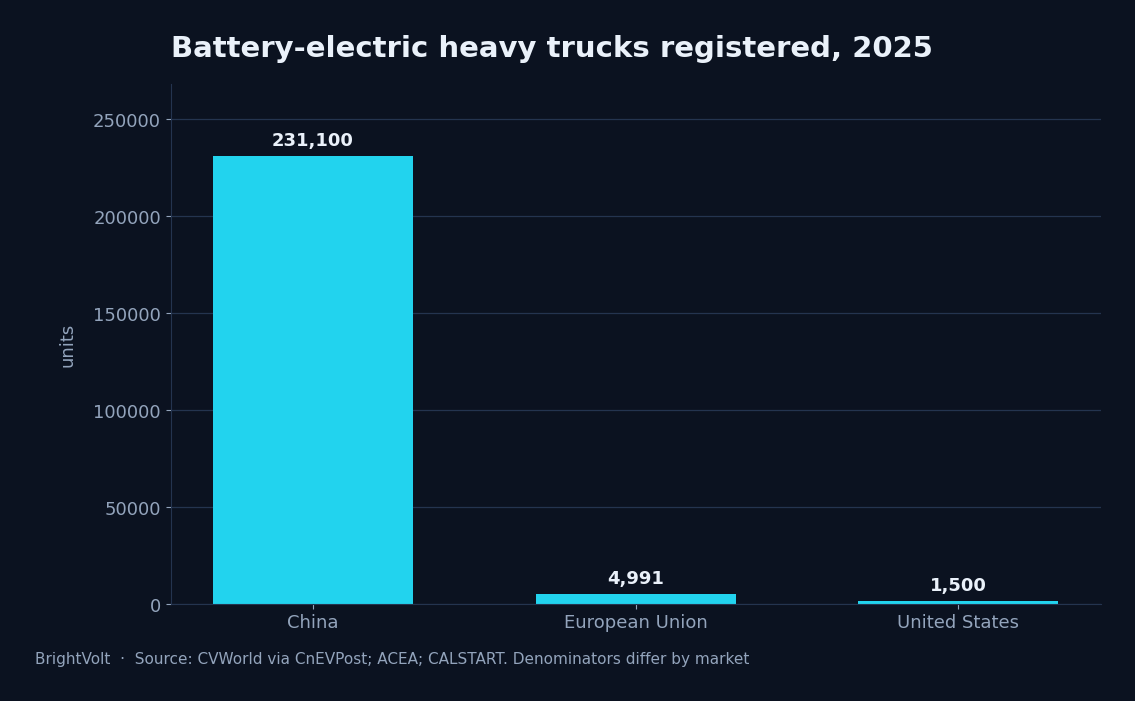
The European Union registered 4,991 battery-electric heavy trucks in all of 2025. China registered 231,100 new-energy heavy trucks — a category that is about 97% battery-electric, the remainder fuel cell. In the first half of 2026 China added another 126,200, up 85% year on year, while a fifth of its heavy trucks sold in May were electric.
China is not ahead of the West on electric trucks. It is running a different race, on duty cycles the West mostly does not have.
The Western numbers, honestly
Europe is growing fast from a small base. Heavy trucks above 16 tonnes hit 2.0% battery-electric share in 2025 on ACEA’s figures — 4,991 units in a market of 254,488. The first half of 2026 was better on the broader measure that includes everything above 3.5 tonnes: electrically chargeable registrations up 47.7%, share from 3.6% to 4.8%. That is a different and wider base than the 2.0% above, and the two should not be read as a series. Germany, the Netherlands and France account for about three-fifths of it — 3,137 units between them. Diesel is still 93.2%.
The American figure needs unpacking, because the headline flatters. CALSTART reported 12,996 zero-emission truck deployments in the second half of 2025, or 4.14% of new deployments. But 12,158 of those were cargo vans. Medium- and heavy-duty combined added 838 units.
That is the American Class 8 market, in a country that has just removed its regulatory forcing function. California withdrew its Advanced Clean Fleets waiver request and must repeal the high-priority and drayage fleet rules by 31 August 2026. Congress revoked the Advanced Clean Trucks waiver in June 2025. Four Section 177 states paused enforcement even before that.
What China is actually doing
| 2025 units | Share of new heavy trucks | |
|---|---|---|
| China, new energy (excl. exports) | 231,100 | 28.9% |
| China, new energy (wider denominator) | 233,200 | 20.5% |
| EU, over 16 tonnes | 4,991 | 2.0% |
| US, medium + heavy | ~1,500 | under 1% |
Two Chinese sources give near-identical volumes and very different penetration rates, because one excludes exports and one does not. Both are worth quoting; neither should be presented as the number.
The composition is the interesting part. Pure charging accounts for 67.4% of Chinese electric heavy trucks; battery swapping accounts for 29.0%. Fuel cells are 3.1%. Over 99% of installed cells are prismatic LFP.
Swapping works there because the duty cycle suits it. Chinese electric heavy trucks are concentrated in steel-mill and port drayage, mine-to-plant haulage and urban tipper work — 150 to 300 kilometre round trips returning to a fixed node. Regional concentration confirms it: Shanghai 34,100 units, Shenzhen 11,700, Guangzhou 9,685. Port and industrial clusters, not long-haul corridors.
Eleven ministries set the target in June 2026: 40% of new heavy truck sales electric by 2030, a fleet above 1.6 million, and around 3,000 heavy-truck charging and swap stations.
One caution. December 2025 saw penetration spike to 53.89% as buyers rushed expiring trade-in subsidies. By May 2026 it was back to 22.74%. The running rate is in the twenties and thirties, not above half.
Europe’s cost parity is bought, not earned
This is the finding that should change how you read European adoption.
ICCT modelling published in April 2026 puts German electric long-haul at 6.8% cheaper than diesel on total cost of ownership in 2026, and regional haul 4.8% cheaper. France and Sweden reach parity with full toll exemption.
| Country | Under current toll policy | With full exemption |
|---|---|---|
| Germany | −6.8%, electric already cheaper | — |
| France | −4.9%, electric already cheaper | — |
| Spain | +26.7% | +12.8% |
| Italy | +27.4% | +14.6% |
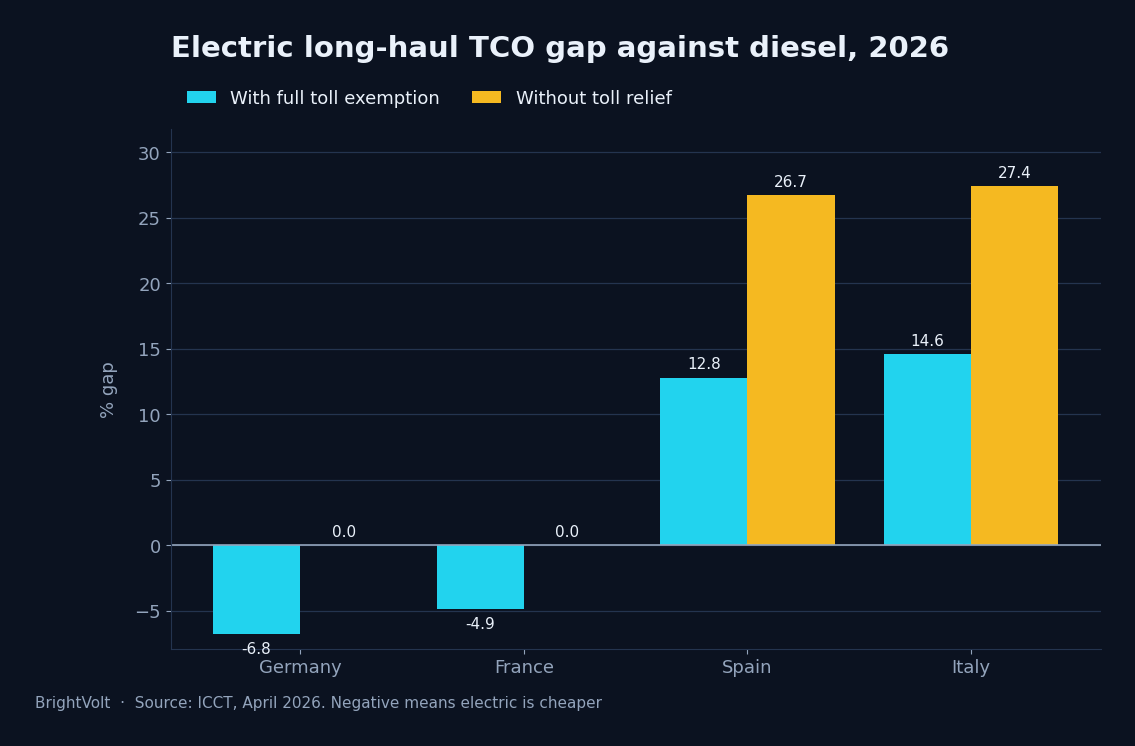
Germany’s advantage comes from a CO2-differentiated road toll, not from the truck. Strip the toll structure out and Italy and Spain sit roughly 27% adrift. A government that reprices tolls reverses the business case overnight without a single specification changing.
The purchase premium is unchanged: Mercedes’ eActros 600 costs up to 2.5 times its diesel equivalent. The payload penalty is largely neutralised in the EU by a 2-tonne allowance for zero-emission trucks — the eActros 600 carries 22 tonnes at 42 tonnes gross — but that helps volume-limited freight more than weight-limited bulk.
Tesla Semi, four years on
The first truck came off the high-volume line at Tesla’s Nevada plant on 29 April 2026, with a stated design capacity of 50,000 a year. Deliveries to date are a few dozen units across pilot programmes since the PepsiCo handover in December 2022. Tesla publishes no cumulative figure.
The 500-mile range claim has never been independently verified. The only outside test remains NACFE’s 2023 Run on Less programme, which recorded longest single-charge runs of 416, 377 and 376 miles on PepsiCo trucks at up to 82,000 lb — respectable, and short of 500. The widely repeated “545-mile day” was a daily total across multiple charges, not a single-charge range.
List prices are $290,000 for the 500-mile version and $260,000 for the 325-mile.
Where electric trucks still do not work
Weight-limited bulk at maximum gross weight, on irregular non-returning routes, with no depot at either end. There the truck loses payload, loses time to charging, and pays public charging rates that erase most of the energy saving.
The honest sceptical position is not that hydrogen wins — fuel cells are 3.1% of even China’s electric heavy truck mix. It is that diesel keeps the residual quarter or so of duty cycles for another decade, and that the electric share grows fastest wherever routes are short, repetitive and end where they started.
Which is precisely the Chinese pattern. The lesson Europe and America should take from 231,100 units is not that China is better at building trucks. It is that China electrified the duty cycles that electrify easily, first, at enormous scale — and that the West has been arguing about long-haul while leaving port drayage and urban distribution on diesel.
What to watch
Whether the ICCT’s toll-dependent parity survives Europe’s 2027 review of heavy-duty CO2 standards, given the Council already granted manufacturers credit-banking flexibility for 2025–29 in March. And whether Tesla’s Nevada line reaches anything resembling volume in the second half of 2026, which is the company’s own stated timeline rather than ours.
Two figures we could not obtain, and which nobody seems to publish: energy cost per kilometre from an independently audited fleet, and residual values for used electric heavy trucks. Both are central to any real total-cost case, and both currently exist only as manufacturer models.
Photo by Igor Passchier on Pexels · Photo by 炀 何 on Pexels