
Gas did not win the AI power race. In 2026 the US grid will add a record 86 GW of capacity, and 6.3 GW of it is natural gas — 7% of the total, behind solar, batteries and wind. The turbine order books everyone points to are real, but the first slots GE Vernova is selling now deliver in 2031. The power connecting this year is overwhelmingly solar and storage, because they are the only thing that can be built in time.
The narrative for the last eighteen months has run the other way. Data centres want firm, round-the-clock power; solar stops at night; therefore the AI boom means a gas comeback, and the clean-energy transition just met an immovable object. It is a tidy story. The 2026 interconnection figures do not support it.
What is actually connecting to the grid in 2026?
Solar and batteries, by a distance. The EIA expects 43.4 GW of utility-scale solar, 24 GW of battery storage and 11.8 GW of wind to come online this year — 79 GW of the 86 GW total. Natural gas adds 6.3 GW. Nuclear adds nothing. After coal and older gas retirements are netted out, one FERC-based reading has net fossil capacity actually falling by about 4 GW on the year.
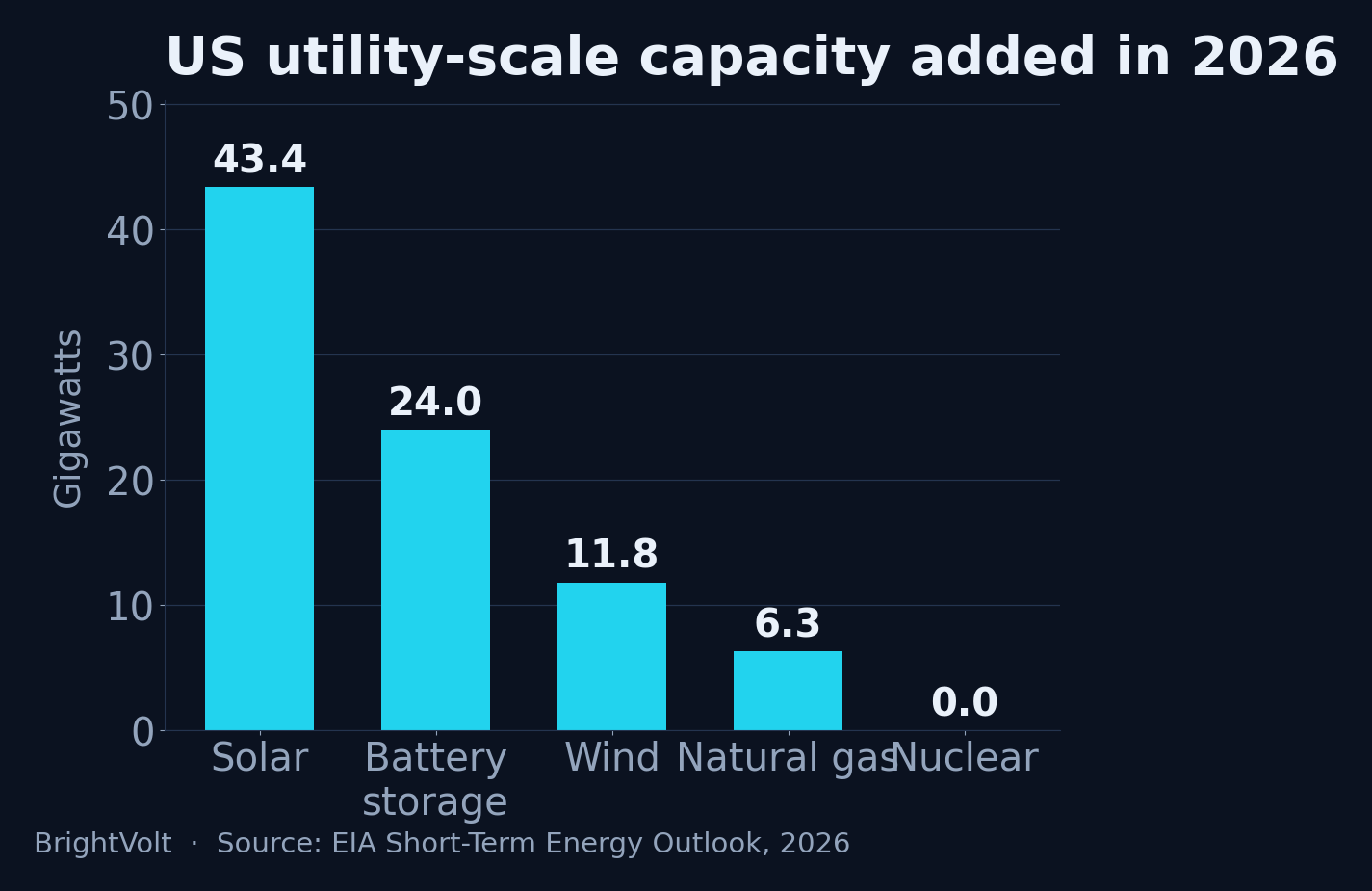
This is not a forecast of what people would like to build. It is the queue of what is already contracted, financed and pointed at an in-service date inside the next eighteen months. And it is 92% carbon-free. In the year gas was supposed to reconquer the grid, gas is a rounding error next to solar.
The reason is boring and decisive: lead time. A utility-scale solar-plus-storage project takes roughly 12 to 24 months from financing to first power. It is modular, the supply chain is deep, and a developer can bring it online in the window a data centre operator actually cares about. That is why the hyperscalers signing the loudest gas headlines are also, quietly, the largest buyers of solar and storage in the country.
So what is the 116 GW of gas turbines everyone keeps citing?
A waiting list, not a delivery. GE Vernova — the largest US turbine maker — ended the second quarter of 2026 with a gas-turbine backlog of 116 GW, up from 100 GW three months earlier. Roughly a fifth of it is data-centre demand. Impressive, until you read the delivery dates: the company is now taking reservations for 2031 deliveries and expects to be more than half-booked for that year by December.
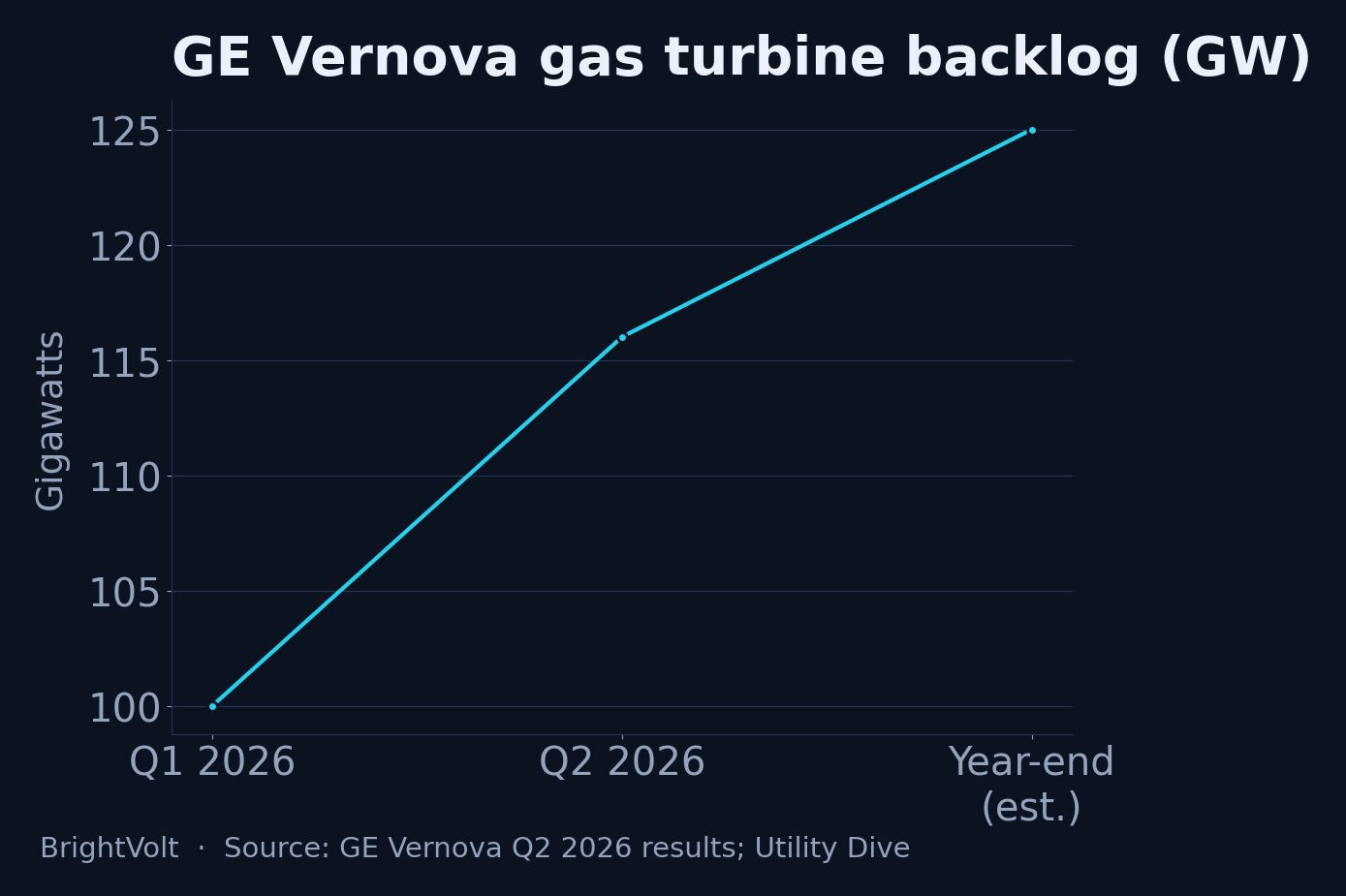
A backlog that grows while the delivery date slides further out is not evidence that gas is winning. It is evidence of scarcity. There are a handful of firms in the world that can cast a heavy-duty HA-class turbine, the forging capacity behind them has not expanded to match the order surge, and so demand queues instead of arriving. The backlog is the bottleneck wearing a victory sash.
That distinction is the whole argument. A gigawatt of gas capacity ordered in 2026 does not power a single server in 2026. It powers servers in 2031, maybe — if the project clears permitting, gets its interconnection, and secures a firm gas supply, none of which is guaranteed. A gigawatt of solar-plus-storage ordered in 2026 is delivering power in 2027. For a data centre racing to energise a campus before its GPUs are obsolete, that gap decides the question.
Doesn’t a data centre need firm power that solar cannot give?
This is the strongest version of the gas case, and it is worth stating properly. A hyperscale data centre runs at high load around the clock. Solar is variable and gone by evening. A gas plant is dispatchable and firm. On the surface, the workloads and the resource are mismatched, and no amount of cheap daytime solar changes that a data centre needs power at 2am.
Two things answer it. First, the firmness increasingly comes from the battery, not the gas plant. The 24 GW of storage landing this year is what turns variable solar into a block of dispatchable capacity, and four- to eight-hour systems now do at 2am what a peaker used to. That is precisely why storage is the second-largest category of additions rather than a niche. Second, nobody serious is proposing a solar-only data centre. The realistic near-term build is solar and storage carrying the bulk of the energy, firmed by grid draw and, where it exists, existing gas — with new turbines arriving late to backfill, not to lead. The gas is in the plan. It is just not the part that gets built first, and it is not the part growing fastest.

The interconnection queue tells the same story from the other side. Across US grid operators the projects waiting for a connection are overwhelmingly solar, storage and wind; gas is a thin slice of a queue measured in terawatts. We have made this point before about the grid: the constraint on American electricity is not generation technology, it is the wire and the transformer. Adding a fuel that takes five years to deliver does not relieve that constraint. It adds to it.
What would prove this read wrong?
A specific, watchable thing: firm gas capacity actually landing at data centres, at scale, before 2028. If GE Vernova and Siemens Energy start delivering into merchant data-centre projects two or three years ahead of the current book, and EIA’s 2027 and 2028 addition figures show gas closing the gap on solar-plus-storage rather than widening it, then the comeback is real and this piece was early. Watch the delivery dates, not the order announcements — the announcements have been bullish for two years while the in-service dates kept slipping right.
Until then, the honest description of 2026 is the uncomfortable one for both camps. Gas is not dead; 6.3 GW is not nothing, and the backlog is genuine future capacity. But it is not what is answering the AI power call this year. Solar and batteries are — not because they are cleaner, but because a developer can switch them on before the decade turns. In an industry measuring time in GPU generations, deliverable beats dispatchable. The turbines will come. The data centres could not wait for them.
Photo by Mikhail Nilov on Pexels · Photo by Ramesh Kambattan on Pexels