
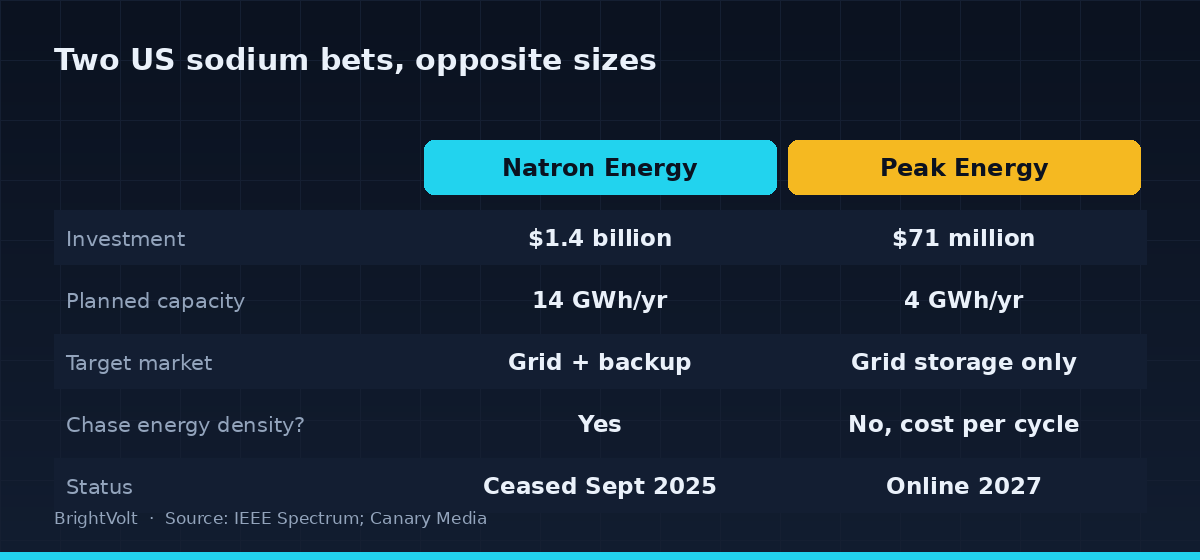
America is getting its first sodium-ion battery factory — for the second time. Peak Energy is building a $71 million plant near Sacramento to make 4 GWh of sodium-ion grid batteries a year, a twentieth of the budget of the $1.4 billion Natron Energy gigafactory that was meant to do roughly the same job and shut down in September 2025. The gap between those two numbers is the whole story of where sodium-ion actually belongs.
It does not belong in a car, and the American revival has stopped pretending otherwise. Natron chased scale; Peak is chasing the one market where sodium’s weakness does not matter. Which market that is comes down to a single figure.
Why Natron’s $1.4 billion sodium bet collapsed
Natron Energy was, briefly, the furthest-ahead sodium-ion company in the United States. It ran the country’s first commercial-scale sodium line, in Holland, Michigan, and had announced a $1.4 billion, 14 GWh factory in North Carolina, backed in part by a $19.8 million ARPA-E award. In September 2025 it ceased operations. Not because the cells did not work — because the money ran out before they could pay for themselves.
The mechanism that killed it is the same one that makes sodium hard everywhere. Sodium-ion cells hold less energy per kilogram than lithium ones, so hitting a given gigawatt-hour target takes more cells, more electrode coating, more machines and more floor space than the lithium equivalent. Battery researcher K.M. Abraham put the investor pressure plainly: companies could not scale fast enough to satisfy the capital they had raised. A 14 GWh sodium plant is a very large, very capital-hungry thing to finance before a single cell has earned a dollar. Natron tried to out-build a disadvantage instead of designing around it.
What Peak is building instead
Peak Energy’s plant is a deliberate retreat from all of that. It is roughly 4 GWh a year in 183,000 square feet, coming online in 2027 with first commercial shipments in the first quarter, and it makes one product: 3.1 MWh containers of stationary grid storage. No car ambitions, no attempt to match lithium on energy density, no 14 GWh moonshot.
The specifications it does chase are the ones a grid operator cares about. Peak claims its system runs to roughly 20,000 cycles over a 20-year life — retaining 80% of capacity at the end of it, against the 8,000-odd cycles a typical LFP pack manages — at 96% round-trip efficiency and tolerating heat up to 55°C without the cooling overhead lithium needs. On lifetime cost it projects about 20% below lithium iron phosphate, with cell price parity arriving around 2028.
The order book is already grid-shaped. Jupiter Power has committed to as much as 4.75 GWh through 2030, a deal worth around $500 million; Energy Vault has signed for 1.5 GWh aimed at data-centre backup; RWE has a pilot near Milwaukee that energised in March 2026, alongside an earlier 3.5 MWh installation in Colorado. General Motors is the one hedge against the thesis — it is co-developing sodium cells with Peak for domestic production in 2028 — but even that is a bet on cheap, cold-tolerant chemistry for entry vehicles, not a claim that sodium is about to out-range lithium.
The one number that decides where sodium goes
Energy density. Today’s commercial sodium-ion cells sit at 100 to 160 Wh/kg, with the best mass-production cell — CATL’s Naxtra — rated at 175 Wh/kg. A literature review this month put the ceiling for advanced prototypes at “approaching 200 Wh/kg.” That is the optimistic number, the one still in the lab. And it lands right about where LFP already sits in mass production.
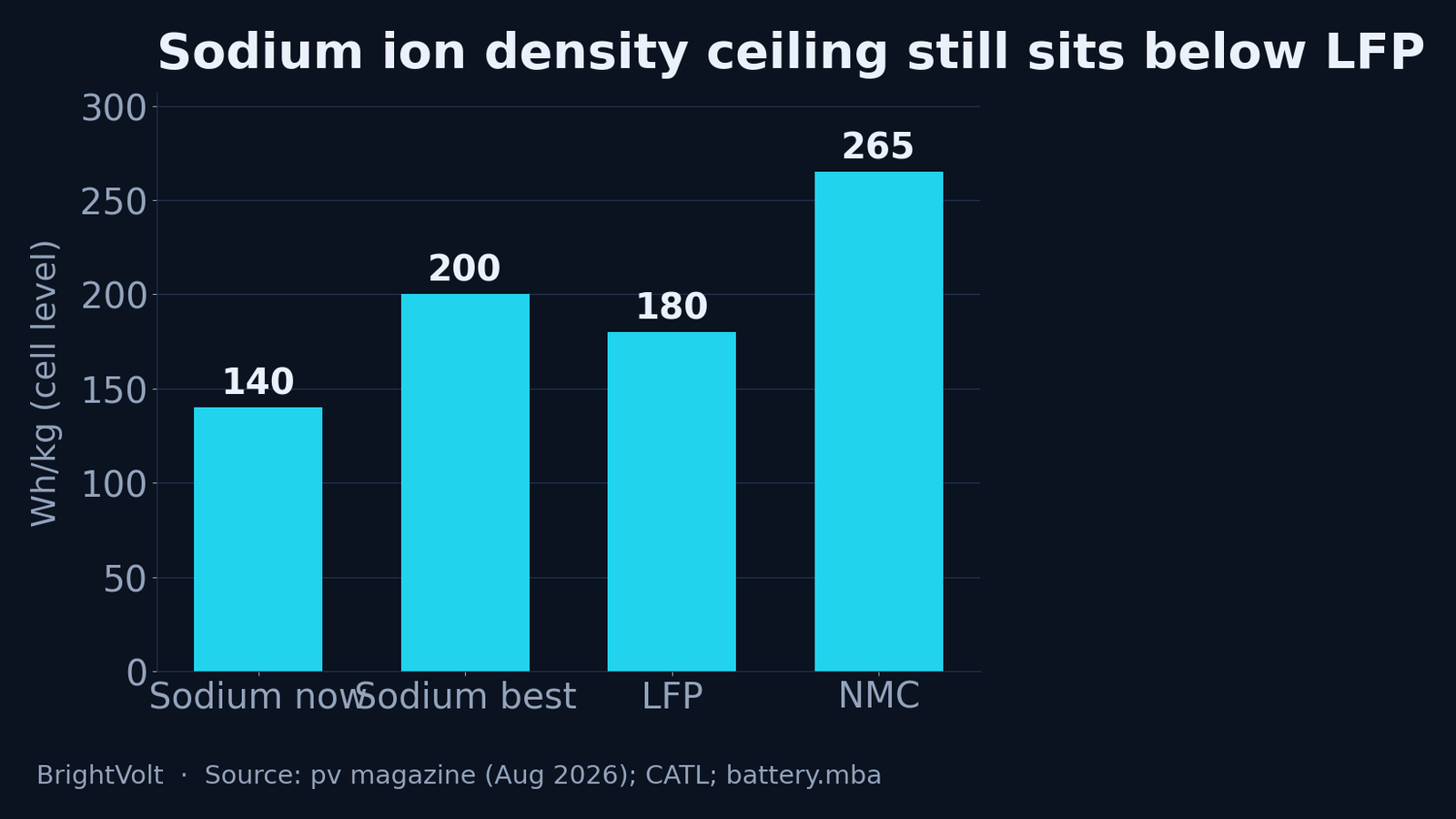
That single fact routes the entire technology. In a car, energy per kilogram sets range, so a chemistry that tops out where LFP starts is a permanent second-best — fine for a cheap city runabout, hopeless for anything that needs to go far. On a concrete pad next to a substation, weight is nearly free. A grid battery is not carried anywhere; it sits still for twenty years and gets judged on cost per cycle, cold-weather behaviour and fire risk — every axis on which sodium is competitive or better.
| Chemistry | Cell energy density | Cycle life (to 80%) | Cell cost |
|---|---|---|---|
| Sodium-ion | 120–160 Wh/kg | 4,000–8,000 | $90–110/kWh |
| LFP | 160–200 Wh/kg | 4,000–10,000 | ~$95/kWh (China <$60) |
| NMC | 240–290 Wh/kg | 1,500–3,000 | $130–150/kWh |
The table is why the honest sodium pitch is not “cheaper lithium.” LFP already undercuts it on both energy and, in China, price. Sodium’s real edges are the ones stationary storage values and cars do not: raw materials that do not depend on lithium or cobalt, cells that keep working at −40°C, and a cost curve that is early and falling rather than mature. None of those wins a range war. All of them win a grid tender.
Why the grid, not the car
Put the two American sodium projects side by side and the lesson writes itself. Natron aimed at everything and needed a fortune up front to get there. Peak aims at one thing, at a twentieth of the capital, and has a signed pipeline before the plant is finished. The difference is not ambition or engineering. It is picking a market where the chemistry’s one incurable flaw simply does not apply.
The scale is still modest. Sodium-ion is under 1% of new US storage this year and forecast to reach around 4% by 2030. But that is a real, growing niche with domestic supply-chain appeal, not a science-project curiosity — and it is a lane China is not yet contesting, because CATL is busy putting Naxtra into cars while the US claims the stationary side. The rise of AI data centres, each wanting hours of on-site backup that never has to move, only sharpens the case for a heavy, cheap, durable battery that does not care what it weighs — the same data-centre power crunch that is straining the grid elsewhere.
What to watch
Three things will show whether Peak has found the sustainable shape Natron missed. First, whether the Sacramento line actually ships in the first quarter of 2027 and whether cost parity with LFP arrives on schedule in 2028 — a sodium company missing a cost target is how this movie ended last time. Second, whether GM’s 2028 sodium cells materialise, because a credible entry-EV use for sodium would widen the market beyond the grid. Third, whether that “approaching 200 Wh/kg” prototype ceiling ever becomes a shipping cell, because if sodium closes the last of the gap to LFP, the calculus that currently pens it into stationary storage starts to loosen.
Until then, the American bet is clear and, this time, correctly sized. Sodium-ion is not the cheaper electric car. It is the battery you bolt to the grid and forget about — and the plant that survives is the one that was built to do only that.
Photo by Heru Dharma on Pexels · Photo by Keegan Checks on Pexels