
A commercial sodium-ion cell holds about 175 Wh/kg. Lithium iron phosphate holds about 205, and NMC about 255. That 30 Wh/kg gap between sodium and the cheapest lithium chemistry is the entire story of what sodium-ion is for, and it is not going to close, because the reason for it is the periodic table rather than engineering effort.
Which has not stopped sodium becoming a real manufacturing bet. CATL and Changan unveiled the first mass-production sodium-ion passenger car on 5 February 2026, and Peak Energy announced a 4 GWh factory in Sacramento on 8 July. It also has not stopped one of its most prominent developers going out of business.
Why sodium-ion holds less energy than lithium
Four separate penalties stack up, and only one of them is the obvious one.
Mass. Sodium weighs 22.99 g/mol against lithium’s 6.94. Each ion carries exactly one electron, so sodium is 3.3 times the dead weight for the same charge moved.
Voltage. The Na⁺/Na couple sits at −2.71 V against the standard hydrogen electrode; Li⁺/Li sits at −3.04 V. Sodium surrenders 0.33 V of cell voltage before a designer makes a single decision. Commercial sodium cells run at a nominal 3.0–3.1 V against LFP’s 3.2 V and roughly 3.7 V for NMC. Energy is capacity multiplied by voltage, so against LFP that 5% voltage deficit accounts for about a third of the 30 Wh/kg gap on its own.
Ion size. The sodium ion measures 1.02 Å in six-fold coordination against lithium’s 0.76 Å. A larger ion means fewer host sites per unit of lattice, slower intercalation, and more structural strain each time the cell cycles.
The anode, which is the real problem. Graphite is the workhorse of every lithium cell, storing about 372 mAh/g. With sodium, at room temperature, it stores under 3% of that — sodium simply does not form the stable staged compounds with graphite that lithium does. So sodium-ion is pushed onto hard carbon instead, at about 300 mAh/g, which is both lower in capacity and less dense than graphite. The volumetric penalty compounds the gravimetric one.
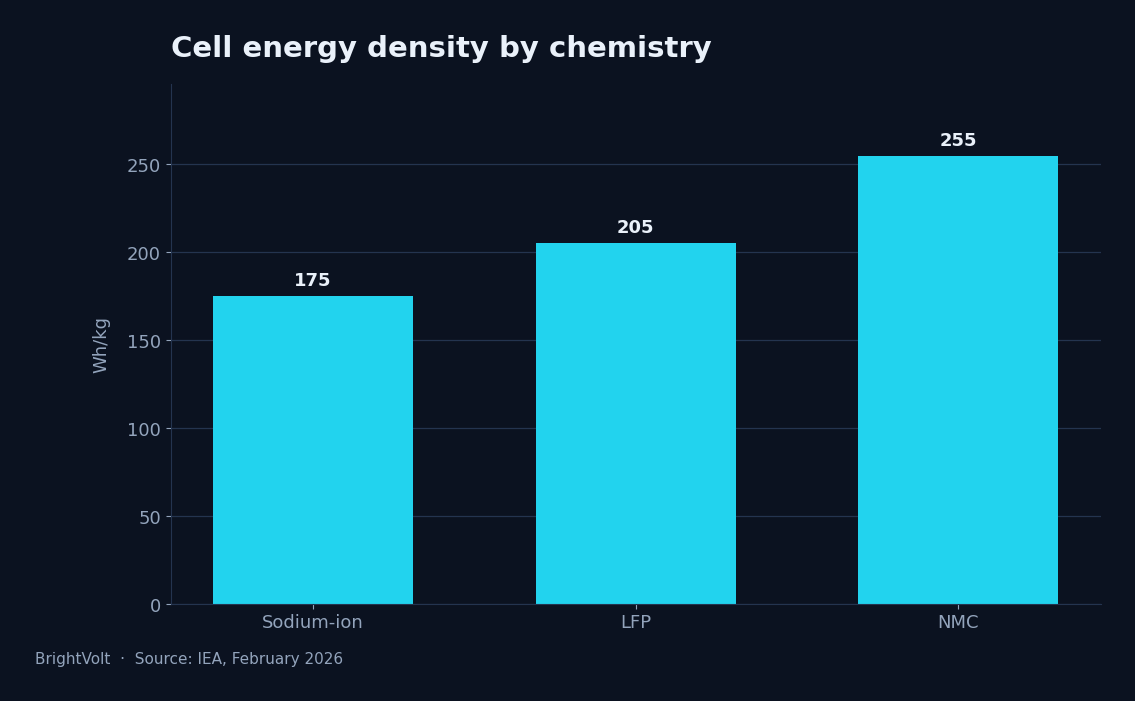
That fourth point is why “they’ll improve it” is the wrong instinct. The first three are constants. The fourth is a materials dead end that thirty years of graphite optimisation cannot be borrowed for. The IEA’s translation into something you can picture: a mid-size SUV gets around 350 km on sodium-ion against 400–600 km on lithium-ion — and those are test-cycle figures, with all the caveats that carries.
What sodium is genuinely better at
Cold, mostly, and by a wide margin.
CATL rates its Naxtra cell at nearly three times LFP’s discharge power at −30 °C, with over 90% capacity retention at −40 °C and stable output down to −50 °C. Independent bench testing presented at EVS38 in June 2025 found a 48 V sodium pack losing 17% of its power at 0 °C against a 50% loss for power-type LFP. Charging works at −20 °C.
Cycle life is the second win. CATL’s TENER grid product is rated at 15,000 cycles to 70% state of health, Envision claims 20,000 and Hithium more than 20,000, against a typical few thousand for LFP.
Then there is the shipping trick, which sounds trivial and is not. Sodium does not alloy with aluminium, so both electrodes can use aluminium current collectors — lithium cells need copper on the anode side. That is what lets a sodium cell be discharged to zero volts and transported shorted, removing the fire-risk classification that governs how lithium cells move around the world.
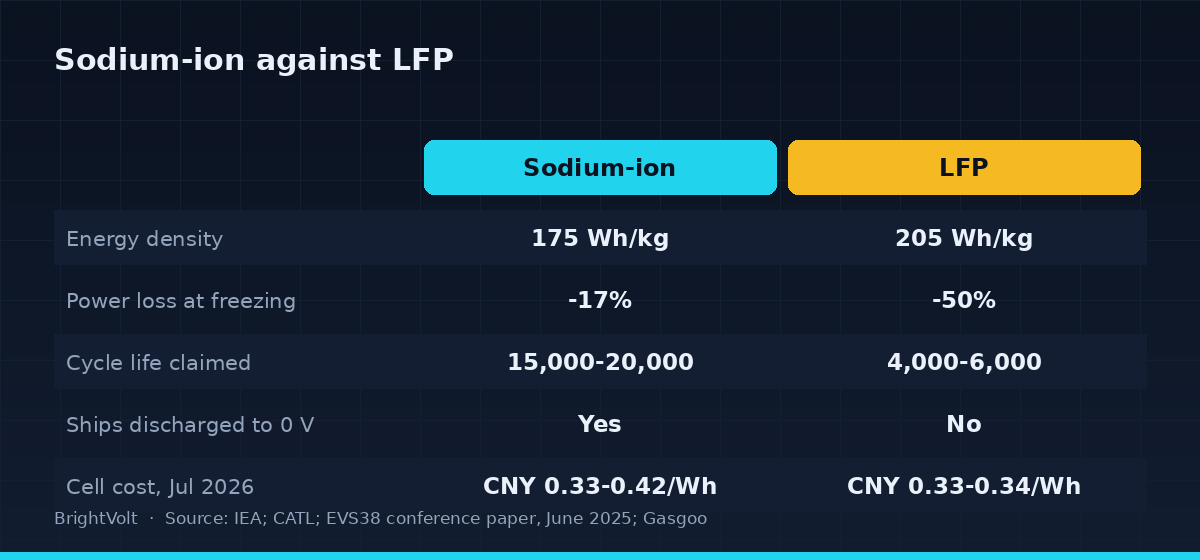
Note the bottom row. Chinese cell prices in July 2026 put sodium at ¥0.33–0.42 per Wh against LFP’s ¥0.33–0.34. After the cold-weather advantage, the cycle life and the shipping exemption, sodium is at best level with LFP on cost and at worst 24% worse.
Where the manufacturing actually is
Almost entirely in China. Sodium-ion is under 1% of global lithium-ion production, and the IEA puts more than 95% of announced 2030 capacity in China.
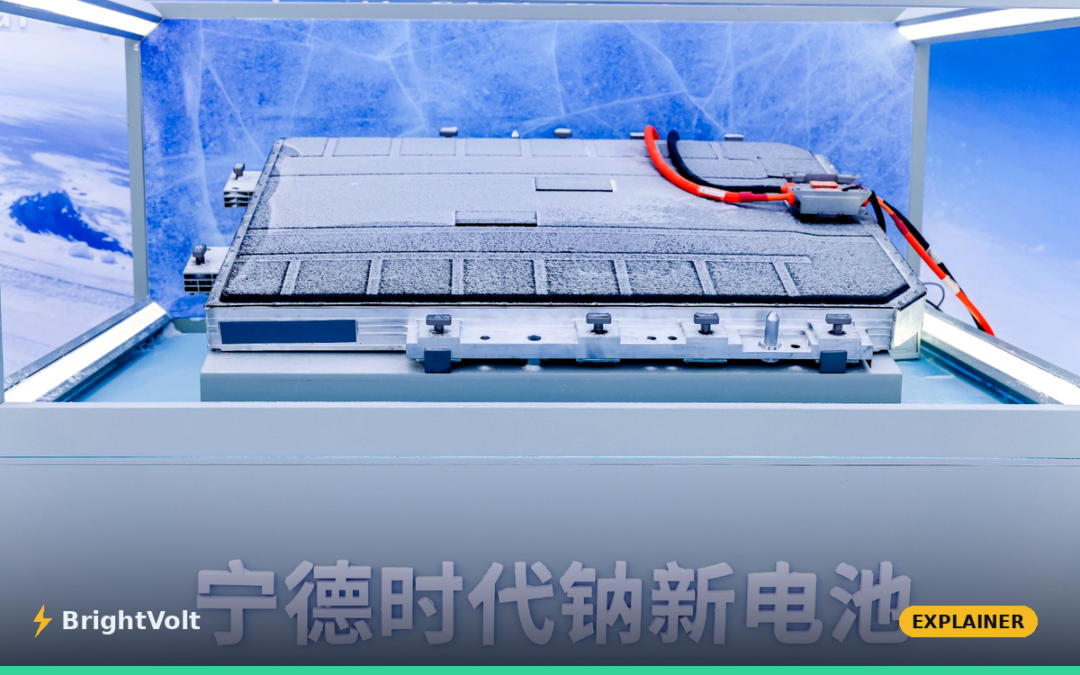
CATL is the anchor. Its Naxtra EV cell reaches 175 Wh/kg and goes into the Changan Nevo A06 — a 45 kWh pack rated at up to 400 km — which reaches the market from the middle of this year. Its grid product ships in China from September 2026 and globally from June 2027.
Hold that alongside the capacity numbers. CATL’s Fuding site carries 40 GWh and Jining is planned at up to 160 GWh, and the company’s cumulative shipment target for sodium by the end of 2026 is 1 GWh. HiNa, whose sodium cells are in mass production today, is at 1 GWh against a 5 GWh target. Announced capacity and operating capacity are two different industries.
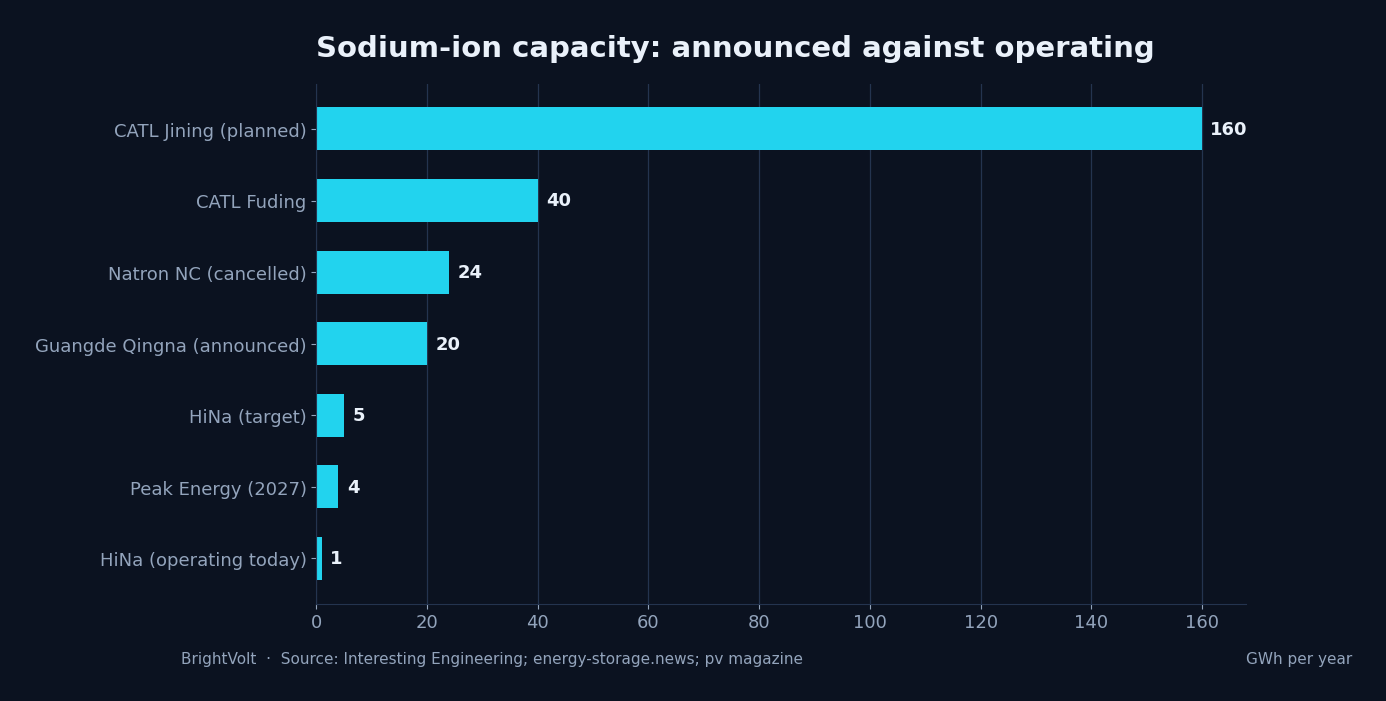
Outside China, Peak Energy’s Sacramento plant is the serious one: 4 GWh a year, up to $71 million, production from the first quarter of 2027, with more than 6 GWh already contracted to Jupiter Power, Energy Vault and RWE Americas. The detail worth noticing is that the cells are General Motors’. Peak partnered with GM in June 2026 and is integrating rather than manufacturing cells — a deliberate choice, and the next section explains why it was a wise one.
The company that died proving the point
Natron Energy shut down on 3 September 2025 after its board concluded a week earlier that its fundraising had failed. Ninety-five employees, two closed facilities, and a $1.4 billion North Carolina gigafactory that was never built. It had taken $19.8 million from ARPA-E.
Natron’s chemistry was Prussian blue analogue, which cycles superbly and holds very little energy. Tyler Evans, who runs the rival sodium-ion firm Mana Battery, named the mechanism precisely: if you want a gigawatt-hour of annual manufacturing capacity, “if your energy density per battery cell is very low, producing that capacity requires more manufacturing lines.” Low energy density is not only a product limitation. It is a capital-expenditure multiplier, because gigawatt-hours are what you sell and cell volume is what you have to build lines for.
Benchmark Mineral Intelligence’s Evan Hartley added the demand-side half: “They were targeting sodium-ion, which meant they had a much lower pool of demand to target.” He put North American sodium-ion demand at no more than 3 to 4 GWh by the end of the decade — which is to say, roughly one Peak Energy factory.
Doesn’t cheap lithium settle this anyway
That was the argument through 2024 and 2025, and it has stopped being true in the way people repeat it. Battery-grade lithium carbonate in China bottomed below ¥60,000 per tonne in June 2025 and traded at about ¥146,000 on 30 July 2026 — roughly double year on year, two and a half times its trough, and still some 75% below the December 2022 peak above ¥575,000.
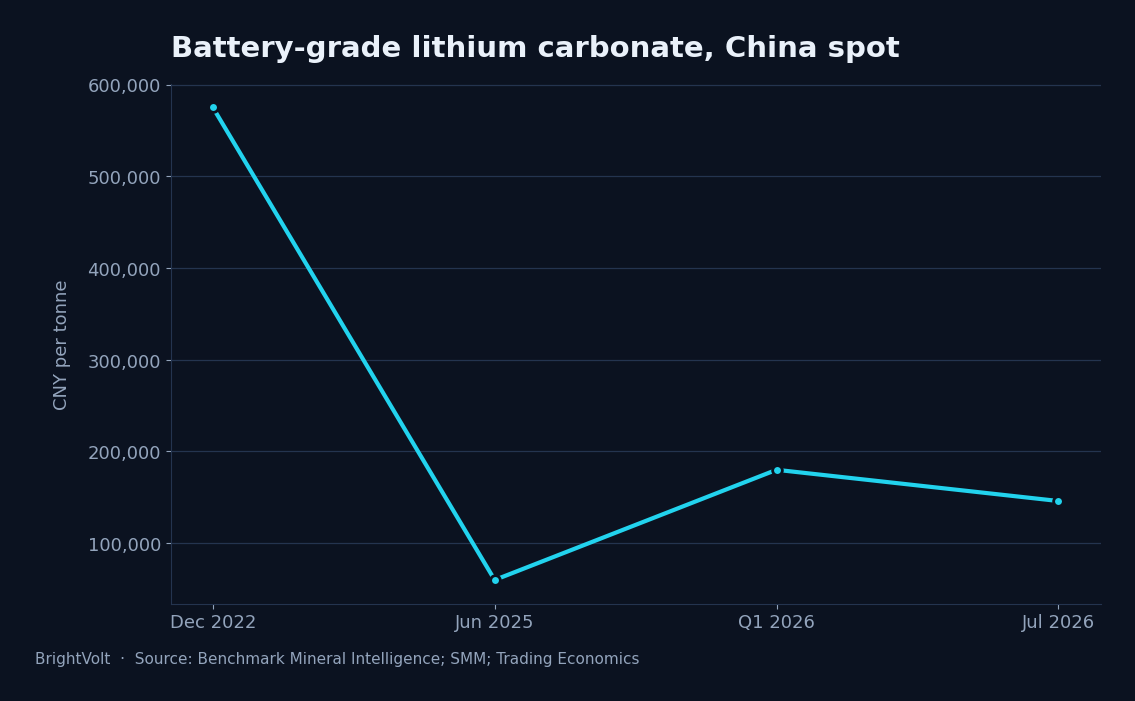
So lithium doubled. And the IEA’s assessment, published in February 2026, still reads: current lithium prices “are not yet high enough for sodium-ion batteries to undercut LFP costs in most applications.”
That is a considerably harder finding than the one it replaced. It is not that cheap lithium is holding sodium back. It is that lithium had to double and sodium still is not cheaper.
Forecasts for cost parity diverge so widely that the divergence is itself informative. CATL says cell parity by the end of 2026 and system parity in 2027. Gasgoo’s analysis says late 2026 to 2027. The IAV engineers behind the EVS38 paper say the mid-2030s. Wood Mackenzie says 2035. Nobody in that list is being unserious; they are making different assumptions about scale, and at sodium’s current volumes nobody has the data to settle it.
What sodium-ion is for
Grid storage in cold places, backup power where cycle count matters more than footprint, and cheap short-range vehicles in markets where winter destroys lithium range. Those are real markets and CATL is not investing in them for fun.
What sodium-ion is not for is replacing lithium in a long-range car, and the useful thing about the physics above is that it tells you this is permanent rather than provisional. Watch two numbers. If sodium cells reach 200 Wh/kg in commercial production, the hard-carbon ceiling has been broken and this analysis needs revisiting. And if CATL ships materially more than its 1 GWh target for 2026, announced capacity is finally becoming real capacity — which, on the evidence of the last three years, would be the more surprising of the two.
Photo by Heru Dharma on Pexels · Image: CATL