
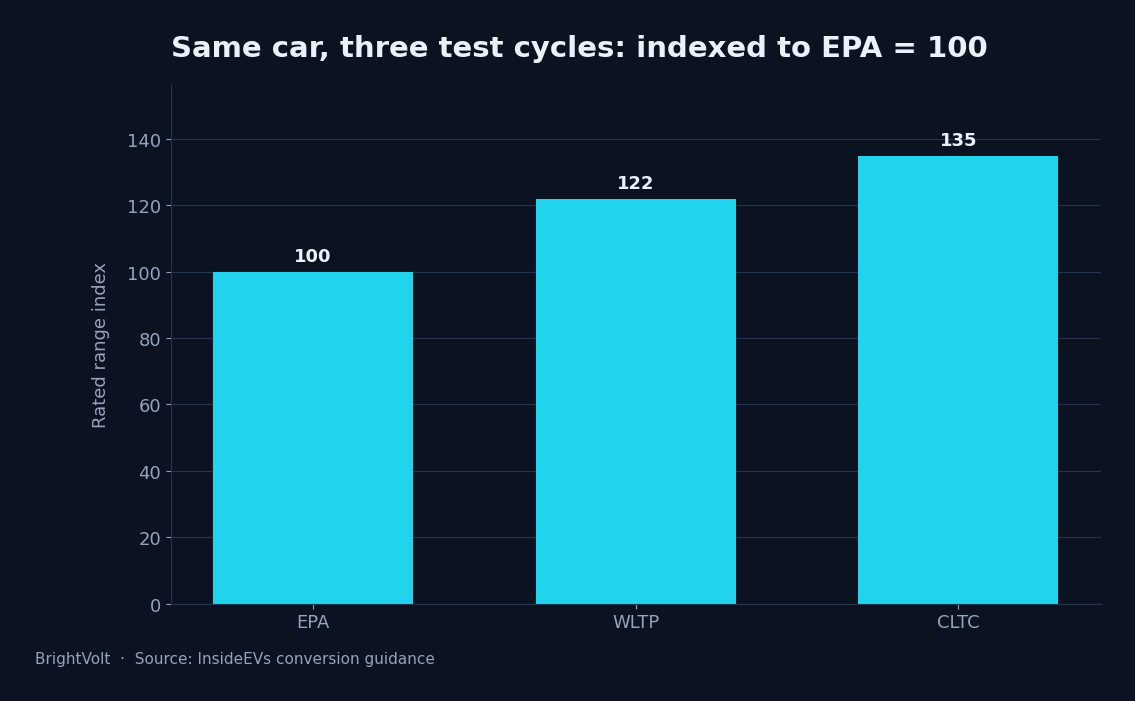
A Chinese electric car advertising 1,000 km of range and an American one advertising 500 km may cover almost the same distance on the same road. The gap is mostly the test, not the car: CLTC figures run roughly 35% above EPA ratings, and WLTP roughly 22% above, which means a single vehicle can carry three very different numbers depending on where it is sold.
This matters more every month, because Chinese manufacturers are now launching vehicles into export markets with headline figures quoted on the most generous cycle in use.
The three numbers you will actually encounter
EPA is the United States standard, administered by the Environmental Protection Agency. It produces figures closest to real-world results — the article-level consensus is that EPA deviates least from independent range tests — because its procedure includes higher-speed driving and applies adjustment factors intended to reflect ordinary conditions rather than ideal ones.
WLTP is the Worldwide Harmonised Light Vehicles Test Procedure, used across Europe and much of the rest of the world. It replaced the older NEDC standard specifically because NEDC had become detached from reality. WLTP is stricter than what it replaced and still optimistic relative to EPA, typically by around 22%.
CLTC is the China Light-duty Vehicle Test Cycle, and it is the most generous of the three. It sits a few percentage points above the NEDC figures it succeeded, and roughly 35% above EPA for the same vehicle.
Why the same car scores differently
The cycles differ in what they simulate. A test that spends more of its duration at low urban speeds will flatter an electric car, because electric drivetrains are at their most efficient in stop-start conditions where regenerative braking recovers energy and there are no idling losses. A cycle weighted towards sustained higher speeds punishes them, because aerodynamic drag rises with the square of velocity and there is no regeneration to recover.
Ancillary loads matter too. Climate control is the largest non-propulsion draw in an electric car, and cabin heating in particular has no waste-heat source to borrow from. A cycle that runs at moderate temperatures with minimal HVAC demand will produce a materially better figure than one that does not.
None of this makes any single cycle dishonest. They are answering slightly different questions, and each is internally consistent — a car that scores better than another on CLTC will almost always score better on EPA too. The problem is only that the numbers get quoted across contexts as though they were interchangeable.
Converting between them, carefully
As working approximations:
| From | To | Rough adjustment |
|---|---|---|
| CLTC | EPA | subtract ~26% (CLTC runs ~35% above EPA) |
| WLTP | EPA | subtract ~18% (WLTP runs ~22% above EPA) |
| CLTC | WLTP | subtract ~10% |
| NEDC | CLTC | roughly comparable, CLTC marginally higher |
Applied to a real example: a Chinese-market sedan quoting 1,660 km CLTC would land somewhere near 1,230 km on an EPA-equivalent basis. Still a remarkable figure — but a quarter lower than the number on the poster, and the difference is larger than the entire range of many earlier electric cars.
The important caveat is that these are rules of thumb and nothing more. The relationship between cycles varies considerably by manufacturer and by model, and there is no reliable way to convert between them with precision. A conversion tells you roughly where a car sits; it does not tell you what it will do on your commute.
What this means when you are comparing cars
Only compare figures measured on the same cycle. If a review quotes CLTC for one car and EPA for another, the comparison is meaningless without adjustment, and adjustment introduces its own error.
Treat the cycle label as part of the specification rather than a footnote. A responsible listing states which standard produced the number; one that quotes a bare kilometre figure with no cycle named is withholding the information you need to interpret it.
And remember that all three are laboratory procedures. Cold weather, sustained motorway speed, roof boxes, headwinds and a full passenger load each cost real range that no cycle fully captures. The most useful mental model is that EPA is the closest to what you will see, WLTP is what you might see on a good day, and CLTC is what the car achieves under conditions you are unlikely to arrange.
Photo by Reinhard Bruckner on Pexels · Photo by Tom Fisk on Pexels