
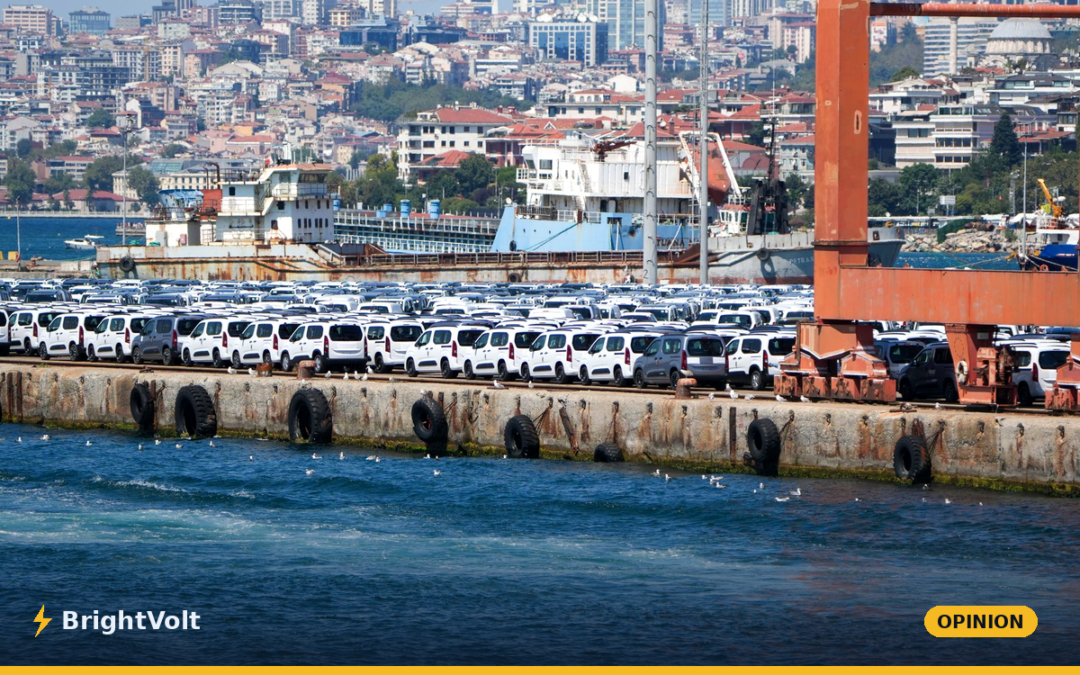
China sold 1.56 million new energy vehicles in July, up 23.7% on a year earlier — and the home market shrank. Retail sales of NEVs fell 3.9%, the seventh straight month of decline, while exports jumped 145%. The growth everyone quotes is happening on the docks, not in Chinese showrooms.
That gap is the story of China’s EV market in 2026, and most headlines get it backwards. “NEV sales up 23.7%” is a wholesale figure inflated by cars leaving the country. Strip the exports out and the picture inverts: domestic demand is contracting, hard, in the largest EV market on earth.
Two scoreboards, pointing opposite ways
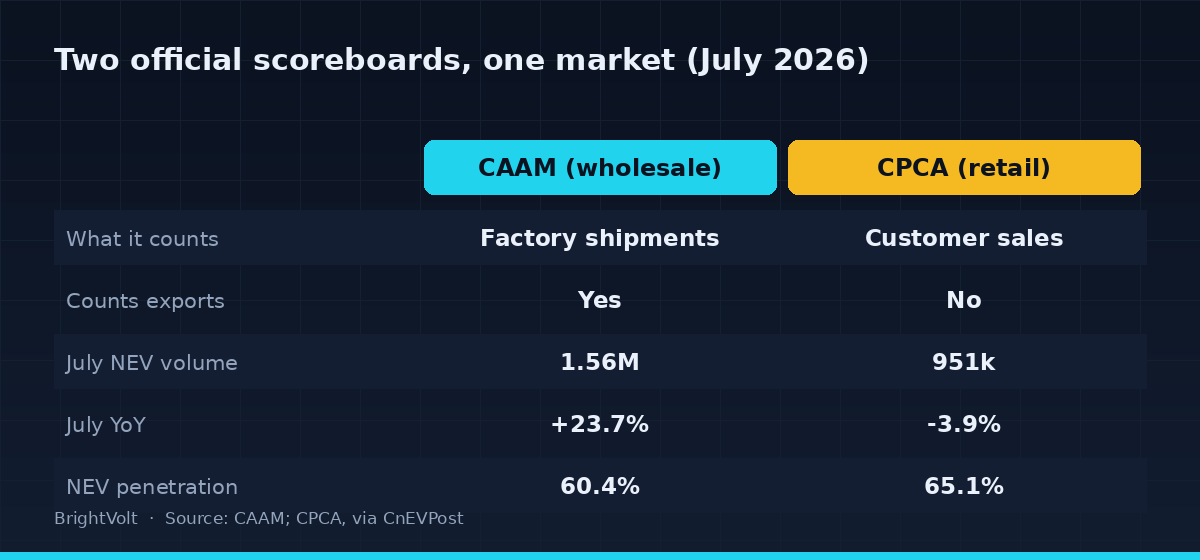
China keeps two sets of books, and for seven months they have disagreed. The China Association of Automobile Manufacturers (CAAM) counts a car when it leaves the factory. The China Passenger Car Association (CPCA) counts it when a customer drives it away. In a normal month the two move together. They have now diverged for seven months running, and the wedge between them is inventory heading overseas.
CAAM’s July was the triumphant one: 1.561 million NEVs sold, up 23.7%, with battery-electric cars up 32.2% and NEV penetration crossing 60% of all vehicle sales for the first time. CPCA’s July was the other story: 951,000 NEVs retailed to actual buyers, down 3.9% on the year and 5.8% on June. A record 65.1% retail penetration sounds like a victory lap until you notice the denominator is shrinking too — total mainland car deliveries fell more than 20% in the month.
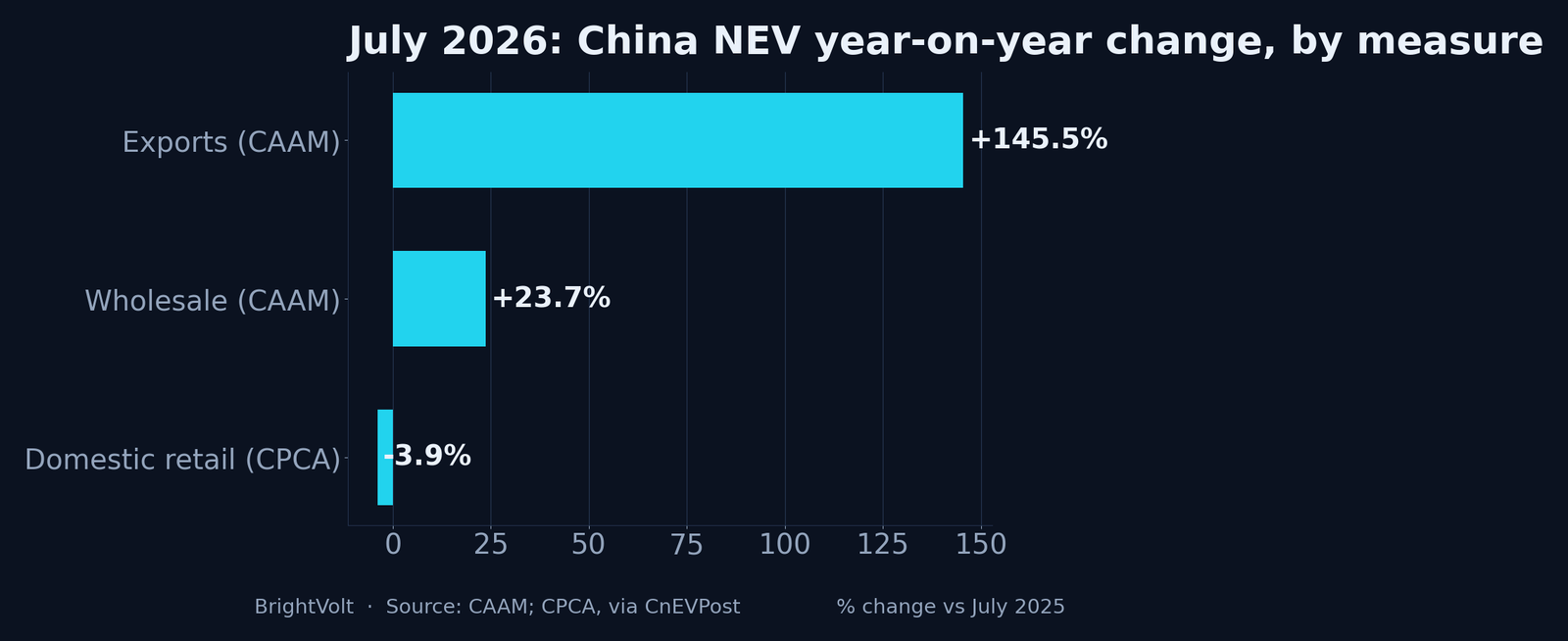
The two numbers are not contradictory once you know what each counts. One books the car at the loading dock; the other at the kerb. The distance between +23.7% and −3.9% is the distance between production and demand, and right now it is being covered by ships.
Where the growth actually went
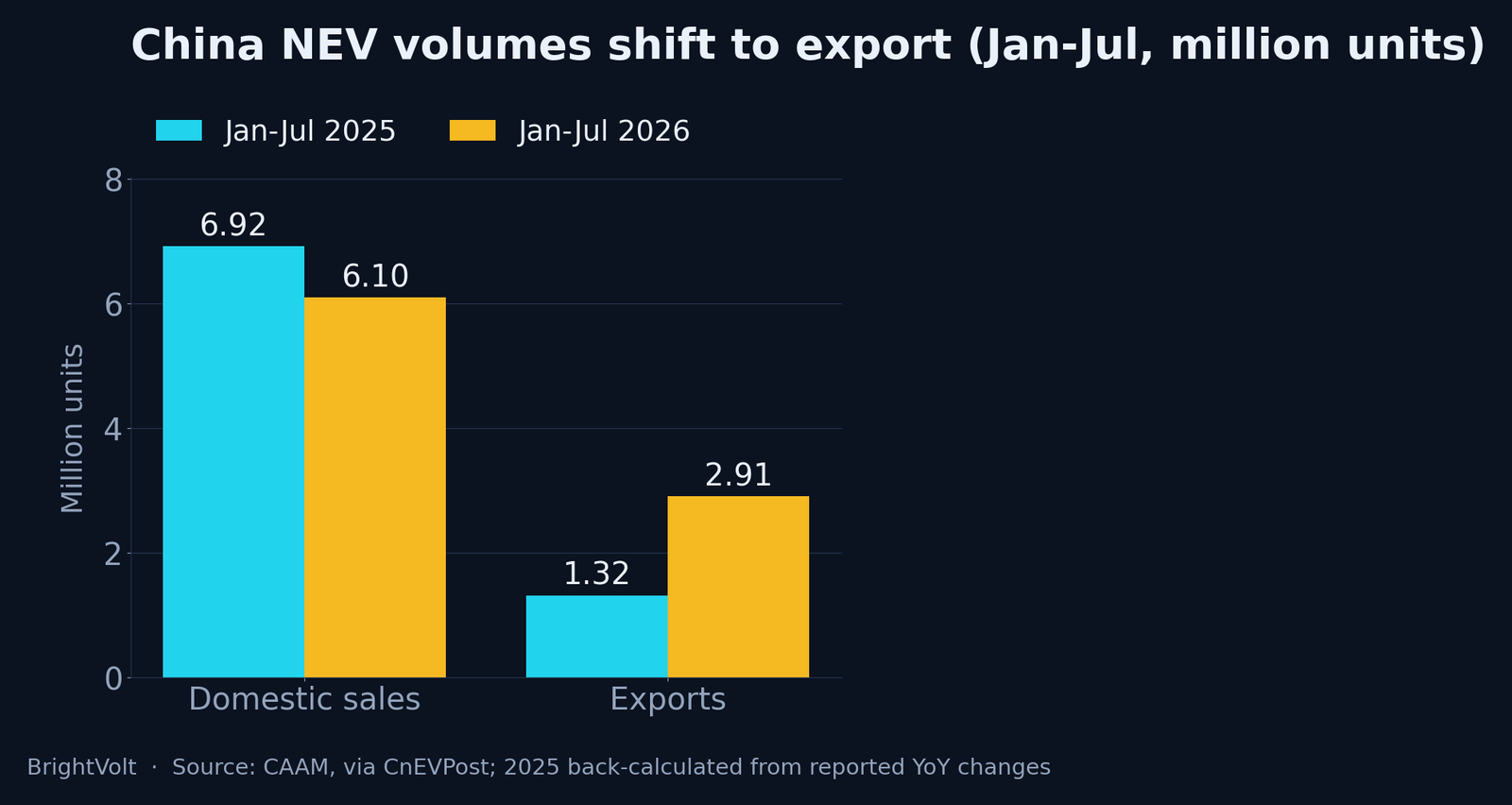
Widen the lens to the first seven months and the export engine is unmistakable. Domestic NEV sales are down around 12% year to date — 6.10 million by CAAM’s count, 5.67 million by CPCA’s — while exports have more than doubled to 2.91 million, up 120%. Nearly one NEV in three that China builds now leaves the country.
| Measure | July 2026 | YoY | Jan–Jul 2026 | YoY |
|---|---|---|---|---|
| NEV wholesale (CAAM) | 1.56M | +23.7% | 9.01M | +10% |
| NEV domestic retail (CPCA) | 951k | −3.9% | 5.67M | −12.5% |
| NEV exports (CAAM) | 553k | +145.5% | 2.91M | +120% |
Where do they go? Russia remains the single largest destination, Brazil now leads the pack of individual markets, and Europe is rising fast despite the tariff walls Brussels put up last year. Total vehicle exports are on track for close to 10 million units in 2026, up from 7.1 million in 2025. That is not a side business. It is increasingly the business.
Who a shrinking home market hurts
A contracting domestic market with thirty-odd brands still fighting for it is a mathematical problem, and the maths is brutal. Only three Chinese NEV makers — BYD, Xiaomi and Leapmotor — turned a profit in 2025, and AlixPartners projects that just seven of the current thirty will break even by 2030. BYD, the most profitable of them, spent the summer setting record discounts. When the price leader is cutting hardest, the companies below it are not competing; they are bailing.
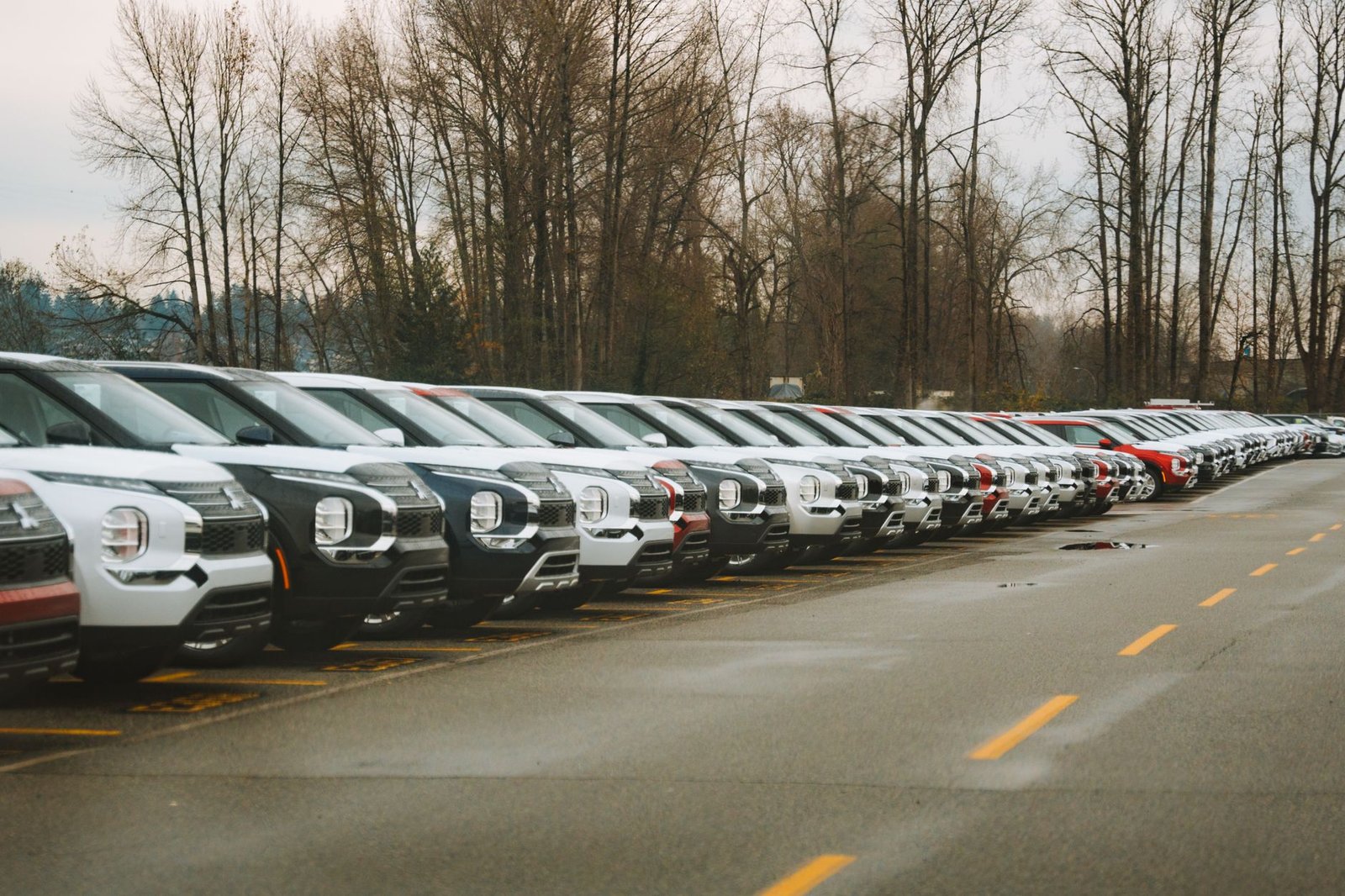
This is what makes the export surge less a strategy than a relief valve. Chinese factories can build roughly twice what the home market absorbs, and a plant running at half capacity loses money on every idle hour. Pushing inventory into export channels keeps the lines moving and the utilisation figures respectable. It is the same instinct that made the wholesale number look healthy while the retail number sank — better to book the car as a sale in transit than to let it sit in a compound in Zhengzhou. The US market is watching the same digestion play out at a lag, minus the export escape hatch.
The strongest case that this is fine
The serious counter-argument runs like this. A 65% penetration rate is not a market in trouble; it is a market that has essentially won, and you cannot compound 30% growth forever once two out of three new cars are already electric. Fading purchase subsidies always produce a hangover, and a shakeout that leaves seven strong builders standing instead of thirty weak ones is healthy, not alarming. Exports, on this reading, are not dumping — they are Chinese cars winning abroad on merit, exactly as Japanese and Korean makers once did.
There is real force in that, and the penetration record genuinely is historic: China sells more electric cars than the rest of the world combined, and no amount of accounting nuance erases it. But saturation and contraction are different shapes on a chart. A maturing market plateaus; it does not fall 12% year to date with domestic retail down seven months in a row. And “exports are real demand” cuts the other way for everyone outside China. Real demand abroad and exported overcapacity look identical on a bill of lading. The difference is whether the factory could have sold the car at home — and increasingly it cannot, which is precisely why Washington and Brussels are reaching for tariffs rather than welcome mats.
What would change this read
One clean quarter of year-on-year growth in domestic NEV retail — CPCA’s number, the one measured at the kerb, not CAAM’s factory-gate figure. That would say the price war has finally cleared the field and home demand is rebuilding on its own, and this piece would be wrong.
Until that shows up, watch two lines. The first is whether exports keep growing fast enough to soak up the overcapacity, because they are the only thing holding the industry’s utilisation off the floor. The second is whether the tariff walls rising in Europe, Brazil and North America start to narrow that release valve. If exports stall while domestic demand is still falling, the shakeout stops being a healthy cull and becomes a disorderly one. The +23.7% headline will not warn you when that happens. The retail line already is.
Photo by Şinasi Müldür on Pexels · Photo by Luke Miller on Pexels