
In 2023 the German state sold four patches of North Sea and Baltic seabed to BP and TotalEnergies for €12.6 billion, and called it proof that offshore wind had outgrown subsidy. In August 2025 the same kind of auction drew zero bids. The zero-subsidy era did not mature into a market. It broke, and Europe is now walking it back one country at a time — Germany’s draft law of 10 August 2026 being the largest admission yet.
How an offshore auction started charging the developer
For most of the industry’s life, a renewables auction asked one question: how little support do you need to build this? The lowest bid won. Germany inverted it. When bidders in its 2023 round all offered to build with no subsidy at all, the auction moved into a second phase — dynamic bidding, better known as negative bidding — in which the tie is broken by asking who will pay the most for the right to the site.
They paid a great deal. Across four zones and between 64 and 72 rounds of bidding each, BP and TotalEnergies committed €12.6 billion for 7 GW of seabed, at prices reaching €1.83 million per megawatt before a single turbine had been ordered.
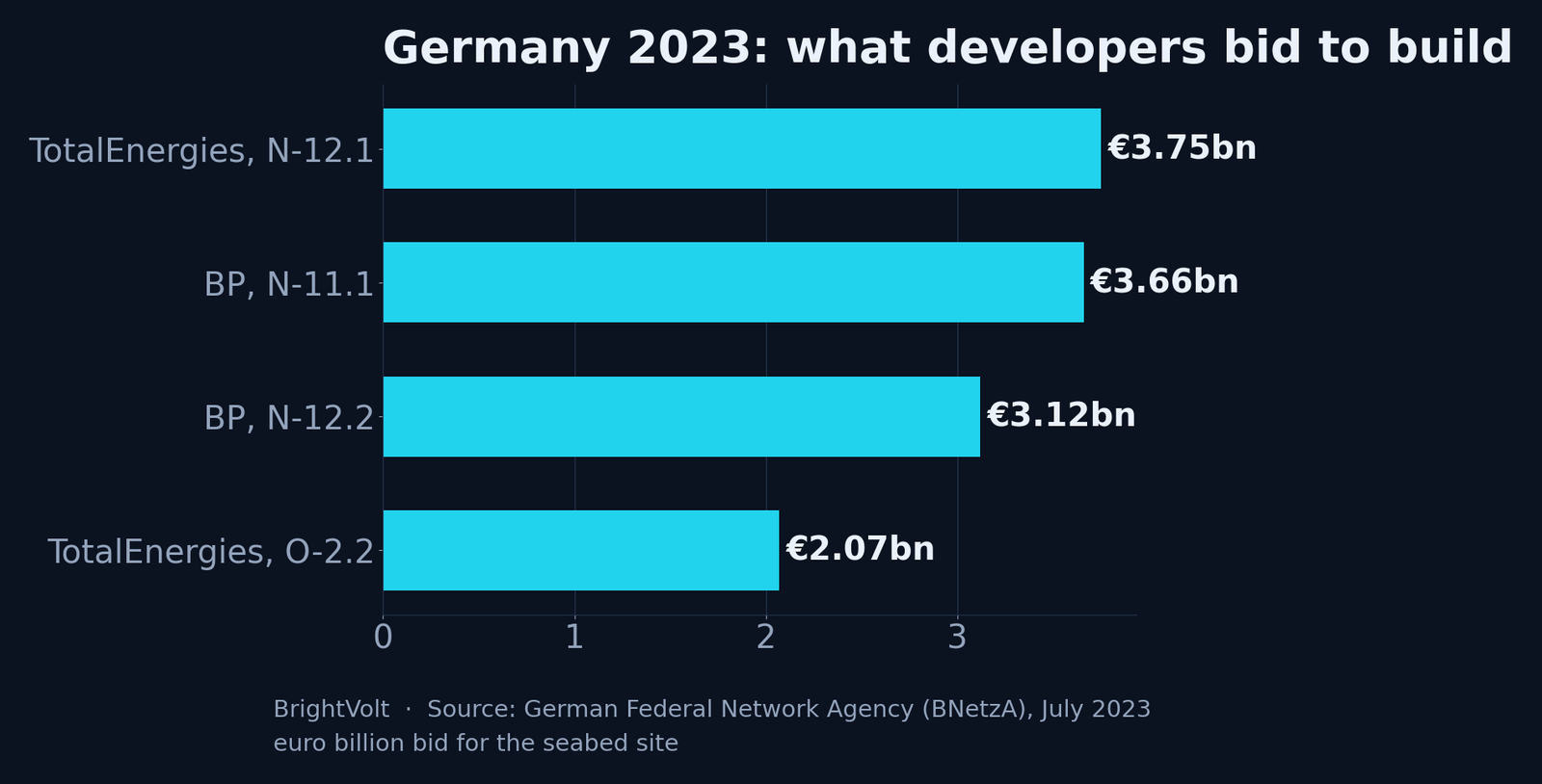
Of that money, 90% is earmarked to reduce electricity costs over twenty years from 2030, with 5% each to marine conservation and cleaner fishing. On paper it was the transition paying for itself: a subsidy scheme running in reverse, the public collecting billions instead of writing cheques. The number was quoted everywhere as the moment offshore wind stopped needing help.
The bill came back as zero bids
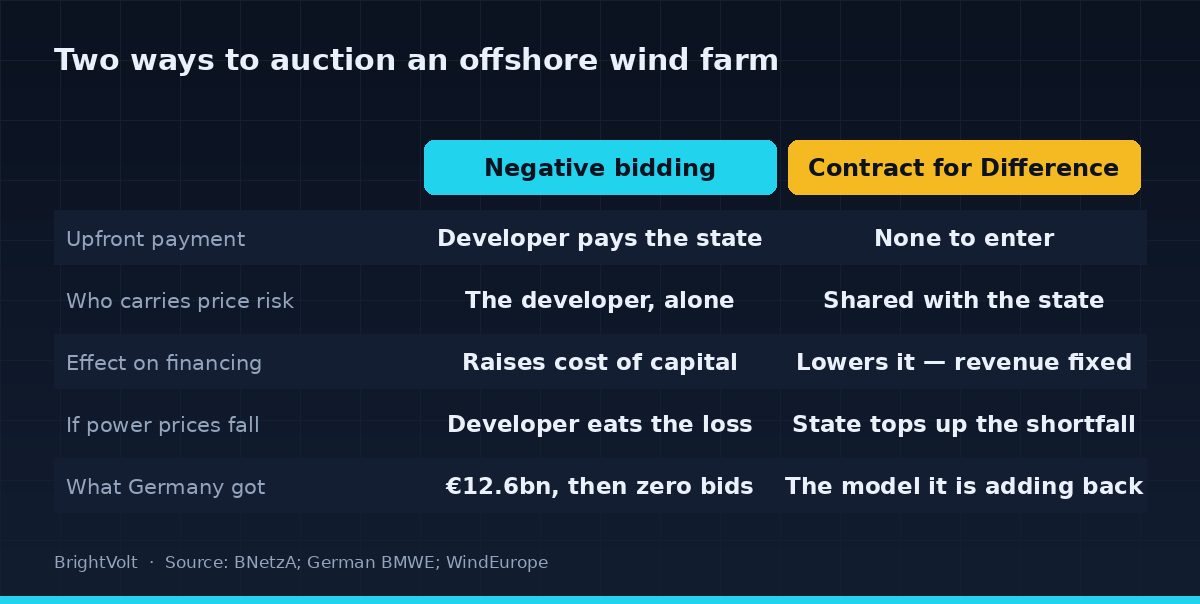
The €12.6 billion did not disappear into the public purse and leave the projects untouched. It went onto the developers’ balance sheets as an upfront cost, and a cost that size does not sit quietly — it raises the return the project has to earn, and therefore the rate at which it can borrow. A negative bid does not remove a subsidy. It converts a future subsidy into a present-day financing penalty, and hands that penalty to the one party least able to hedge it: the developer betting on wholesale power prices a decade out.
Then the weather the model depended on turned. Interest rates rose, and steel, cables, turbines and installation-vessel day-rates all repriced upward through 2024 and 2025. The merchant-revenue bet that justified a negative bid — build cheaply, sell into a high wholesale price — collided with exactly the falling capture prices that more wind and solar guarantee. So when Germany came back in August 2025 to auction two more North Sea zones, nobody bid. Not a lower number. Nothing. Denmark’s 2024 negative-bidding round had already drawn the same blank.
“Negative bidding makes offshore wind more expensive,” WindEurope’s chief executive Giles Dickson put it bluntly: “it means higher upfront costs and higher financing costs.” That is not a complaint about greedy developers. It is a description of where the money always goes.
What everyone is running back to
The instrument Europe is retreating toward is the two-sided Contract for Difference. A CfD fixes a strike price for the power a wind farm sells: when the market price falls below it, the state pays the difference; when it rises above, the developer pays the surplus back. The public is not writing a blank cheque — above the strike price the money flows the other way — but the developer’s revenue is fixed, which is precisely what lets it borrow cheaply. Remove the price risk and the cost of capital falls with it. A German study cited by WindEurope reckons the switch could cut generation costs by up to 30%.
The United Kingdom never left this model, and it is the one now visibly working. Its 2026 Allocation Round 7 cleared a record 8.4 GW of offshore wind, the largest such auction Europe has run, and the follow-on AR8 is seeking more than 17 GW at strike-price caps frozen at the previous round’s level.
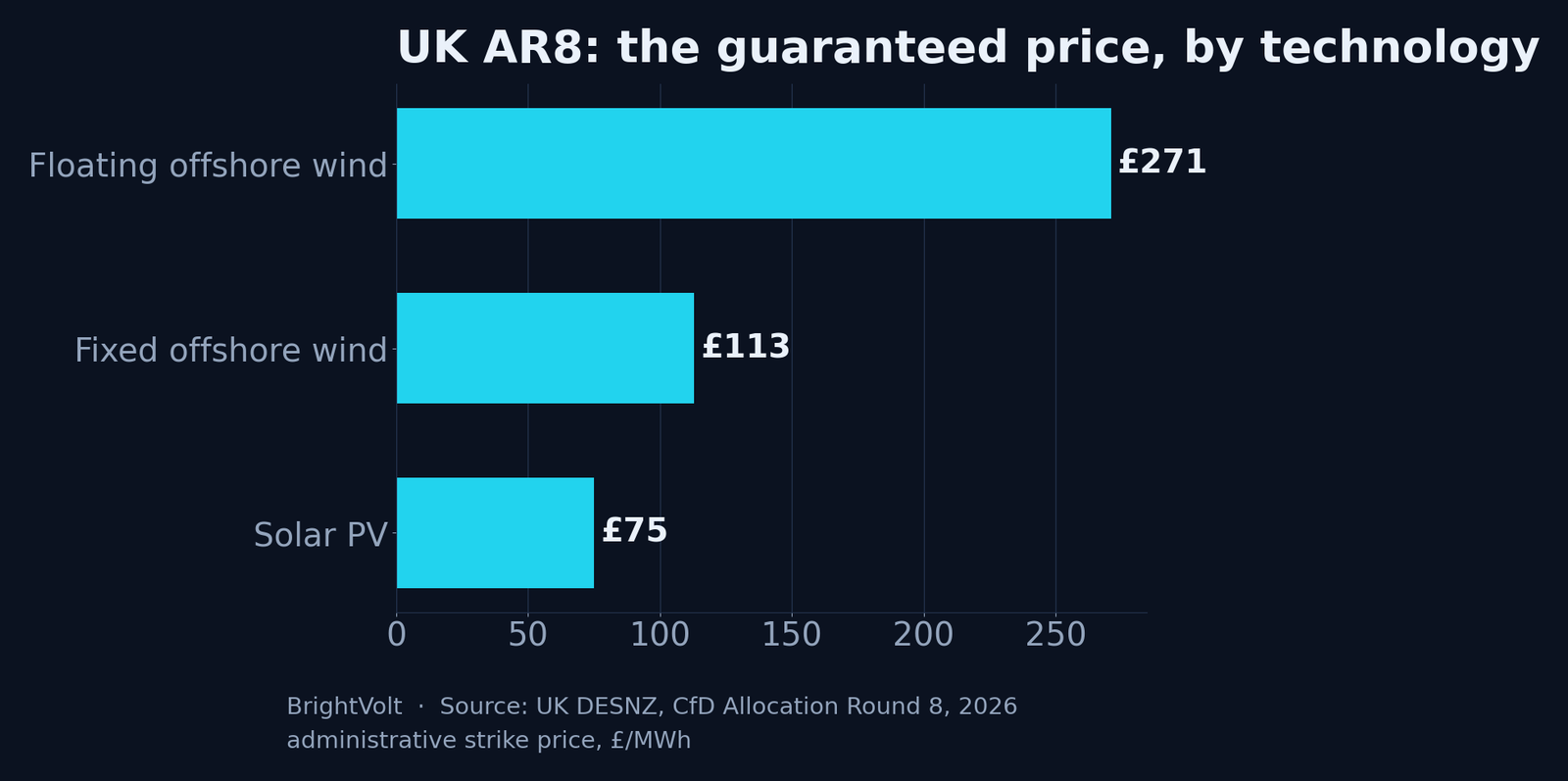
Set the two mechanisms side by side and the difference is not ideological. It is about who is asked to hold a risk nobody can price fifteen years ahead.
The retreat is now a continental pattern rather than one country’s rethink — and it is worth noticing that Europe is arguing about which subsidy design builds the most offshore wind while the United States is paying developers nearly $4 billion to cancel it.
| Market | Old model | New direction | What forced the change |
|---|---|---|---|
| Germany | Uncapped negative bidding | CfD added to a two-stage auction (Aug 2026 draft) | €12.6bn in 2023, then zero bids in 2025 |
| Denmark | Negative bidding | CfDs for 3 GW across three sites | 2024 auction drew no bids |
| Netherlands | Negative bidding | CfDs from around 2027, plus €1bn of interim support | An “Action Plan” scrapping the zero-subsidy model |
| United Kingdom | Never used it — CfD throughout | CfD continues; AR7 cleared a record 8.4 GW | Nothing. It is the model the others are copying |
Sources: WindEurope; German BMWE; UK DESNZ. Most of Europe — Belgium, France, Ireland, Italy, Poland, Spain and others — already auctions on CfDs; the negative-bidding holdouts are down to four Nordic and Baltic states operating 250 MW between them.
Germany’s draft is Europe finishing the retreat
The draft amendment to Germany’s Wind Energy at Sea Act, presented on 10 August 2026, keeps the 70 GW-by-2045 target but rebuilds the machinery underneath it. Fixed 4 GW annual rounds become a flexible 2–4.8 GW corridor from 2027. Permits stretch from 25 years to 35. And the auction becomes two-stage: a merchant round first, in which developers can still bid as before, with a two-sided CfD held in reserve — activated only if a site draws no viable merchant bid.
That reservation is the fight. The German offshore association BWO welcomed the CfD but objected to it being a “fallback option,” arguing the guarantee should be a standard choice in the tender rather than an emergency parachute, and asking for long-term power-purchase agreements alongside it. Read that against the two failed auctions and the subtext is plain: the government is still trying to make merchant-first work, and the industry is telling it the guarantee is the reason anything will get built at all. Germany has, notably, scheduled no auctions in 2026 while it sorts this out.
The strongest case for negative bidding, and why it fails
Here is the case for the defence, in its best form. Negative bidding did real work: it forced genuine price discovery, revealed what developers would actually pay for prime sites, and delivered the public €12.6 billion instead of a subsidy liability. When it works, the taxpayer nets money and the ratepayer still gets the power. And the 2025 collapse was not the mechanism’s fault — it was an interest-rate and supply-chain shock that would have bruised any procurement model.
The first half is true and the conclusion still does not hold. An auction design that only functions when rates are low and supply chains are slack is not a robust market; it is a fair-weather one, and the weather is the whole point of a scheme meant to last to 2045. The €12.6 billion was never free either — it is recovered from the same electricity consumers over twenty years, after raising the developers’ borrowing costs in the interim, which is the gap that 30% figure measures. The public did not escape the subsidy. It prepaid it, at a worse financing rate, and then watched the next auction fail.
What would change our mind
Germany kept a merchant Stage One precisely to test whether developers will still build without a price floor. That makes the next round a clean experiment. If the post-reform German auctions clear at Stage One — real bidders, at scale, taking merchant risk — then negative bidding’s premise was sound, only its timing was unlucky, and this Take is wrong. Watch two things: whether Germany’s first auction after 2026 clears without the CfD, and whether the “fallback” is ever left unused.
Our read is that the fallback becomes the mechanism on first contact, that within two auction cycles the two-stage design is quietly simplified into the CfD it was built to avoid, and that the phrase “subsidy-free offshore wind” retires with it. The seabed stopped paying in 2025. From here the grid pays instead — on terms a developer can actually finance, which is the only kind of auction that builds a wind farm.
Photo by Damir K on Pexels · Photo by Fred dendoktoor on Pexels