
The right size for a home battery is the amount of electricity you can actually shift from an expensive hour to a cheap one, or store through an outage — not the number on the installer’s quote. For most American homes in 2026 that is a smaller battery than the one being sold, and for a large minority it is no battery at all. A typical install now runs about $15,650 before incentives, and the 30% federal credit that used to knock nearly five thousand dollars off that number expired at the end of 2025. The arithmetic changed, and most of the advice online has not caught up.
Start with your load curve, not the brochure
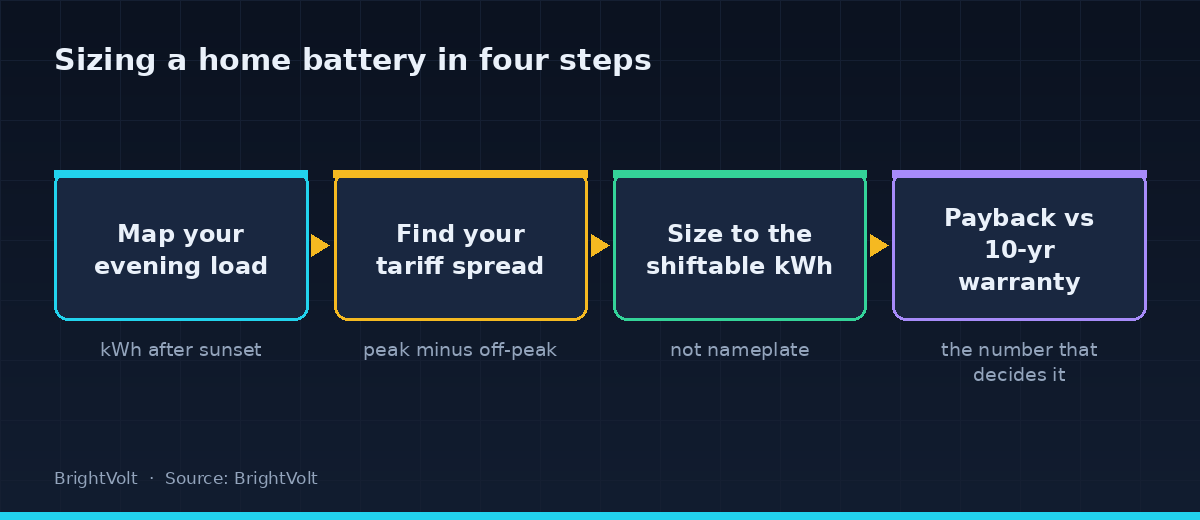
A battery only earns its keep on the energy that passes through it. So the first number is not capacity, it is how many kilowatt-hours you actually move each day — the solar you would otherwise export for pennies, or the grid power you buy at peak and could have bought off-peak instead.
A common install is a single 13.5 kWh unit, the usable capacity of a Tesla Powerwall 3. But usable is not the same as used. If your evening load — the hours after the sun sets and before rates drop overnight — is 6 or 8 kWh, then two-thirds of a second Powerwall sits idle most nights, earning nothing while it ages against a ten-year warranty. Oversizing is the most expensive mistake in the category, and it is the one every sales incentive pushes toward.
The honest sizing question is narrow: how much energy do you move between a high-price hour and a low-price one on a normal day? Size to that, plus a margin for the occasional heavy evening. Everything above it is money spent on capacity you will not cycle.
The tariff is what decides everything
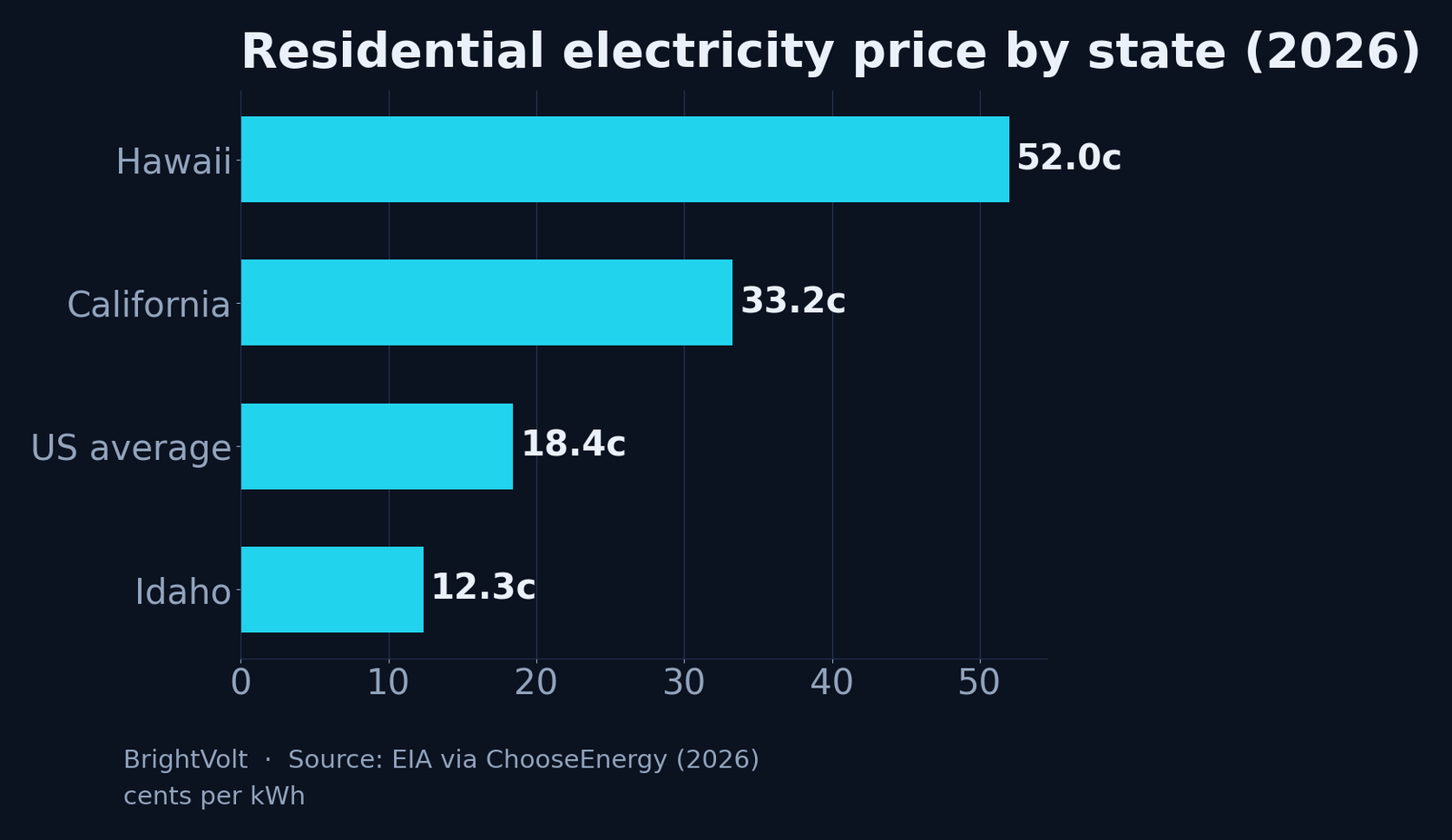
Whether a battery saves anything at all depends almost entirely on the gap between what you pay for power at different times — and that gap varies wildly by where you live. The US residential average is 18.44 cents per kWh as of mid-2026, but the average hides the only figures that matter for a battery.
Three tariff structures, three completely different answers. On a flat rate with full net metering — where the utility credits your exported solar at the same price it charges you — a battery saves almost nothing, because the grid is already acting as a free, lossless battery for your surplus. On a time-of-use tariff, the battery can buy cheap and avoid the peak, and the wider the peak-to-off-peak spread, the more it earns. And where net metering has been rolled back so exports earn a fraction of the retail rate, a battery lets you consume your own solar in the evening instead of selling it cheap — which is where the economics have quietly moved.
This is why the same battery is a sound buy in one zip code and a luxury in the next. It is not the hardware that changed; it is the rate.
The payback arithmetic
Work it through with real numbers. Take the 13.5 kWh Powerwall at $15,650, no federal credit, cycling once a day at roughly 90% round-trip efficiency after inverter losses. The saving per cycle is the energy shifted times the price gap you avoid.
| Situation | Realistic annual saving | Years to break even |
|---|---|---|
| Flat rate, full net metering | Near zero on energy | Never (backup value only) |
| Time-of-use, ~25¢/kWh peak spread | $700–1,100 | 14–22 |
| Low export credit, high self-use | $900–1,200 | 13–17 |
| Above, plus a state rebate and a VPP payment | $1,400–1,900 | 8–11 |
Those figures are illustrative — your load curve and tariff set the real ones — but the shape holds. Even the generous arithmetic struggles to beat the ten-year warranty on bill savings alone, and the Powerwall’s warranty runs ten years with unlimited cycles. A battery that takes fifteen years to pay for itself on a device warrantied for ten has not paid for itself. EnergySage, which sells the things through its marketplace, puts it plainly: adding a battery “can double your solar costs,” and it is “not a smart investment for every homeowner.”
The federal credit mattered more than the brochures admit. At 30%, it turned that $15,650 into roughly $11,000 and pulled several years off every row in the table. Gone, the same battery has to save the full retail price of hardware that keeps getting cheaper — which is a reason to wait as much as a reason to buy.
When the answer is no battery
For a household on a flat tariff with intact net metering and a reliable grid, the honest recommendation is to skip the battery. It will not lower the bill in any meaningful way, the grid already stores the surplus at par, and the money buys nothing but a very expensive uninterruptible power supply. No amount of sizing fixes a case where there is no price gap to arbitrage and no outage to ride through. The installer will not say this. The arithmetic does.
That verdict flips the moment any one of three things is true.

What actually makes one pay
The first is outages. If your grid drops out several times a year, the battery is not an investment, it is insurance, and it should be sized to your critical loads — the fridge, the router, a few lights, a well pump — for the length of a typical outage, not to your whole house for a day. Resilience is a real value that never shows up in a payback table, and pretending to price it in dollars only muddies the decision.
The second is a poor export rate. Where exported solar earns well below the retail price, self-consumption is the whole game, and a battery that lets you burn your own midday solar after dark is shifting energy away from a bad export deal toward avoided retail cost — often the full 30-plus cents a California home pays. That is the case that has strengthened as net metering has been cut back, and it is the one worth modelling carefully.
The third is a subsidy or a market. A state rebate that cuts the upfront cost, or a virtual power plant programme that pays you to let the utility dispatch your battery on peak days, can move a fifteen-year payback under ten. Both are location-specific, both change year to year, and both are worth checking before signing — because without one of them, the 2026 arithmetic for a battery bought purely to save money is harder than it has been in years.
Size to the energy you will actually move, price it against your own tariff rather than a national average, and be willing to conclude that the right battery is no battery. The one number that settles it is not on the spec sheet. It is the gap, in your zip code, between the most and least you pay for a kilowatt-hour.
Photo by Elite Power Group on Pexels · Photo by Robert So on Pexels