
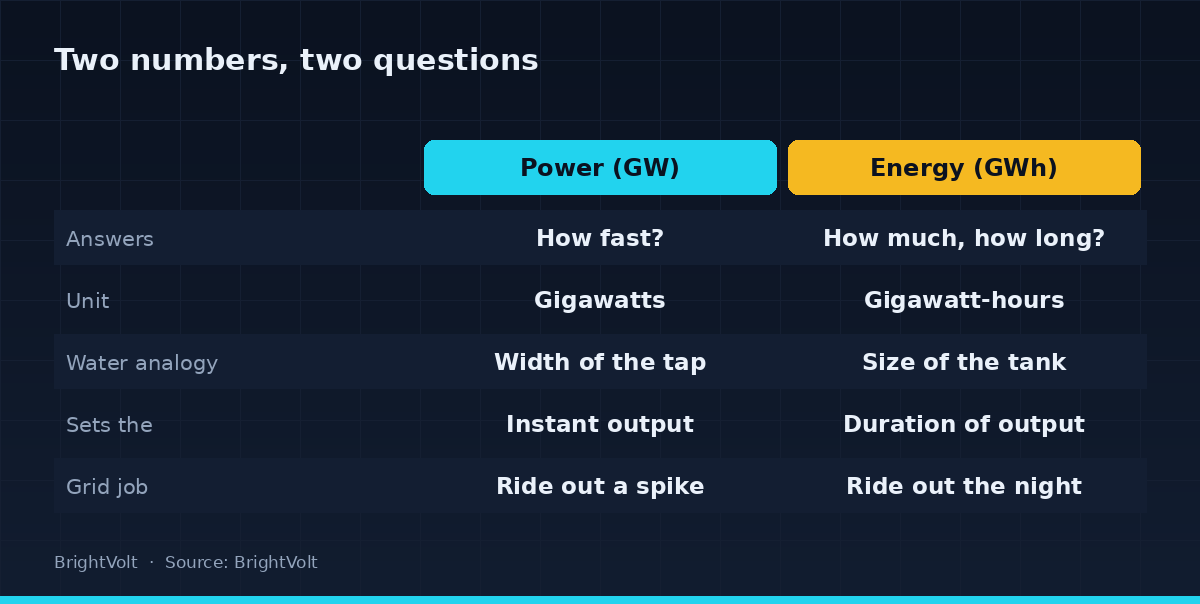
A battery rated at 100 megawatts and a battery rated at 100 megawatt-hours are not the same battery, and mixing the two up is the most common error in energy storage. Power, measured in watts — kilowatts, megawatts, gigawatts — is how fast a battery can push electricity out. Energy, measured in watt-hours — kWh, MWh, GWh — is how much it holds in total. Divide the second by the first and you get the number that actually decides what a battery is good for: how many hours it can run.
Almost every confused storage headline comes from quoting one and meaning the other. “China installed 155 GW of batteries” sounds enormous, and it is — but it says nothing about how long any of them can run. That is a separate number, and it is the one that matters most for a grid trying to get through the night.
Power is the tap, energy is the tank
The cleanest way to hold the distinction is a water tank with a tap at the bottom. Power is the width of the tap — how fast water can leave. Energy is the size of the tank — how much water is in there to leave. A wide tap on a small tank empties in seconds; a narrow tap on a huge tank trickles for days. Neither number tells you the other.
For a battery the arithmetic is exact. Duration equals energy divided by power. A system with 400 megawatt-hours of energy and 100 megawatts of power runs for four hours at full output — 400 ÷ 100. Give it the same 400 MWh but only 50 MW of power and it runs for eight hours at half the rate. Same tank, narrower tap. The stored energy did not change; what you can do with it did.
This is why a storage project is only fully described by two numbers, written as power/energy: a “100 MW / 400 MWh” battery. Quote just the first and you have described the tap and said nothing about the tank.
Why “155 GW of batteries” tells you almost nothing
Run the real figures and the point lands hard. China finished the first quarter of 2026 with 155.2 GW / 400.8 GWh of new energy storage — the largest fleet on earth. Divide the energy by the power and the whole thing averages just 2.6 hours of storage at full output. The most powerful battery fleet ever built would, run flat out, be empty before the evening peak was over.

That is not a criticism of China’s batteries — 2.6 hours is exactly what a lithium fleet built to shift solar into the early evening and shave demand peaks is supposed to be. It is a warning about the gigawatt figure. A GW number on its own is marketing. It sounds like capability, and it measures only speed. The honest question to ask of any storage announcement is the second one: gigawatts for how many hours?
The duration spectrum: four hours to a hundred
Storage technologies do not cluster around one duration. They spread across a spectrum from a few hours to several days, and where a technology sits is set almost entirely by the ratio of its energy to its power — the tank-to-tap ratio.
Lithium-ion, the workhorse, is a short-duration technology. Most grid-scale lithium batteries are built for two to four hours — China’s giant fleet averages 2.6 — because past that point adding more cells to a battery whose value comes from fast daily cycling stops paying. Pumped hydro sits higher: the largest facility on the planet, Dominion’s Bath County plant in Virginia, pairs about 3,000 MW of power with roughly 24,000 MWh of energy — an eight-hour tank, and other pumped schemes run far longer. And the multi-day chemistries go higher still: Form Energy’s iron-air battery is designed for 100 hours at roughly $20/kWh, about a tenth of lithium’s energy cost, precisely because it trades power for an enormous, cheap tank.
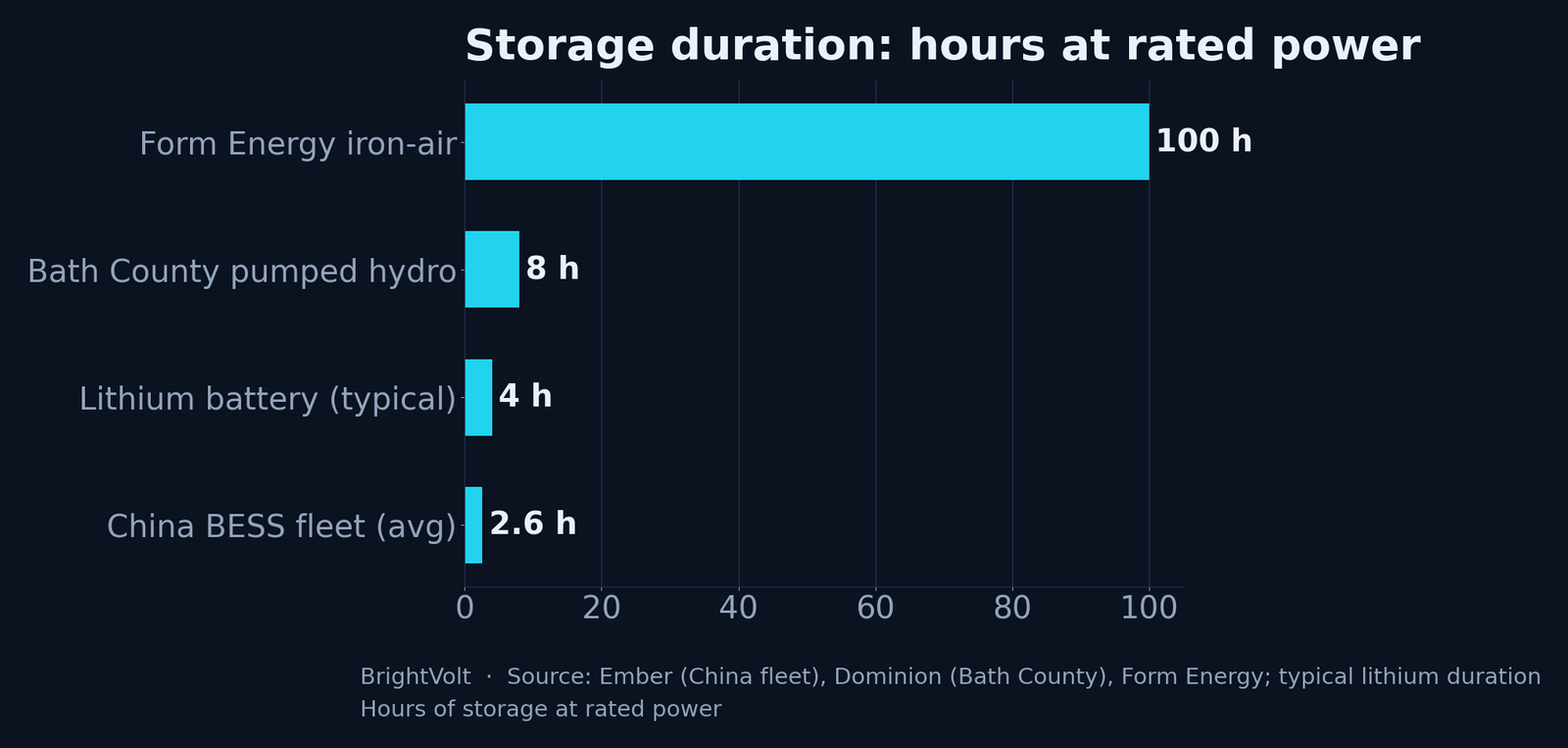
None of these is better than the others. They answer different questions. A four-hour battery rides out an evening peak. A 100-hour battery rides out a windless week. Asking which is “best” is like asking whether a sprinter is better than a marathon runner — long-duration storage and daily batteries are not competing for the same job.
Batteries are winning the GW race and losing the GWh one
Here is where the distinction stops being pedantic and starts moving money. Batteries now add more power — more gigawatts — to the world’s grids each year than any other storage technology, on the back of a cost collapse that made daily cycling cheap. But measure energy, the gigawatt-hours actually stored, and the ranking flips.
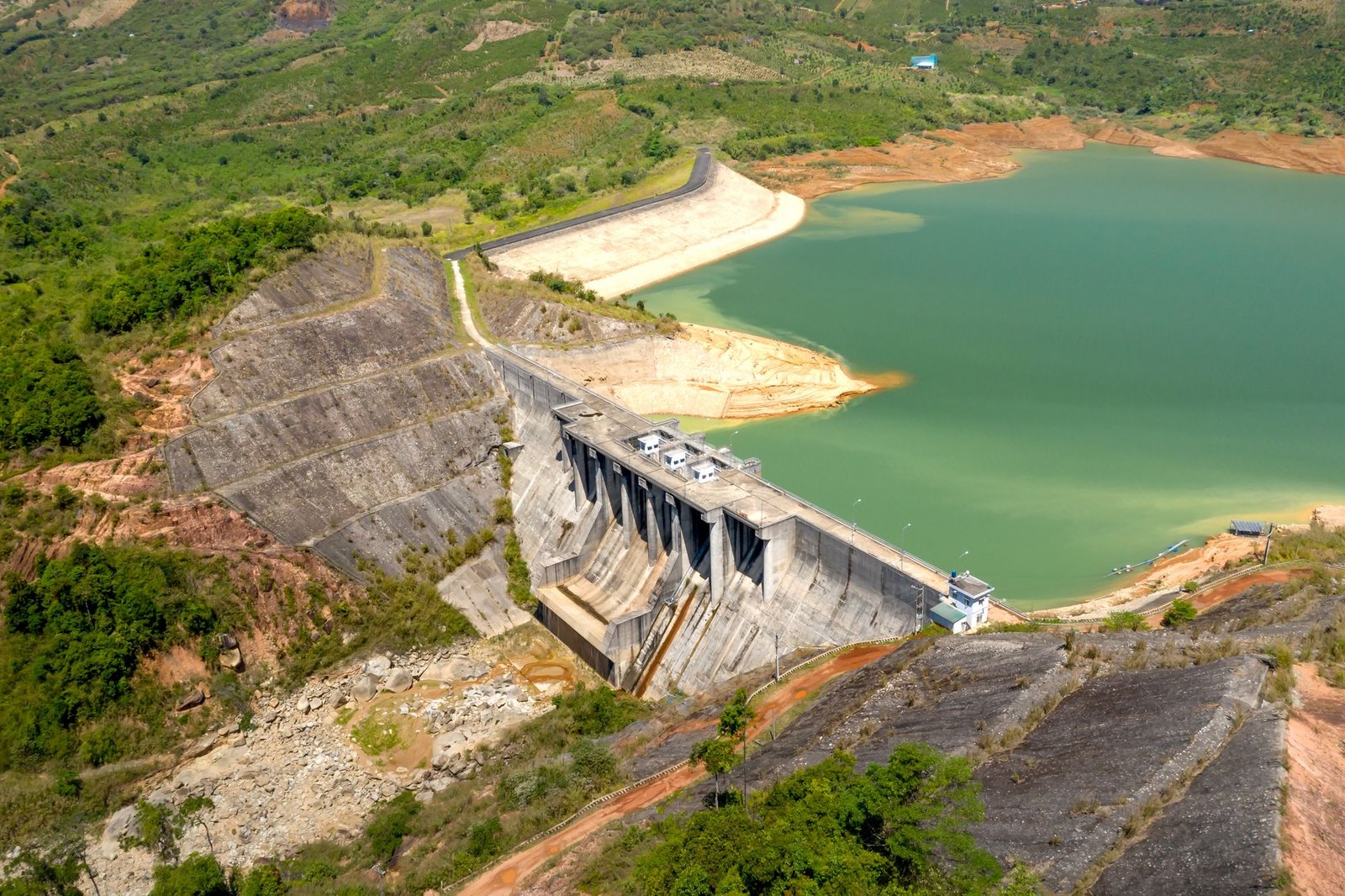
Pumped hydro passed 201 GW globally in 2025 and remains, in the industry body’s words, “the world’s dominant form of large-scale energy storage” — not because it has the most gigawatts, but because each of those gigawatts sits on a tank measured in hours or days rather than minutes. A pumped-storage reservoir holds vastly more energy per unit of power than a lithium pack does. The battery wins the sprint. The water battery still holds the reserves.
This is exactly why the two numbers cannot be traded for one another. Two hundred gigawatts of four-hour batteries and 200 GW of pumped hydro are the same on a power chart and nothing alike on an energy one — the second stores several times as much electricity and can hold it for the days the first cannot. A grid that reads only the GW column will think it has built enough storage and discover, on the first long, still, cloudy stretch, that it bought a great deal of tap and not much tank.
Which number to read
The habit worth building is simple: whenever a storage figure is quoted in gigawatts alone, ask for the hours. A 3 GW announcement could be a 12 GWh peaker that empties in minutes or a 30 GWh asset that runs all night, and those are different machines doing different jobs for very different money. The serious announcements give you both numbers, written as power/energy, because the people building the projects know the second one is where the value — and the cost — actually lives.
For a grid leaning harder on wind and solar every year, the binding constraint is quietly shifting from power to energy. Riding out a spike takes gigawatts. Riding out a windless week takes gigawatt-hours, and a lot of them. The technologies that win the next decade will be the ones with the cheapest tanks, not the fastest taps — which is why the storage map is filling in above the four-hour line, not just along it.
Photo by Giant Asparagus on Pexels · Photo by Heru Dharma on Pexels · Photo by Quang Nguyen Vinh on Pexels