
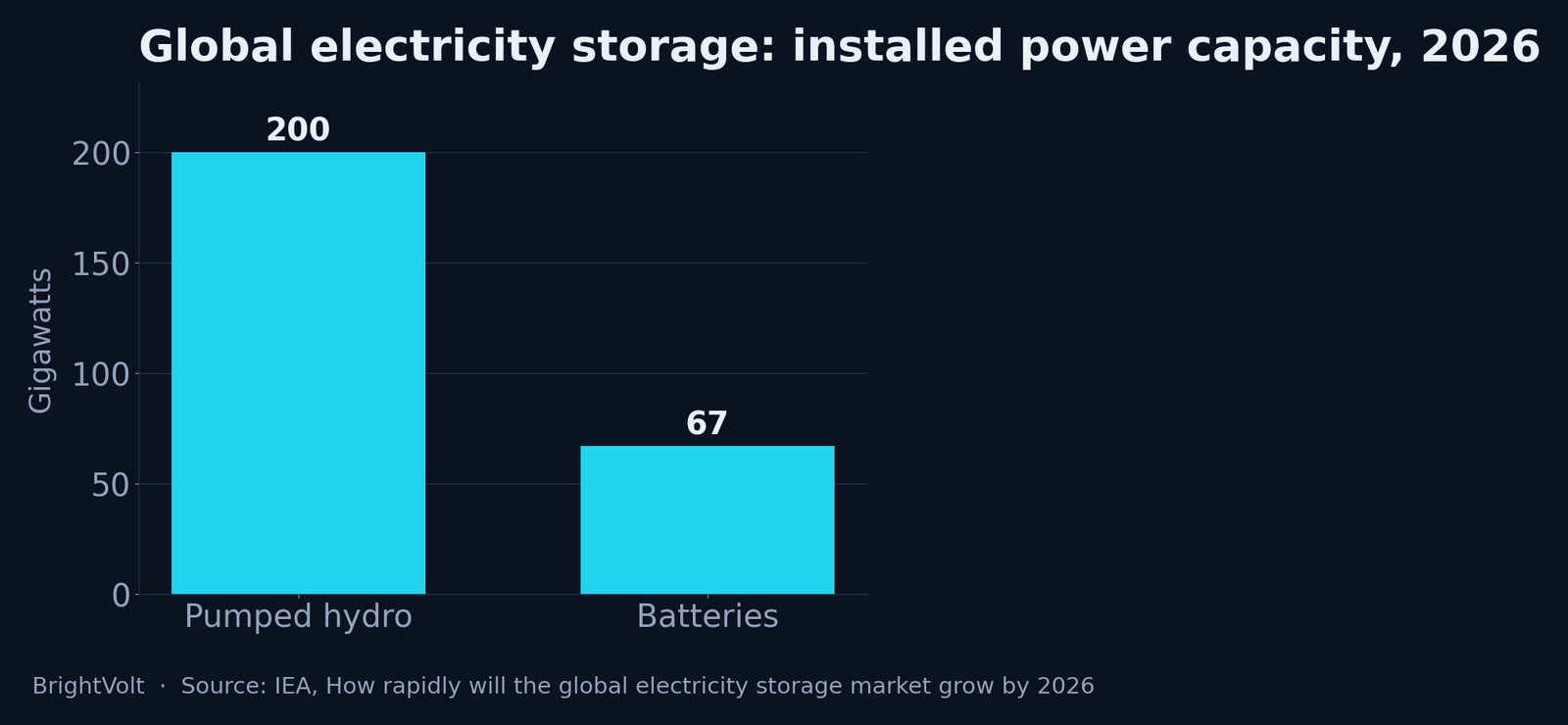
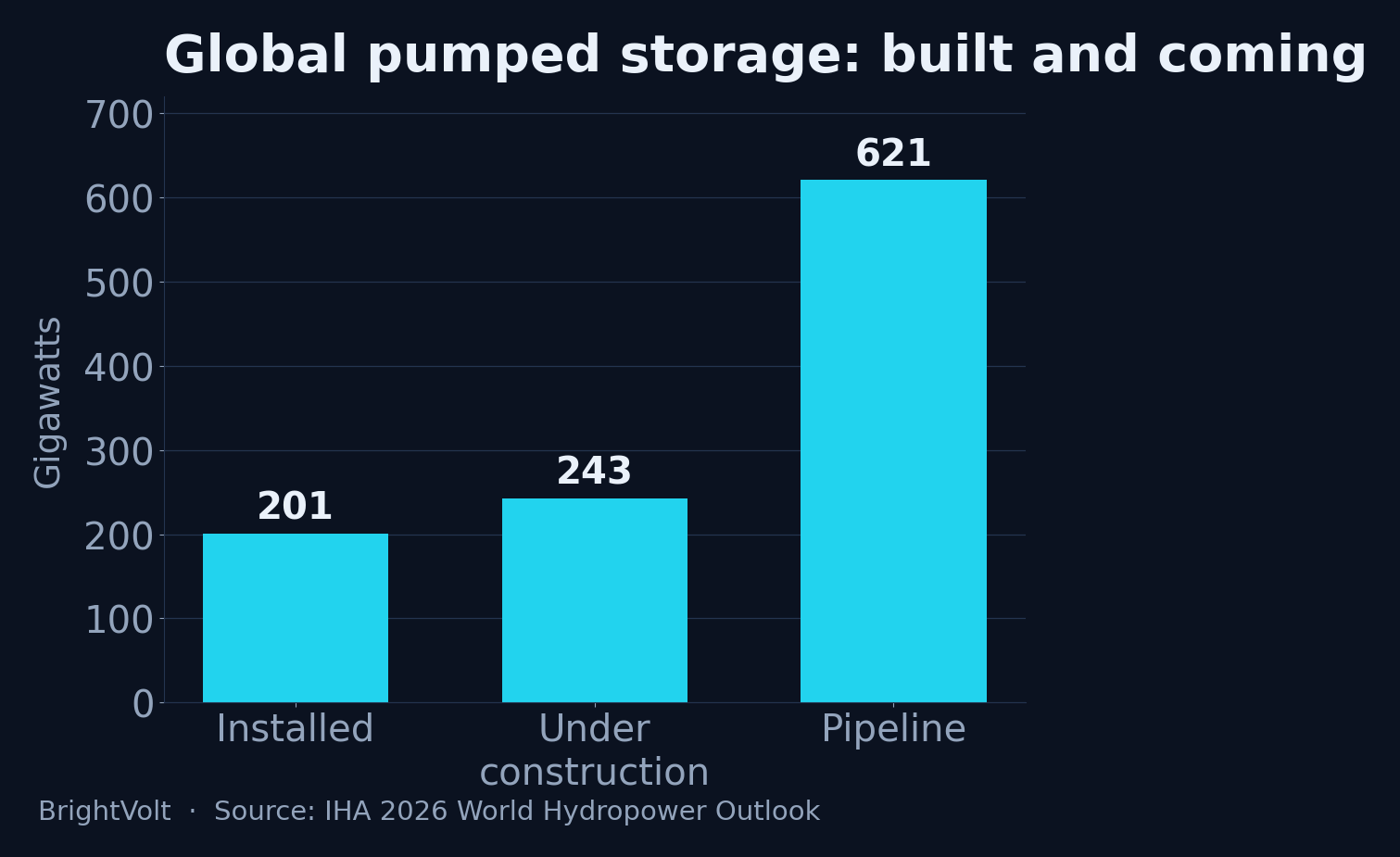
Batteries get every storage headline. Pumped hydro does the work. The world crossed 201 gigawatts of pumped storage in 2025, and by the IEA’s reckoning it holds almost all of the roughly 12 terawatt-hours of electricity the planet can store — a share lithium-ion, for all its growth, comes nowhere near. This is the storage nobody counts, and it is most of the storage there is.
How a water battery works
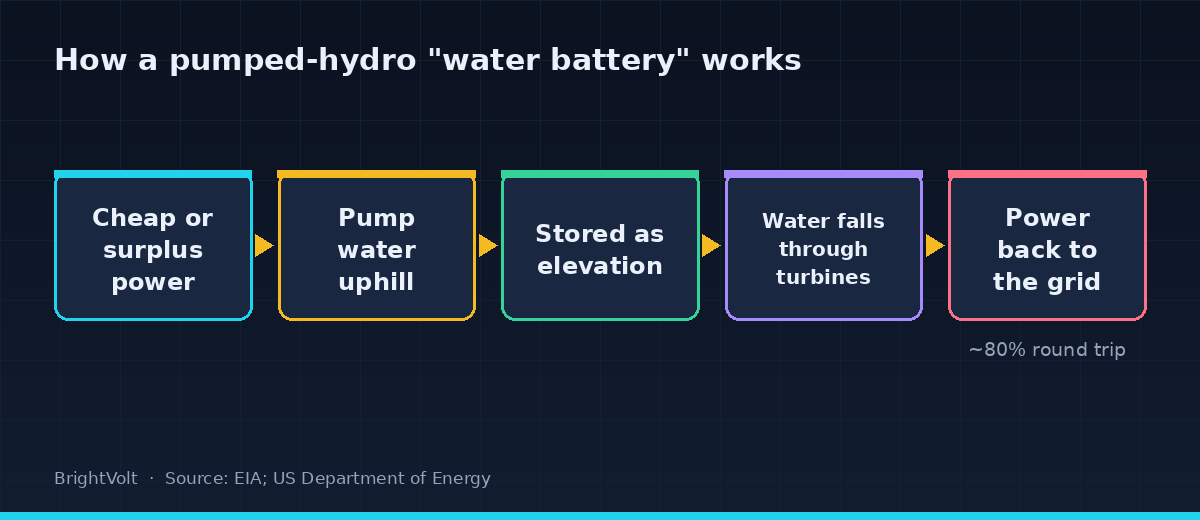
A pumped-storage plant is two reservoirs at different heights and a reversible turbine between them. When power is cheap or surplus — a windy night, a sunny noon — the plant runs the turbine backwards as a pump and lifts water from the lower reservoir to the upper one. The energy is now sitting in the sky as gravitational potential energy, held in a few million tonnes of water a few hundred metres up. When the grid needs it back, the water falls through the same turbine and generates electricity, exactly as a conventional hydro dam does.
That is the whole idea. No chemistry, no cells, no degradation curve — just water, gravity and a machine that spins both ways. The round trip is not free: some energy is lost to friction, pumping and turbine losses. But less than you might expect. The US Energy Information Administration measured pumped storage at about 79% round-trip efficiency and utility-scale batteries at about 82% — close enough that efficiency is not what separates them. Duration is.
Why it is still most of the world’s stored energy
Here is the distinction that the storage conversation keeps dropping: power and energy are not the same thing, and pumped storage wins on the one that matters for a grid running on weather.
Power is how fast a battery can push — measured in gigawatts. Energy is how much it holds, and for how long — measured in gigawatt-hours or terawatt-hours. A lithium-ion grid battery is typically built to discharge for under four hours; a pumped-storage plant runs for anywhere from 5 to 175. That is why, even as battery power capacity grows sixfold, pumped storage still accounts for almost all of the world’s storage capability. The IEA expects global storage to reach nearly 12 TWh in 2026, “with PSH accounting for almost all of it.” Batteries are winning the gigawatt race and losing the terawatt-hour one.
The two are not really competing for the same job. A battery is superb at the fast, short task — smoothing a cloud passing over a solar farm, injecting power in the first seconds of a grid fault. Pumped storage is for the long, dull task nobody notices: holding a nuclear plant’s overnight surplus until the evening peak, or carrying a week of wind through a still spell. Ask a battery to do that and you need a wall of them; ask pumped storage to respond in milliseconds and it cannot.
| Pumped hydro | Lithium-ion battery | |
|---|---|---|
| Typical discharge | 5–175 hours | Under 4 hours |
| Round-trip efficiency | ~79% | ~82% |
| Plant lifespan | 80–100 years by design | ~10–15 years |
| Siting | Needs two reservoirs and a height difference | Modular, sites almost anywhere |
| Best at | Bulk energy, long duration | Fast response, short bursts |
Why nobody counts it
If pumped storage is most of the world’s storage, why does it barely appear in the storage story? Three reasons, and none of them is that it stopped working.
It is old, and old technology is invisible. The first pumped-storage plants ran in the Alps before the First World War, and the technology has changed less in a century than batteries change in a year. It gets filed under “hydropower”, not “storage”, so a grid statistician counting a country’s batteries often leaves it out of the same table entirely — a classification quirk that quietly erases the majority of the fleet. And it is slow and lumpy: a plant takes the better part of a decade to build, needs a specific landscape of two reservoirs and a hill between them, and arrives as a single gigawatt-scale lump rather than a container you bolt down in a car park. Batteries generate a constant drip of announcements. Pumped storage generates one enormous one every few years, and the news cycle has moved on by the time the water flows.
Where the water batteries are being built
The invisibility is geographic, too. The West largely stopped building pumped storage decades ago; Asia never did. China alone has 218 GW of pumped storage under construction — more than the entire world’s installed fleet today — and India plans to go from around 4 GW now to 100 GW by 2035. Globally there is 243 GW under construction and a pipeline past 600 GW, against 201 GW built. We covered the gap between licensing plants and pouring concrete when China’s build-out pulled decisively ahead; the outlook figures only widen it.
The United States is the pattern in miniature. As recently as 2020, pumped storage was 92% of US storage capacity — 21.9 GW against barely a gigawatt of batteries. The battery boom has since overtaken it in power, which is exactly why the American storage story now sounds like an all-battery one. It isn’t. It is a fast-growing battery fleet stacked on top of a much larger reserve of energy that was quietly built last century and will still be running long after today’s cells are recycled.
What to watch
Pumped storage will not win the storage argument, because there is no single argument to win. The grid needs both: batteries for the fast seconds and short hours, water for the long haul that a chemical cell cannot economically reach. The number to watch is not whether batteries overtake pumped storage in gigawatts — they will, and it means less than it sounds. It is whether the West restarts building long-duration storage of any kind before the weeks-long lulls in a wind-and-solar grid arrive to expose the gap. China and India have decided the answer is water. Everyone else is still counting batteries.
Photo by Tom Fisk on Pexels · Photo by Jan Slaný on Pexels