
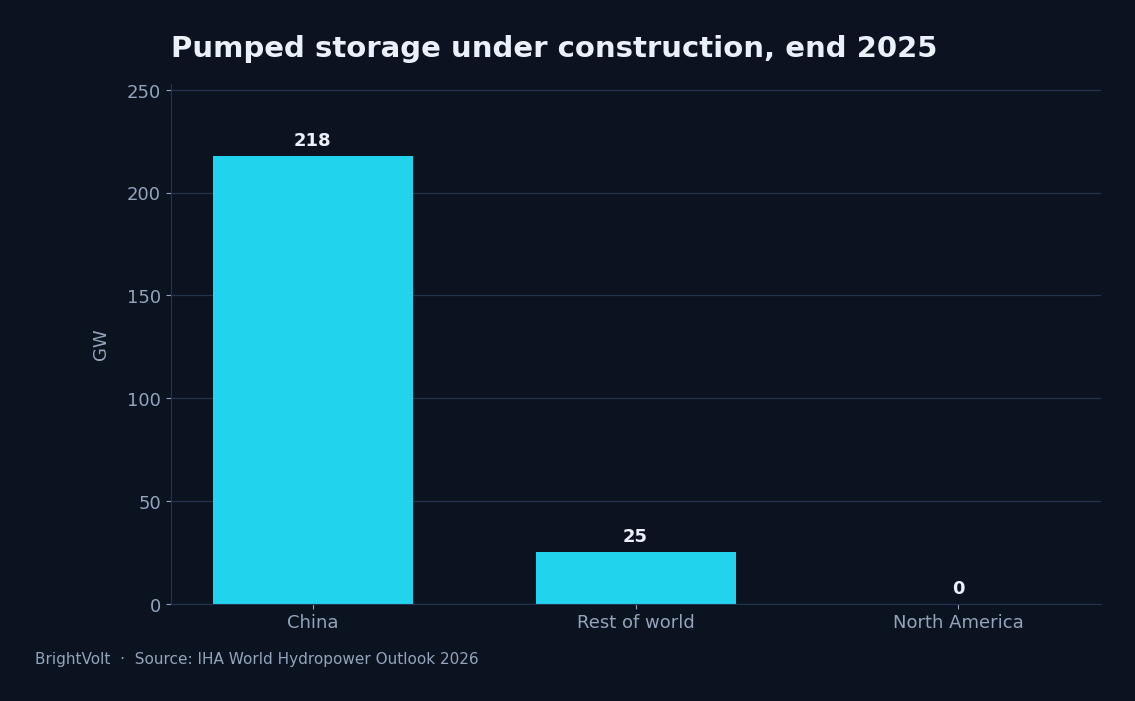
Global pumped storage capacity passed 201 GW in 2025, the first time it has cleared 200, on a record 11.7 GW of additions. There is 243 GW more under construction. China accounts for 218 GW of it — 90% of everything being built on the planet.
North America, by contrast, has more than 60 GW of pumped storage in development and almost nothing in construction.
What the numbers say
The International Hydropower Association’s 2026 World Hydropower Outlook, published on 24 June, puts total hydro capacity at 1,469 GW generating 4,495 TWh, with 28 GW added during 2025. Within that, pumped storage is the segment moving fastest: 11.7 GW added, 243 GW building, a development pipeline of 621 GW.
The IEA expects annual pumped storage additions to roughly double to 16.5 GW a year by 2030, with China supplying more than 60% of the growth.
This matters because pumped storage is the only long-duration storage that exists at scale today. The United States operates 43 sites totalling about 23 GW. That was the overwhelming majority of American utility-scale storage until very recently — batteries passed 26 GW during 2024 and overtook it, which is a reversal worth registering rather than assuming.
Duration is the whole argument
Four-hour lithium batteries dominate new storage procurement, and for a four-hour evening peak they are the right tool. Pumped storage is a different product.
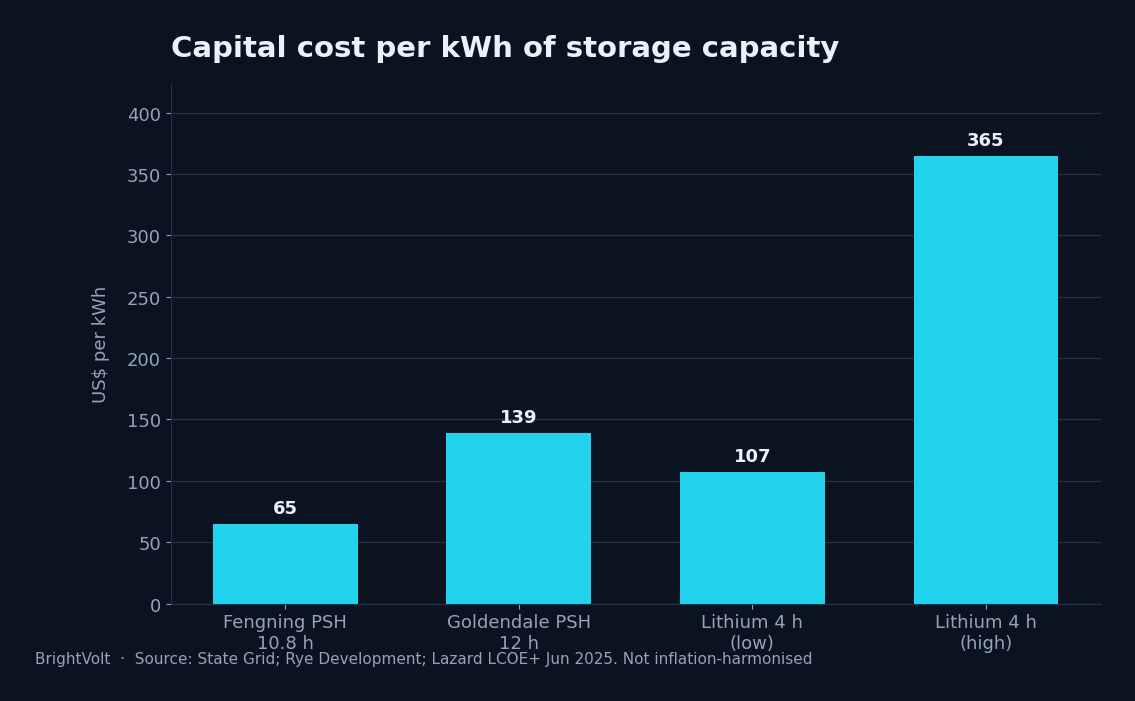
Fengning in Hebei, the largest pumped storage plant ever built, holds 3,600 MW for about 10.8 hours — roughly 40 GWh in a single asset. Spain’s July award funded 2.071 GW across 21.091 GWh, an average duration above ten hours. Goldendale in Washington State is licensed at 1,200 MW for 12 hours.
A four-hour battery cannot cover a still, cold week. Ten to twelve hours starts to.
| Fengning (China) | Goldendale (US) | Typical 4-hour lithium | |
|---|---|---|---|
| Power | 3,600 MW | 1,200 MW | — |
| Duration | ~10.8 h | 12 h | 4 h |
| Energy | ~40 GWh | ~14.4 GWh | — |
| Capital cost | $1.9bn–$2.6bn | ~$2bn | — |
| Cost per kWh stored | $48–65 | ~$139 | $107–365 |
| Round-trip efficiency | ~80% | ~80% | ~82% |
The round-trip efficiency gap is smaller than reputation suggests. The EIA measured the US pumped storage fleet at 79% against 82% for utility-scale batteries; NREL’s Annual Technology Baseline uses 80% for pumped storage and assumes no future improvement. Three percentage points is not what decides this.
Two caveats on the cost table, because they matter. NREL’s pumped storage capex range is stated in 2021 dollars while the Lazard battery figures are 2025 dollars, so the comparison is indicative rather than harmonised. And the per-kWh figures for Fengning and Goldendale are our own arithmetic — capital cost divided by energy capacity — not published metrics. Fengning’s capital cost is itself reported between $1.87bn and $2.6bn, which is where the range comes from.
Why the West cannot build it
Not cost. Time and consent.
Fengning took eleven and a half years to construct. That is the number that kills projects in jurisdictions where capital wants a return inside a decade and permits can be litigated the whole way.
Goldendale is the live example. The Federal Energy Regulatory Commission issued a 40-year licence on 22 January 2026 for a $2bn, 1,200 MW project developed by Rye Development and Copenhagen Infrastructure Partners. Construction must begin within two years. The Yakama Nation and sixteen other tribal governments oppose it: the upper reservoir site is Pushpum, a sacred first-foods gathering place. Litigation is live.
That is not a story about pumped storage being unfashionable. It is a story about a technology that needs a specific piece of topography, and about who else has a claim on it. A battery goes on a concrete pad next to a substation and nobody’s ancestors are buried there.
Spain and Austria are the European exceptions, and Spain’s July award is instructive: €165 million for seven projects, with the budget raised from an initial €90 million because demand exceeded it. The appetite exists where the permitting is tractable.
The case against reading this as neglect
The obvious conclusion — that the West is ignoring a proven technology in favour of a fashionable one — does not survive contact with what China is actually doing.
Chinese pumped storage has fallen from 89.3% of the country’s storage fleet to 37.4%, because lithium storage there passed 101.3 GW and now holds 59.9% of a total that grew 110% year on year. The country building 218 GW of pumped storage is simultaneously deploying batteries faster than anyone. It is not choosing between them.
So the honest reading is not that batteries are crowding out pumped storage. It is that China can do both because it can build both quickly, and the West can do one because it can only build one quickly. The binding constraint is delivery speed, not technology preference.
What to watch
Whether Goldendale actually breaks ground inside its two-year window, or whether the licence becomes another entry in the long list of American pumped storage projects that were permitted and never built. That single project is the test of whether a US pumped storage revival is real.
And whether India moves. It has 3.5 to 5 GW today and a stated target of 100 GW by 2035 — a twentyfold increase in a decade, in a country with the topography and the demand growth to justify it. If India starts pouring concrete, the 90% figure stops being a story about China and becomes a story about who else can still build large infrastructure at all.
One note on the figures above. The IHA counts 201 GW of pumped storage while IRENA counts 160 GW, because IRENA excludes mixed pumped-storage plants that also take natural inflow. The two datasets should not be mixed, and this piece uses IHA’s throughout.
Photo by Quang Nguyen Vinh on Pexels · Photo by Tom Fisk on Pexels