

India’s grid regulator has told new solar and wind farms to help hold the grid up, not just feed into it. A draft rule published on 3 September 2026 requires every renewable plant built from July 2027 to run grid-forming inverters and carry two hours of its own battery storage.
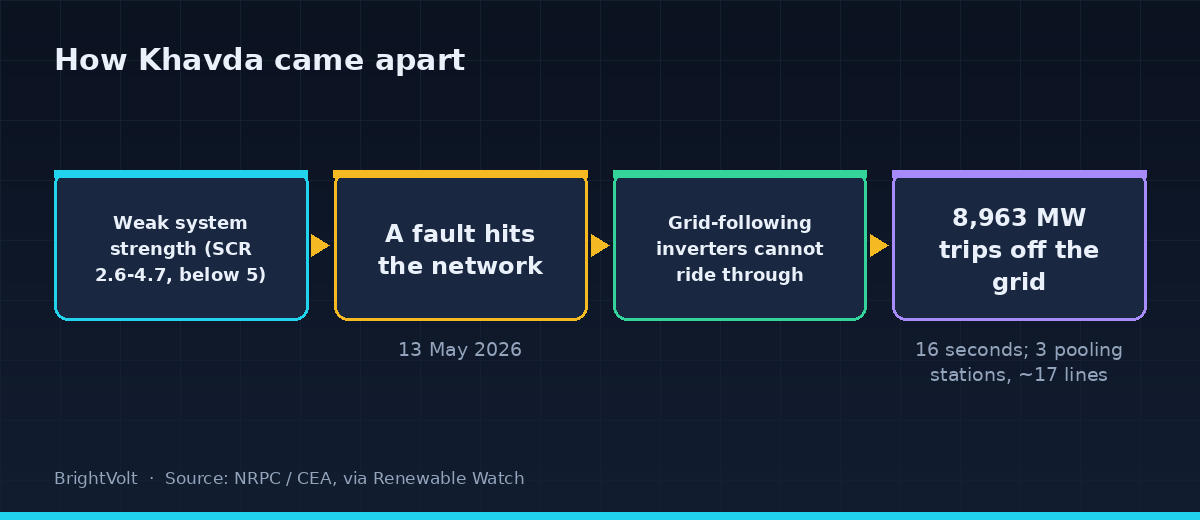
The trigger sits in the record. On 13 May, 8,963 MW of generation near the Khavda renewable complex — India’s largest — fell off the grid in sixteen seconds. The draft is the regulator’s answer to that, and the clause everyone is quoting is not the one that will change the most.
What the draft actually requires
The Central Electricity Authority’s draft names three things, and it applies them to ground-mounted solar and onshore wind plants commissioned on or after 1 July 2027. First, at least 15% of a plant’s inverters must run grid-forming control. Second, every plant must be built with co-located storage of at least 10% of its capacity, able to run for at least two hours — so a 100 MW solar farm needs a 10 MW battery holding 20 MWh. Third, every power-conversion unit inside a standalone battery project must be grid-forming, with no exemptions.
The storage floor gets steeper on a timer. Projects commissioned between July 2029 and June 2031 keep the 10% capacity rule but must hold four hours, not two — doubling the same 100 MW plant’s battery to 40 MWh. The document is a draft, open for comment until 4 October, and the CEA has kept itself room to revise the percentages before it lands.
| Requirement | New plants from Jul 2027 | Plants from Jul 2029 |
|---|---|---|
| Grid-forming inverters | 15% of a plant’s inverters | 15% of a plant’s inverters |
| Co-located storage, power | ≥ 10% of plant capacity | ≥ 10% of plant capacity |
| Co-located storage, duration | ≥ 2 hours | ≥ 4 hours |
| Storage on a 100 MW plant | 10 MW / 20 MWh | 10 MW / 40 MWh |
| Standalone battery control | All conversion units grid-forming | All conversion units grid-forming |
Why Khavda changed the rules
Because a weak grid fell over in real time, and the regulator watched it happen at the site meant to showcase the build-out. At around 14:09 on 13 May, a fault near the Khavda complex in Gujarat cascaded into the loss of 8,963 MW in sixteen seconds — three pooling stations totalling 15.9 GW of installed capacity and around seventeen extra-high-voltage lines, gone almost together.
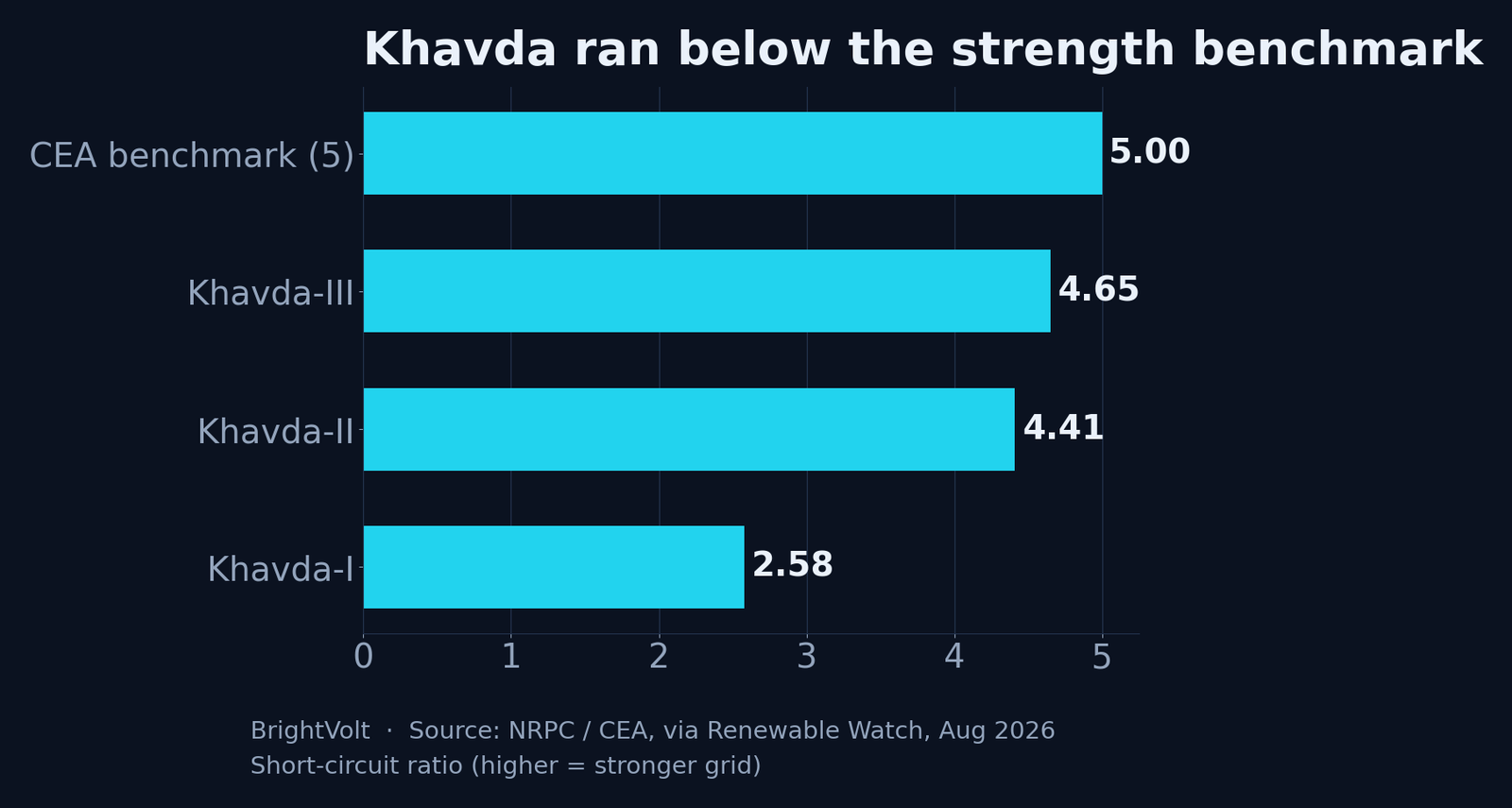
The cause was not the fault itself but how little the grid could absorb it. Engineers measure that with the short-circuit ratio — a proxy for system strength, the grid’s ability to hold a steady voltage when something goes wrong. The three Khavda pooling stations were running at ratios of 2.58, 4.41 and 4.65, all under the CEA’s own benchmark of 5. Below that line, a network is “weak,” and the grid-following inverters that make up almost all of India’s renewable fleet start to misbehave: they wait for a clean voltage signal to lock onto, and in a weak grid, during a fault, that signal is exactly what disappears. They tripped rather than ride the dip through.
Khavda was the loud one, not the only one. India logged 68 major disturbances in its renewable fleet over roughly a year, with single events shedding as much as 7 GW. A grid adding a record 55.3 GW of non-fossil capacity in a single financial year is discovering, repeatedly, that connecting the generation is the easy half.
A grid-forming inverter can’t run on nothing
Here is the part the headlines skate over. A grid-forming inverter sets its own voltage and frequency instead of chasing the grid’s — it behaves like a synchronous generator rather than following one, which is precisely what a weak grid needs. But forming a grid means pushing or pulling real power the instant the grid wobbles, and an inverter can only move power it has behind it. A solar inverter at night has nothing. A solar inverter already running flat out has nothing spare either. The control mode is only as useful as the energy sitting behind it. (We pulled that distinction apart here, and it is the whole reason grid-forming and storage keep arriving in the same sentence.)
That is why the storage floor, not the 15% inverter clause, is the load-bearing part of this draft. Two hours of battery on every new plant is what gives a grid-forming inverter something to form the grid with — headroom to inject during the dip and soak up the ramp after. It is also the more expensive requirement by a wide margin, which is why it is the one developers will fight over.
The inverter number, by contrast, has already softened. After Khavda, the CEA floated a requirement of 25% grid-forming capacity on new renewable plants. The formal draft asks for 15% of inverters — a smaller share, and a blunter unit, because a plant can meet an inverter headcount without the grid gaining a guaranteed quantity of system strength anywhere in particular. A mandate written in units of hardware is easier to comply with than one written in units of grid performance. That is not a reason to drop it; it is a reason to read the storage clause as the one doing the work.
How India’s bet compares
India is doing something Britain and Australia have mostly avoided: writing grid-forming straight into the connection code rather than buying it project by project. Britain’s system operator has largely procured stability through targeted stability tenders and spinning synchronous condensers; Australia’s market operator has driven grid-forming batteries onto the network through directives and connection rules at specific weak points, case by case. Both treat system strength as something the operator shops for where a study says it is short. We argued in August that the grid does not need spinning steel to stay stable — India is now testing whether it can be legislated into existence instead of tendered for.
A blanket rule is faster and it scales, which matters for a market installing solar at India’s pace — 274.68 GW of renewables and 150.26 GW of solar as of March, third in the world and still accelerating. It also aims the requirement at every new plant instead of the handful an operator gets around to studying. The cost is precision: a national percentage cannot know that Khavda’s corner of Gujarat needed strength more than a well-connected plant in the north did. The site that fell over was the one with the weakest ratios, and a headcount rule does not target the weak nodes — it spreads the same obligation evenly across strong ones and weak ones alike.
What to watch
The comment window closes on 4 October, and the fight will be about the storage, specifically the 2029 jump to four hours — the clause that roughly doubles the battery on a mid-decade project and lands while cell prices are still the biggest line in a plant’s budget. Watch whether it survives intact.
Watch, too, whether the final rule keeps measuring compliance in inverters or switches to something the grid can actually feel — a short-circuit-ratio floor, a system-strength target at the connection point. If the CEA raises the 15% share or indexes it to SCR, the reading here is wrong and the inverter clause was the point after all. But as drafted, India has answered a system-strength problem with a hardware headcount and a storage mandate, and only one of those two can hold a grid up.
Photo by Tom Fisk on Pexels · Photo by Andy Coffie on Pexels