
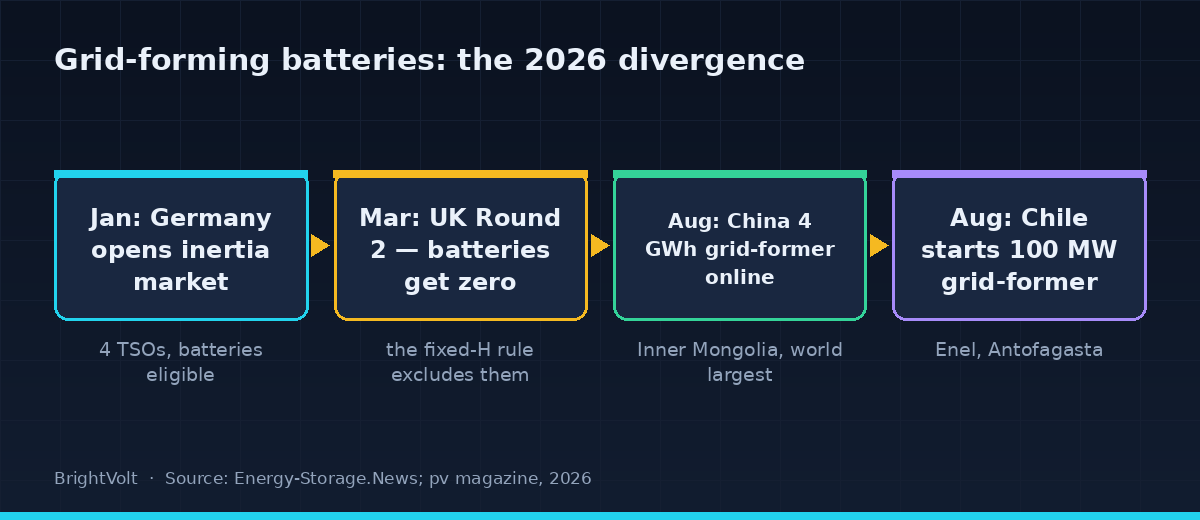
Grid-forming batteries can now do the one job the power system long insisted only spinning steel could: hold the grid’s frequency steady when a big generator trips or the wind drops. Germany started paying for it in January. China switched on four gigawatt-hours of it this month. Britain’s latest grid-stability auction bought 7.3 GVA and handed batteries none of it.
That last decision is the interesting one, because it was not forced by physics. It was written into the rules. Across 2026 the world has split into two camps on the same question — can an inverter hold up a grid the way a turbine does? — and the split runs along procurement design, not along what the hardware can actually do.
Why “inertia” was a synonym for gas
Every coal, gas, nuclear and hydro plant spins a heavy turbine and generator, thousands of tonnes turning at grid frequency. That rotating mass stores kinetic energy, and when a large unit trips off the system the mass keeps spinning for a few seconds and pushes energy back in, slowing the rate at which frequency falls. Grid operators call that inertia. It is the cushion that buys time for everything else — the gas peakers and reserves — to react before the lights go.
Solar panels and wind turbines connect through inverters. They have no synchronous spinning mass coupled to the grid, so on the old model they contributed no inertia. That is the wall the renewables build-out kept hitting. British system studies back in 2012 concluded that once non-synchronous generation ran past roughly 65% of what was online, the transmission system could no longer be secured. More wind and solar did not just need more wires. It appeared to need something to replace the spin.
What grid-forming actually changed
An ordinary “grid-following” inverter is a passenger: it watches the grid’s voltage and syncs to it. A grid-forming inverter is a driver — it sets the voltage waveform itself, the way a synchronous machine does, and injects or absorbs power within milliseconds to arrest a frequency swing. It can even black-start a dead network. The inertia is synthetic, defined in software rather than in steel, and because it is software it responds faster than a physical rotor, not slower.
This is not a lab result. Zenobē’s Blackhillock battery in Scotland — 200 MW and 400 MWh in its first phase — already delivers 370 megawatt-seconds of synthetic inertia and 116 MVA of short-circuit strength to the British grid, under a contract the grid operator itself awarded. The machine that Britain’s stability market just refused to buy is one that Britain is already running.
Germany decided one thing. Britain decided the opposite.
On 22 January 2026, Germany’s four transmission operators — 50Hertz, Amprion, TenneT and TransnetBW — opened a standing market for inertia, with contracts running two to ten years and a premium product paying €888.5 per megawatt-second a year for 90% availability. Grid-forming batteries are explicitly eligible. For a developer, that is a bankable revenue stream to build against, and it is technology-neutral: meet the frequency-holding spec and you get paid, whatever is behind the meter.
Britain ran the same errand and came home with the opposite answer. In NESO’s Stability Market Round 2, covering delivery from October 2026, 7.3 GVA of contracts went to synchronous condensers and open-cycle gas turbines across five awards. Batteries won nothing. Every battery bid failed at the technical stage, because Round 2 introduced a requirement for a “fixed H constant” — a committed, non-variable inertia value. A spinning mass has exactly that, as an accident of being a spinning mass. A grid-forming inverter is deliberately the opposite: its inertia is programmable, which is the entire point of it, and it will not pretend to be a fixed lump of iron to satisfy a form. The industry reading was blunt: the criteria still favour synchronous and thermal assets over the zero-carbon alternatives.
| Holding the frequency up | Synchronous condenser | Open-cycle gas | Grid-forming battery |
|---|---|---|---|
| Inertia source | Spinning mass | Spinning mass | Software-defined |
| Response speed | Physical, instant | Seconds to ramp | Milliseconds |
| Also delivers energy | No | Yes, burning gas | Yes, stored solar or wind |
| Operating carbon | None | CO₂ | None |
| Offers a fixed inertia value | Inherently | Inherently | Controllable, not fixed |
| Won a UK Round 2 contract | Yes | Yes | No |
Everywhere that isn’t Britain is just building it
Step outside the tender room and the argument looks settled. This month China switched on the world’s largest lithium-iron-phosphate grid-forming battery in Inner Mongolia — 1 GW and 4 GWh, built specifically to firm up a renewables-heavy grid — and the region of Ulanqab has already picked developers for another 4.4 GWh of grid-forming storage. On 17 August, Enel began construction of a 100 MW grid-forming battery inside its Finis Terrae solar plant in northern Chile, its sixth storage project in a country whose desert solar fleet is drowning in midday curtailment. Australia is on track for around 2 GW of grid-forming batteries backed by its clean-energy agency.
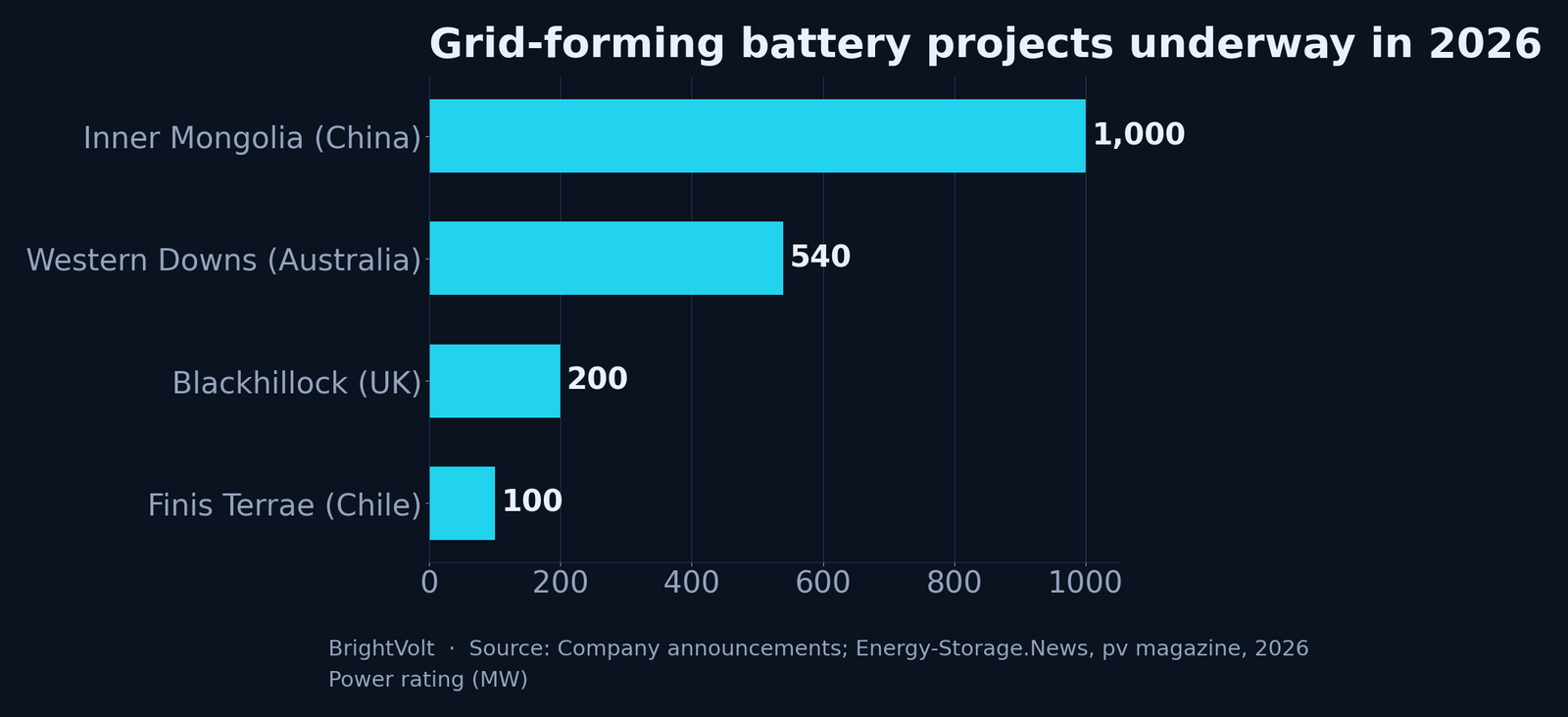
The pattern is not subtle. Where a market pays for the service, or a grid physically cannot cope without it, grid-forming batteries get built at gigawatt scale. The technology is not waiting on a breakthrough. It is waiting on rulebooks.
Where Britain has a point — and where it does not
The conservative case deserves its strongest form, because grid stability is genuinely not the place to run an experiment. A synchronous condenser is boring, proven and lasts forty years. A fixed inertia value you can bank on is operationally simpler than a fleet of inverters whose control settings a system operator has to model, trust and coordinate through a fault it may never have seen at that scale. NESO calls itself reassuringly conservative about the one service that must never fail, and for the equipment holding up the grid, “reassuringly boring” is a virtue, not an insult.
But there is a difference between conservatism about outcomes and conservatism about hardware. A rule that demands a fixed H constant is not asking “can you arrest the frequency fall?” It is asking “are you a spinning mass?” — and answering its own question by excluding anything that holds the grid up a different way. That buys the past at a premium and quietly books more gas onto a decarbonising system. Germany showed the alternative: specify the outcome, pay for it, and let batteries prove they can meet it.
We think the divergence is a mistake that corrects itself, because the physics has already left the tender behind. Here is the test that would change our mind. If a grid-forming fleet is asked to hold a large system through a serious fault in the next year or two and visibly fails — a Blackhillock or an Inner Mongolia that cannot arrest a real frequency event the way a condenser would — then Britain’s caution was foresight and the fixed-H rule was doing its job. Short of that, the split between Berlin and London is not a disagreement about what batteries can do. It is a disagreement about who got to write the rules, and it is the way the grid counts capacity, not the way the hardware behaves, that is holding the newer machine back.
Photo by Mr Dr3igeteilt on Pexels · Photo by Daryana Vasson on Pexels