
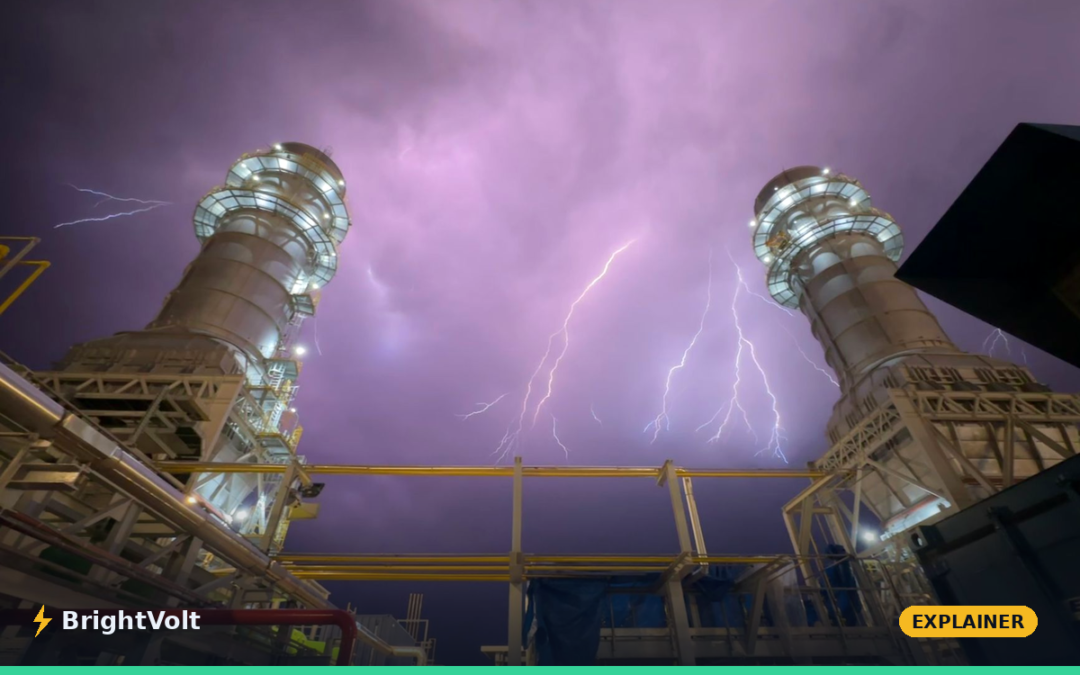
A peaker plant is a power station built to sit idle. It earns its keep by running a few hours a year, on the evenings when demand spikes and everything cheaper is already maxed out — and that scarcity is exactly why it produces the most expensive electricity on the grid: up to $276 a megawatt-hour, against roughly $40 for solar.
Least used, most costly. That inversion is the whole reason batteries are now retiring peakers before anything else. Here is why the arithmetic is so lopsided, and where it stops working.
What a peaker plant actually does
A peaker is a generator held in reserve for the demand peaks that steadier plants cannot cover: the 6pm ramp when people come home, the third afternoon of a heat wave, the still January dusk after solar has set. Most are simple-cycle gas turbines — industrial cousins of the jet engine — because they start fast and reach full power in minutes.
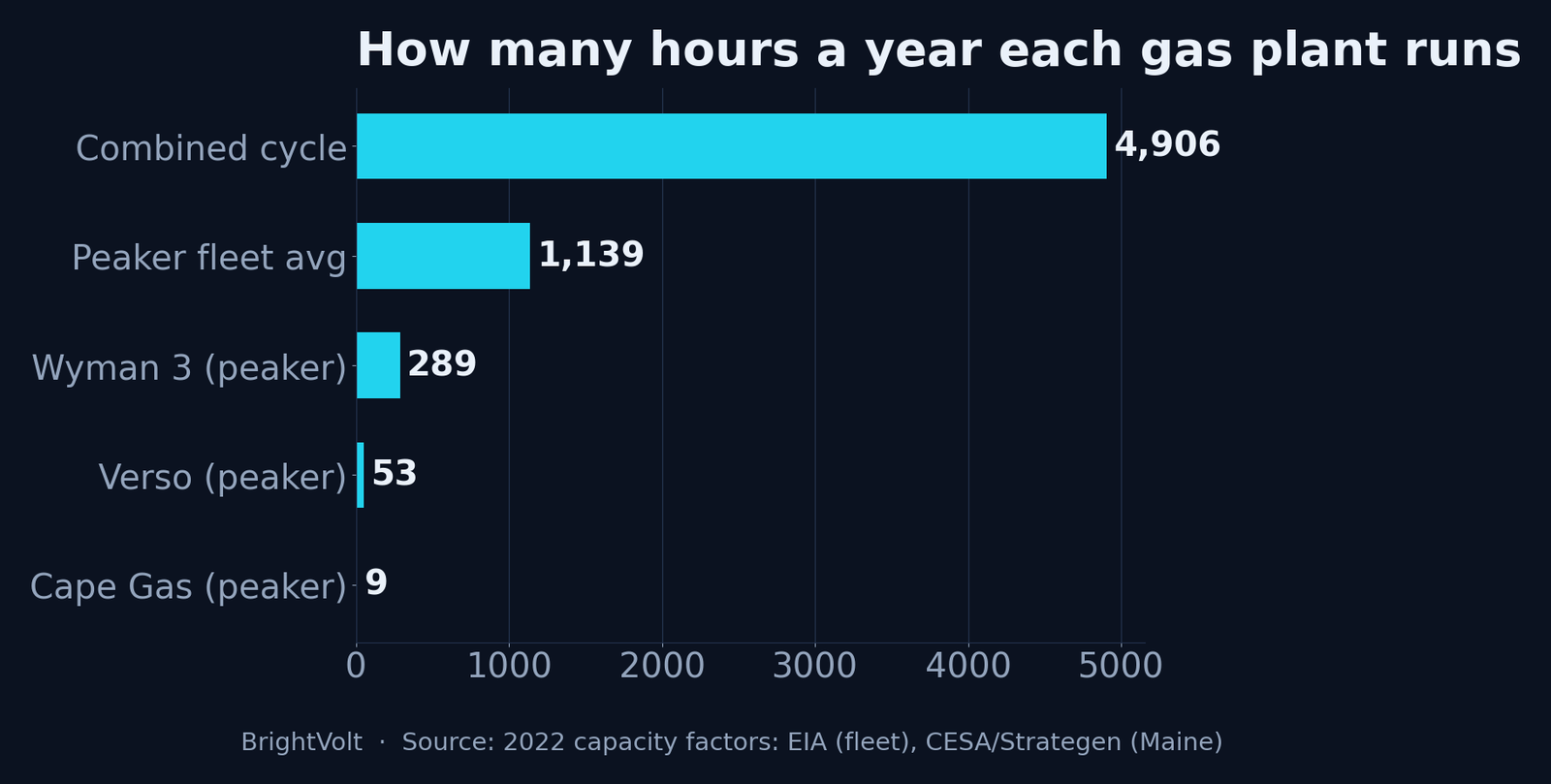
How little they run is the surprising part. Across the US simple-cycle gas fleet, the average capacity factor — the share of the year a plant actually generates — was about 13% in 2022, against 56% for the combined-cycle gas plants that do the steady work. And that average hides the extremes. The three aging Maine peakers a 2024 Clean Energy States Alliance study proposed retiring ran at 0.1%, 0.6% and 3.3% of the year — about nine hours, fifty-three hours, and two hundred and eighty-nine hours respectively. A plant that fires for nine hours out of 8,760 is not really a power station. It is an insurance policy with a smokestack.
Why the least-used plant costs the most
The cost follows directly from the idleness. A plant’s price per megawatt-hour is its lifetime cost — the turbine, the financing, the crew kept on to run it twice a summer — divided by the megawatt-hours it produces. Shrink the denominator to a few hundred hours and every one of them turns expensive.
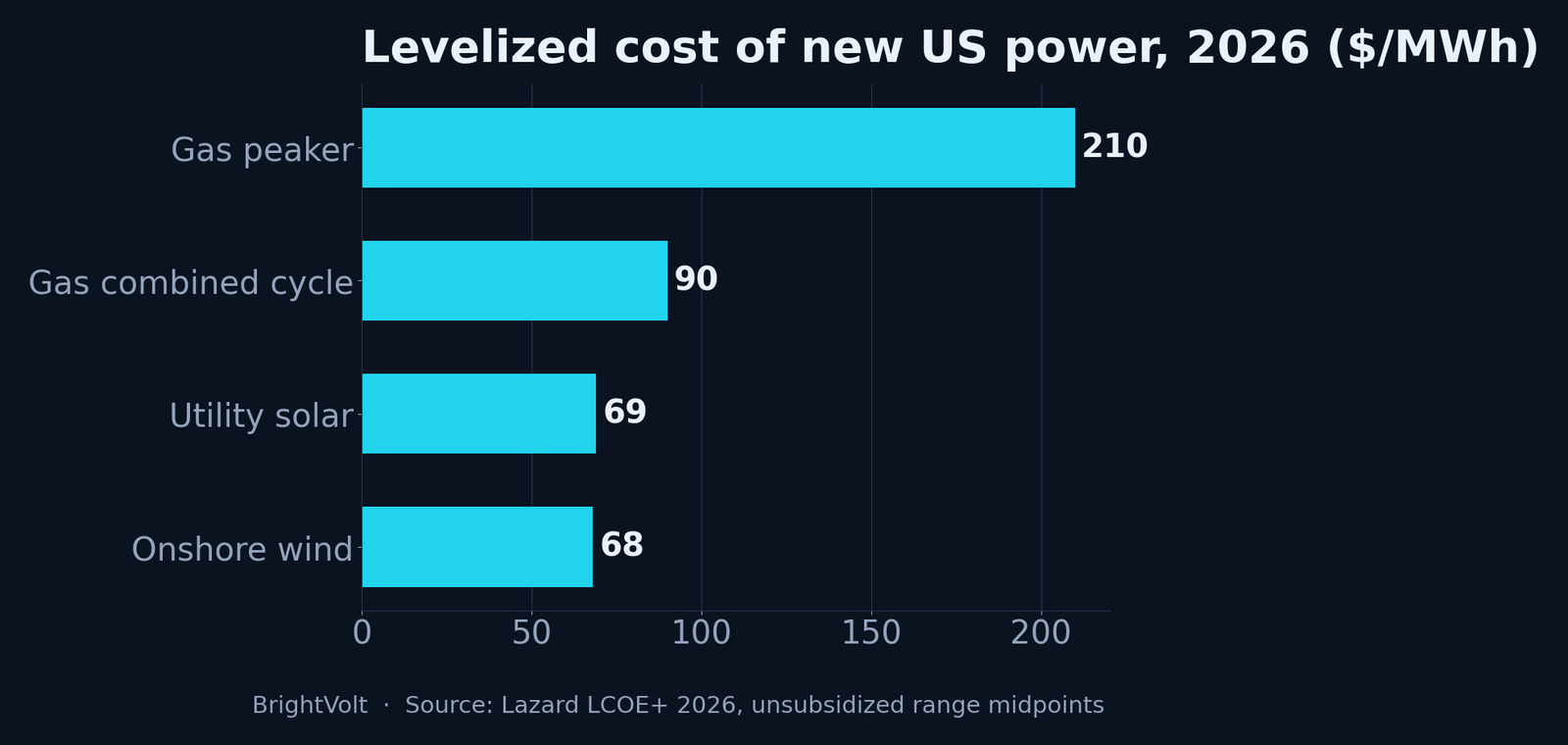
Lazard’s 2026 LCOE+, published in July, puts new gas peaking at $144 to $276 per megawatt-hour — the dearest form of new generation it tracks. Combined-cycle gas runs $51 to $129. Utility solar is $40 to $98, onshore wind $37 to $99. A peaker’s floor sits above most other sources’ ceiling.
There is a second cost that never appears in a plant’s own numbers. Because peakers run in the tightest hours, they routinely set the market-clearing price that everyone pays. When Green Mountain Power dispatched its battery fleet during Vermont’s July heat wave and held down the most expensive hours on the wholesale market, it saved every customer on the system — not just the ones with a battery — a combined $6 million over the event. That is what shaving the peak is worth. A peaker does not merely cost a lot to run; it sets the price of the whole hour it runs in.
Why a four-hour battery is the natural replacement
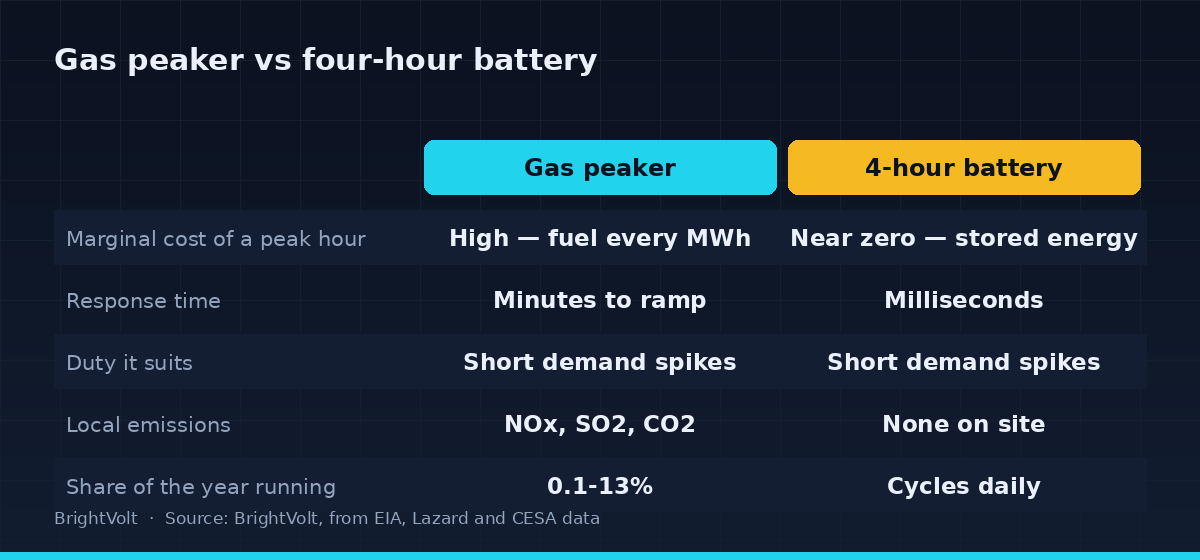
A peaker’s job description — cover a short, sharp demand spike, then stand down — happens to be the exact job a battery does best. The evening ramp lasts a few hours; a four-hour battery discharges for a few hours. The duty and the tool match.
Everything else favours the battery. Its marginal cost in the peak hour is close to zero, because it is releasing energy it stored earlier when power was cheap rather than burning fuel priced by the megawatt-hour. It responds in milliseconds, not the minutes a turbine needs to spin up. It emits nothing where it stands. The Clean Energy States Alliance analysis found that swapping two of the Maine peakers for up to 200 MW of four-hour storage came out cheaper than building a new gas turbine once the cost of carbon and local pollution was counted — and retiring the pair would cut 9,700 tonnes of CO₂, 8.4 tonnes of NOx and 14.6 tonnes of SO₂ a year in neighbourhoods home to some 83,000 people.
The one honest caveat is duration, and it is the same caveat that governs how the grid pays these resources in the first place. A four-hour battery covers a four-hour spike. It does not cover a three-day cold snap, which is why grids credit storage through effective load-carrying capability rather than at face value — and why the accredited worth of a battery slips as more of them crowd onto the same evening.
The peakers already going dark
This is no longer theoretical. Green Mountain Power permanently closed its peakers in Vergennes and Rutland through ISO-New England’s retirement process, and now leans on a 110 MW virtual power plant — 53 MW of it batteries sitting in customers’ basements — that the utility pays households to host. It says further peaker retirements will follow as the fleet of home batteries grows.
The prize is far bigger than Vermont. The US runs on the order of 1,000 gas peaker plants, many of them decades old and sited, disproportionately, in low-income neighbourhoods that breathe the exhaust for the few dozen hours a year the turbines fire. Retiring the oldest and least-used of them is the cleanest win in the whole storage transition: the plants are barely running, they bill the most expensive megawatts on the system, and the thing that replaces them is cheaper, faster and silent.
What would keep peakers running
The case for holding onto peakers is not sentimental, and it is getting louder. AI data centres are dragging electricity demand up faster than new firm capacity can be built, and some grids are pulling old peakers back into service rather than closing them. Storage economics can wobble too: Lazard noted battery costs rose in 2026 for the first time in years, as tariffs and supply-chain rules bit.
Those pressures change the timing, not the direction. A peaker earns its place only in the hours nothing cheaper can reach, and the band of hours a battery cannot cover keeps narrowing as durations lengthen and fleets grow. Watch two numbers. If gas peaker capacity factors climb back above the mid-teens, data-centre load is winning the race. If they keep sliding toward the Maine plants’ fraction of a percent, the batteries are. For now, the batteries are.
Photo by Mehmet Orak on Pexels · Photo by Ramesh Kambattan on Pexels