

The US House voted 417-3 to make large data centers pay the full cost of the electricity grid they demand. Two weeks later, on September 30, the Senate let the bill die on a 57-43 procedural vote. Neither result changes a single household’s power bill — because the law they fought over only asked state regulators to consider the idea.
That is the whole shape of the Ratepayer Protection Act, and it is stranger than the party-line box score suggests. The decision it only gestured at — who pays when a gigawatt of server load lands on a regional grid — is already being made, in dollars, inside state utility commissions that did not wait for Washington.
What the Ratepayer Protection Act actually did
H.R. 9340, introduced by Representative Gabe Evans of Colorado, passed the House on September 16 by 417 votes to three. The text is narrow. It directs state public utility commissions to consider a ratemaking standard, added to the federal menu under Section 111(d) of the Public Utility Regulatory Policies Act, under which data centers drawing more than 100 MW would cover the full incremental cost of serving them instead of socializing it onto households and small businesses. “If you create the cost, you should pay the cost,” is how the bill’s Senate champion, Jon Husted of Ohio, framed it.
The load threshold and the principle are real. The verb is the catch. PURPA’s standards are a list that states are obliged to evaluate and free to reject; a federal instruction to consider a standard is not an instruction to adopt it. A commission can hold a hearing, decide it already does enough, and comply fully having changed nothing.
The Senate never reached a vote on passage. Husted first brought the bill up for unanimous consent on September 17, and a Democrat objected. A motion to advance it then failed 57-43 on September 30, three short of the 60 needed to break a filibuster, with four Democrats — Maggie Hassan, Amy Klobuchar, Jon Ossoff and Raphael Warnock — crossing over. It was one of the last acts before the chamber broke for the election recess.
Why a 417-3 landslide could not survive the Senate
The paradox dissolves once the two tallies are read as answers to different questions. The House voted on whether data centers paying their own way is a good idea; almost everyone thinks it is. The Senate voted on whether this particular bill does anything about it; there, “optional” satisfied no one.
Both sides said so plainly. Senate Minority Leader Chuck Schumer called it “a toothless messaging bill”; Senator Martin Heinrich, who wants mandatory cost-causation rules, said it “does not do enough to address the rising costs of AI data center development.” Husted read the same vote the opposite way — “Now they own it. The Democrats are obstructionists on lowering electricity prices.”
Do data centers actually raise your bill?
Here the sourcing stops agreeing with itself, and the disagreement is the story.
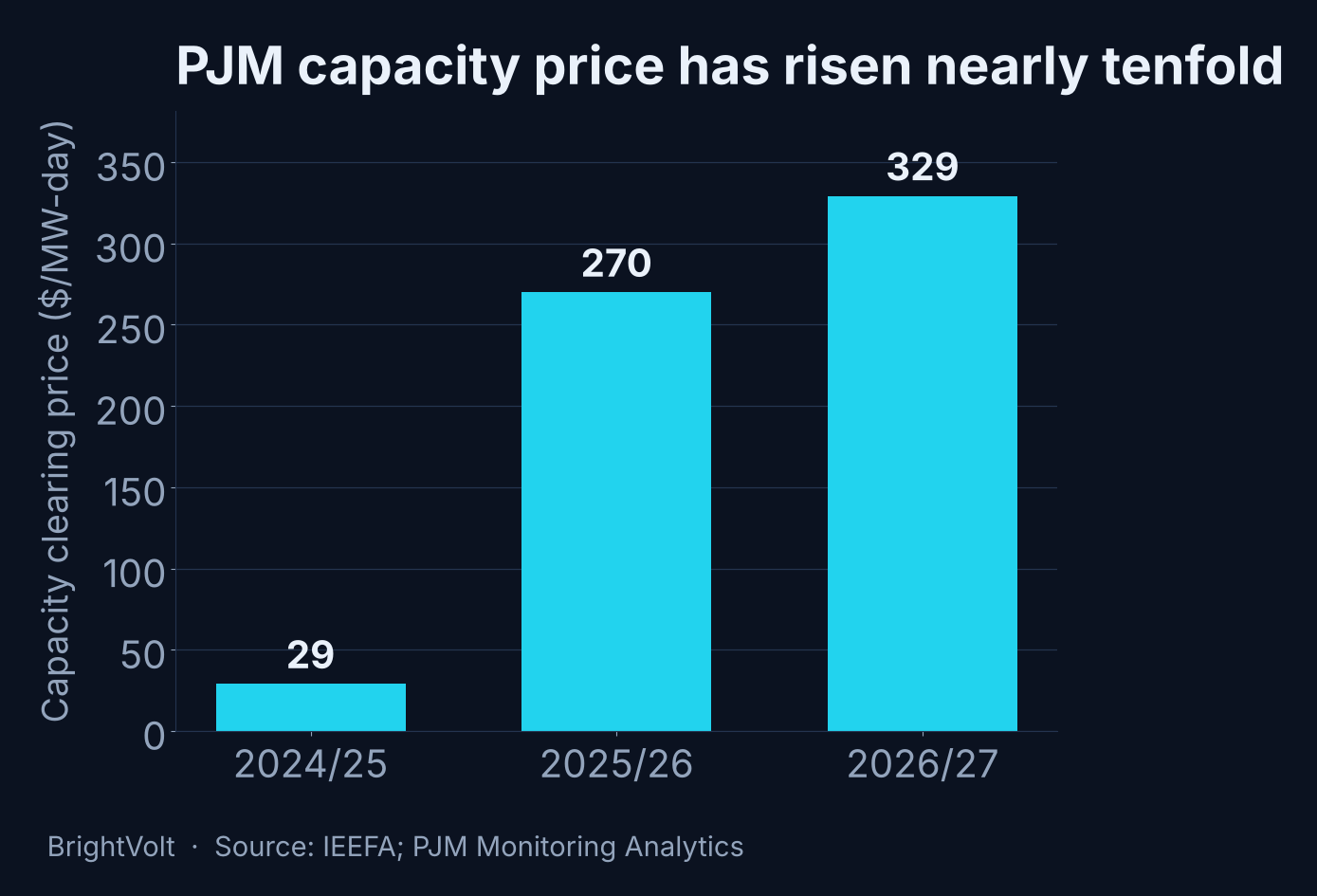
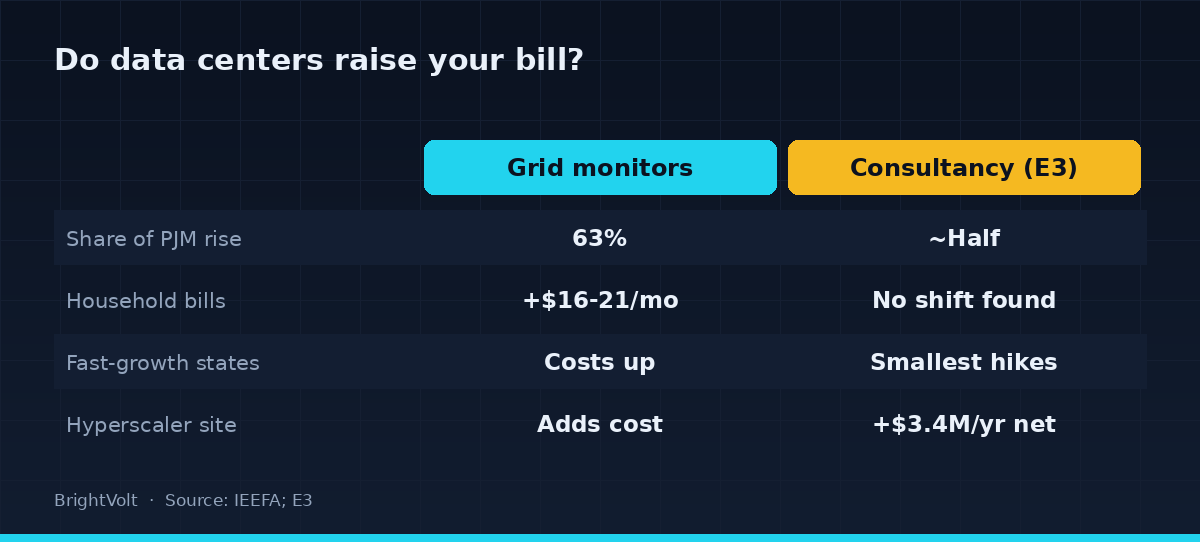
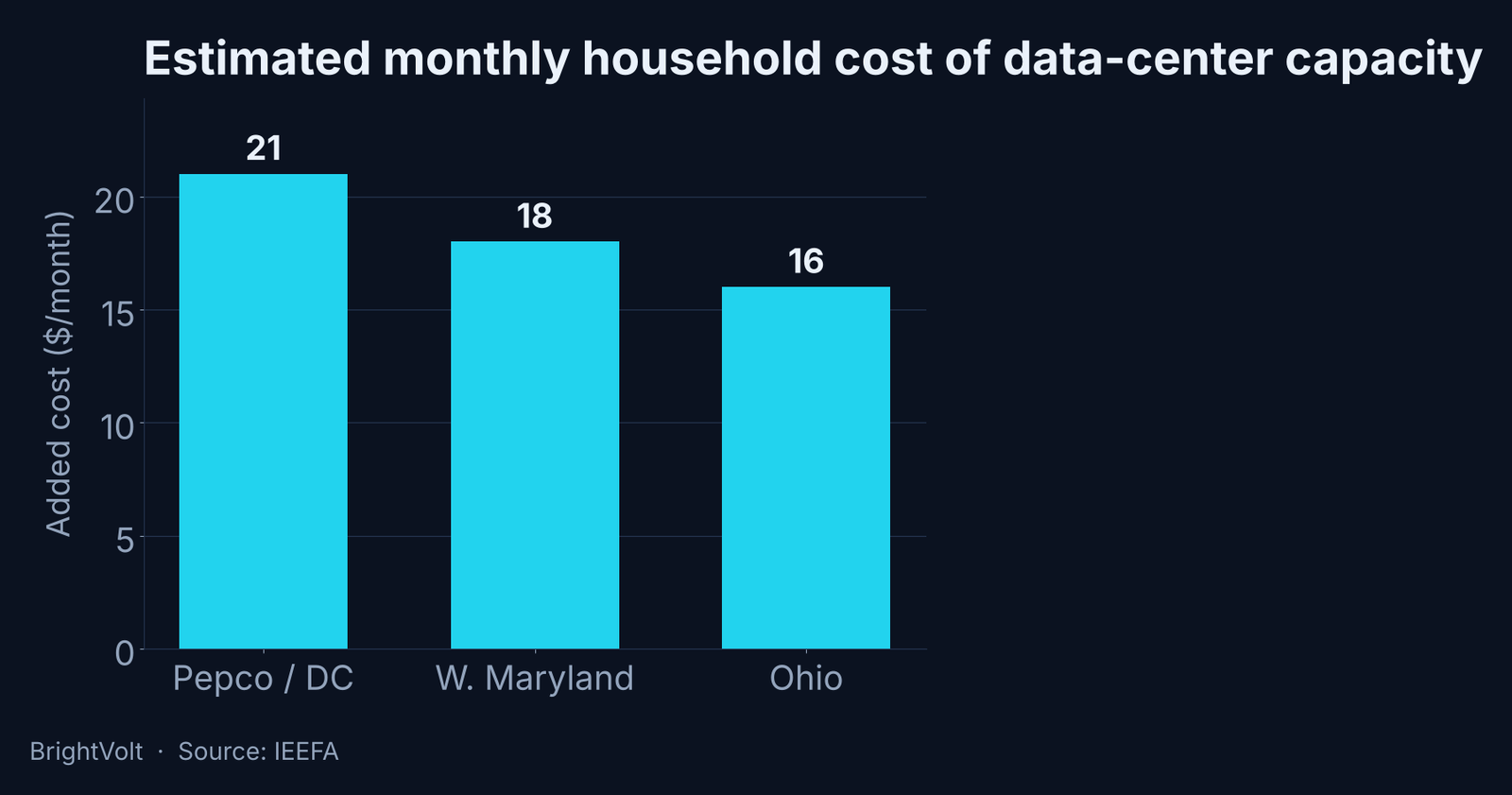
The case that they do runs through PJM, the grid operator for about 67 million people across 13 states and Washington DC. Its annual capacity auction — what generators are paid to promise they will be available — ran from $28.92 per megawatt-day for 2024/25 to $269.92, then $329.17 for 2026/27, close to a tenfold jump in two years. PJM’s own market monitor attributed 63% of the 2025/26 increase to data-center demand. IEEFA put the added capacity cost across PJM at $9.3 billion and traced it onto bills: roughly $21 a month more in the Pepco zone around DC, $18 in western Maryland, $16 in Ohio. On that reading the capacity market is already shifting the server boom’s cost onto everyone on the same wires.
The case that they do not is quieter and brings its own figures. A 2026 whitepaper from the consultancy E3 found that load growth explained only about half of PJM’s capacity-price rise — the rest being plant retirements and market-design changes that would have lifted prices anyway. More awkwardly, the states with the fastest load growth — Texas and Virginia — saw some of the smallest rate increases, while California and New York, where demand is flat, saw the largest. E3 found no evidence of a historical cost shift from data centers onto households in Virginia, the densest data-center market on earth, and calculated that the Amazon sites it examined each paid, on average, about $3.4 million a year more than it cost to serve them.
Both can be true at once, and the shouting misses the seam where they meet. Data centers add load, and load adds cost; no one disputes the total rises when a 300 MW campus connects. The live question is narrower: does the tariff make that campus pay for the transmission and capacity its arrival requires, or does the cost spread quietly onto the ratepayers next door? That is a cost-allocation question — and cost allocation is set by rate design, not by a congressional vote on whether rate design should be looked at.
Where the money is actually being decided
While Congress argued over a bill that tells states to think about it, several states did the thing itself. Ohio is the template, and its own households were among those IEEFA estimated already paid about $16 a month more for data-center capacity.
 In July 2025 its commission approved a tariff for AEP Ohio requiring data centers above 25 MW to pay for at least 85% of the capacity they reserve, every month, for as long as 12 years — whether they draw it or not. It is a take-or-pay contract dressed as a tariff, and its logic is the one the federal bill only named: a customer that asks the grid to build for a gigawatt is on the hook for a gigawatt. The same demand-charge principle that governs a commercial building’s bill, scaled to a hyperscaler.
| H.R. 9340 (federal) | AEP Ohio tariff (state) | |
|---|---|---|
| Status | Blocked in the Senate | In force since July 2025 |
| Threshold | Data centers over 100 MW | Data centers over 25 MW |
| What it does | Tells states to consider a cost-causation standard | Requires paying for 85% of reserved capacity for up to 12 years |
| Binds anyone? | No — advisory under PURPA | Yes — a signed, enforceable contract |
| Enforcement | State discretion | Exit fees, financial assurance |
Texas, Indiana and others are moving down the same path with minimum-demand terms and dedicated large-load rate classes. That is where cost causation becomes an enforceable number — not because Washington directed it, but because a commission that approves a connection owns the fallout when the next residential rate case lands.
What to watch
The Ratepayer Protection Act will almost certainly return; a bill that polls this well — 53% of Americans told pollsters they are “extremely” or “very” concerned about data centers’ effect on power prices — is too useful to leave on the floor. The more consequential front is the state dockets and whatever FERC decides to do about cost allocation in the organized markets, because that is where an advisory principle becomes a binding dollar figure.
The read here is that the federal vote changed nothing a household will feel, and the state tariffs will. What would prove it wrong is specific and worth watching for: a commission somewhere adopting a cost-causation standard it would otherwise have skipped, and citing the PURPA “consider” obligation as the reason it finally did. Until then, the place to look for your next bill is your state’s utility commission, not the Congressional Record.
Photo by panumas nikhomkhai on Pexels · Photo by Andy Coffie on Pexels