
An energy-only market pays a power plant for one thing: the electricity it actually generates, priced moment to moment. A capacity market pays it twice — once for that energy, and again, years in advance, simply for promising to be available when demand peaks. That single design choice is why Texas built more grid batteries than anywhere else in the United States while the mid-Atlantic’s capacity bill just cleared a record high.
Both markets are trying to keep the lights on. They send opposite signals to do it, and the assets that answer each signal are different.

What an energy-only market pays for
An energy-only market has one revenue stream for a generator: the wholesale price of power, settled in real time, plus a smaller income from ancillary services — the fast reserves that keep frequency steady. Texas’s grid, run by ERCOT, is the standard example. There is no separate payment for existing. If a plant wants to earn, it has to be running, or standing ready to run, in the hours when power is expensive.
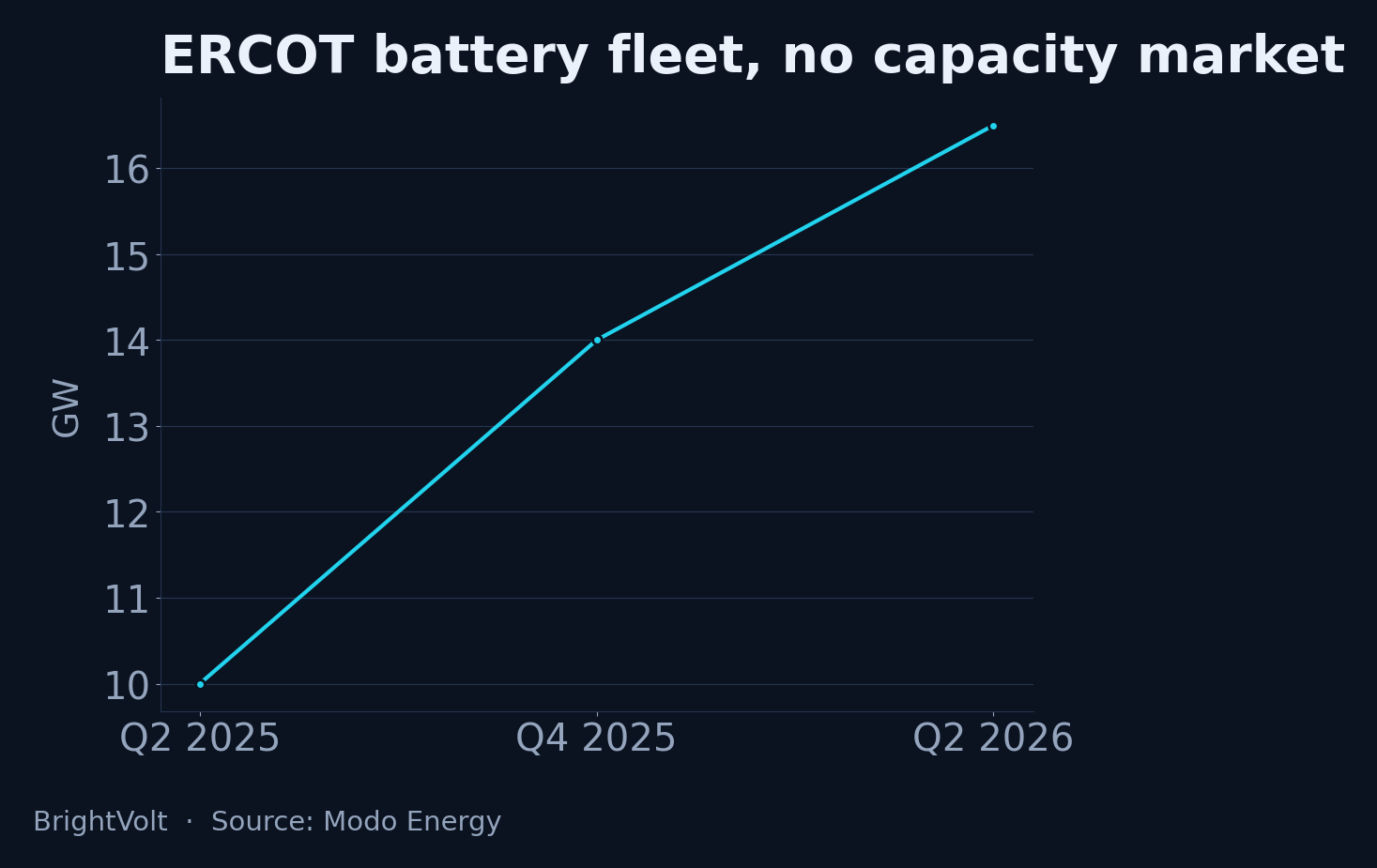
The mechanism that makes those hours pay is scarcity pricing. As spare generation tightens, ERCOT layers an administrative adder onto the real-time price through its Operating Reserve Demand Curve, pushing it toward a systemwide offer cap that the Texas regulator cut from $9,000 to $5,000 per megawatt-hour after Winter Storm Uri. A generator’s whole business case rests on capturing a handful of those spikes a year. That rewards a specific kind of asset — one that is cheap to hold idle and can inject power the instant prices jump. A battery is exactly that asset, which is why ERCOT’s fleet reached 16.5 GW in mid-2026 with no storage mandate and no capacity payment behind it. The catch is volatility: battery revenues in ERCOT were pacing at just $29 per kilowatt-year through early 2026, so the model rewards flexibility but offers a developer no floor.
What a capacity market adds on top
A capacity market keeps the energy market and bolts a second one in front of it. Grid operators such as PJM, which runs the largest US power market across thirteen mid-Atlantic and Midwestern states, run a forward auction — the Base Residual Auction — that buys firm capacity roughly three years ahead of when it is needed. A generator that clears the auction is paid a fixed rate, quoted in dollars per megawatt-day, for committing to be available in that future year, whether or not it is ever dispatched.
The point is bankability. A developer with a three-year revenue commitment in hand can finance a plant against it, which is a far easier conversation with a lender than “we will capture some scarcity spikes, probably.” A capacity payment is insurance the grid buys against a shortfall, and like insurance it is paid whether or not the bad day arrives. The price of that insurance is set in the auction, and it is meant to rise when the system looks short of firm supply — a signal to build.
The worked case: Texas versus the mid-Atlantic
The two designs produced two very different 2026 stories. PJM’s forward auction is the one that made headlines, because the price of firm capacity did not just rise — it detonated.
| Energy-only (ERCOT) | Capacity market (PJM) | |
|---|---|---|
| Pays a generator for | Energy and ancillary services, in real time | Firm availability, about 3 years ahead |
| Price signal | Scarcity adder, up to $5,000/MWh | Auction clearing price, $/MW-day |
| Best suited to | Flexible, fast assets: batteries, demand response | Firm capacity a lender can finance |
| Who carries the risk | The developer — revenue is volatile | Consumers — the capacity charge lands on bills |
| 2026 outcome | 16.5 GW of batteries, no mandate | Capacity price hit a record ~$329/MW-day |
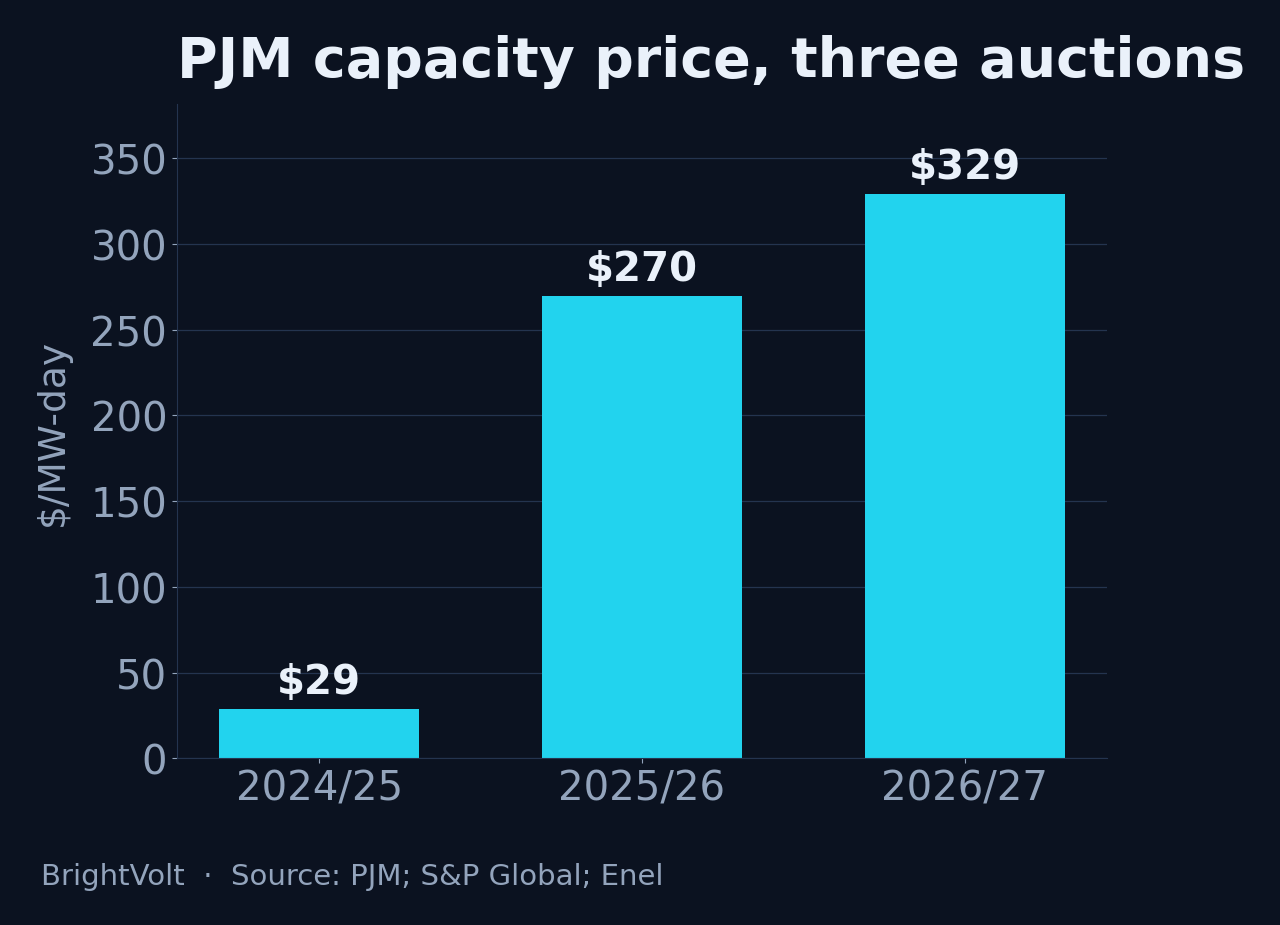
PJM’s capacity price ran from $28.92/MW-day in the 2024/2025 auction to $269.92 for most of the footprint in 2025/2026, then to $329.17/MW-day for 2026/2027 — the FERC-imposed ceiling. That is an elevenfold jump in two years, driven by surging data-centre demand, thermal plant retirements and a system falling short of its own reliability target. Because a capacity charge flows through to customers, the increase is a straight addition to bills across the region.
Texas, running no capacity auction at all, added grid batteries faster than any other US market over the same period. The energy-only signal — get paid in the scarce hours or not at all — turned out to be exactly what a fast, flexible asset wants to hear.
Which market builds what
Neither design is a free lunch, and the trade is symmetrical. An energy-only market shifts revenue risk onto the developer and, in exchange, sends the sharpest possible signal to flexible resources: it is no accident that ERCOT is both the most volatile major US market and the one with the most batteries and demand response. A capacity market shifts that risk onto consumers, who pay the capacity charge every year, and in exchange gives developers the bankable, forward revenue that firm plants need to get financed. It buys reliability insurance and pays the premium whether or not it is used.
That is also why the argument between them is really an argument about what a grid most needs. A system worried about a developer’s ability to finance new firm plants leans toward a capacity market. A system that wants to reward flexibility and let scarcity do the signalling leans energy-only. The choice interacts with everything downstream — how projects clear the interconnection queue, how capacity credit is assigned to a battery or a wind farm, and whether a peaker plant earns enough from a few hours a year to stay open.
What to watch
The two models are converging at the edges. ERCOT is rolling out its real-time co-optimisation redesign, which pays energy and reserves together and sharpens the scarcity signal further, while PJM is under pressure to reform an auction that produced back-to-back record prices without obviously fixing the shortfall that caused them. The durable framing survives all of it: an energy-only market pays for power and lets scarcity reward flexibility; a capacity market pays for a promise and hands developers a signal a bank will lend against. When a headline quotes a battery boom in one market and a capacity-price shock in another, the market design is usually the reason — and BrightVolt’s look at how Texas out-built California on storage is the same lesson read from the other end.
Photo by Vjanodic WERSOV on Pexels · Photo by Ramesh Kambattan on Pexels