
Texas has built the largest grid-battery fleet in the United States — roughly 21 GW of operating capacity by mid-2026, against California’s 17 GW — and it did so with no storage mandate, no capacity market and no climate target. The lesson the rest of the country keeps missing is not political. It is that ERCOT pays a battery for exactly what a battery does.

That framing matters because the standard story runs the other way. California ordered storage into existence: the Public Utilities Commission set procurement targets in 2013, and every distributed-energy roadmap since has treated the mandate as the engine of deployment. A dozen states have copied the template — set a gigawatt goal, pay for it through a capacity mechanism, wait for the fleet to appear. Texas set no goal, and has more batteries than any of them.
The scoreboard: Texas leads on gigawatts, California on use
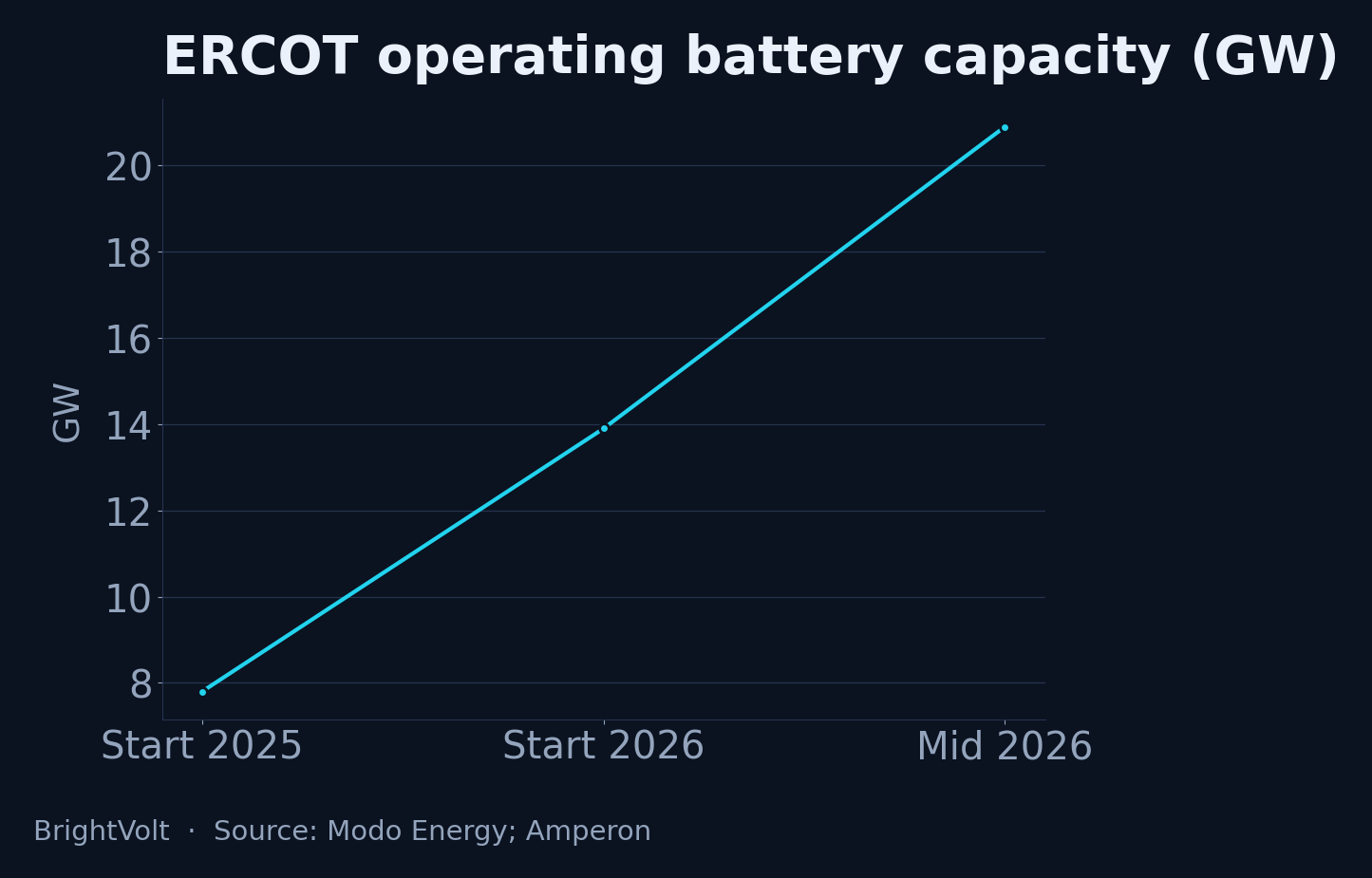
Texas entered 2026 with 13.9 GW and 22.9 GWh of commercially operational grid-scale storage, according to Modo Energy — a near-doubling of the fleet in a single year, with 6 GW and 60 new sites coming online in 2025 alone. By the middle of the year ERCOT was running about 20.9 GW of batteries against CAISO’s 17.0 GW. On raw capacity, it is not close.
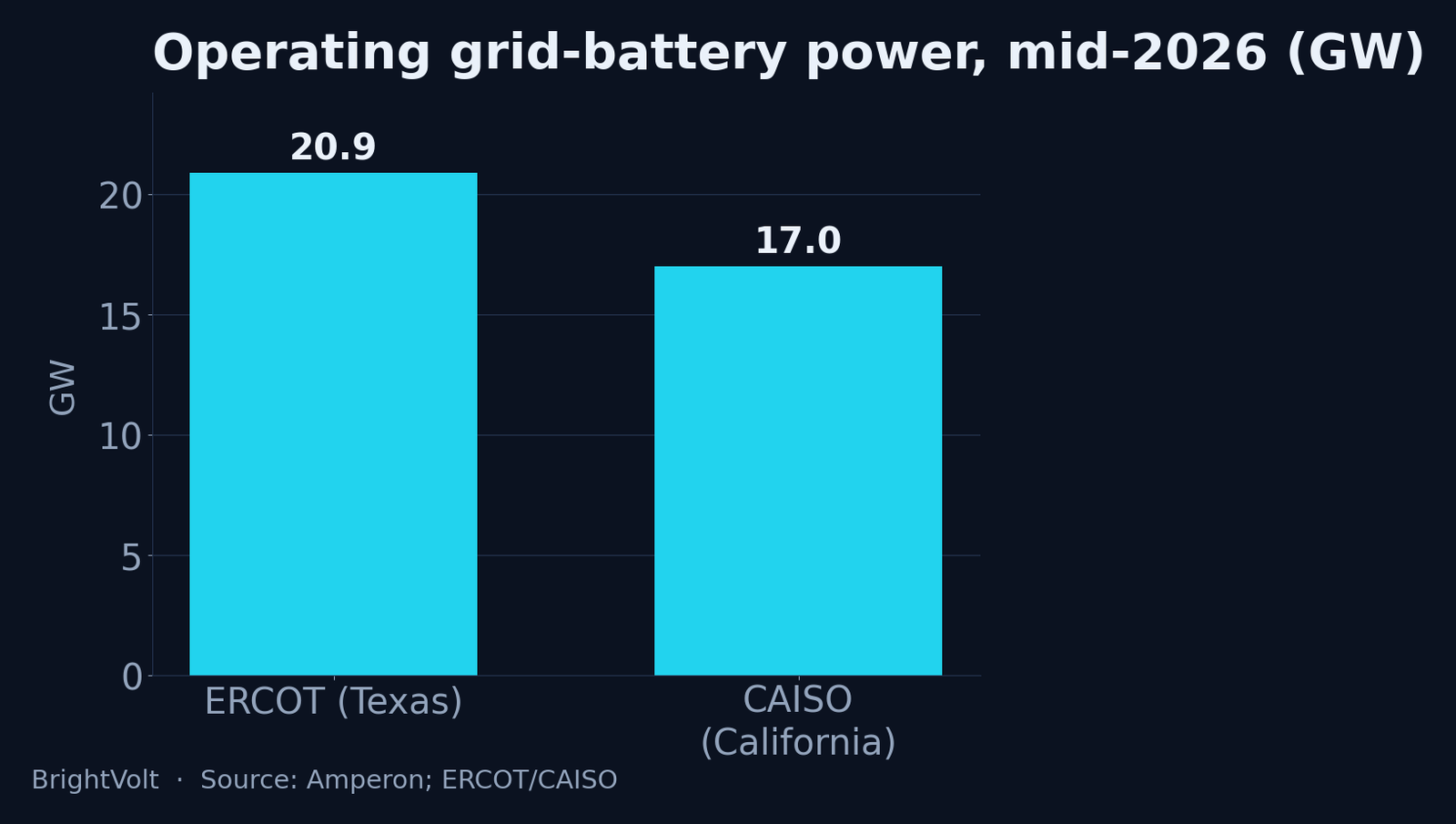
On use, it inverts. Those 17 GW in California cover roughly 33% of the state’s system peak; ERCOT’s larger fleet covers about 23% of a bigger one. California got to grid storage first, leans on it harder each evening, and squeezes more out of every megawatt it installed. The honest reading is that the two states optimised different things — California the intensity of use, Texas the speed and scale of the build. This piece is about the build, because that is the part everyone else is trying and failing to copy.
What ERCOT actually pays a battery to do
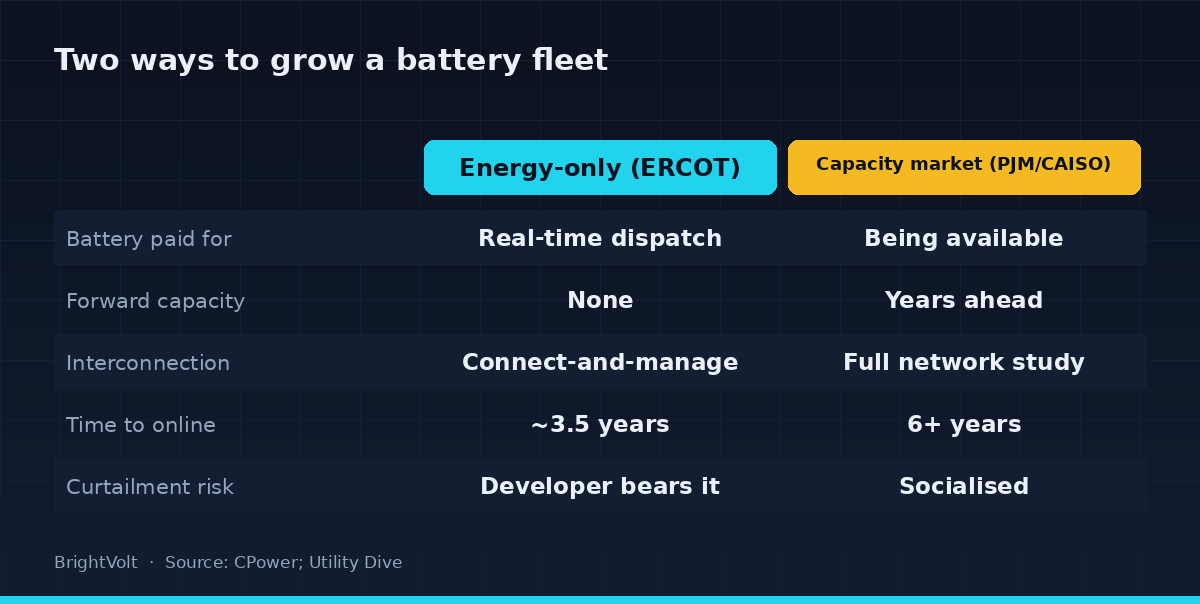
ERCOT is an energy-only market with no forward capacity market, and the only deregulated US grid not overseen by federal regulators. There is no annual payment for merely existing and being available. A battery earns by buying cheap power and selling it dear, by holding reserves, and by responding in milliseconds when the grid tightens and the real-time price spikes toward the offer cap. The market pays for the service at the moment the service is worth the most. That is a design that a battery — fast, precise, short-duration — is almost purpose-built to exploit.
Compare the alternative. PJM runs the largest capacity market in the world, procuring capacity three years ahead, and California layers a resource-adequacy obligation on top of its energy market. Both pay an asset partly for being there, which is steadier for a developer but blunter as a signal: it rewards nameplate over the thing the grid actually needs at 7pm on a still evening.
Then there is the queue. ERCOT uses connect-and-manage interconnection: it studies only the local upgrades a project needs to plug in, and manages the resulting congestion through redispatch rather than making each developer pay for the entire network to be reinforced first. A project reaches the grid in about three and a half years, against six or more in PJM and the Southwest Power Pool. In 2021 and 2022 ERCOT brought 14.2 GW online; PJM, over the same two years, managed 5.6 GW. The catch is real and worth naming: the developer, not the ratepayer, carries the curtailment risk, and ERCOT clipped about 9% of utility-scale solar and 5% of wind in 2022. Builders price that risk and mostly decide it is worth it. Meanwhile interconnection costs in PJM’s queue jumped eightfold, to $240 per kW — the kind of number that kills a project before it starts. This is the same bottleneck we have written about in the interconnection queue explainer; Texas simply refuses to let it form.
The mandate has the causation backwards
Put the two levers side by side and the conclusion is uncomfortable for the policy-first camp. The mandate is a floor. The market is the engine. California’s target guarantees a minimum; it does not explain why Texas, with no target at all, built more and faster. What builds batteries is a price that pays them for dispatch and a queue that lets them reach the grid before the opportunity closes.
This is the storage cousin of an argument we made about generation, where the states adding the most solar are increasingly the ones with the least climate policy and the fewest permitting hurdles. Batteries follow the same logic, only more sharply, because a battery lives or dies on price volatility — and an energy-only market manufactures exactly the volatility a battery monetises.
| Texas (ERCOT) | California (CAISO) | |
|---|---|---|
| Operating batteries, mid-2026 | ~20.9 GW | ~17.0 GW |
| Added in 2025 | 6 GW / 60 sites | — |
| Share of system peak | ~23% | ~33% |
| Time to bring a project online | ~3.5 years | 6+ years (study-based) |
| Adequacy construct | Energy-only, no capacity market | Resource adequacy obligation |
Where the Texas model gets tested
An honest Take names the strongest case against it. Here are the two that matter.
The first is reliability. An energy-only market outsources the promise of keeping the lights on to scarcity prices, and in February 2021 that market presided over the Winter Storm Uri blackout that killed hundreds of Texans. But Uri was a generation-adequacy and weatherisation failure — frozen gas wellheads and uninsulated wind turbines, a fleet that could not physically run — not a flaw in how storage is paid. If anything, the batteries built since are the fastest-responding insurance ERCOT now owns. The market that gets blamed for Uri is also the one that has since bought more grid flexibility than any other state.
The second is more serious, because it is about the model’s own success. New battery interconnection applications in ERCOT fell by half in the second half of 2025, to 13.6 GW. Build enough batteries and they compress the very price spreads that pay for them; the easy money in two-hour arbitrage thins out as the fleet grows, a cannibalisation the same dynamic that turned pumped hydro’s economics is now visiting on lithium. That is the genuine risk. But it is also the market doing its job: a price signal detected saturation, and capital stepped back without a regulator having to guess. A capacity market would have kept paying for steel the grid did not yet need.
So here is the falsifiable version of our read. If ERCOT’s newly commissioned battery capacity in 2026 and 2027 collapses as spreads compress — while California’s mandate-driven build grinds on regardless — then Texas’s lead was an arbitrage windfall, not a repeatable design, and the mandate states will look prudent for having a floor. Watch two numbers: ERCOT’s commissioned gigawatts through 2027, and whether its ancillary-services and scarcity prices hold a floor high enough to keep the next 20 GW penciling out. Our bet is that they do, and that the market, not the mandate, keeps building.
Photo by Heru Dharma on Pexels · Photo by Kindel Media on Pexels