
Behind the meter, gas is winning the AI power race. The US grid will add a record 86 GW of capacity in 2026, and only 6.3 GW of it is natural gas — a result we read as gas losing back in August. That reading was right about the grid. It missed a second power system being built alongside it: 59 data-centre projects have lined up roughly 90 GW of on-site generation, overwhelmingly gas, that never shows up in an interconnection queue or an EIA capacity table.
We want to correct the record, because the correction is more interesting than the original call. Gas did not reconquer the grid everyone watches. It built a grid nobody is counting.
The capacity figures measure the wrong grid
Every “renewables are winning” chart, ours included, counts what connects to the public network. On that measure the story is settled: the EIA expects 43.4 GW of utility-scale solar, 24 GW of batteries and 11.8 GW of wind this year against 6.3 GW of gas. Carbon-free capacity is roughly 92% of the total. Nothing about that is wrong.
It is just not where the fastest data centres are getting their power. According to Cleanview, which reconstructs the projects from air-quality permits, SEC filings and satellite imagery, 92% of the behind-the-meter pipeline — about 82 of the 90 GW — was announced after the start of 2025, and it already represents more than a quarter of all planned US data-centre capacity. OpenAI and Anthropic alone have signed leases for more than 10 GW of it. xAI’s Colossus site in Memphis is running close to 1,500 MW of on-site gas today. These plants are invisible to the national numbers by design: a generator that serves one campus and never touches the public wires is not in anyone’s interconnection queue, so it is not in anyone’s capacity statistics either.
That is the hole in the “gas lost” argument, and we were standing in it.
The queue is the reason, and the engine is the method
Why build your own power station in 2026? Because the alternative is a waiting list. US interconnection queues held around 2,000 GW of generation and storage at the end of 2025, the median project now waits about five years for a connection, and across two decades only 19% of what entered the queue was ever built (Lawrence Berkeley National Laboratory). A hyperscaler racing to energise a campus before its GPUs age out cannot spend five years in a line four-fifths of whose occupants leave empty-handed.
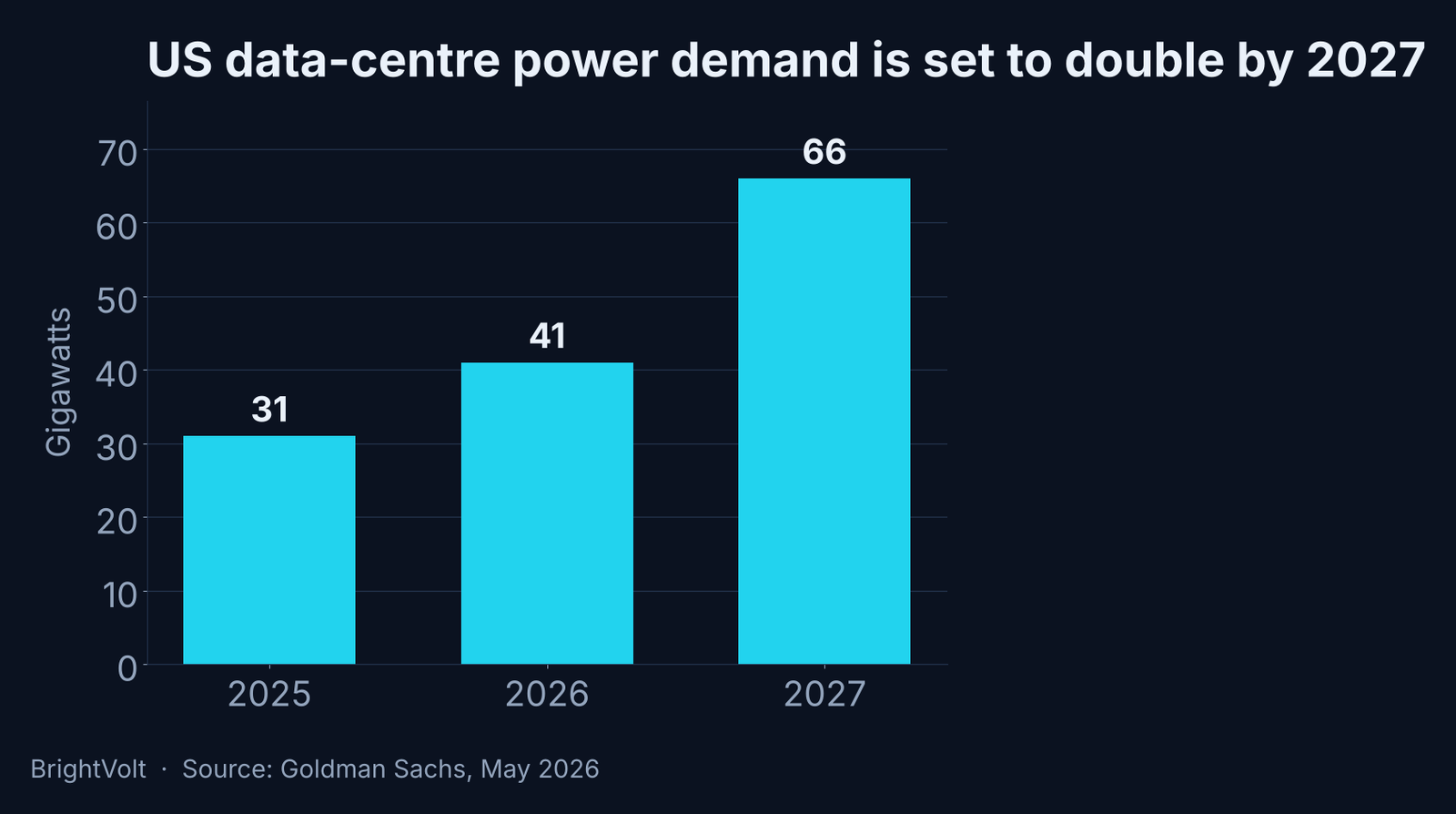
And the hurry is real: Goldman Sachs expects US data-centre power demand to roughly double from 31 GW in 2025 to 66 GW in 2027. That is the load looking for somewhere to plug in.
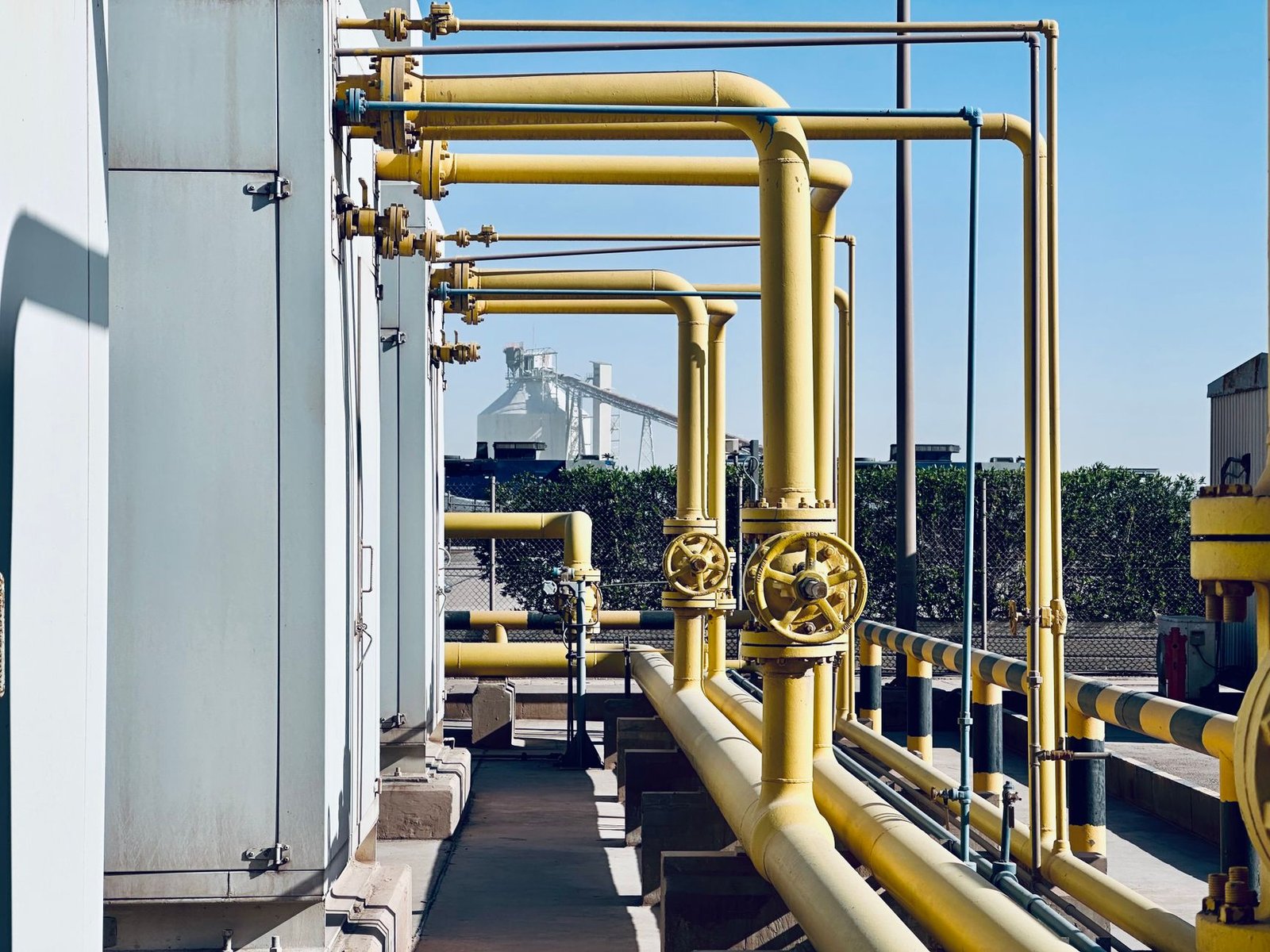
Going behind the meter deletes that wait. It also, crucially, dodges the other bottleneck everyone is fixated on. The heavy-duty gas turbine — the HA-class frame that powers a utility combined-cycle plant — is sold out: GE Vernova is now taking reservations for 2031 and carries a 116 GW backlog, and Wood Mackenzie expects turbine prices to hit $600/kW by 2027, up 195% on 2019. If the grid-scale turbine were the only way to burn gas, the gas comeback would indeed be a 2031 story. It is not the only way.
| Power source | Typical scale | Can a data centre get it in 2026? |
|---|---|---|
| HA-class gas turbine (combined cycle) | 300 MW and up | No — GE Vernova is booking 2031 slots |
| Reciprocating gas engines (Caterpillar et al.) | 1–100 MW, modular | Yes — about a third of behind-the-meter orders |
| Fuel cells (Bloom Energy, gas-fed) | modular | Yes — roughly a seventh of orders |
| A public-grid connection (any fuel) | — | A ~5-year queue; 19% of entrants ever built |
The behind-the-meter fleet is not waiting on the scarce machine. Caterpillar holds about 33% of the on-site equipment Cleanview can identify and Bloom Energy about 14% — reciprocating engines and fuel cells, built on an industrial production line, shippable this year. The constraint that makes grid gas a 2031 proposition simply does not bind the thing that is actually being installed. That is the whole trick: skip the queue, and skip the turbine, by burning gas in a box you can buy off the shelf.
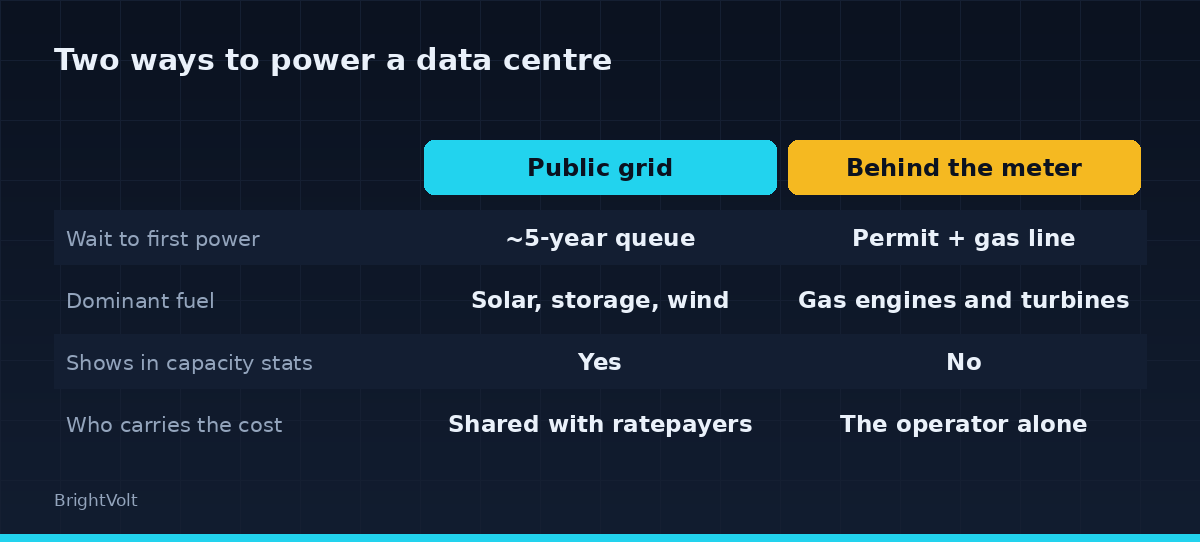
The two routes to a powered data centre now look almost nothing alike. One is slow, shared and mostly clean; the other is fast, private and mostly gas — and only one of them is counted.
The honest objection: it is still a pipeline
Here is where intellectual consistency costs us something. In August we dismissed the 116 GW turbine backlog as “a waiting room with a very high mortality rate” — order books are not power plants. The same scalpel has to cut the other way. Of Cleanview’s ~90 GW, only about 2 GW is actually operating, across four projects. Roughly a third more is permitted; around 60% is still an announcement or an early-stage plan. Cleanview’s own 2027 scenarios run from 13 GW if the signed tenants hit their dates down to 5 GW if they slip.
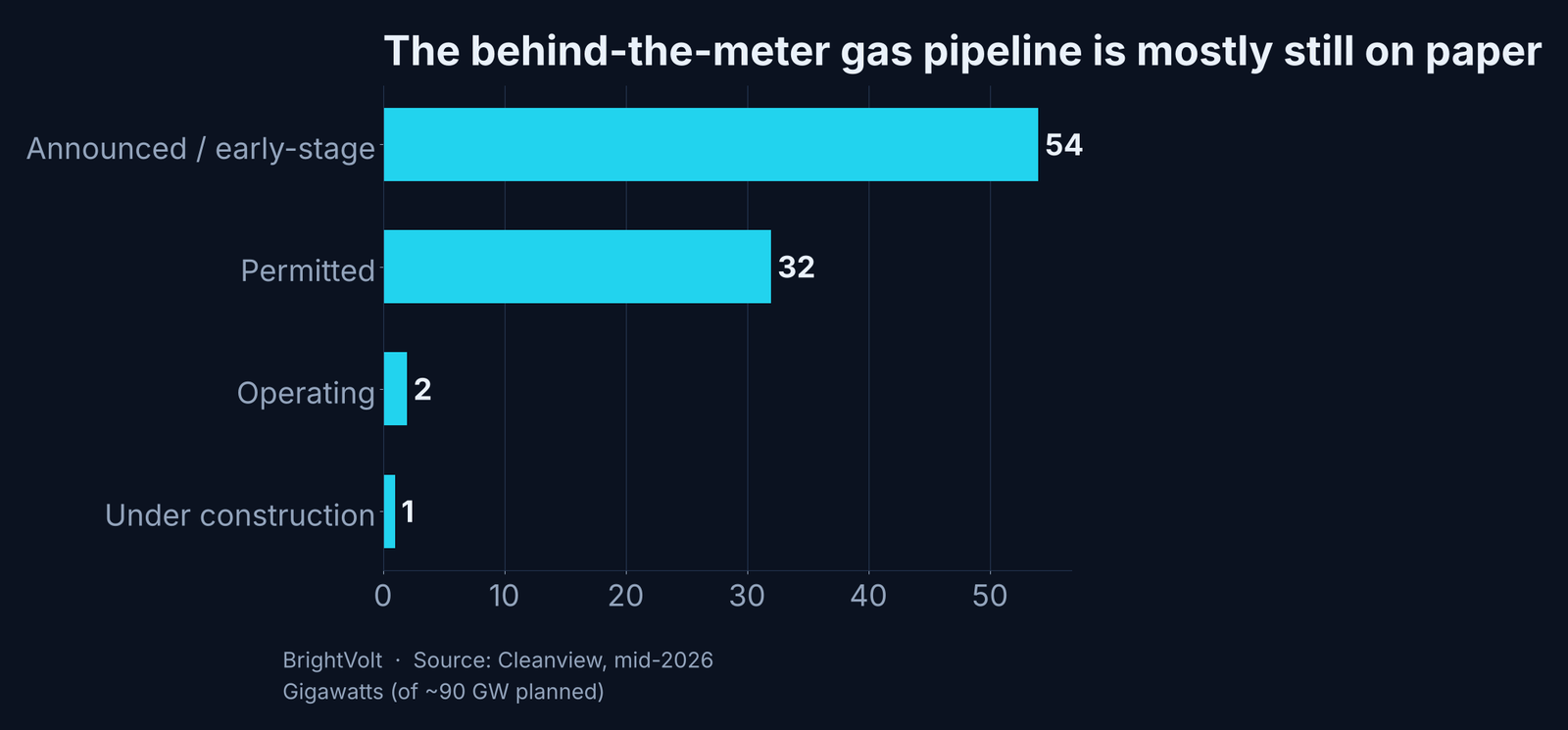 A 90 GW pipeline that is 2 GW built is a claim about the future, not a description of the present, and we would be doing exactly what we criticised if we waved it through.
So the claim is narrower than the headline. Gas is winning the behind-the-meter race in commitments, permits and construction starts — not yet in installed gigawatts. What makes this pipeline more likely to convert than the grid-turbine backlog is the point above: its equipment is available now, and it answers to a permit and a gas line rather than to a five-year queue and a 2031 delivery slot. A project that needs only an air permit and a Caterpillar order has far fewer places to die than one waiting on both an interconnection study and a turbine that does not exist yet. The mortality rate is real. It is lower here.
What to watch, and what would prove us wrong
The number that settles this is conversion, not announcement. If Cleanview’s operating figure climbs from ~2 GW toward its 13 GW high case through 2027 — if the permitted third starts pouring concrete — then behind-the-meter gas is a fleet, not a forecast, and the “clean grid” statistics will be describing a shrinking share of where electrons for compute actually come from. If instead the pipeline stalls at 2 to 5 GW, defeated by gas-pipeline constraints, local air-permit fights or tenants who quietly reconnect to the grid, then this was a burst of press releases and our August call stands with an asterisk.
Either way, one habit has to change. Reading US generation from the interconnection queue alone now undercounts gas, because the fastest-moving buyers have stepped off the public grid to avoid the very bottleneck that makes the clean numbers look so decisive. The transition on the shared grid is real and it is mostly carbon-free. Next to it, in permit offices from Texas to Ohio, a parallel fossil build-out is taking shape with no obligation to appear in the figures we all quote. We cheered the first grid too early. The second one is the story now.
Photo by Brett Sayles on Pexels · Photo by Mumtaz Niazi on Pexels