
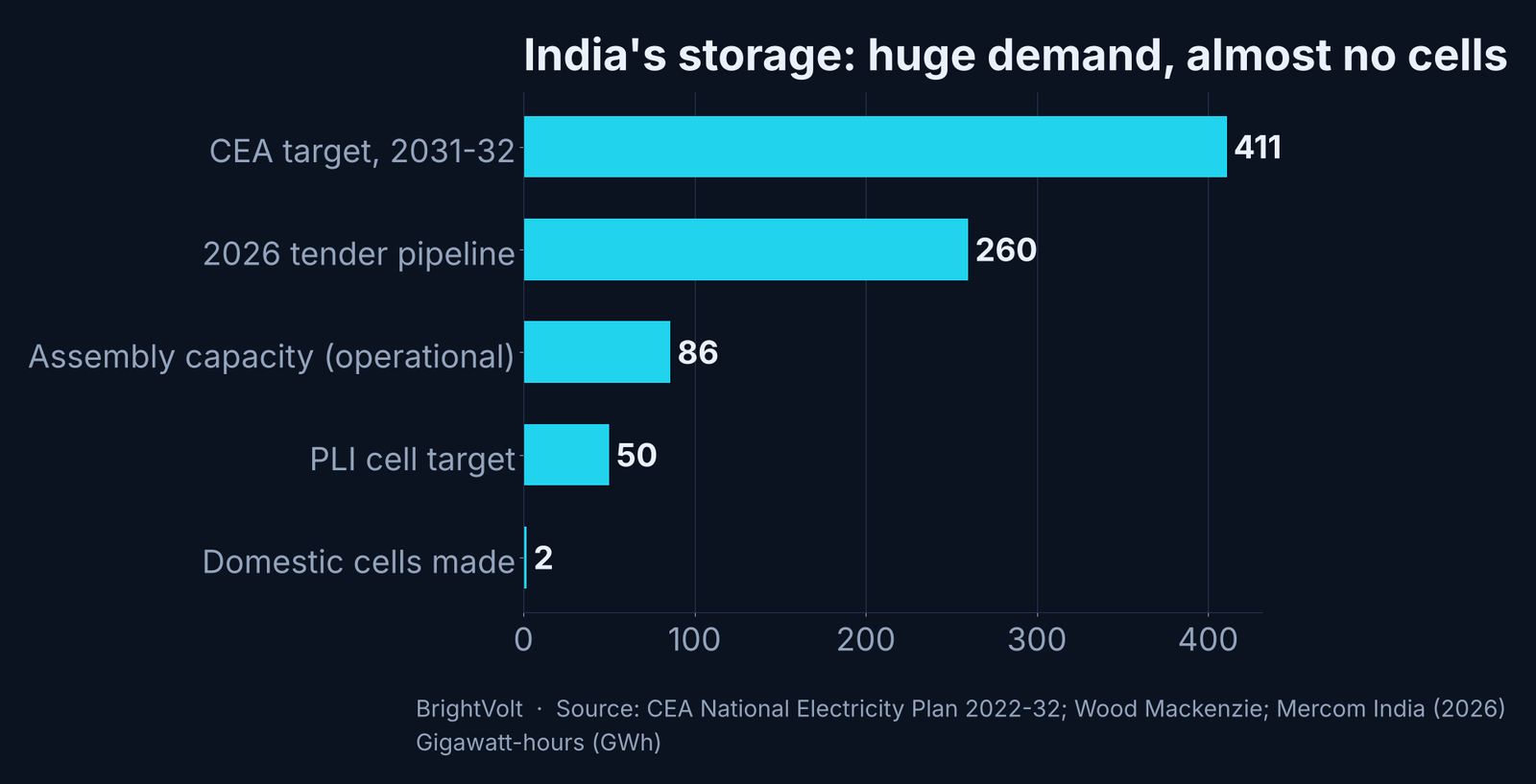
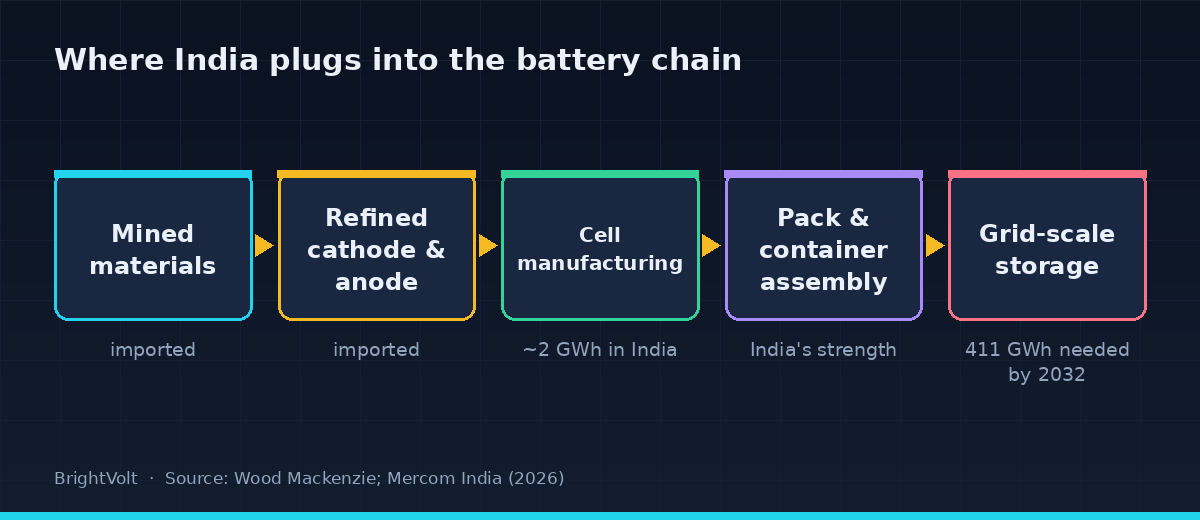
India is on course to build one of the world’s largest grid-battery markets and almost none of the batteries. Its official plan calls for 411 GWh of storage by 2031-32, competitive tenders in 2026 alone have reached roughly 260 GWh, and yet the country’s commissioned battery-cell factories can make about 2 GWh a year. The boom is real. It is also, for now, an assembly line bolted onto an import pipe.
That gap is the whole story, and it hides inside a number that reads like success.
The number that flatters India’s battery industry
Mercom’s new ecosystem report puts India’s operational battery “manufacturing” capacity at 86 GWh, a figure large enough to sound like a solved problem. It is not a cell figure. Ninety-two percent of that operational capacity is downstream work — packs, containers, energy-management and SCADA systems, the integration that turns imported cells into a shippable energy-storage system. Cell manufacturing, the part that actually decides whether a country makes batteries, is the remaining eight percent.
Independent counts land lower still. InfoLink’s Robin Song reckons India’s operating advanced-chemistry-cell capacity at no more than 3 GWh; Wood Mackenzie puts commissioned cell capacity at 2 GWh. Call it two to three gigawatt-hours of real cell output against a 2026 tender pipeline that Wood Mackenzie sizes at 260 GWh — domestic capacity covering under one percent of near-term demand. The headline capacity exists. The thing the headline implies does not.
Assembly is the easy end
The reason the split matters is that the two halves of “making a battery” are not remotely the same industry. Pack and container assembly is metalwork, wiring, software and quality control — hard to do well, but buildable in two to three years, and India is genuinely good at it. Cell manufacturing is electrochemistry at scale: coating electrodes, managing moisture to parts-per-million, running dry rooms and calendaring lines whose equipment itself comes from China, Japan and Korea. Wood Mackenzie reckons cells on imported inputs are two to five years out, and domestic refining of the cathode and anode materials underneath them is more than a decade away.
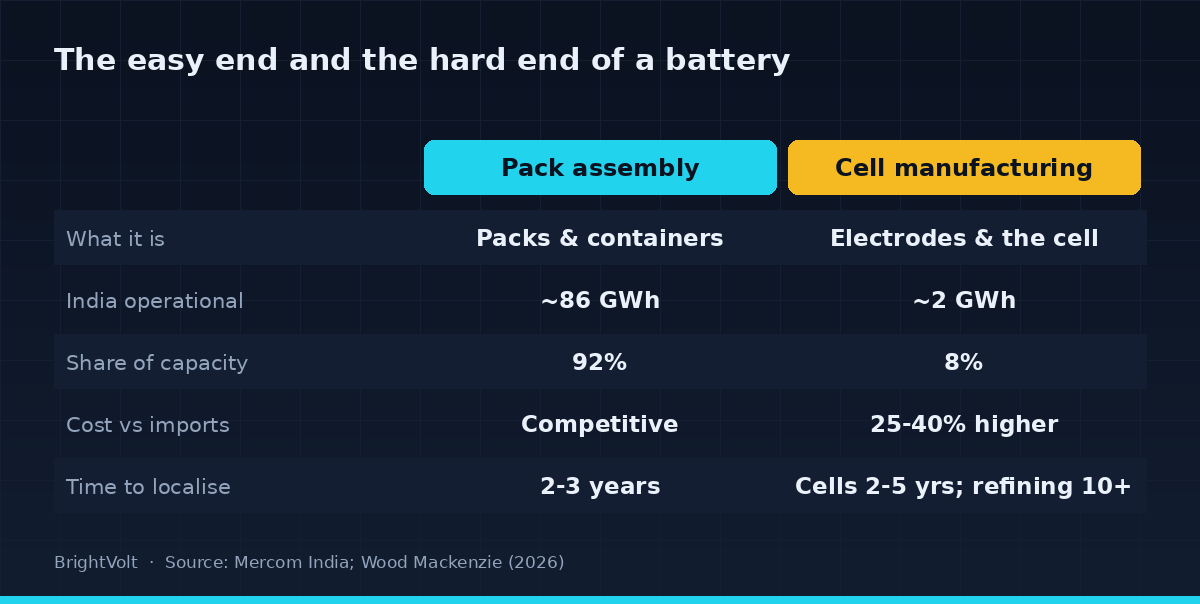
Cost compounds the problem. A cell made in India today runs 25 to 40 percent more expensive than an imported one, and Wood Mackenzie’s economics are unforgiving: a 5 GWh plant runs at a negative EBITDA margin, breakeven arrives near 10 GWh, and only beyond 20 GWh does a line make money. Four players have commissioned gigafactories in India so far. China’s cumulative cell capacity is 2,695 GWh, and it holds 85 to 98 percent of every major link in the supply chain. India is not trying to catch a moving target. It is trying to start a race the leader finished a decade ago.
The PLI scheme has missed by a decade
None of this is for want of policy. India’s production-linked incentive for advanced chemistry cells launched in 2021 with 181 billion rupees — about 2.2 billion dollars — and a target of 50 GWh of domestic cell capacity. Five years on, the operational capacity it has produced is under a tenth of that target.
The allocation history reads as a list of things that did not happen on schedule:
| PLI cell award | Capacity | Status |
|---|---|---|
| Ola Electric | 20 GWh | Timeline revised in August 2026, eligibility extended to 2031 |
| Reliance | 10 GWh | Awarded in the 2024 re-tender |
| Hyundai Global Motors | 20 GWh | Allocation withdrawn |
| Open global tender | 10 GWh | Bids due 10 November 2026 |
The government is now recycling the withdrawn capacity through a fresh international tender and drafting a separate upstream incentive — roughly 130 billion rupees for cathode, anode, electrolyte, separator and copper foil — because it has worked out that subsidising cell assembly while importing every component inside the cell does not build a supply chain. The subsidy structure is being redesigned mid-stream. That is not a sign the first attempt worked.
The mandate turns the gap into a deadline
Demand is about to stop waiting. A Central Electricity Authority draft from September would require every solar and wind project commissioned after July 2027 to co-locate storage worth at least 10 percent of its capacity, starting at two hours’ duration and rising to four hours from mid-2029. Set against a 500 GW non-fossil target for 2030 and the 8,133 GWh of solar India already curtailed between April and June this year, the mandate is sensible grid engineering. It is also a cell order the country cannot fill domestically, arriving at least a year before the first large home-grown cell lines are expected to switch on in 2028.
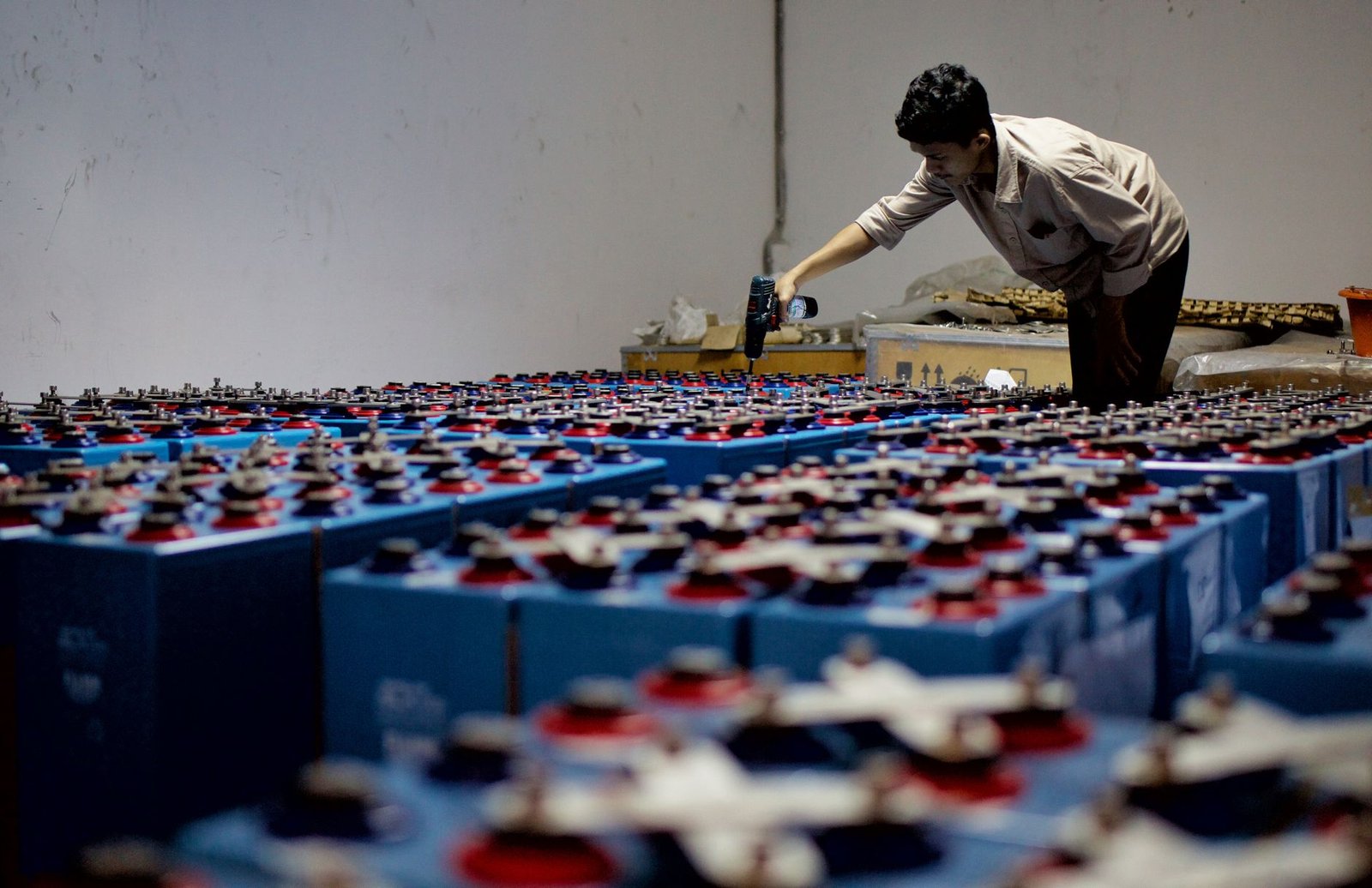
So the cells will come from China, as they already do, and the domestic-content rules do little to stop it: the 20 percent local-content floor on grid-scale tenders can be met with exactly the downstream hardware India is good at — containers, management systems, integration — without a single domestic cell. India has written procurement rules that reward assembly and call it localisation. It is the same move the United States made with solar, stamping modules at home while importing the cells that do the actual work, and it ends in the same place: a manufacturing statistic that looks like sovereignty and functions like a tariff on imported value.
What to watch
The 10 November tender is the near-term tell. If it draws serious bids at a workable strike price, the re-tendered 10 GWh could put real cell capacity on the ground by 2028 and the gap starts to close on Wood Mackenzie’s optimistic end. If it stalls the way the first PLI round did, the CEA mandate lands in 2027 onto a cell industry that still rounds to zero, and India spends the late 2020s buying the one component it most wants to stop buying.
The figure that would prove this read wrong is domestic cell output — not pack or container capacity, which will keep climbing regardless. Watch for commissioned cell lines clearing 20 GWh, the point where the economics finally work without a subsidy. Until that number moves, every announcement about India’s battery “capacity” is a measure of how fast it can unbox someone else’s.
Photo by Kindel Media on Pexels · Photo by Giant Asparagus on Pexels · Photo by Heru Dharma on Pexels