
A 100 kWh battery pack rolled off a line in Changzhou on 26 October that recharges 500 km of range in twelve minutes — and it is neither a conventional lithium-ion cell nor the solid-state battery the industry keeps promising. It is semi-solid-state, the hybrid chemistry nobody markets, and in 2026 it is the one reaching mass production.
The maker is SVOLT, a battery company Great Wall Motor spun up in 2012 and the world’s ninth-largest by EV battery installations over the first eight months of this year. Its new pack is called Dragon Armor. The interesting thing is not the name, or even the specs. It is the schedule.
What SVOLT actually put on the line
Dragon Armor is a 100 kWh pack on a 900-volt architecture that supports 6C charging — six times the pack’s capacity per hour, enough to add 500 km in twelve minutes on the company’s own figures. SVOLT also claims a cycle life beyond 3,000 full charges, a theoretical million kilometres of driving, dual-sided liquid cooling, and an underside built up in six armoured layers it rates at three times China’s impact standard.
Those numbers come from SVOLT, delivered by chairman Yang Hongxin in a Weibo video, and the test conditions behind the twelve-minute figure were not disclosed. Treat them as a manufacturer’s claim until a car carries the pack. The energy density is thinner evidence still: only electrive reports it, at 300 Wh/kg for this first generation and a 360 Wh/kg target for the next, and no second outlet has carried those figures. They are one publication’s account of what SVOLT said, not an established number.
What is not in doubt is the timing. In mid-2025 Yang said series production would come in 2027. In May this year he moved it to September 2026. It arrived in late October — months late against the spring promise, years early against the one before it. No customer is confirmed: SVOLT says “multiple” automakers have signed up and will be named later, and CarNewsChina expects Great Wall’s own Wey V8X to be among the first to carry it.
Why “semi-solid” is not a rounding error on “solid”
A semi-solid-state cell keeps a little liquid electrolyte and gels or solidifies the rest — a solid-liquid hybrid, in the industry’s phrase. That sounds like a hedge, and it is, but the hedge is the entire value. The pure all-solid-state cell promises more energy density and no flammable liquid; it also cracks at the electrode interface, resists fast charging, and has defeated every attempt to build it cheaply at scale. Semi-solid keeps just enough liquid to wet that interface and run on something close to existing production lines. That is why it ships and the pure version does not.
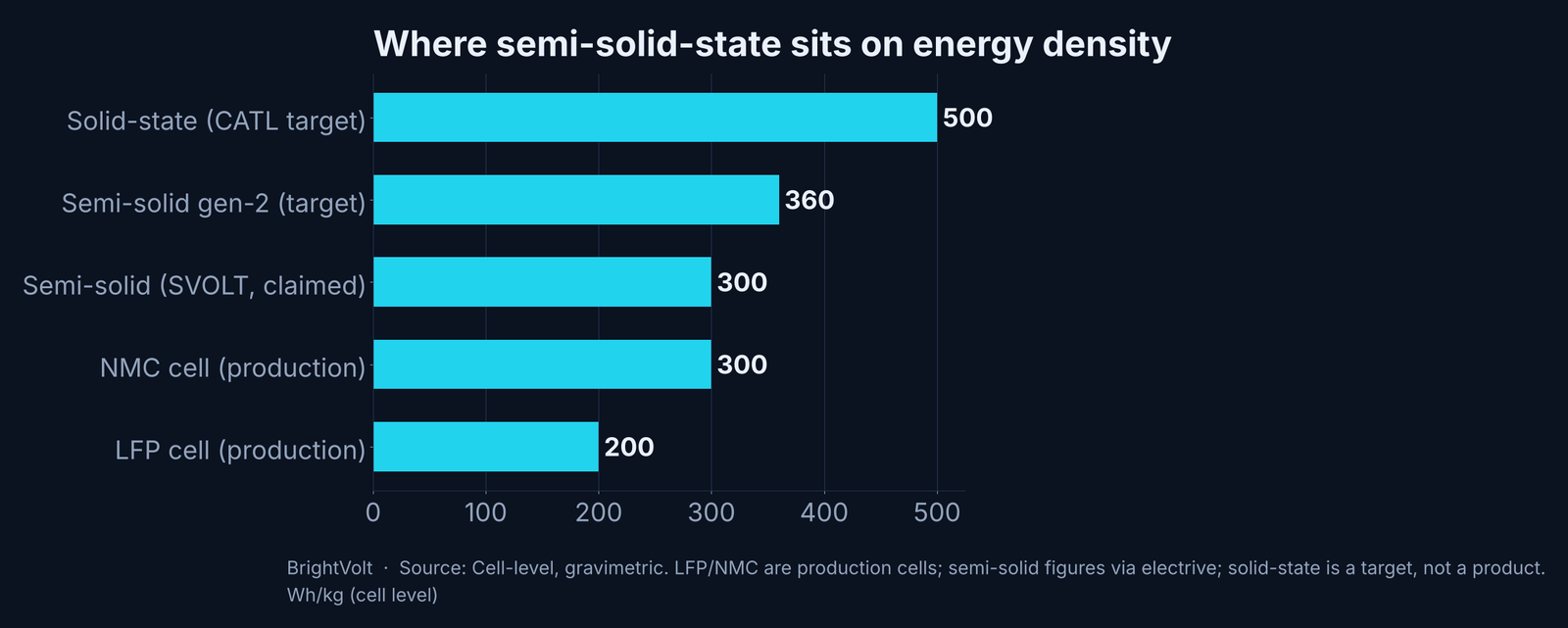
Stacked against the cells in cars today, semi-solid’s headline energy density is good rather than revolutionary. SVOLT’s claimed 300 Wh/kg sits level with the best high-nickel NMC and comfortably above the roughly 200 Wh/kg of China’s newest LFP. These are cell figures, not the pack number on the spec sheet, and the two are not the same thing. The gap semi-solid is chasing is the one above it, not the one below.
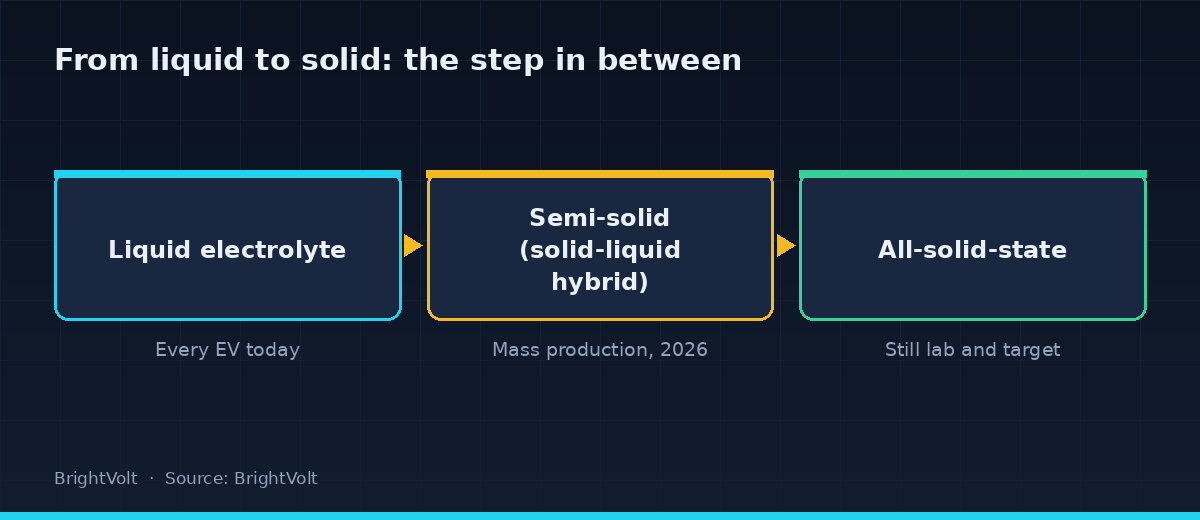
The honest way to picture the field is a line with three stops, and only two of them are open for business.
It is already a category, not a one-off
SVOLT is not the pioneer here, which is exactly why this reads as a trend and not a stunt. NIO has been fitting a 150 kWh semi-solid pack — cells from WeLion, rated around 360 Wh/kg — to its sedans since April 2024, and WeLion was named one of MIT Technology Review’s 2026 climate-tech companies to watch on the strength of the same chemistry. What SVOLT adds is a cheaper, faster-charging version built for volume rather than a flagship. The pattern across three years is the tell: the launches have stopped being single halo packs and started being product lines.
| Liquid Li-ion | Semi-solid-state | All-solid-state | |
|---|---|---|---|
| Electrolyte | Liquid | Solid–liquid hybrid | Fully solid |
| Cell energy density | ~200 (LFP) to ~300 (NMC) Wh/kg | ~300 Wh/kg claimed, 360 targeted | 500 Wh/kg target; 824 reported in a lab |
| In mass production (2026)? | Yes, universally | Yes — NIO since 2024, SVOLT this week | No |
| Cost vs today’s cells | baseline | roughly at parity, per SVOLT | multiples higher |
| The safety pitch | flammable liquid electrolyte | less liquid, harder to ignite | no liquid; best in theory |
The timeline that keeps moving
The case against semi-solid is clean, and worth stating at full strength. It is a compromise, and the compromise ceiling is low. All-solid-state can in principle reach 500 Wh/kg — CATL’s stated target — and WeLion has reported 824 Wh/kg from a laboratory cell, roughly triple a good pack today. Semi-solid, still carrying liquid and running near-conventional chemistry, will never get there. On that logic it is a bridge, and bridges are temporary.
The trouble with the logic is the date on the far side. CATL has pencilled mass-market solid-state in for the end of the decade; Yang, who is building both, says the pure version “will take a very long time”; and Toyota has moved its solid-state launch so often the dates have stopped carrying information. A bridge is temporary only if the far bank is reachable. On current evidence the semi-solid bridge may have to carry traffic through most of the 2030s, and a compromise that ships for a decade is not a stopgap. It is the market.
What to watch
The read here is that semi-solid-state wins the back half of this decade on availability, not on physics, and that the solid-state arrival date recedes by roughly a year for every year that passes. Two things would overturn it. If a major automaker puts a genuinely all-solid-state car into volume production at a competitive price before 2028 — not a limited run, not a press demonstrator — the bridge argument collapses and semi-solid becomes the stopgap its critics call it. And if SVOLT’s undisclosed test conditions are hiding a soft real-world figure, the million-kilometre, cost-parity, 6C story deflates to marketing the moment the Dragon Armor pack reaches a car.
Until then, watch which automaker confirms the pack, whether the 360 Wh/kg second generation turns up, and whether cost parity survives contact with a bill of materials. The pure solid-state battery is still coming. It has just been a few years away for about six years running — and this week, someone shipped the thing you can buy instead.
Photo by Looking For Feferences on Pexels · Photo by Ramesh Kambattan on Pexels