
A kilogram of diesel holds about 12,700 watt-hours of energy; a kilogram of lithium-ion battery pack holds around 200 — a gap of more than sixty to one. That figure is real, and it is nearly useless. A combustion engine throws away roughly 70 percent of its fuel as heat before any of it turns a wheel; an electric drivetrain wastes almost none. Count the losses, and the sixty-to-one gap on the label collapses to about twenty-five to one in useful work.
That second number is the one that decides what gets electrified and what does not. It is also the one almost nobody quotes, because it does not appear on any spec sheet. Here is how to work it out, and why it matters more than the headline.
The nameplate number, where fuel looks untouchable
Energy density — properly, specific energy, the energy stored per kilogram — is where liquid fuels embarrass batteries. Gasoline carries about 46 megajoules per kilogram, diesel about 46, and jet fuel around 43, on figures from the University of British Columbia’s physics group. In the units an EV driver recognises, that is roughly 12,900 watt-hours per kilogram for gasoline and 12,700 for diesel. The US National Academies puts military jet fuel (JP8) at 44 MJ/kg and notes diesel sits about 2 percent above it — the two sources agree within a rounding error.
A lithium-ion battery is not in the same postcode. A good modern pack delivers somewhere between 150 and 250 watt-hours per kilogram at the system level; the National Academies uses 150 Wh/kg for a commercial cell with its safety hardware, and the best packs shipping today sit nearer 200 to 250. Take 200 as a round figure and the raw ratio is stark: diesel carries about sixty-four times the energy of the same weight of battery.
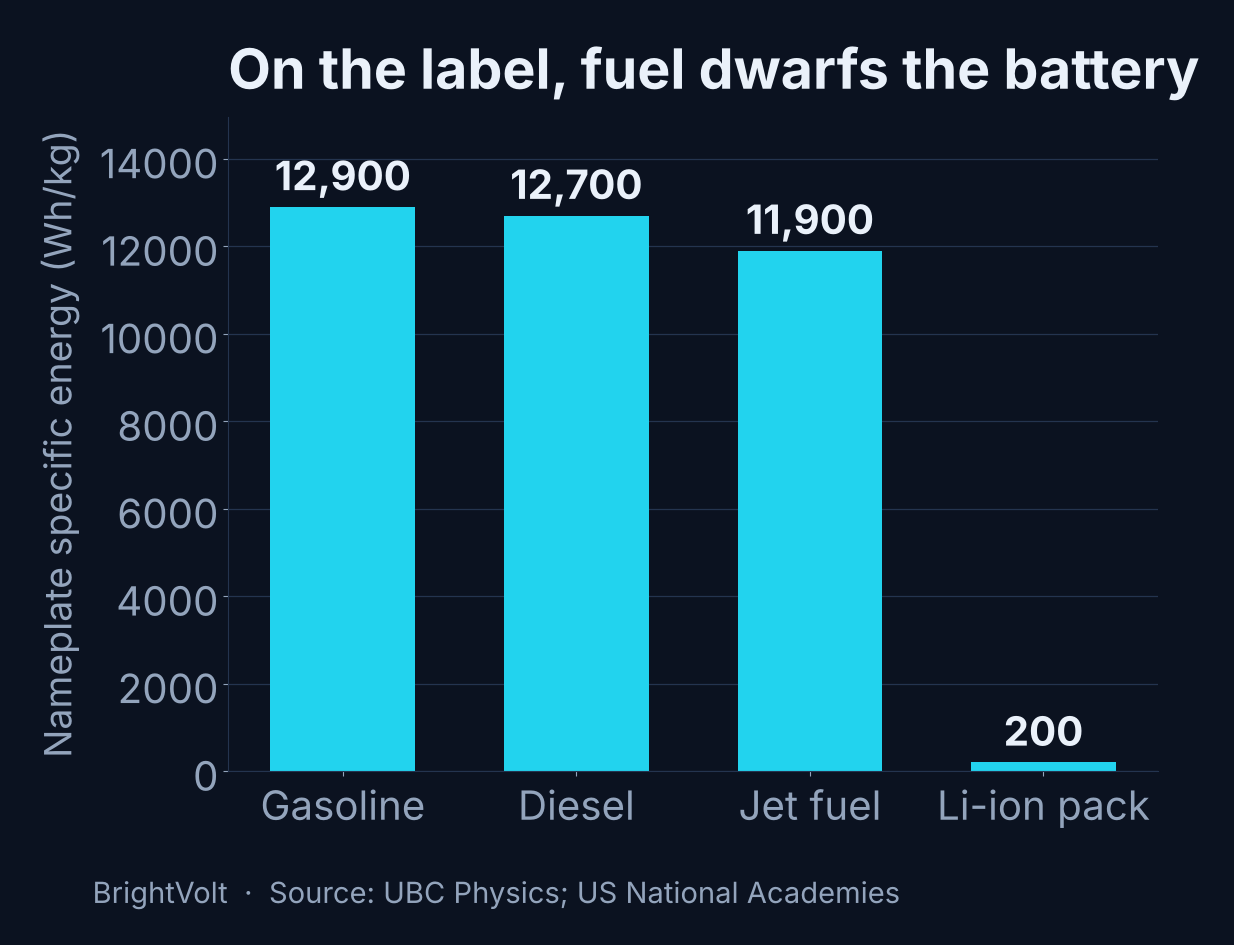
This is the number that gets quoted to prove batteries can never fly a passenger jet or cross an ocean. On the raw figure, the argument looks unanswerable. The sliver of a bar next to the fuels is the whole case against electrification, printed in one chart. It is also only half the arithmetic.
The number the label leaves out
A fuel’s energy is not useful work. It is a claim on useful work that an engine has to cash, and engines are terrible bankers. Burning diesel or gasoline is a heat process, and a heat engine is bound by thermodynamics to waste most of what it burns: the exhaust is hot, the radiator is hot, the block is hot, and all of that heat is fuel that never reached the road.
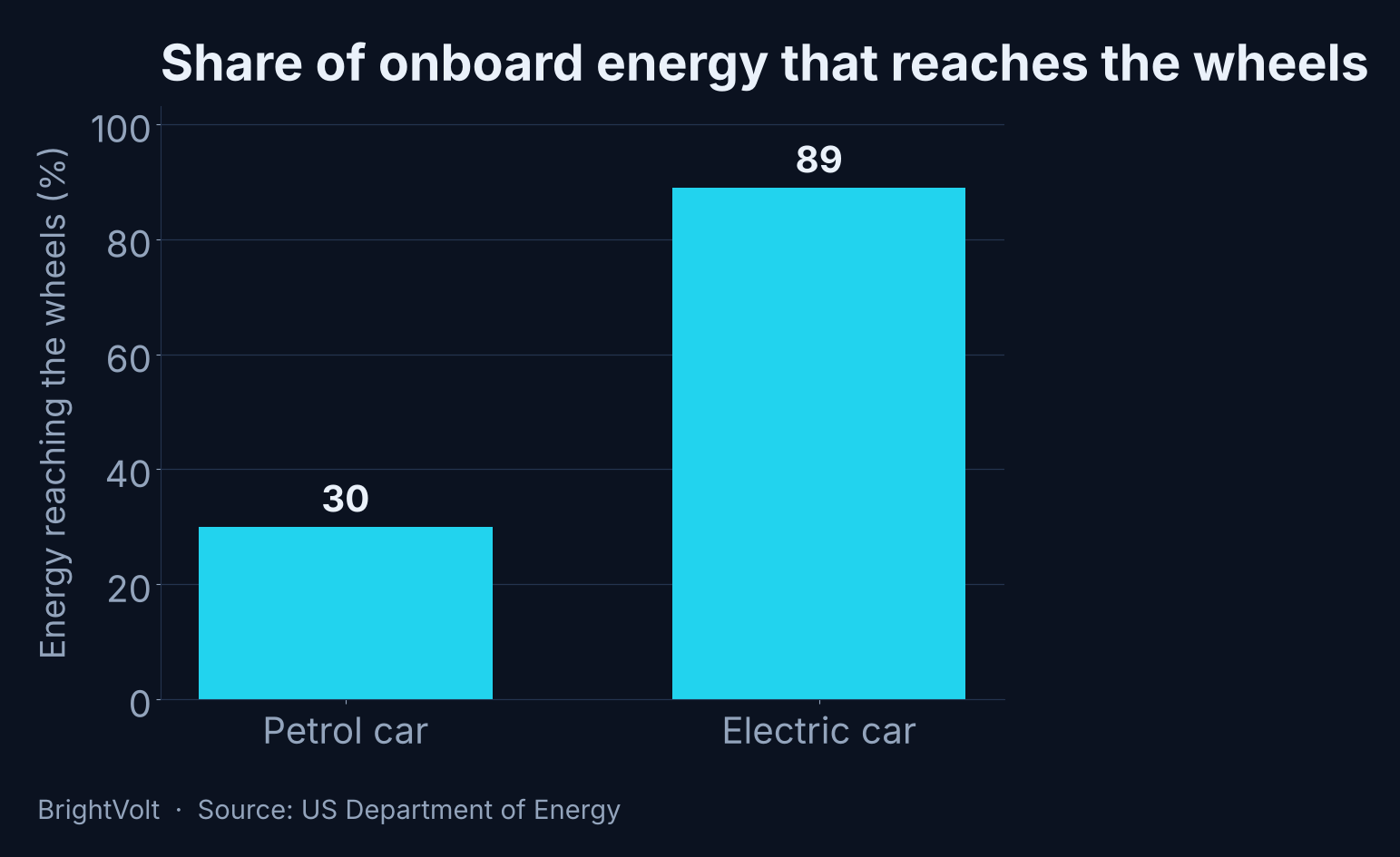
The US Department of Energy puts hard numbers on it. A conventional gasoline car converts only about 30 percent of the energy in its tank into motion; the engine alone loses 64 to 75 percent of it as heat, before the drivetrain, idling and accessories take their cut. A battery-electric car, on the same agency’s measurement, is 87 to 91 percent efficient once regenerative braking is counted — and even ignoring regen, 65 to 69 percent of the energy stored on board reaches the wheels. The electric motor is not slightly better than the engine. It is two to three times better.
Diesel does better than petrol — a diesel engine is the most efficient thing in the combustion family, reaching the low 40s percent at its best point — but it is still throwing away more than half of every litre. The physics is not negotiable. You can make the engine marginally less wasteful; you cannot make it stop being a heat engine.
Effective energy density: the gap that actually ships
Put the two halves together. Effective energy density is the nameplate figure multiplied by the fraction an engine or drivetrain actually turns into motion — the energy per kilogram you can spend, not the energy per kilogram you were sold.
Run diesel against a battery pack on that basis. Diesel’s roughly 12,700 Wh/kg, through a real-world powertrain keeping perhaps 35 percent, comes out near 4,400 Wh/kg of useful work. A 200 Wh/kg pack, delivering about 85 percent to the wheels, yields roughly 170. The gap is still large — but it is about twenty-five to one, not sixty-four to one. The electric motor’s efficiency quietly erased more than half of fuel’s apparent lead before the vehicle moved an inch.
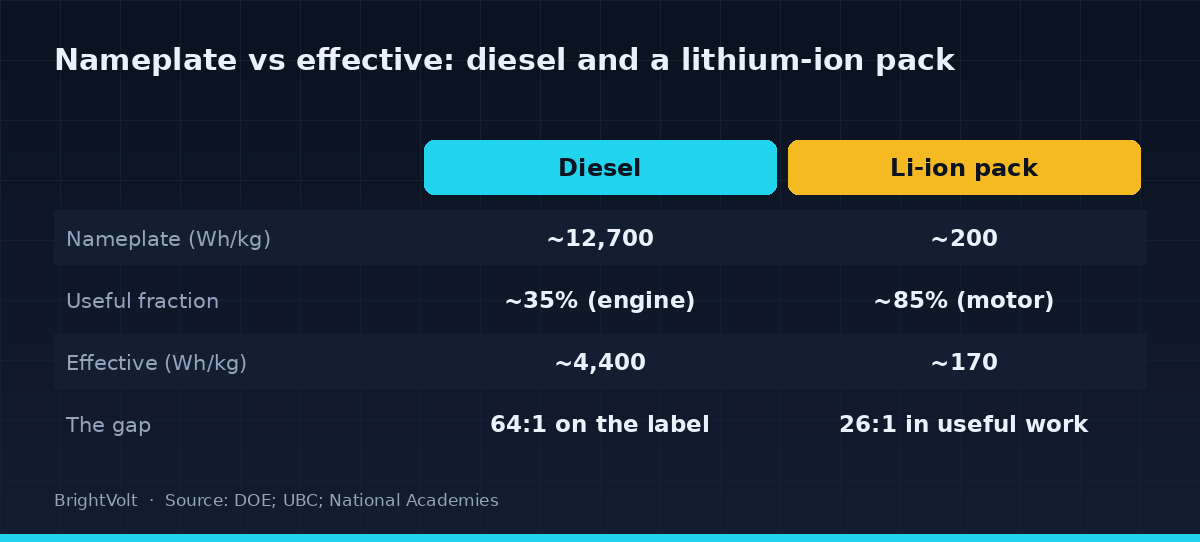
This is the figure the honest version of every “batteries can’t do X” argument has to use, and it is the one our pieces on electric boats and e-bike packs both lean on. It does not rescue the battery — a twenty-five to one deficit in energy per kilogram is still a wall when weight is the thing that decides whether a vehicle works. It just moves the wall to where it actually is.
What the real gap explains
The effective figure explains the pattern of electrification far better than the nameplate one. Cars went electric first not because batteries got light enough to match petrol, but because a car never needed petrol’s density — it carries a few hundred kilograms of pack, loses a little boot space, and the motor’s efficiency hands most of it back. The weight penalty is real and survivable.
The modes that resist electrification are the ones where the twenty-five to one gap is multiplied by something unforgiving. An airliner has to lift its energy store for the whole flight and burns most of its fuel fighting its own weight; a cargo ship needs days of range with no charging in the middle of an ocean; a long-haul truck trades every kilogram of battery for a kilogram of payload it can no longer carry. For those, even the efficiency-adjusted number is a hard ceiling, which is why heavy transport is electrifying last and why the argument there is about duty cycles and charging stops rather than raw range.
What would move the wall again is cell chemistry, not the motor — the drivetrain is already near its ceiling at 90 percent, with almost nothing left to win. A pack reaching 400 to 500 Wh/kg, the target the next generation of cells is chasing, would roughly double the effective figure and bring the short-haul end of aviation into range. What will not move it is another round of quoting the sixty-to-one headline as if the engine that has to burn the fuel were free. The engine is the expensive part. It always was. The spec sheet just never charged you for it.
Photo by Engin Akyurt on Pexels · Photo by Jeffry Surianto on Pexels